Mots C Dosage 5mg: Schedule, Units & Safety
No approved human MOTS-c dose exists; a 5 mg vial is its total contents, not a validated dose or schedule.
Quickstart Highlights for a 5 mg MOTS-c Vial
There is no approved human dose for MOTS-c from a 5 mg vial. No completed human efficacy study establishes how much to inject, how often to inject it, or how long a cycle should last 2310.
MOTS-c is a 16-amino-acid peptide encoded in the mitochondrial 12S rRNA gene 3. Human exercise research measures the body’s own MOTS-c, not the safety or effect of a known injected dose 7.
- Human dose: None is approved or clinically established. A 5 mg vial describes total peptide content, not a validated amount per injection 23.
- Trial status: NCT07505745 is a recruiting Phase 2 study of MOTS-c for adults with prediabetes and overweight or obesity; it has no completed dose or outcome results 10.
- Mechanism: Reviews describe a Folate-AICAR-AMPK pathway, but mechanism research does not establish clinical benefit or a safe dose 6.
- Units: U-100 syringe units measure volume. With 1 mL added to a 5 mg vial, each unit represents 50 mcg; the pharmacy’s directions must govern any actual preparation or use.
- Safety: Human safety data for unapproved peptides are scarce, and serious harm is possible 2.
- Next step: Do not choose a schedule from social media. Ask a licensed prescriber and pharmacist to review the product, its lawful sourcing, preparation directions, and your personal risks.
Key takeaways
- No FDA-approved MOTS-c dose, labeled titration schedule, or validated cycle length is established 23.
- The registered Phase 2 study NCT07505745 is recruiting for prediabetes and overweight or obesity; it has no completed dose or outcome results 10.
- The proposed Folate-AICAR-AMPK pathway is a research mechanism, not proof of clinical benefit 6.
- With 1 mL added to a 5 mg vial, the concentration is 5 mg/mL and each U-100 unit represents 50 mcg; this is conversion arithmetic, not a dose recommendation.
- Human safety data are scarce, and cell research raises questions about inflammatory signaling while a review discusses mitochondrial signals in cancer progression 249.
MOTS-c Dosing Schedule for a 5 mg Vial

For an approved medicine, titration should follow its FDA label or the relevant clinical trials. No approved MOTS-c product or validated human dosing standard is established 23. No completed human efficacy study establishes an injected MOTS-c dose, a weekly total, or a cycle plan 2310.
No human dose or unit amount per week is established 2310. Units depend on a product’s concentration, so putting a made-up unit number beside an unestablished dose would be unsafe. NCT07505745 is recruiting and does not report completed dose or outcome results 10.
| Week | Dose (mg) | Dose (mcg) | U-100 units | Evidence status |
|---|---|---|---|---|
| Week 1 | Not established | Not established | Not established | No validated starting dose |
| Week 2 | Not established | Not established | Not established | No validated titration step |
| Week 3 | Not established | Not established | Not established | No validated maintenance dose |
| Week 4 | Not established | Not established | Not established | No validated cycle endpoint |
Although some websites and online discussions publish specific MOTS-c schedules, no human dose range, weekly total, or tested titration plan has been established 2310. For that reason, this guide does not turn unverified schedules into a dosing table. A reported schedule is not a clinical-trial result.
There is no human evidence establishing whether a small daily amount or a larger weekly amount produces different outcomes. Human exercise research examined changes in naturally produced MOTS-c after exertion; it did not compare injected schedules 7. A 5 mg vial contains 5 mg total, but that number does not specify how many injections to take or how far apart to give them.
Syringe Unit Conversion Table
Units to draw on a U-100 insulin syringe (100 units = 1 mL) from a 5 mg vial. Find your dose, then read the column for the water you added. Every number is calculated, not estimated.
| Dose | 1 mL water 5 mg/mL · 1 unit = 50 mcg | 2 mL water 2.5 mg/mL · 1 unit = 25 mcg | 2.5 mL water 2 mg/mL · 1 unit = 20 mcg |
|---|---|---|---|
| 50 mcg | 1 · 100 doses | 2 · 100 doses | 2.5 · 100 doses |
| 100 mcg | 2 · 50 doses | 4 · 50 doses | 5 · 50 doses |
| 200 mcg | 4 · 25 doses | 8 · 25 doses | 10 · 25 doses |
| 250 mcg | 5 · 20 doses | 10 · 20 doses | 12.5 · 20 doses |
| 300 mcg | 6 · 16 doses | 12 · 16 doses | 15 · 16 doses |
| 500 mcg | 10 · 10 doses | 20 · 10 doses | 25 · 10 doses |
| 750 mcg | 15 · 6 doses | 30 · 6 doses | 37.5 · 6 doses |
| 1 mg | 20 · 5 doses | 40 · 5 doses | 50 · 5 doses |
| 1.5 mg | 30 · 3 doses | 60 · 3 doses | 75 · 3 doses |
| 1.7 mg | 34 · 2 doses | 68 · 2 doses | 85 · 2 doses |
| 2 mg | 40 · 2 doses | 80 · 2 doses | 100 · 2 doses |
| 2.4 mg | 48 · 2 doses | 96 · 2 doses | over 100 |
| 2.5 mg | 50 · 2 doses | 100 · 2 doses | over 100 |
| 3 mg | 60 · 1 doses | over 100 | over 100 |
| 4 mg | 80 · 1 doses | over 100 | over 100 |
| 5 mg | 100 · 1 doses | over 100 | over 100 |
MOTS-c 5 mg Vial Dosage Calculator
Shows the exact insulin-syringe units to draw. Pre-loaded with the 5 mg vial; change any value to match yours.
Total volume of your syringe?
How much mg is in the vial?
How much bacteriostatic water are you adding?
Dose per injection?
Educational tool only. Concentration = vial ÷ water; units = dose ÷ concentration × 100 (U-100 syringe). Confirm every dose with your prescriber. Different vial or peptide? Use the peptide calculator.
MYPEPTIDEVENDORAffiliate link · we may earn a commission.
Reconstitution Steps for a 5 mg Vial
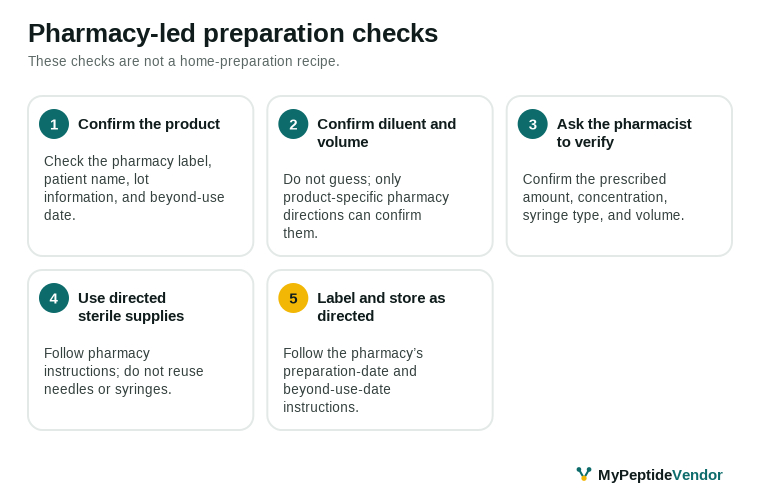
MOTS-c has no approved preparation label or established clinical method of use 23. These steps are a safety check, not a home-preparation recipe. If a licensed pharmacy has dispensed a product for clinician-directed use, follow that pharmacy’s exact written instructions.
- Confirm the product. Check the pharmacy label, patient name, product identity, lot information, and beyond-use date. If the vial has no pharmacy directions or its source is uncertain, do not prepare or inject it.
- Confirm the diluent and volume. Do not select either by guesswork. Different volumes change the concentration, and only product-specific pharmacy directions can confirm what is appropriate.
- Ask the pharmacist to verify the math. Have the pharmacist confirm the prescribed amount, concentration, syringe type, and corresponding volume before any administration.
- Use only directed sterile supplies and technique. Do not reuse needles or syringes. Follow the pharmacist’s instructions for vial access, preparation, and disposal.
- Label and store as directed. If the pharmacy instructs you to prepare the product, follow its directions for recording the preparation date and using the stated beyond-use date.
A 5 mg vial reconstituted with 1 mL gives 5 mg/mL, or 5,000 mcg/mL. On a U-100 syringe, that concentration corresponds to 50 mcg per unit: 500 mcg corresponds to 10 units, and 1,000 mcg corresponds to 20 units. The full vial corresponds to 100 units at that concentration. These are conversion examples, not recommended injection amounts.
Reconstituting a 5 mg vial with 2 mL gives 2.5 mg/mL, or 25 mcg per U-100 unit. Using 2.5 mL gives 2 mg/mL, or 20 mcg per unit. The same syringe marking therefore does not always represent the same amount of peptide.
A U-100 syringe has 100 units per milliliter. Units measure volume, not peptide mass. Verify the exact concentration and syringe marking against the pharmacy label; never infer a personal dose from the vial strength alone.
Use this chart
Free to reuse with a link back:
Supplies Needed for One Full Vial

There is no universal supply list for preparing a full MOTS-c vial because no approved product label establishes a standard diluent, route, concentration, or storage period 23. The dispensing pharmacy must specify the supplies for the exact product.
- Vial: 1 vial, if dispensed for clinician-directed use.
- Diluent: The product and volume stated by the dispensing pharmacy; do not substitute another liquid.
- Syringes and needles: The type and quantity specified by the pharmacist. The number needed depends on the prescribed schedule, which is not established for MOTS-c.
- Cleaning supplies: Use the sterile supplies and instructions specified by the pharmacy.
- Sharps container: Use an appropriate container for used needles and syringes, following local disposal rules.
Do not assume all 5 mg are intended for one injection or that one vial is meant for a particular number of uses. The prescription, concentration, pharmacy instructions, and beyond-use date determine those details.
Protocol Overview and Cycle Notes

MOTS-c is a 16-amino-acid mitochondrial-derived peptide encoded by a short open reading frame in the mitochondrial 12S rRNA gene 36. During metabolic stress, it can move to the nucleus and affect gene regulation 36.
The main proposed mechanism is the Folate-AICAR-AMPK pathway 6. AMPK is an enzyme involved in cellular energy sensing. This pathway gives researchers a reason to study glucose handling and energy metabolism, but it does not show that injected MOTS-c treats disease in people 36.
No evidence-based cycle length, injection count, rest interval, or repeat-cycle frequency has been established for MOTS-c 23. NCT07505745 is a registered, recruiting Phase 2 study for prediabetes and overweight or obesity; it is not a completed result or a dosing recommendation 10.
Daily and intermittent schedules are sometimes discussed online, but no human study establishes the safety or comparative effect of those approaches 2310. Frequency alone cannot show that one is safer or more effective. The direct human dose and timing questions remain unanswered.
Evidence tiers matter here. Cell studies can identify pathways and cytokine signals, but cannot set a human dose 69. Animal studies can support research questions about metabolism and exercise, but cannot predict a human treatment response 78. Human exercise research measures endogenous MOTS-c, meaning peptide produced by the body, rather than injected dosing 7.
Reviews describe possible metabolic effects in preclinical research, while also stating that no effective method of applying MOTS-c in the clinic has been developed 3. The nine registered MOTS-c studies include research on related measurements and other settings; NCT07505745 is the registered Phase 2 MOTS-c study for prediabetes and overweight or obesity 10. Its registration does not provide a completed human dosing result.
Stacking MOTS-c with another peptide adds uncertainty. The primary sources cited here do not establish safe or beneficial MOTS-c combinations. A prescriber should review every medicine, supplement, and peptide before considering an unapproved product; combining products makes it harder to identify which one caused a symptom.
Exercise and injected MOTS-c are not interchangeable. Acute high-intensity exercise can increase naturally produced MOTS-c in human muscle and plasma, but evidence on chronic training effects is conflicting 7. Treatment with MOTS-c improved exercise-related outcomes in mice, but that does not prove an exercise-mimicking effect in people 7.
Claims that centenarians maintain youthful MOTS-c levels are not established by the research summarized here. A review reports that circulating mitochondrial-derived peptides are associated with lower levels in obesity, diabetes, and aging, while tissue expression may respond differently to stress 8. A blood measurement and muscle expression are different kinds of evidence.
Biomarkers to discuss: Fasting insulin, HOMA-IR, HbA1c, and body composition can provide clinical context for metabolic health. No MOTS-c response target or timing for biomarker change is established in 3610. HOMA-IR is calculated from fasting glucose and insulin.
Claim check: A four-week titration, a specific weekly injection total, and a claim that injected MOTS-c mimics exercise are not established by the cited human evidence 23710. Human exercise findings concern naturally produced peptide, and mouse treatment findings are not human dosing evidence 7.
Storage and Handling
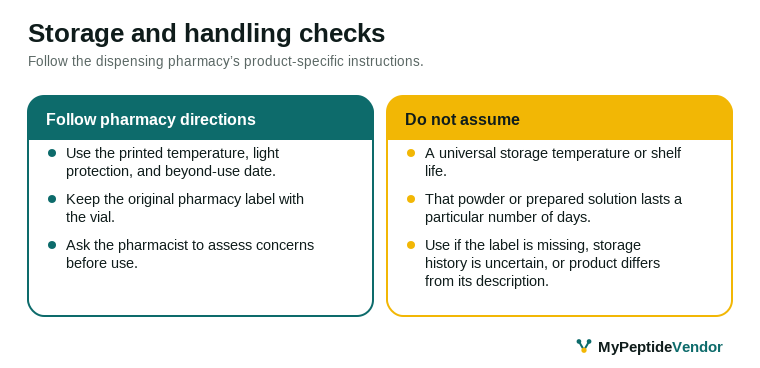
Follow the storage temperature, light protection, and beyond-use date printed by the dispensing pharmacy. A universal storage temperature or post-preparation shelf life cannot be confirmed for every MOTS-c product because there is no approved standard formulation and label 23.
Do not assume that powder or prepared solution remains usable for a particular number of days. Formulation and pharmacy handling instructions can differ, and no universal shelf life is established in the cited evidence 23.
Keep the original pharmacy label with the vial. Do not transfer it to an unlabeled container or use it if the label is missing, the storage history is uncertain, or the product differs from the pharmacy’s description. Ask the dispensing pharmacist to assess concerns before use.
Use this chart
Free to reuse with a link back:
Injection and Tracking Tips
No standard clinical injection route or site is established for MOTS-c 3. Repeated online instructions about injection locations do not prove that a route has been clinically validated.
If a clinician directs use of a pharmacy-dispensed product, follow its written administration instructions. Record the pharmacy, product lot, preparation directions, date, prescribed amount, and any symptoms so the clinician can review what happened.
Before discussing treatment, gather baseline fasting insulin, HOMA-IR, HbA1c, and body-composition information if your clinician considers those measures appropriate. The reviewed studies do not establish when these measurements should change after MOTS-c or what change would count as a response 3610.
A pre-start review can include cancer history, pregnancy or breastfeeding status, diabetes medicines, other medicines and supplements, and sport-testing obligations. These details help a clinician assess risk; they do not make an unapproved product safe 24.
Athletes subject to testing should check current rules with their governing body before considering any unapproved peptide. Human safety data for unapproved peptides are scarce, and serious harm is possible 2. No current anti-doping classification for MOTS-c is established 2, so athletes should not assume it is permitted and should check their governing body's rules.
Safety, Side Effects, and Who Should Avoid It
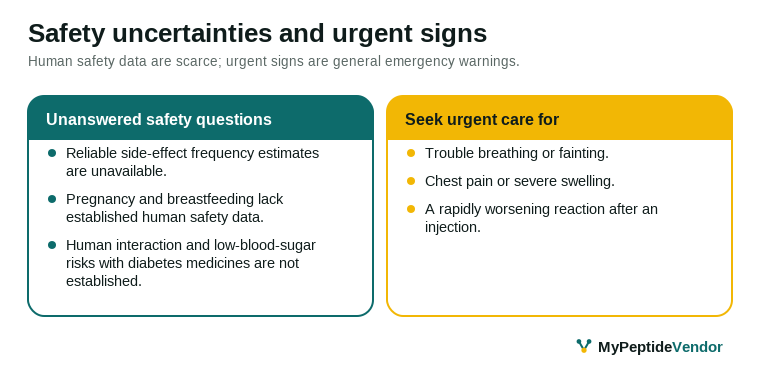
No reliable frequency estimates for MOTS-c side effects are available from an approved product label or completed human treatment trial 210. A percentage cannot be given responsibly when adverse-event rates have not been established. A sports medicine review warns that human safety data for unapproved peptides are scarce and serious harm is possible 2.
Cell research raises a specific safety question: MOTS-c increased secretion of IL-6, IL-1β, IL-8, IL-10, and tumor necrosis factor alpha in senescent cells 9. This is a laboratory finding, not proof that an injection causes inflammatory disease in a person. Whether it changes risk for someone with chronic inflammatory disease has not been studied.
People with current or past cancer should discuss the uncertainty with an oncologist or other treating clinician before exposure. A review lists MOTS-c among mitochondrial retrograde signals that may contribute to cancer progression 4. That does not show that MOTS-c causes cancer, but it also does not establish safety for people with cancer history.
Pregnancy and breastfeeding are not settings with established human MOTS-c safety data 23. People taking diabetes medicines should consult the prescribing clinician before considering a compound studied for metabolic signaling; human interaction and low-blood-sugar risks have not been established 3610.
People with chronic inflammatory disease face an unanswered question: cell findings about cytokine secretion do not tell us whether an injected product would worsen or improve their condition 9. This is a reason for clinician review, not a proven contraindication based on the cell study alone.
Seek urgent care for trouble breathing, fainting, chest pain, severe swelling, or a rapidly worsening reaction after an injection. These are general emergency warning signs, not MOTS-c effects with known frequencies.
No effective method of applying MOTS-c in the clinic has been developed 3. A product described as compounded or research grade is not thereby proven safe or effective for human use 2. Any contemplated use requires a licensed prescriber and pharmacist to review product identity, lawful sourcing, preparation directions, and individual risks.
Before a clinical discussion: Bring your medication list, supplement and peptide list, cancer history, pregnancy or breastfeeding status, baseline metabolic results if available, and sport-testing questions. No checklist can fill the central evidence gap: no validated human dose or established side-effect frequency exists 2310.
Use this chart
Free to reuse with a link back:
Frequently asked questions
How much MOTS-c should you take per day?
No approved or validated daily human dose is established 23. Human exercise findings measure naturally produced MOTS-c, not a daily injection schedule 7.
How much MOTS-c should you take per week?
No evidence-based weekly total has been established in human treatment studies 2310. NCT07505745 is recruiting and has no completed dose or outcome results 10.
How many units is 5 mg of MOTS-c?
There is no single unit answer because the amount per unit depends on concentration. With 1 mL added to a 5 mg vial, the full vial corresponds to 100 U-100 units; that is a conversion example, not an instruction to inject the full vial.
How much diluent should you add to a 5 mg MOTS-c vial?
There is no universal volume for every product. Use only the diluent and volume directed by the dispensing pharmacy, because the volume changes the concentration and syringe conversion.
When is the best time to take MOTS-c?
No human trial establishes the best time of day for injected MOTS-c 2310. A rise in naturally produced MOTS-c after acute exercise does not establish an ideal injection time 7.
How often should MOTS-c be injected, and how long should a cycle last?
No validated injection frequency, cycle length, or repeat-cycle interval is established 23. A schedule shared online is not a substitute for a human trial.
Does MOTS-c work like exercise?
Acute exercise can raise naturally produced MOTS-c in human muscle and plasma, while findings on chronic training effects conflict 7. Mouse treatment findings do not prove that MOTS-c reproduces exercise benefits in people.
Can people with diabetes or cancer use MOTS-c?
Human safety and interaction data are not established for people taking diabetes medicines or people with current or past cancer 2310. A clinician should review metabolic medicines and cancer history, including the research discussion of mitochondrial stress signals in cancer progression 46.
Should athletes use MOTS-c?
Athletes should check current rules with their sport’s governing body before considering an unapproved peptide. Human safety data are scarce, and serious harm is possible 2; the cited review does not establish MOTS-c’s current anti-doping classification.
References
- FDA: Certain bulk drug substances for use in compounding that may present significant safety risks
- Mendias et al. Safety and Efficacy of Approved and Unapproved Peptide Therapies for Musculoskeletal Injuries and Athletic Performance. Sports Med. 2026.
- Zheng et al. MOTS-c: A promising mitochondrial-derived peptide for therapeutic exploitation. Front Endocrinol (Lausanne). 2023.
- Wang et al. Role of the mitochondrial stress response in human cancer progression. Exp Biol Med (Maywood). 2020.
- Fasipe et al. Exercise and vascular function in sedentary lifestyles in humans. Pflugers Arch. 2023.
- Wan et al. Mitochondria-derived peptide MOTS-c: effects and mechanisms related to stress, metabolism and aging. J Transl Med. 2023.
- Woodhead et al. Mitochondrial-derived peptides and exercise. Biochim Biophys Acta Gen Subj. 2021.
- Merry et al. Mitochondrial-derived peptides in energy metabolism. Am J Physiol Endocrinol Metab. 2020.
- Mendelsohn et al. Mitochondrial-Derived Peptides Exacerbate Senescence. Rejuvenation Res. 2018.
- ClinicalTrials.gov: 9 registered studies (search: MOTS-c)
Written by the MyPeptideVendor editorial team from the FDA label, peer-reviewed studies and ClinicalTrials.gov records listed above, fact-checked line by line and reviewed 2026-11-12.
Cite this page
MyPeptideVendor Editorial Team. mots c dosage 5mg: Schedule, Units & Safety. MyPeptideVendor. Updated November 12, 2026. https://mypeptidevendor.com/protocols/mots-c-dosing-5mg/MyPeptideVendor Editorial Team. (2026, November 12). mots c dosage 5mg: Schedule, Units & Safety. MyPeptideVendor. https://mypeptidevendor.com/protocols/mots-c-dosing-5mg/Related protocols
Cardiogen 20 mg
Research UseNo approved human dose or validated cycle exists for Cardiogen peptide; its published findings are preclinical, not a dosing protocol.
View protocolChonluten 20 mg
Research UseNo human Chonluten dose or titration schedule is established; the cited research tested cells, not people.
View protocolCortagen 20 mg
Research UseCortagen has no established human dose; this guide explains 20 mg vial math and the limits of the animal and laboratory evidence.
View protocol