NAD Plus Dosage 500mg: Dose & Safety
A 500mg vial is not an established injection dose; no FDA-approved human NAD+ injection schedule is established.
Quickstart highlights for NAD+ dosage 500mg
There is no established human injection dose for NAD+ 500mg, and the 500mg printed on a vial is the total amount in the container, not a recommended injection. Do not start a 50mg dose or a daily-then-every-other-day schedule unless your prescriber and dispensing pharmacy have confirmed the exact product and written directions.
The NMN trial 3 and the NR trial 6 studied oral products, not NAD+ injections. A 500mg-in-3mL preparation and a 500mg-in-2mL preparation have different concentrations, so a syringe marking from one cannot safely be transferred to the other.
- 500mg is the vial total. It does not establish the dose for one injection or how many injections a container can provide.
- No approved injection schedule exists. Human trials of NMN and NR studied oral products, not injections of NAD+ 36.
- Concentration changes the volume. A conversion table for 500mg reconstituted in 2mL (250 mg/mL, 2500 mcg per unit) does not apply to a 500mg-in-3mL product.
- Do not assume the 50mg schedule is standard. A 50mg injection and a start of daily dosing followed by every-other-day dosing have not been established in human NAD+ injection trials 36.
- Get written directions first. Confirm the prescribed dose, concentration, route, device marking, storage instructions, and discard date with the pharmacy before preparing or injecting a product.
NAD+ (nicotinamide adenine dinucleotide) is a coenzyme found in living cells. It carries electrons in redox reactions that support energy metabolism, including glycolysis and oxidative phosphorylation; it also serves as a substrate for enzymes involved in DNA repair and other cell functions 45710. Those biochemical roles do not prove that an injection improves energy, aging, or any disease.
A vial marked 500mg tells you how much NAD+ is present in the container, but it does not tell you the intended route, diluent, final concentration, dose, or period of use. Those details must come from the dispensing pharmacy for that exact preparation.
Key takeaways
- A 500mg vial states the total amount supplied, not the amount to inject at one time.
- No FDA-approved human NAD+ injection dose or titration schedule is established 36.
- The reported 50mg injection and daily-for-3-days schedule are not validated by the oral NMN or NR trials 36.
- A 500mg-in-2mL conversion chart does not apply to a 500mg-in-3mL product.
- Use only a product-specific plan confirmed by the prescriber and dispensing pharmacy.
NAD+ dosing schedule: week-by-week

No FDA-approved human NAD+ injection dose or titration schedule is established. The NMN trial used oral doses of 300mg, 600mg, or 900mg daily for 60 days, and the NR trial used 1g orally each day for 21 days; neither trial tested NAD+ injections 36. The weeks below are planning rows only, not a recommended injection plan.
| Week | Dose in mg | Dose in mcg | U-100 units |
|---|---|---|---|
| Week 1 | Not established | Not established | Not established |
| Week 2 | Not established | Not established | Not established |
| Week 3 | Not established | Not established | Not established |
| Week 4 and later | Not established | Not established | Not established |
A daily start for 3 days followed by every-other-day injections is not a schedule established by the human trials 36. A twice-weekly plan is not established by those trials either. These schedules should not be combined, alternated, or chosen by vial size. Ask the prescriber to write the exact amount and timing for your product, including what to do after a missed dose.
The 500mg-in-2mL conversion (250 mg/mL; 1 unit = 2500 mcg) lists microgram amounts and U-100 markings for that concentration. It does not provide a 50mg entry, and it does not apply to a vial mixed with 3mL. Do not estimate a dose from an online unit claim, a different pen, or a syringe with a different scale.
The maximum safe injection dose, whether a 50mg dose measurably changes blood NAD+, and how long any change might last have not been established in human injection trials 36. Do not increase a dose because you feel no immediate effect or because another person follows a different schedule.
Syringe Unit Conversion Table
Units to draw on a U-100 insulin syringe (100 units = 1 mL) from a 500 mg vial. Find your dose, then read the column for the water you added. Every number is calculated, not estimated.
| Dose | 2 mL water 250 mg/mL · 1 unit = 2500 mcg |
|---|---|
| 50 mcg | 0.02 · 10000 doses |
| 100 mcg | 0.04 · 5000 doses |
| 200 mcg | 0.08 · 2500 doses |
| 250 mcg | 0.1 · 2000 doses |
| 300 mcg | 0.12 · 1666 doses |
| 500 mcg | 0.2 · 1000 doses |
| 750 mcg | 0.3 · 666 doses |
| 1 mg | 0.4 · 500 doses |
| 1.5 mg | 0.6 · 333 doses |
| 1.7 mg | 0.68 · 294 doses |
| 2 mg | 0.8 · 250 doses |
| 2.4 mg | 0.96 · 208 doses |
| 2.5 mg | 1 · 200 doses |
| 3 mg | 1.2 · 166 doses |
| 4 mg | 1.6 · 125 doses |
| 5 mg | 2 · 100 doses |
| 7.5 mg | 3 · 66 doses |
| 10 mg | 4 · 50 doses |
| 12.5 mg | 5 · 40 doses |
| 15 mg | 6 · 33 doses |
NAD+ 500 mg Vial Dosage Calculator
Shows the exact insulin-syringe units to draw. Pre-loaded with the 500 mg vial; change any value to match yours.
Total volume of your syringe?
How much mg is in the vial?
How much bacteriostatic water are you adding?
Dose per injection?
Educational tool only. Concentration = vial ÷ water; units = dose ÷ concentration × 100 (U-100 syringe). Confirm every dose with your prescriber. Different vial or peptide? Use the peptide calculator.
Affiliate link · we may earn a commission.
Reconstitution steps for a 500mg vial
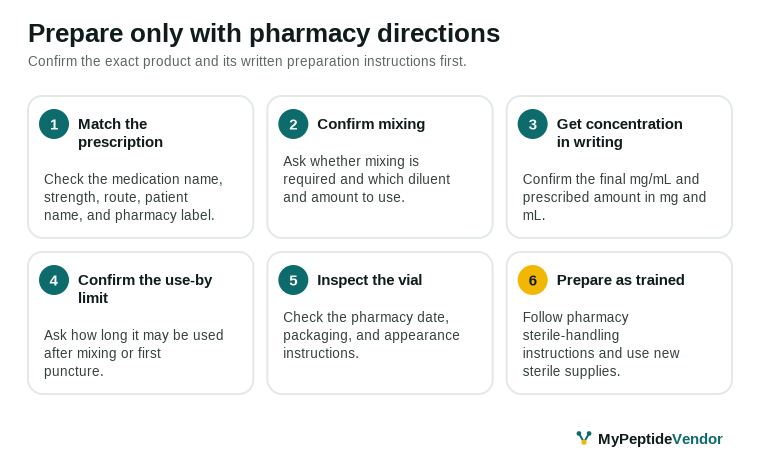
Do not choose a diluent, mixing volume, or post-mixing storage period yourself. The vial strength alone does not tell you how to prepare the product or whether it is intended for one use or repeated punctures. If the dispensing pharmacy has not supplied written, product-specific directions, do not reconstitute or inject it.
- Match the vial to the prescription. Check the medication name, strength, route, patient name, and pharmacy label. If any detail differs from the prescription, stop and call the pharmacy.
- Confirm whether mixing is required. Ask the pharmacist which diluent is prescribed, how much to use, how to mix the contents, and whether the vial is single-use. Do not substitute sterile water or another liquid based on a general online instruction.
- Get the final concentration in writing. Ask for the final concentration in mg/mL and the prescribed amount in both mg and mL. Have the pharmacist identify the matching syringe marking or compatible pen setting.
- Confirm the use-by limit. Ask how long the product may be used after mixing or first puncture and whether the discard date changes after either event. Refrigeration alone does not establish a safe use period.
- Inspect the vial and packaging. Check the pharmacy expiry or beyond-use date and follow its appearance instructions. If the vial is damaged, expired, or looks different from the pharmacy’s description, do not use it.
- Prepare only as trained. Follow the dispensing pharmacy’s sterile-handling instructions and use new sterile supplies. If any step is unclear, ask a pharmacist or clinician to demonstrate it before you proceed.
Reconstitution does not make an unverified dose safe. The calculation depends on the exact vial, diluent, final volume, prescribed amount, and injection device. Keep the written pharmacy instructions with the vial so you do not accidentally use directions for a different concentration.
Use this chart
Free to reuse with a link back:
Supplies needed for a full 500mg vial
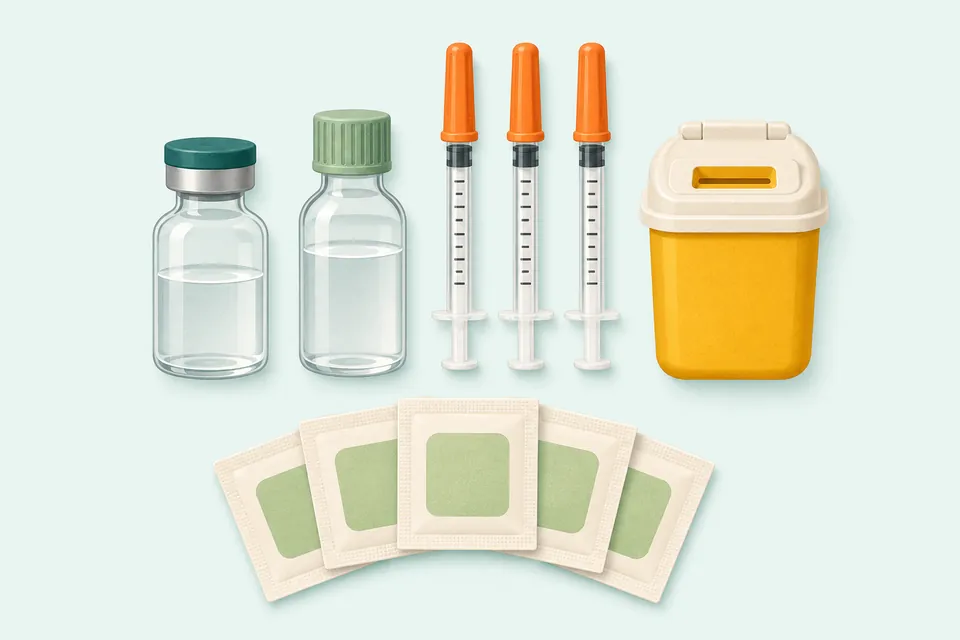
The number of injections one vial can provide cannot be determined from the 500mg total alone. It depends on the prescribed dose, the pharmacy’s preparation, and whether the label identifies the vial as single-use or multidose. Do not divide a vial into future doses unless the pharmacy has specifically dispensed and labeled it for that use.
- One pharmacy-dispensed 500mg vial, if that is the exact strength on your prescription.
- One pharmacy-specified diluent container, only if the exact product requires reconstitution.
- One new sterile syringe and needle for each prescribed injection, or the compatible pen and new needle specified by the pharmacy.
- Alcohol swabs for the vial top and injection site as directed by the pharmacy.
- One puncture-resistant sharps container for used needles and syringes.
- One written instruction sheet listing the prescribed dose, concentration, route, storage range, discard date, and pharmacy contact.
An insulin syringe, pen, cartridge, and vial may not use the same scale or be compatible with the same formulation. Before the first injection, ask the pharmacist to confirm that the device matches the product and that the prescribed amount matches the device marking.
If the label says single-use, use the vial once and discard the remainder as directed; do not re-enter it for a later dose. Never reuse a needle or syringe. The vial’s total amount does not by itself establish that it is safe or sterile for repeated use.
Protocol overview and cycle notes
NAD+ is a coenzyme involved in energy metabolism and in cell processes that use NAD+-dependent enzymes, including sirtuins and PARPs 457. It is continually made, used, and recycled; it is not simply a dose of fuel that remains unchanged in the body 8.
The body makes NAD+ through metabolic pathways that use precursors, and NAD+ cannot be taken directly from food 10. One review describes NAD turnover with a half-life on the order of minutes in some tissues 8. That observation does not establish how injected NAD+ behaves in a person, how much reaches a tissue, or how long an injection changes blood or tissue levels.
NAD+ levels decline with age in multiple model organisms and in human tissues, but the best way to restore levels in people and the health effects of doing so remain open questions 4. Cellular NAD+ concentrations change during aging, and supplementation with NAD+ precursors may be a therapeutic opportunity 7. These findings do not establish an injection dose or justify selecting one by age.
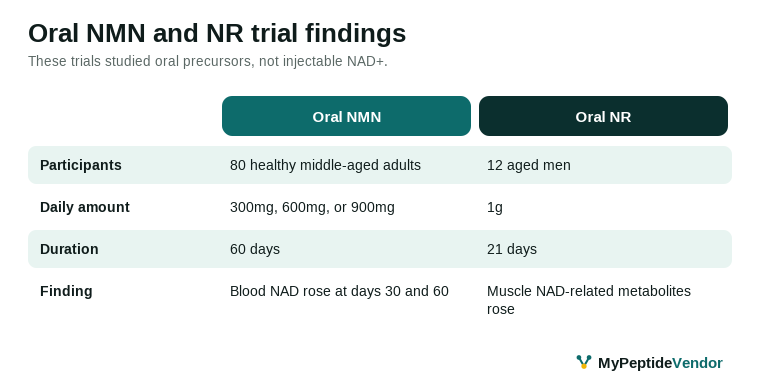
In a randomized, multicenter, placebo-controlled trial, 80 healthy middle-aged adults took oral NMN or placebo once daily for 60 days. The NMN groups received 300mg, 600mg, or 900mg daily; blood NAD concentrations rose versus placebo and baseline at day 30 and day 60 in all NMN groups (all p≤0.001) 3. This was a precursor-supplement trial, not an injectable NAD+ study.
In a randomized, double-blind, placebo-controlled crossover trial, 12 aged men took 1g of oral NR daily for 21 days. NR increased muscle NAD-related metabolites and lowered circulating inflammatory cytokines, while muscle mitochondrial bioenergetics did not change 6. The study does not show that injected NAD+ works better than oral NMN or NR.
ClinicalTrials.gov lists NCT07880925 as a recruiting phase 1 study of trigonelline monohydrate and NAD+ metabolism in healthy adults 11. It is not a trial of a 50mg NAD+ injection. Human intervention research remains early, and key questions about safety and health benefits remain unresolved 4.
No human evidence establishes a standard cycle length, a routine break period, or dose adjustments based on body weight, age, kidney function, or liver function 346. Tell the prescriber about pregnancy, breastfeeding, kidney or liver disease, allergies, and current medicines before discussing an injection. The clinician should decide whether any of these factors change the plan.
The FDA category 2 page describes certain nominated bulk drug substances that may present significant safety risks; it is a regulatory resource to check, not an approval or safety finding for a particular NAD+ vial 2. Ask the pharmacy whether the exact preparation is compounded, what standards and beyond-use date apply, and whether it is FDA-approved. Do not treat a compounded preparation as an FDA-approved drug.
| Evidence | Product and amount | Study period and participants | What was observed |
|---|---|---|---|
| NMN trial | Oral NMN: 300mg, 600mg, or 900mg daily | 60 days; 80 healthy middle-aged adults | Blood NAD increased versus placebo and baseline at day 30 and day 60; all p≤0.001 |
| NR trial | Oral NR: 1g daily | 21 days; 12 aged men | Muscle NAD-related metabolites increased and circulating inflammatory cytokines decreased; muscle mitochondrial bioenergetics did not change |
| Review | NAD+ metabolism and aging | Review of human and model-organism research | Describes age-related NAD+ decline and unresolved questions about safe, effective restoration |
These findings provide context about oral precursors and NAD biology, not dose instructions for an injection. There is no direct comparison in these studies showing whether injected NAD+ is better than oral NMN or NR 36.
Use this chart
Free to reuse with a link back:
Storage and handling
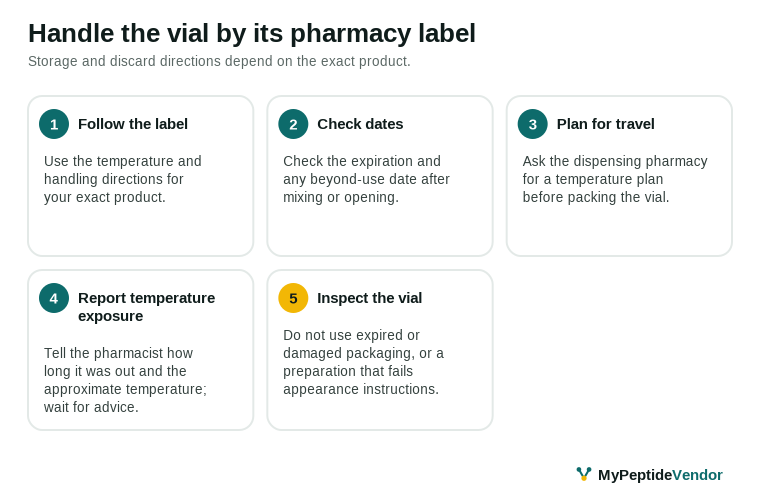
Use the temperature and handling directions printed on the pharmacy label for your exact product. Do not assume that refrigeration at 2–8°C is a universal NAD+ requirement: that range appears in the storage instructions for the unrelated Bexsero vaccine, not as a validated storage standard for NAD+ 1. If your NAD+ pharmacy label specifies 2–8°C, keep it within that range and do not freeze it.
Keep the vial in its labeled packaging and away from children. Check the expiration date before use and the beyond-use date after mixing or opening, if applicable. Ask the pharmacy whether its discard clock starts at first puncture, reconstitution, or another event; the NMN and NR trials do not establish an opened-vial storage period for injectable NAD+ 36.
For travel, ask the dispensing pharmacy for a temperature plan before packing the vial. If it was left out of refrigeration or exposed to heat, tell the pharmacist how long it was out and the approximate temperature, then wait for advice before using it. Do not place the vial directly against a frozen pack if that could freeze the product.
Appearance cannot confirm sterility or potency. Do not use an expired vial, a vial with damaged packaging, or a preparation that does not match the pharmacy’s appearance instructions. Call the pharmacy rather than trying to correct a temperature excursion yourself.
Use this chart
Free to reuse with a link back:
Injection and tracking tips

Use an injection only if a clinician prescribed that exact product and the dispensing pharmacy confirmed its route and device. Ask a clinician or pharmacist to demonstrate the technique before your first dose. A general guide cannot confirm that a particular NAD+ preparation is suitable for a pen or subcutaneous injection.
- Gather the prescribed supplies. Set out the pharmacy-labeled vial or pen, the specified new sterile needle and syringe if needed, alcohol swabs, and a sharps container.
- Check the dose before drawing. Compare the written dose, final concentration, and device marking. If any value differs from the pharmacy label, pause and call before injecting.
- Prepare the product as directed. Follow the pharmacy’s instructions for vial handling or pen setup. Do not attach a needle, cartridge, or device that the pharmacy has not confirmed as compatible.
- Choose a taught injection site. Use only a site recommended for your product and device. Avoid skin that is infected, inflamed, bruised, scarred, or painful, and rotate sites as instructed by your clinician.
- Clean and inject as demonstrated. Clean the skin and let it dry. Use the angle and skin-fold method taught for your needle length and body type; inject steadily without forcing the device.
- Dispose of the used needle safely. Put the needle and syringe directly into a puncture-resistant sharps container. Do not reuse or share a needle or syringe, and do not put loose needles in household recycling.
- Record the injection. Note the date, time, prescribed amount, site, and any reaction. A written log can help prevent an accidental repeat dose and gives the clinician useful information at follow-up.
If you miss a dose, do not double the next one. The correct next-dose timing depends on the prescriber’s plan, so contact the clinician or pharmacy instead of adding an extra injection.
Do not use a pen unless its manufacturer and the dispensing pharmacy confirm it is compatible with the exact product. Pen settings and syringe markings are not interchangeable; confirm the prescribed amount in mg and mL before the first use.
Safety and side effects
Reliable frequency estimates for side effects from subcutaneous NAD+ injections are not established in human trials 36. Stinging, bruising, tenderness, or redness can occur with injections, but no frequency from a different medicine should be used to estimate the risk of NAD+.
The 60-day NMN trial reported no safety issues based on adverse-event, laboratory, and clinical monitoring, but participants took oral NMN rather than injectable NAD+ 3. The NR trial studied oral dosing in 12 aged men for 21 days, not NAD+ injections 6. Neither study establishes the frequency or severity of injection reactions.
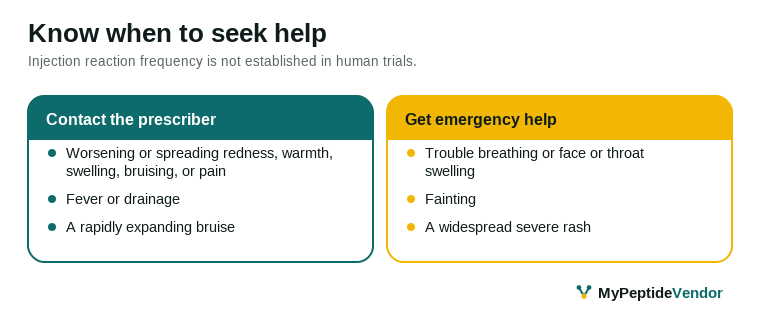
For mild local irritation, keep the site clean and avoid rubbing it. Contact the prescriber if redness, warmth, swelling, bruising, or pain is worsening, spreading, or not settling. Pause further injections and seek prompt clinical advice for fever, drainage, or a rapidly expanding bruise.
Get emergency help for trouble breathing, swelling of the face or throat, fainting, or a widespread severe rash after an injection. Do not inject again until a clinician has reviewed a suspected serious allergic reaction.
Discuss pregnancy, breastfeeding, kidney or liver disease, allergies, and current medicines with the prescriber before treatment. The oral NMN and NR trials do not establish the safety of injectable NAD+ in these circumstances 36.
Ask the prescriber and pharmacist to confirm the product’s regulatory status, concentration, route, storage range, beyond-use date, and after-hours contact. The FDA category 2 page concerns potential risks for certain nominated bulk substances; it does not establish approval or safety for a specific vial 2.
Use this chart
Free to reuse with a link back:
Frequently asked questions
How much NAD+ should I take from a 500mg vial?
The 500mg amount describes the vial contents, not your injection dose. There is no FDA-approved human injection dose; use only the amount your prescriber wrote for the exact product and the pharmacy confirmed.
Is 50mg the standard NAD+ injection dose?
No human injection trial establishes 50mg as a standard dose. The available NMN and NR trials studied oral products, so they do not validate a 50mg NAD+ injection 36.
How many units is 50mg of NAD+?
The answer depends on the final concentration and device. A conversion for a 500mg vial mixed with 2mL does not apply to a 500mg-in-3mL preparation, which has a different concentration; ask the pharmacy to verify the amount in mg, mL, and device marking.
Should I inject NAD+ daily for 3 days and then every other day?
That pattern has not been established in human NAD+ injection trials 36. Follow the schedule written for your prescription, and ask the prescriber what to do if a dose is missed.
How many injections can I get from a 500mg vial?
The total amount alone does not establish the permitted number of injections. The answer depends on the prescribed dose and whether the pharmacy labeled the vial for single or multiple use.
Is injectable NAD+ better than oral NMN or NR?
The trials do not compare these options. Oral NMN raised blood NAD in an 80-person trial lasting 60 days, while oral NR changed muscle NAD-related metabolites in a 12-person trial lasting 21 days; neither tested injectable NAD+ 36.
How long can an opened or mixed NAD+ vial stay refrigerated?
There is no universal period established by the oral NMN and NR trials 36. Use the pharmacy’s beyond-use date and ask whether it changes after mixing or first puncture.
What should I do if the vial was left out of the refrigerator?
Do not use it until the dispensing pharmacy reviews the time and temperature exposure. Keep it from freezing and do not rely on appearance alone to decide whether it is usable.
Which side effects mean I should stop and contact a clinician?
Pause further injections and contact a clinician about worsening redness, warmth, swelling, pain, or bruising, or about fever or drainage. Trouble breathing or swelling of the face or throat needs emergency care.
References
- FDA prescribing information: Bexsero (Neisseria Meningitidis Serogroup B Nhba Fusion Protein Antigen, Neisseria Meningi (DailyMed)
- FDA: Certain bulk drug substances for use in compounding that may present significant safety risks
- Yi et al. The efficacy and safety of β-nicotinamide mononucleotide (NMN) supplementation in healthy middle-aged adults: a randomized, multicenter, double-blind, placebo-controlled, parallel-group, dose-dependent clinical trial. Geroscience. 2023.
- Covarrubias et al. NAD+ metabolism and its roles in cellular processes during ageing. Nat Rev Mol Cell Biol. 2021.
- Imai et al. NAD+ and sirtuins in aging and disease. Trends Cell Biol. 2014.
- Elhassan et al. Nicotinamide Riboside Augments the Aged Human Skeletal Muscle NAD+ Metabolome and Induces Transcriptomic and Anti-inflammatory Signatures. Cell Rep. 2019.
- Verdin et al. NAD⁺ in aging, metabolism, and neurodegeneration. Science. 2015.
- Chini et al. Evolving concepts in NAD+ metabolism. Cell Metab. 2021.
- Katsyuba et al. NAD+ homeostasis in health and disease. Nat Metab. 2020.
- Navas et al. NAD+ metabolism, stemness, the immune response, and cancer. Signal Transduct Target Ther. 2021.
- ClinicalTrials.gov: 764 registered studies (search: NAD+)
Written by the MyPeptideVendor editorial team from the FDA label, peer-reviewed studies and ClinicalTrials.gov records listed above, fact-checked line by line and reviewed 2026-11-12.
Cite this page
MyPeptideVendor Editorial Team. NAD Plus Dosage 500mg: Dose & Safety. MyPeptideVendor. Updated November 12, 2026. https://mypeptidevendor.com/protocols/nad-plus-dosing-500mg/MyPeptideVendor Editorial Team. (2026, November 12). NAD Plus Dosage 500mg: Dose & Safety. MyPeptideVendor. https://mypeptidevendor.com/protocols/nad-plus-dosing-500mg/Related protocols
Cardiogen 20 mg
Research UseNo approved human dose or validated cycle exists for Cardiogen peptide; its published findings are preclinical, not a dosing protocol.
View protocolChonluten 20 mg
Research UseNo human Chonluten dose or titration schedule is established; the cited research tested cells, not people.
View protocolCortagen 20 mg
Research UseCortagen has no established human dose; this guide explains 20 mg vial math and the limits of the animal and laboratory evidence.
View protocol