Crystagen Dosage 20mg: Protocol & Safety
No approved human dose or validated vial instructions are established; the 20 mg label states vial content, not a treatment schedule.
Quickstart highlights for Crystagen 20 mg
There is no established human dose for a Crystagen 20 mg vial. The published abstract reports immune-cell findings in spleen during aging, not a human dose, injection route, reconstitution method, or course schedule 2.
Chervyakova et al. studied Crystagen alongside Vilon, Timogen, and R-1 2. Crystagen is described as a short peptide, but its amino-acid sequence is not reported in 2. A vial labeled 20 mg tells you the amount in the vial; it does not establish how much a person should take.
- Human dose: No approved or evidence-based human dose is established by the Crystagen study abstract 2.
- Schedule: No titration, daily dose, course length, or off-cycle interval is reported in that abstract 2.
- Identity: Some product descriptions name a peptide sequence for Crystagen, but this sequence is unverified 2. Chervyakova et al. describe it as a short peptide but do not give its sequence 2.
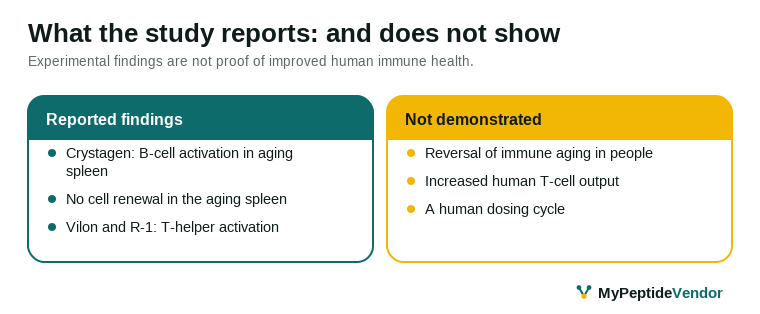
- Immune-cell finding: The study reports spleen B-cell activation, but no cell renewal during aging; it reports T-helper activation for Vilon and R-1 2.
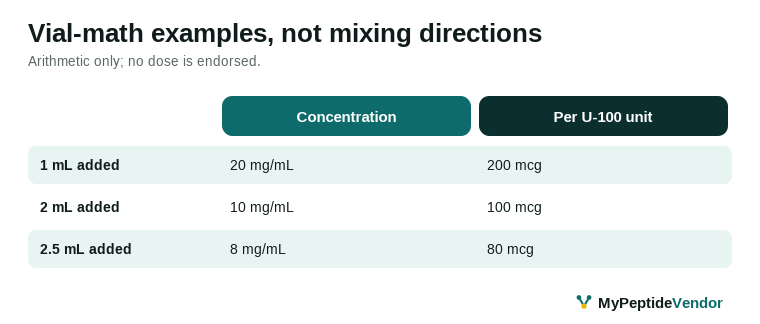
- Mixing math: A 20 mg vial divided by 2 mL is 10 mg/mL; divided by 2.5 mL it is 8 mg/mL. These are calculations, not validated preparation directions.
- Storage and safety: The study abstract gives no product-specific storage temperature, stability period, contraindication list, or side-effect frequency 2.
Key takeaways
- No approved or trial-established human dose, titration, course length, or off-cycle interval is reported for Crystagen 2.
- The study reports spleen B-cell activation without cell renewal during aging; Vilon and R-1 activated T-helper cells 2.
- For arithmetic only, a 20 mg vial with 2 mL added liquid yields 10 mg/mL, while 2.5 mL yields 8 mg/mL.
- The Crystagen study abstract does not report a human participant count, adverse-event frequency, clinical response rate, route, or dose 2.
- FDA category 2 describes bulk substances FDA identifies as potentially posing significant safety risks; that category is not a Crystagen label or approval decision 1.
Crystagen dosing schedule

No FDA-label titration applies to Crystagen; no Crystagen prescribing label or human dose is reported in 1 or 2. The study reports immune-cell findings in spleen during aging, not a human treatment schedule 2.
A U-100 syringe has 100 units per milliliter, but assigning a syringe mark requires both a verified dose and an approved product-specific concentration. Neither is established for Crystagen here.
| Week or phase | Daily dose (mg) | Daily dose (mcg) | U-100 units | Course and off-cycle |
|---|---|---|---|---|
| Weeks 1 onward | Not established | Not established | Not established | No evidence-based course length or off-cycle interval reported |
The cited abstract does not report a human treatment duration 2. A longer or more detailed schedule is not better supported just because it appears in a product listing.
Do not treat a vial’s total 20 mg content as a daily dose. Milligrams describe the amount of peptide, milligrams per milliliter describe concentration, and syringe units describe volume. Those measurements do not establish a safe or effective human regimen.
Syringe Unit Conversion Table
Units to draw on a U-100 insulin syringe (100 units = 1 mL) from a 20 mg vial. Find your dose, then read the column for the water you added. Every number is calculated, not estimated.
| Dose | 1 mL water 20 mg/mL · 1 unit = 200 mcg | 2 mL water 10 mg/mL · 1 unit = 100 mcg | 2.5 mL water 8 mg/mL · 1 unit = 80 mcg |
|---|---|---|---|
| 50 mcg | 0.25 · 400 doses | 0.5 · 400 doses | 0.62 · 400 doses |
| 100 mcg | 0.5 · 200 doses | 1 · 200 doses | 1.25 · 200 doses |
| 200 mcg | 1 · 100 doses | 2 · 100 doses | 2.5 · 100 doses |
| 250 mcg | 1.25 · 80 doses | 2.5 · 80 doses | 3.12 · 80 doses |
| 300 mcg | 1.5 · 66 doses | 3 · 66 doses | 3.75 · 66 doses |
| 500 mcg | 2.5 · 40 doses | 5 · 40 doses | 6.25 · 40 doses |
| 750 mcg | 3.75 · 26 doses | 7.5 · 26 doses | 9.38 · 26 doses |
| 1 mg | 5 · 20 doses | 10 · 20 doses | 12.5 · 20 doses |
| 1.5 mg | 7.5 · 13 doses | 15 · 13 doses | 18.75 · 13 doses |
| 1.7 mg | 8.5 · 11 doses | 17 · 11 doses | 21.25 · 11 doses |
| 2 mg | 10 · 10 doses | 20 · 10 doses | 25 · 10 doses |
| 2.4 mg | 12 · 8 doses | 24 · 8 doses | 30 · 8 doses |
| 2.5 mg | 12.5 · 8 doses | 25 · 8 doses | 31.25 · 8 doses |
| 3 mg | 15 · 6 doses | 30 · 6 doses | 37.5 · 6 doses |
| 4 mg | 20 · 5 doses | 40 · 5 doses | 50 · 5 doses |
| 5 mg | 25 · 4 doses | 50 · 4 doses | 62.5 · 4 doses |
| 7.5 mg | 37.5 · 2 doses | 75 · 2 doses | 93.75 · 2 doses |
| 10 mg | 50 · 2 doses | 100 · 2 doses | over 100 |
| 12.5 mg | 62.5 · 1 doses | over 100 | over 100 |
| 15 mg | 75 · 1 doses | over 100 | over 100 |
Crystagen 20 mg Vial Dosage Calculator
Shows the exact insulin-syringe units to draw. Pre-loaded with the 20 mg vial; change any value to match yours.
Total volume of your syringe?
How much mg is in the vial?
How much bacteriostatic water are you adding?
Dose per injection?
Educational tool only. Concentration = vial ÷ water; units = dose ÷ concentration × 100 (U-100 syringe). Confirm every dose with your prescriber. Different vial or peptide? Use the peptide calculator.
Reconstitution steps for a 20 mg vial
No Crystagen-specific bacteriostatic-water volume, validated concentration, or preparation method is established in the cited study 2. The calculations below show how different volumes change concentration; they are not instructions to mix or inject. Use a vial only if a licensed prescriber and dispensing pharmacist verify the exact product and give written, product-specific directions.
- Pause before opening. Ask the dispensing pharmacist to verify the product name, stated strength, manufacturer, lot, expiration, and intended route. A 20 mg vial label alone does not establish that it is intended for human injection.
- Confirm the diluent and volume in writing. Do not choose bacteriostatic water, sterile water, or a volume from a website. The study abstract does not provide mixing directions 2.
- Check the arithmetic. Concentration equals vial content divided by final liquid volume. For a 20 mg vial, 2 mL gives 10 mg/mL and 2.5 mL gives 8 mg/mL.
- Follow the pharmacy’s handling method. Use the equipment and aseptic method specified by the dispensing professional. The study does not describe vial handling or dissolution technique 2.
- Get storage and discard instructions before mixing. The cited abstract does not establish a storage temperature or beyond-use period for a prepared Crystagen solution 2.
Two milliliters and 2.5 mL are not interchangeable: they produce 10 mg/mL and 8 mg/mL, respectively. Neither arithmetic result proves sterility, stability, suitability for injection, or a proper human dose. A concentration claim such as 2 mg/mL or approximately 6.67 mg/mL would require a different dilution and is not validated by the cited study 2.
Worked example, not a dose: at 8 mg/mL, each milliliter contains 8 mg of peptide. That calculation does not tell you how many milligrams a person should use. The human dose remains unestablished in the cited evidence 2.
Conversion reference: These are vial-math examples only. The values below are arithmetic examples of concentration and U-100 volume only; no dose is endorsed.
| Added liquid | Concentration | Amount per U-100 unit | Example conversion listed |
|---|---|---|---|
| 1 mL | 20 mg/mL | 200 mcg | 200 mcg = 1.0 unit |
| 2 mL | 10 mg/mL | 100 mcg | 200 mcg = 2.0 units |
| 2.5 mL | 8 mg/mL | 80 mcg | 200 mcg = 2.5 units |
| 3 mL | Not listed in the conversion table | Not listed | No conversion shown |
| 10 mL | Not listed in the conversion table | Not listed | No conversion shown |
A different amount of diluent changes concentration and syringe volume, while the amount of peptide in the vial remains 20 mg. Do not use a calculated syringe mark without written directions for the exact product.
Use this chart
Free to reuse with a link back:
Supplies needed for a full vial
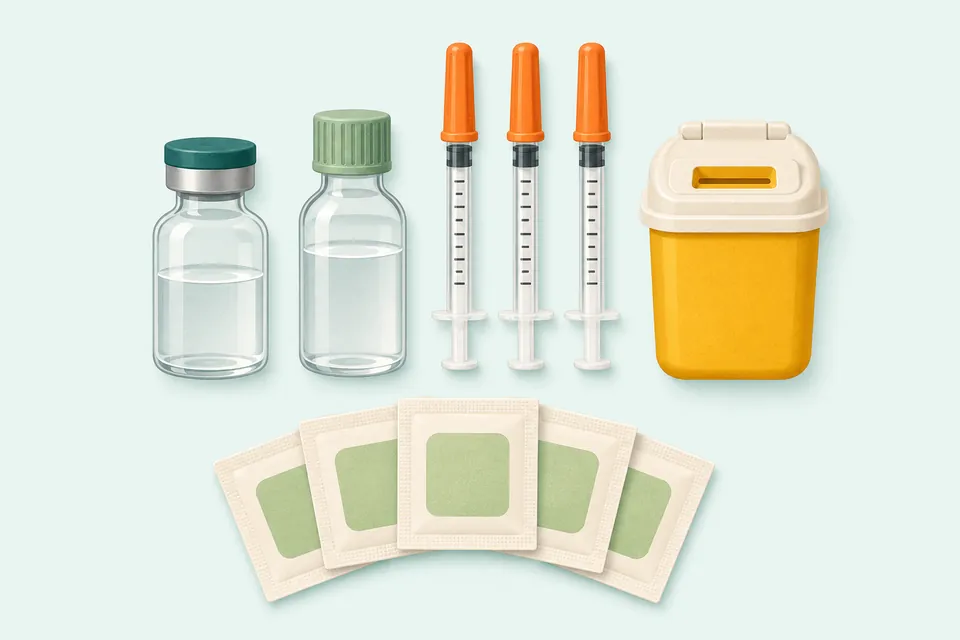
A safe quantity list for a full vial cannot be calculated without a verified human dose, route, frequency, course length, diluent, and discard date. The cited abstract provides none of those instructions 2. Listing a fixed number of syringes or alcohol swabs would imply a treatment plan that the evidence does not establish.
- For verification: Have the unopened vial and its full label available for review by a pharmacist or prescriber.
- For preparation: If a clinician authorizes preparation, obtain only the diluent, sterile supplies, syringe type, and sharps container specified by the dispensing professional.
- For a complete course: Ask the prescriber and pharmacist to calculate quantities after they establish a legitimate indication and product-specific written directions.
- For batch documentation: Request a certificate of analysis that identifies the tested batch, identity and purity methods, reported results, stated concentration, and sterility or endotoxin testing relevant to the intended route.
A certificate of analysis reports batch testing claims; it does not establish human safety, clinical benefit, sterility for injection, or an effective dose. It also does not replace review by the dispensing pharmacy.
Protocol overview and cycle notes
Crystagen is one of four short peptides (Vilon, Timogen, Crystagen, and R-1) examined for immunoprotective effects in spleen during aging 2. The reported Crystagen finding is B-cell activation without cell renewal in the aging spleen 2. That result does not demonstrate restored thymus function, fewer infections, or reversal of immune aging in people.
The study also challenges the simple claim that Crystagen is a T-cell activator. Chervyakova et al. report T-helper activation for Vilon and R-1; they report B-cell activation for Crystagen and Timogen, with different cellular findings for Timogen 2. These are experimental findings, not proof that any of the peptides improves a person’s immune health.
Thymus and immunosenescence: Crystagen has been studied for its effects on the spleen 2. The cited study reports spleen effects during aging, not a demonstrated human thymus mechanism 2. Immunosenescence means age-related change in immune function, but this study abstract does not show that Crystagen reverses it or increases human T-cell output.
Evidence limits: The available abstract reports cellular findings but does not provide a participant count, clinical endpoint, human dose, route, adverse-event table, or independent replication details 2. It therefore cannot support a human response rate or a dosing cycle.
The 82% immunogram claim: Chervyakova et al. do not report an 82% normalization result 2. The abstract gives no sample size, study design, comparator, clinical endpoint, or such percentage. Without a traceable report with those details, the figure should not be used to predict benefit.
Oral capsules versus injectable vials: A per-dose amount and a vial's total milligrams are different measurements. The cited abstract does not identify a human route or establish that oral capsules and lyophilized vials produce equivalent exposure 2. Crystagen-specific oral bioavailability has not been reported in that abstract. A general estimate for small peptides should not be presented as a measured Crystagen value.
Course-length disagreements: Seller-claimed course lengths cannot be ranked as trial-supported schedules, because 2 reports no human treatment duration or interval between courses. It reports no human treatment duration or interval between courses 2. A repeated seller recommendation is not evidence that the schedule is effective or safe.
Comparison with Thymosin Alpha-1: The Crystagen study does not compare Crystagen with Thymosin Alpha-1 2. They should not be treated as interchangeable, and this evidence cannot establish which is safer or more effective. Within the study’s peptide comparisons, Crystagen’s reported B-cell effect differs from the T-helper effects reported for Vilon and R-1 2.
Independent replication: The abstract does not give details of independent replication 2. That limitation does not prove no other research exists; it means this study alone cannot show whether its immune findings have been reproduced independently.
Use this chart
Free to reuse with a link back:
Storage and handling
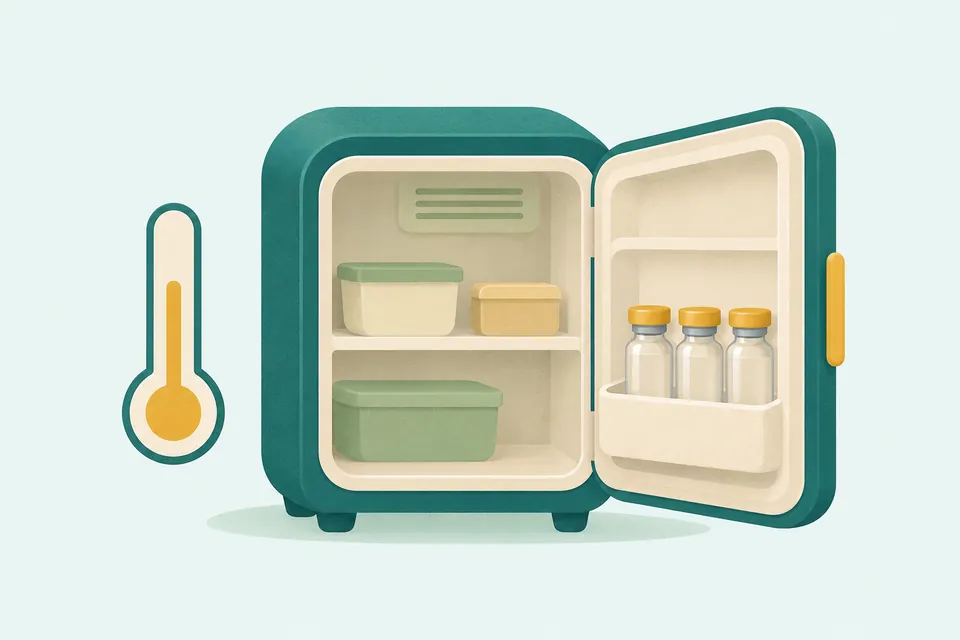
No Crystagen-specific storage temperature or stability period is established in the cited study 2. Claims that a dry vial belongs below 25 °C or at −20 °C, or that a mixed vial should be kept at 2–8 °C, cannot be confirmed from that abstract. The exact manufacturer’s written directions matter because storage requirements depend on the product and formulation.
Before accepting or preparing a vial, ask the dispensing professional to confirm the unopened-product temperature, conditions after mixing, beyond-use date, and response to a temperature excursion. The cited abstract gives none of those product-handling details 2.
Keep the original container and record its lot and expiration information. If the label is incomplete, damaged, or inconsistent with the pharmacy’s directions, do not use the vial until the discrepancy is resolved.
Injection and tracking tips
The cited study abstract does not establish a human injection route, site, frequency, or technique 2. Do not self-inject a vial unless a licensed prescriber and dispensing pharmacy confirm that the exact product is intended for human administration and give consistent written directions.
If a clinician is evaluating an immune concern, agree on the clinical question before ordering tests. CD4 and CD8 counts, natural-killer-cell activity, and infection frequency may be discussed with a clinician, but the Crystagen abstract does not validate them as treatment-response targets 2. A change in one lab result does not show that Crystagen caused a health improvement.
For an accurate medical record, note the product lot, any clinician-authorized amount, dates, symptoms, infections, and other medicines. Ask the clinician to set a follow-up interval and define what would change care. The cited abstract does not establish a baseline-to-3-month testing schedule or a response threshold for Crystagen 2.
Before considering an immune-active research product, ask a clinician to review autoimmune disease, transplant history, current or past cancer treatment, chemotherapy history, and immunosuppressant medicines. The cited study does not establish safety or interaction guidance for these groups 2.
Safety, side effects, and regulatory status
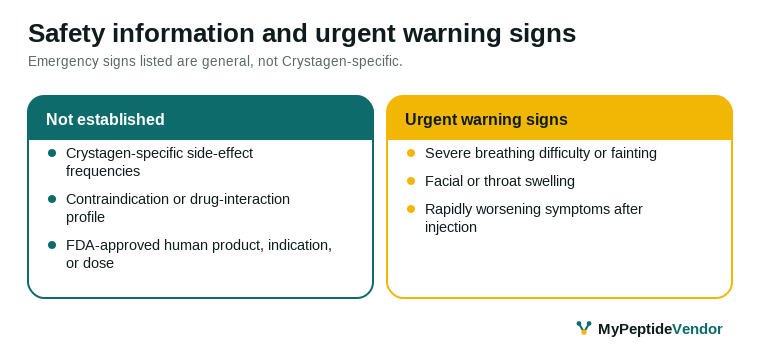
No Crystagen-specific side-effect frequencies are reported in the cited study 2. Its abstract describes immune-cell findings, not a human adverse-event table, so it cannot show how often injection reactions, allergic reactions, or other harms occur. No reported frequency is not proof that side effects do not occur.
The cited evidence does not establish a Crystagen contraindication list or drug-interaction profile 2. People with autoimmune disease, a transplant, cancer treatment, chemotherapy history, or immunosuppressant medicines should not assume the peptide is safe; ask a clinician who knows their medical history.
FDA category 2 covers bulk drug substances that FDA has identified as potentially presenting significant safety risks under its compounding policies 1. That category does not itself establish Crystagen’s regulatory status, and the FDA page is not a Crystagen product label 1.
No FDA-approved Crystagen human product, indication, or dose is established here 12. A research-use listing or certificate of analysis is not FDA approval and does not establish an effective human dose. Verify any product-specific regulatory or compounding question with a qualified pharmacist or regulatory professional.
Severe breathing difficulty, fainting, facial or throat swelling, or rapidly worsening symptoms after an injection require urgent medical care. These are general emergency warning signs, not Crystagen-specific adverse events or measured frequencies.
Use this chart
Free to reuse with a link back:
Frequently asked questions
Is Crystagen FDA approved?
No FDA-approved Crystagen human product, indication, or dose is established here 12. FDA category 2 refers to bulk substances the agency identifies as potentially posing significant safety risks under compounding policies; it is not a Crystagen approval record or prescribing label 1.
What is the Crystagen 20 mg dosage?
No human dose is established in the cited Crystagen study 2. The 20 mg figure describes the vial’s total content, not a daily dose or validated course.
What does the 82% immunogram-normalization claim mean?
That percentage is not reported in Chervyakova et al. 2. The abstract gives no sample size, design, comparator, or clinical endpoint for an 82% result.
Does Crystagen activate T-cells or B-cells?
The study reports Crystagen activation of spleen B-cells without cell renewal during aging 2. It reports T-helper activation for Vilon and R-1, so calling Crystagen simply a T-cell activator misses the distinction in the reported findings 2.
How much bacteriostatic water should I add to a 20 mg vial?
The study does not give a product-specific diluent volume 2. As arithmetic only, 2 mL yields 10 mg/mL and 2.5 mL yields 8 mg/mL; neither is a validated mixing instruction. Get written directions for the exact product from the dispensing pharmacist.
Can I use the same dose for an oral capsule and an injectable vial?
No equivalent dose between those forms is established in the cited study 2. The abstract does not specify a human route or show that an oral amount and an injectable amount produce equal exposure.
Is Crystagen safe with autoimmune disease, a transplant, or chemotherapy?
Safety in those situations is not established in the cited study 2. Ask a clinician who knows your history and medicines before considering an immune-active research product.
What should I check before using a vial?
Ask a pharmacist or prescriber to verify identity, lot, expiration, intended route, concentration, storage directions, and sterility information relevant to that route. A certificate of analysis can report batch testing, but it does not establish human safety or an effective dose.
References
- FDA: Certain bulk drug substances for use in compounding that may present significant safety risks
- Сhervyakova et al. [Molecular aspects of immunoprotective activity of peptides in spleen during the ageing process]. Adv Gerontol. 2014.
Written by the MyPeptideVendor editorial team from the FDA label, peer-reviewed studies and ClinicalTrials.gov records listed above, fact-checked line by line and reviewed 2026-11-12.
Cite this page
MyPeptideVendor Editorial Team. crystagen dosage 20mg: Protocol & Safety. MyPeptideVendor. Updated November 12, 2026. https://mypeptidevendor.com/protocols/crystagen-dosing-20mg/MyPeptideVendor Editorial Team. (2026, November 12). crystagen dosage 20mg: Protocol & Safety. MyPeptideVendor. https://mypeptidevendor.com/protocols/crystagen-dosing-20mg/Related protocols
Cardiogen 20 mg
Research UseNo approved human dose or validated cycle exists for Cardiogen peptide; its published findings are preclinical, not a dosing protocol.
View protocolChonluten 20 mg
Research UseNo human Chonluten dose or titration schedule is established; the cited research tested cells, not people.
View protocolCortagen 20 mg
Research UseCortagen has no established human dose; this guide explains 20 mg vial math and the limits of the animal and laboratory evidence.
View protocol