Bronchogen: Evidence, Dosing & FDA Status
Tetrapeptide bioregulator
Brand names: Bronchogen

Bronchogen is a short peptide studied for possible effects on airway cells and lung tissue; the reported findings come from laboratory and animal research, not published human treatment trials 2–8.
Researchers reported changes in a rat lung model after a 60-day nitrogen-dioxide exposure, but the animal dose and route were not stated 57. Human dosing, half-life, and safety remain unknown 2–9.
Key takeaways
- Bronchogen is a four-amino-acid peptide, but papers disagree on whether its sequence is Ala-Asp-Glu-Leu or Ala-Glu-Asp-Leu 2346.
- In a DNA experiment, the melting temperature rose 3.1°C only within a peptide-to-DNA ratio of 0.01–0.055 2.
- The rat COPD model used 60 days of intermittent nitrogen-dioxide exposure; the 2015 report describes one month of treatment 57.
- No published human treatment trial, human dose, or human side-effect rate is established in the cited research 2–9.
- ClinicalTrials.gov lists one completed airway gene-expression study, NCT00746759; its registry entry does not establish that participants received bronchogen 9.
Bronchogen at a glance
- Class
- Short tetrapeptide bioregulator
- Mechanism
- Proposed DNA binding and gene-expression effects; no proven human treatment mechanism
- FDA Status
- Not an FDA-approved medicine; research-only status
- Brand names
- Bronchogen
- Administration
- No human route established
- Typical Dose
- No human dose established
- Half-life
- Unknown in humans
- Primary Uses
- Experimental research on airway cells, lung models, and gene expression
What is it?

Bronchogen is a tetrapeptide, meaning it is made from four amino acids. Russian research associated with Khavinson and the bioregulator tradition has examined it in airway-cell, DNA, and animal models; those studies do not establish it as a respiratory medicine 2–8.
The published papers disagree about the amino-acid order. The DNA thermostability paper names Ala-Asp-Glu-Leu, abbreviated ADEL 2. Other papers identify bronchogen as Ala-Glu-Asp-Leu, or AEDL 346. Aspartic acid and glutamic acid switch positions, so these are not simply two spellings of the same sequence. The cited research does not resolve the discrepancy or verify the contents of any particular vendor vial.
The primary research papers do not report a CAS number or molecular weight for bronchogen 2–8. Those identifiers should not be treated as confirmed from a product listing alone, especially when the papers themselves disagree about sequence. For a specific product, a batch-specific identity test would need to state which sequence was tested and what analytical method was used.
“Bioregulator” is the term used in this research tradition; it does not mean that a peptide has been shown to regulate human airway tissue in a clinically useful way. A change in a cell dish, an effect in a rat, and a treatment benefit in a person are different levels of evidence. Bronchogen has not crossed that gap in the cited work 2–8.
What makes it different
The proposed difference is that bronchogen may interact with DNA rather than acting only through a cell-surface receptor. A receptor-based peptide typically binds a protein on the outside of a cell and starts a signaling chain. Bronchogen researchers have instead tested whether the peptide can associate with DNA and affect gene activity; this remains a proposed mechanism, not a demonstrated human effect 26.
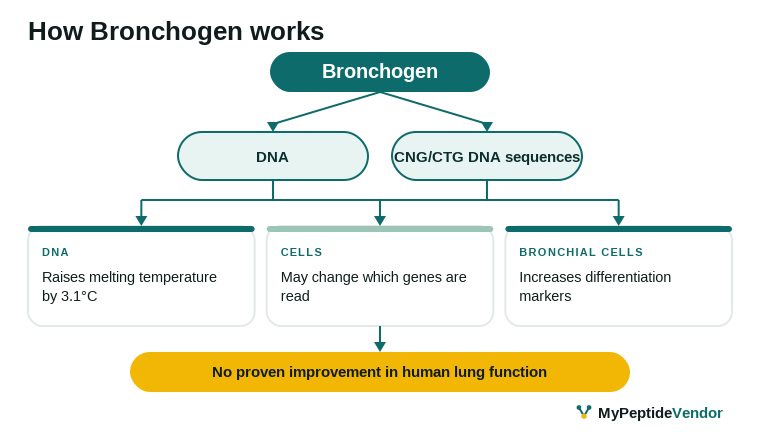
In a laboratory DNA-melting experiment, bronchogen raised the melting temperature of calf-thymus and mouse-liver DNA by 3.1°C, but only at a bronchogen-to-DNA base-pair molar ratio of 0.01–0.055 2. Put simply, within that narrow range, the DNA strands separated at a higher temperature. Adding more peptide did not raise the melting temperature further 2.
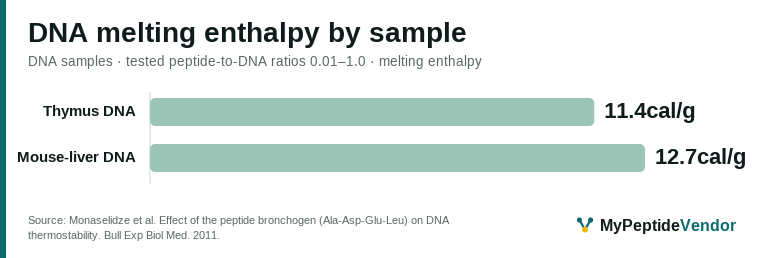
The melting enthalpy (the heat absorbed as DNA strands separate) did not change across the tested ratio range of 0.01–1.0 2. The reported enthalpy values were 11.4 cal/g for thymus DNA and 12.7 cal/g for mouse-liver DNA 2. These are measurements on DNA samples, not measurements of lung repair, breathing, or symptoms.
A separate binding study reported preferential interaction with short DNA sequences containing CNG, including sequences with methylated cytosine, and with CTG-containing sequences 6. Cytosine methylation is a chemical tag involved in gene regulation. This gives researchers an epigenetic hypothesis to test, but it does not show that bronchogen changes a specific human lung gene or improves a disease outcome 6.
In another experiment, fluorescently labeled short peptides appeared in the cytoplasm, nucleus, and nucleolus of HeLa cells 6. That observation does not prove that unmodified bronchogen reaches human lung-cell nuclei after a practical dose. Nor does it show that DNA interaction caused the tissue changes reported in separate rat studies 57.
How does it work?
In plain words, researchers are asking whether bronchogen can get near a cell’s DNA and influence which genes the cell reads. If that happens, the cell’s behavior might change. Laboratory findings suggest DNA binding and gene-expression effects, but they do not show a proven path from a dose in a person to better lung function 2346.
This idea differs from a familiar receptor mechanism. Many peptide medicines bind a receptor on a cell’s surface, like a key meeting a lock, and trigger a defined signal inside the cell. Bronchogen research instead describes DNA stabilization, sequence-related binding, and changes in gene expression 236. No cited study proves that this is the only mechanism or the cause of the rat findings 57.
In cultures of human embryonic bronchial cells, bronchogen was reported to increase expression of differentiation markers, with a stronger effect in aged cultures 4. A dish of cells does not reproduce a person’s airways, drug breakdown, immune system, or symptoms. This is evidence of a cell-level response, not proof that bronchogen restores an aging airway 4.
A separate gene-expression experiment used tobacco callus, not lung tissue. Bronchogen concentrations of 10⁻⁷ to 10⁻⁹ M affected CLE, KNOX1, and GRF gene-family expression and were associated with plant growth and leaf-development findings 3. Plant-cell results can suggest biological questions, but they do not predict a human lung response on their own.
Use this chart
Free to reuse with a link back:
What the clinical evidence actually shows

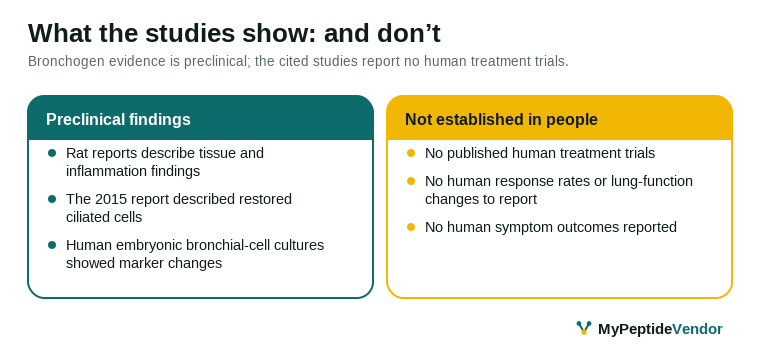
There are no published human treatment trials of bronchogen in the cited studies 2–8. There are therefore no human response rates, lung-function changes, COPD flare-up results, or patient side-effect percentages to report. The evidence is preclinical: DNA experiments, cell and tissue cultures, and rat studies.
The most relevant disease model used rats exposed intermittently to nitrogen dioxide for 60 days to produce obstructive lung pathology 57. The 2015 report describes one month of bronchogen treatment 5. The rat COPD reports do not state animal count, dose in mg/kg, or administration route 57. Without those details, readers cannot reconstruct the animal exposure or compare it with a possible human dose.
In the 2015 rat report, treatment was described as reversing goblet-cell hyperplasia, squamous metaplasia, lymphocytic infiltration, and emphysema, while restoring ciliated cells 5. Goblet cells make airway mucus, while ciliated cells help move material along the airway lining. These are tissue findings in an induced animal model, not evidence that people with COPD breathe better or have fewer exacerbations 5.
A 2017 report described lower neutrophilic inflammation and normalization of cell composition and inflammatory markers in bronchoalveolar lavage fluid, the liquid sampled from the lower airways 7. It also reported increases in secretory immunoglobulin A (sIgA), a local immune marker, and surfactant protein B (SP-B), which helps reduce surface tension in the air sacs 7. Neither report supplies human symptom or lung-function outcomes 57.
Other studies examine tissues and cells rather than COPD treatment. Rat organotypic explant cultures from young and aged animals showed a reported tissue-specific stimulating effect at 0.05 ng/ml 8. Human embryonic bronchial-cell cultures showed changes in differentiation-marker expression 4. Neither result shows that a person taking bronchogen would absorb it, deliver it to airway tissue, or benefit from it.
A culture concentration cannot be converted directly into a dose for a person. For example, 0.05 ng/ml describes the concentration around an explant in a laboratory setup, not an amount to swallow, inject, or inhale 8. A human dose estimate would require a defined route, absorption, distribution into lung tissue, breakdown and clearance, a target concentration, and a safety margin. These steps have not been established in the cited research 2–8.
The only registered study returned for bronchogen is ClinicalTrials.gov NCT00746759, titled “Airway Epithelium Gene Expression: AEGIS IDE,” and listed as completed 9. Its title concerns airway gene-expression measurement. The registry entry does not establish that bronchogen was administered, so it cannot be counted as a bronchogen treatment trial 9.
What remains unknown: whether bronchogen can reach human airway cells by a practical route, whether it changes human lung gene activity, whether such a change would improve symptoms, and what harms might appear with short- or long-term exposure. No cited human treatment study answers those questions 2–9.
The table separates the experimental models because their species, exposures, and outcomes cannot be combined as though they were one clinical program 2–9.
| Study | Model | Exposure or concentration | Reported result | Main limitation |
|---|---|---|---|---|
| Monaselidze et al., 2011 | Purified calf-thymus and mouse-liver DNA | Ratio 0.01–0.055 for the temperature change | DNA melting temperature rose 3.1°C | Physical DNA measurement, not a treatment outcome |
| Zakutskiĭ et al., 2006 | Young and aged rat organotypic tissue explants | 0.05 ng/ml | Reported stimulating effect in relevant tissue cultures | Culture concentration is not a human dose |
| Khavinson et al., 2012 | Human embryonic bronchial-cell culture | Concentration not stated | Differentiation-marker expression increased, especially in aged cultures | Cell markers do not establish patient benefit |
| Fedoreyeva et al., 2017 | Tobacco callus culture | 10⁻⁷–10⁻⁹ M | Gene-expression and plant-development effects were reported | Plant tissue is not human lung tissue |
| Kuzubova et al., 2015 | Rat nitrogen-dioxide obstructive-lung model | 60-day model exposure; one-month treatment | Airway structure, inflammation, and sIgA findings | Rat count, dose, route, and patient outcomes are not stated |
| Titova et al., 2017 | Rat nitrogen-dioxide obstructive-lung model | 60-day model exposure; treatment duration not stated | Inflammation, sIgA, and SP-B findings | Rat count, dose, route, and patient outcomes are not stated |
| NCT00746759 | Registered airway gene-expression study | Bronchogen dose not established | Listed as completed | Does not establish bronchogen administration |
No study gives a human treatment result or a human adverse-event rate 2–9.
Use this chart
Free to reuse with a link back:
Use this chart
Free to reuse with a link back:
Typical dosing

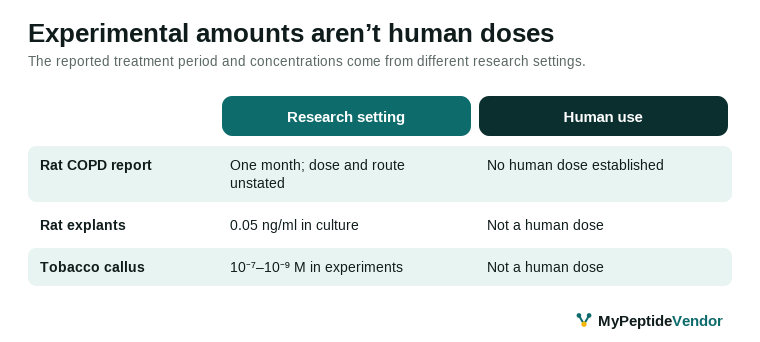
No human bronchogen dose, schedule, or route has been established in the cited research 2–9. The rat COPD report from 2015 describes a one-month treatment course, but the rat reports do not state a dose in mg/kg or administration route 57. That treatment period describes animal research; it is not a human dosing range.
Reported laboratory concentrations vary by model. Rat organotypic explants used 0.05 ng/ml, while tobacco callus experiments used 10⁻⁷–10⁻⁹ M 38. These numbers describe concentrations in different experimental settings, not amounts a person should take. The studies do not provide the absorption, clearance, lung exposure, or safety data needed to translate them into a human dose 38.
There is no published human trial from which to set an amount, frequency, or treatment length 2–9. Any schedule promoted outside these studies is not a human trial-tested regimen. A vial’s stated mass cannot answer the dose question without verified identity, a defined route, and clinical safety data.
Use this chart
Free to reuse with a link back:
Side effects: what to actually expect
No human safety study in the cited evidence provides a reliable side-effect rate for bronchogen 2–9. There is no percentage for headache, nausea, allergy, injection-site reaction, or any other event. An unreported rate does not mean the risk is zero; it means the rate has not been measured in a published human treatment trial 2–9.
The rat and cell papers focus on tissue, gene-expression, and inflammation outcomes rather than a complete adverse-event assessment 3–8. They do not give enough information to determine which harms were systematically monitored, how often they occurred, or whether delayed effects were assessed. Human safety, including the effects of repeated exposure, remains unknown 2–8.
For a vendor product, identity, purity, contamination controls, and dose accuracy affect what is in the vial, but the cited research does not verify any individual vendor’s product or certificate of analysis 2–8. Ask for a batch-specific certificate of analysis (COA) that identifies the tested sequence, analytical method, measured purity, and batch number. A COA only describes the batch and tests it actually covers.
Regulatory & access status in the US
Bronchogen is not established as an FDA-approved medicine or approved treatment for lung disease in the cited regulatory and research materials 1–9. The FDA describes Category 2 as a category for bulk drug substances nominated for compounding that may present significant safety risks 1. The FDA Category 2 table in 1 lists cesium, chloral hydrate, diethylstilbestrol, domperidone, and edetate disodium.
The FDA page therefore does not establish that bronchogen itself is in Category 2, and a Category 2 listing would not be an approval to use a substance as a medicine 1. No FDA-approved bronchogen product or established legal pathway to market it as an FDA-approved medicine is documented here 1–9. A product marked “research use only” is not thereby authorized for human treatment.
The completed AEGIS IDE registry entry is not evidence of FDA approval or bronchogen treatment: its title concerns airway gene-expression measurement, and the registry entry does not establish peptide administration 9. Research-only labeling does not demonstrate that a product has been evaluated for human use.
For a vendor product, request a batch-specific COA that states identity, the sequence tested, purity, the test method, and the batch number. The primary studies do not establish commercial-product purity standards, sterility, shelf life, or storage conditions 2–8. Follow documented laboratory handling instructions for a specific product; do not assume a storage temperature or expiry period from the peptide’s research history.
Research-grade Bronchogen is available from Certified-Pep. Sold for laboratory research only, not for human use. Affiliate link
How it compares to its closest alternative
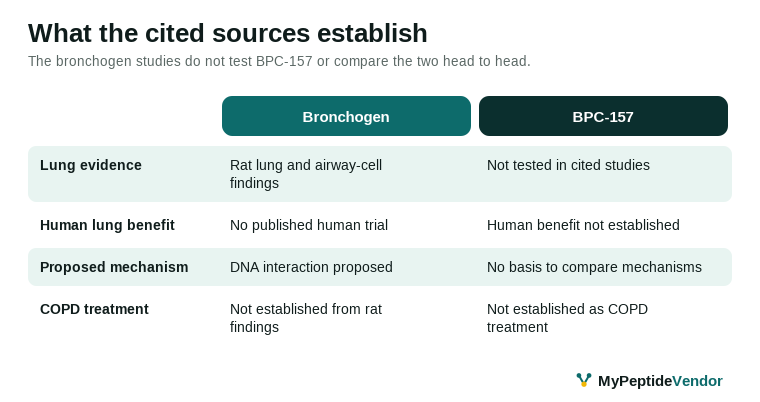
BPC-157 is a useful comparison because it is also discussed in connection with experimental tissue repair. None of the bronchogen studies 2–9 tests BPC-157, so they cannot establish a lung benefit for it. This comparison is about the evidence available in these primary sources, not a ranking of treatments 2–9.
The table compares what the bronchogen research can support with what it does not establish about BPC-157; the cited bronchogen studies contain no head-to-head trial 2–9.
| Question | Bronchogen | BPC-157 |
|---|---|---|
| What lung-related evidence is covered here? | Rat obstructive-lung findings and airway-cell research are reported. | The cited bronchogen studies do not test BPC-157. |
| Is human lung benefit established? | No published human bronchogen treatment trial is established by these studies. | The cited studies do not establish a human lung benefit for BPC-157. |
| What mechanism is proposed? | DNA interaction and gene-expression effects are proposed from laboratory research. | The bronchogen papers provide no basis for comparing mechanisms. |
| Can either be called the best COPD peptide? | No; rat findings do not establish a human COPD treatment. | No; these sources do not establish it as a COPD treatment. |
Bronchogen’s rat findings do not show that it is better than BPC-157, standard COPD care, or another treatment 57. There is no head-to-head comparison in the cited evidence, and animal findings cannot establish which option helps patients 2–9.
Use this chart
Free to reuse with a link back:
FAQ
These answers distinguish experimental findings from treatments shown to work in people 2–9.
Where to Buy Bronchogen for Research
Certified-Pep
US-made research peptides with batch-specific lab reports (COA) and a QR code on every vial.
- Independent laboratory testing (Vanguard Laboratory)
- Made in the USA, ships in 1-2 business days
- Research use only, not for human or veterinary use
Affiliate disclosure: we may earn a commission if you order through the link above. Bronchogen is not approved by the FDA for human use.
Frequently asked questions
What is bronchogen peptide used for?
Researchers have used it to study airway-cell differentiation, DNA interactions, and lung changes in rats 245. A proven human medical use has not been established in the cited studies 2–8.
What peptides repair lungs?
The cited research does not prove that any peptide repairs human lungs. Bronchogen has cell and rat-model findings, but those experiments do not demonstrate lung repair in patients 4578.
Does BPC-157 help the lungs?
The bronchogen studies do not test BPC-157, so they cannot establish whether it helps human lungs. Bronchogen’s rat findings are not evidence for BPC-157.
References
- FDA: Certain bulk drug substances for use in compounding that may present significant safety risks
- Monaselidze et al. Effect of the peptide bronchogen (Ala-Asp-Glu-Leu) on DNA thermostability. Bull Exp Biol Med. 2011.
- Fedoreyeva et al. Short Exogenous Peptides Regulate Expression of CLE, KNOX1, and GRF Family Genes in Nicotiana tabacum. Biochemistry (Mosc). 2017.
- Khavinson et al. Peptides tissue-specifically stimulate cell differentiation during their aging. Bull Exp Biol Med. 2012.
- Kuzubova et al. Modulating Effect of Peptide Therapy on the Morphofunctional State of Bronchial Epithelium in Rats with Obstructive Lung Pathology. Bull Exp Biol Med. 2015.
- Fedoreyeva et al. Penetration of short fluorescence-labeled peptides into the nucleus in HeLa cells and in vitro specific interaction of the peptides with deoxyribooligonucleotides and DNA. Biochemistry (Mosc). 2011.
- Titova et al. [ANTIINFLAMMATORY AND REGENERATIVE EFFECT OF PEPTIDE THERAPY IN THE MODEL OF OBSTRUCTIVE LUNG PATHOLOGY]. Ross Fiziol Zh Im I M Sechenova. 2017.
- Zakutskiĭ et al. [The tissue-specific effect of synthetic peptides-biologic regulators in organotypic tissues culture in young and old rats]. Adv Gerontol. 2006.
- ClinicalTrials.gov: 1 registered studies (search: Bronchogen)
Written by the MyPeptideVendor editorial team from the FDA label, peer-reviewed studies and ClinicalTrials.gov records listed above, fact-checked line by line and reviewed 2026-11-12.
Cite this page
MyPeptideVendor Editorial Team. Bronchogen: Evidence, Dosing & FDA Status. MyPeptideVendor. Updated November 12, 2026. https://mypeptidevendor.com/peptides/bronchogen/MyPeptideVendor Editorial Team. (2026, November 12). Bronchogen: Evidence, Dosing & FDA Status. MyPeptideVendor. https://mypeptidevendor.com/peptides/bronchogen/Related peptides
Argireline (Acetyl Hexapeptide-3)
Not approvedA small 4-week trial found wrinkle improvements, but lasting effects, ideal concentration, and Argireline-specific side-effect rates remain unknown.
Learn moreAHK-Cu
Not approvedAHK-Cu has early lab findings related to hair follicles, but human hair benefits, safe dosing, and side-effect rates are not established.
Learn moreAHK (Tripeptide-3)
Not establishedAHK-Cu is a copper tripeptide used as a cosmetic ingredient, but human hair-growth benefit and a proven scalp dose remain unestablished.
Learn more