fox04 Dri: Evidence, Safety & FDA Status
Experimental senolytic peptide
Brand names: No FDA-approved brand name is established.

FOXO4-DRI is an experimental peptide designed to disrupt a protein interaction that may help senescent cells survive. Research is preclinical: no human trial has established a dose, safety profile, or benefit for people 4.
It is not a supplement or an FDA-approved treatment. As of 2026, neither human use nor a human lifespan benefit has been established 46.
Key takeaways
- A 2026 review retained 89 publications; only 18 were directly FOXO4-specific 4.
- FOXO4-DRI is designed to disrupt FOXO4-p53 signaling and prompt apoptosis in some senescent cells, but human benefit has not been demonstrated 4.
- Animal research reports effects in aging and brain-disease models; those findings do not establish human treatment effects 56.
- No human trial establishes a FOXO4-DRI dose, duration, route, or side-effect rate 4.
- Fisetin has preliminary human findings, but no supplement has been shown to reliably clear senescent cells in people 6.
FOXO4-DRI at a glance
- Class
- Experimental senolytic peptide
- Mechanism
- Designed to disrupt the FOXO4-p53 interaction and promote apoptosis in senescent cells.
- FDA Status
- Not FDA-approved; no human clinical validation is reported.
- Brand names
- No FDA-approved brand name is established.
- Administration
- Experimental peptide; no human route has been validated.
- Typical Dose
- No established human dose or schedule.
- Half-life
- Human half-life has not been established.
- Primary Uses
- Research into senescent-cell biology; no established clinical indication.
What is it?

FOXO4-DRI is a laboratory-designed peptide studied as a senolytic: a substance intended to remove some senescent cells. These cells have stopped dividing but can remain active and release signals that affect nearby tissue. Senescent cells can contribute to inflammation and reduced tissue repair, including in aging kidneys 2.
The name's “DRI” means “D-retro-inverso.” It describes a peptide design using D-amino acids in reversed sequence order. The design aims to preserve a binding shape while making the peptide less vulnerable to some enzymes that break down peptides; this general design rationale does not establish how long FOXO4-DRI lasts in a person or what dose would be safe 6.
FOXO4-DRI is not a dietary supplement. FOXO4-DRI is an experimental research peptide, not a vitamin or food supplement with a proven human benefit, and no route of administration has been established in human studies 4. No human study has established a route or regimen for personal use 4.
“Senolytic” describes the intended research effect, not a guarantee that only harmful cells will die. Senescent cells also take part in normal processes such as wound healing, so their removal could affect useful tissue functions 5.
FOXO4 is one member of a larger protein family. A FOXO1 or FOXO3 result cannot automatically be treated as evidence that FOXO4-DRI works in the same way; the distinction matters because much of the FOXO literature is not specific to this peptide 4.
What makes it different
FOXO4-DRI is designed to interfere with a particular protein-to-protein interaction: FOXO4 binding to p53, a protein involved in the cell's response to damage. That target-focused design differs from small molecules that act on broader pathways, but a specific design does not prove that the peptide is more selective or safer in a whole person 4.
The D-retro-inverso structure is another distinction from an ordinary peptide sequence. It is intended to make the molecule more resistant to breakdown while retaining a shape that can bind its target. Human absorption, distribution, breakdown, and duration of action have not been established, so the design itself cannot provide a human dosing schedule 6.
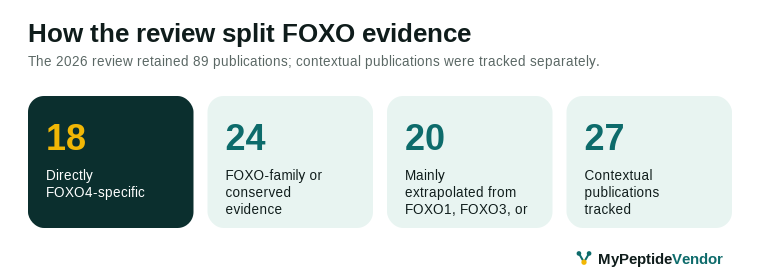
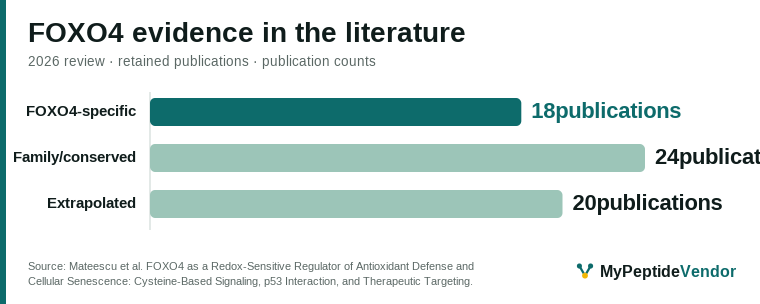
A 2026 review retained 89 publications: 18 were directly FOXO4-specific, 24 addressed FOXO-family or conserved evidence, and 20 were mainly extrapolated from FOXO1, FOXO3, or DAF-16. The 27 contextual publications were tracked separately from those 89 4.
That evidence split limits what can be said about FOXO4 itself. The same review found that direct FOXO4 evidence for several commonly cited antioxidant target genes remains insufficient, with much of that discussion inferred from FOXO3 or the broader FOXO family 4.
FOXO4-DRI is also distinct from a supplement marketed for general wellness. It is an experimental peptide studied for a specific cell-survival mechanism, and no human study establishes that it improves aging, cognition, or any disease 46.
Use this chart
Free to reuse with a link back:
How does it work?
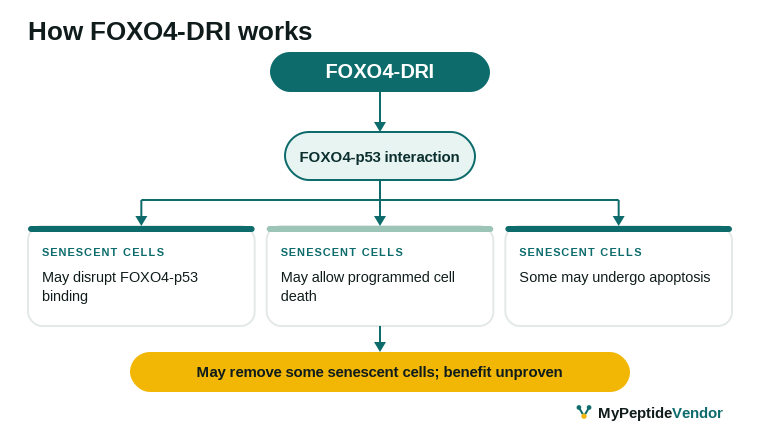
In plain words: Some damaged cells stop dividing but avoid the usual process of cell death. FOXO4-DRI is designed to interrupt a protein interaction that may help those cells stay alive. If the interaction is disrupted, the cell's own programmed-death process may start; the technical term is apoptosis 4.
FOXO4 is a transcription factor, a protein that helps regulate gene activity. P53 responds to cellular damage and can help trigger cell death. In the proposed senolytic mechanism, FOXO4 binds p53 and helps support the survival of senescent cells; FOXO4-DRI is designed to interfere with that interaction 4.
The selectivity idea is that some senescent cells may rely more heavily on FOXO4-p53 signaling for survival than healthy cells do. That is a proposed difference in dependence, not proof that the peptide spares every healthy cell in every organ. Selectivity in people has not been measured 4.
There is a practical reason to question selectivity. Senescence can have helpful as well as harmful roles, including a role in normal wound healing. The effects of causing many senescent cells to die in one tissue at once have not been established for people receiving FOXO4-DRI 5.
FOXO4 also has other biological roles. A 2026 review describes cysteine-based redox sensing, stress-related movement into and out of the cell nucleus, and interactions with coactivators as areas of FOXO4 research. It also says that parts of FOXO4's target-gene activity remain incompletely resolved 4.
This means the simple phrase “clears bad cells” leaves out important questions. Researchers would need to show which cells are affected, how many are removed, whether neighboring tissue is harmed, and whether the cell removal improves a meaningful health outcome. Those questions have not been answered in human FOXO4-DRI studies 45.
Use this chart
Free to reuse with a link back:
What the clinical evidence actually shows

There are no human clinical trials establishing a dose, safety profile, or clinical benefit for FOXO4-DRI. That means there are no human participant counts, treatment durations, response rates, or adverse-event percentages to report for this peptide 4. Cell and animal experiments are not clinical trials in people.
Baar et al. 2017: Mouse work on FOXO4-DRI, which targets senescent cells, is described in a 2018 review 5. The review describes cell-penetrating FOXO4-DRI as inducing apoptosis in senescent cells and reducing age-associated damage and dysfunction in experimental animals. It also discusses improved kidney function and performance in animal studies. The review information does not provide a participant-style sample size, a numerical treatment effect, or a human treatment duration 5.
Zhang et al. 2020 and Leydig cells: The available review evidence does not establish a human effect on testosterone, fertility, or symptoms of low testosterone 45.
Brain models: A 2026 review reports that FOXO4-DRI in aged mammalian models restored cerebral blood flow and blood-brain barrier integrity, reversed hippocampal atrophy, and improved cognitive function. In Alzheimer’s disease and tauopathy models, the review reports lower amyloid-beta and pathological tau alongside better memory performance 6. These are animal-model findings, not results from people treated for dementia.
Human evidence for related approaches: The 2026 review describes preliminary human findings involving high-dose fisetin, including changes in the senescence-associated secretory phenotype and cognitive or physical measures. Fisetin is not FOXO4-DRI, and those preliminary findings do not establish that FOXO4-DRI improves cognition, physical function, or lifespan 6.
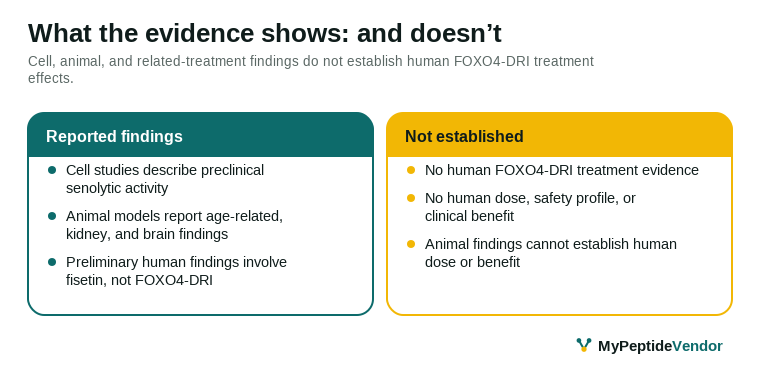
Evidence tiers: Cell studies can test a proposed mechanism in a controlled setting, but cannot show whole-body safety. Animal studies can test effects in a living organism, but cannot establish a safe human dose or clinical benefit. There is no human FOXO4-DRI treatment evidence 46.
The table separates what each evidence level can show from what it cannot establish; the review counts and findings above are reported in the cited literature 456.
| Evidence level | What has been reported | What it can and cannot establish |
|---|---|---|
| Cell and laboratory research | Preclinical senolytic activity is described in reviews. | Can examine a cell mechanism; cannot establish human safety, dose, or clinical benefit. |
| Mouse and other animal models | Age-related, kidney, and brain-model findings are discussed in research and reviews. | Can identify possible effects in animals; cannot show that people will have the same results. |
| Human FOXO4-DRI treatment | No clinical validation is reported. | Cannot establish human benefit, side-effect rates, or lifespan effects. |
| Human evidence for a related senolytic | Preliminary findings for high-dose fisetin are summarized in a review. | Does not establish that fisetin reliably clears senescent cells or that FOXO4-DRI works in people. |
The publication count helps put broad claims in perspective: only 18 of 89 retained publications were FOXO4-specific, while the rest of the counted evidence involved conserved FOXO-family topics or extrapolation from related proteins 4. Those other findings may guide research questions, but they do not demonstrate that FOXO4-DRI produces the same effect.
No evidence establishes that FOXO4-DRI extends healthy lifespan in people. Animal improvements in kidney or brain measures cannot answer whether a treatment lengthens human life or extends the years lived in good health 456.
A human trial would first need to establish how the peptide is absorbed and distributed, what dose reaches relevant tissue, and whether it engages the intended target. Later controlled studies would need prespecified clinical outcomes and follow-up long enough to assess both benefit and harm. Safety monitoring would need to examine tissue injury, repair, and the effects of cell death in tissues where senescence may serve useful functions 45.
For example, a trial would need to specify whether its main endpoint is a disease symptom, organ function, or a measurable change in senescent-cell activity. It would also need to track adverse events and compare outcomes with a control group; without those measures, a change in a laboratory marker alone would not establish clinical benefit 45.
Use this chart
Free to reuse with a link back:
Use this chart
Free to reuse with a link back:
Typical dosing

There is no typical human dose. No human trial or approved product establishes a FOXO4-DRI dose range, route, schedule, or treatment duration 4.
There is no label-based dose to report. An amount used in an animal experiment cannot be converted directly into a human regimen by adjusting for body weight; human exposure and response have not been established 4.
Online personal-use schedules, including staged microgram schedules, are not clinical dosing evidence. No human trial has validated a “dosing ladder,” injection route, or duration for FOXO4-DRI 4.
Because no regimen has been validated, there is no evidence-based injection instruction or reconstitution guide to give. A research-use label does not establish the identity, strength, sterility, or suitability of an injectable product for use in a person 14.
For a clinician, the absence of a known dose is not a small gap that can be solved by choosing a low amount. Dose-finding research would first need to measure exposure and safety; the reviewed literature does not establish either for human FOXO4-DRI 4.
Side effects: what to actually expect
No human side-effect percentage is available. There is no human FOXO4-DRI trial or approved label reporting how often people experience an adverse effect, and no human safety profile has been established 4. An unreported rate does not mean the risk is zero.
Cell and animal findings cannot provide a reliable list of symptoms to expect after a person uses the peptide. They also do not show how risk changes with dose, how long an adverse effect might last, or how often a serious effect could occur in people 4.
The central biological concern is selectivity. Senescent cells can contribute to normal wound healing, while FOXO4-DRI is intended to trigger cell death in at least some senescent cells. The balance between removing harmful cells and affecting useful tissue functions has not been established in humans 5.
Small-molecule senolytics have dose-limiting side effects in experimental settings, and a review discusses targeted delivery as a possible need for successful application in some settings. That concern supports careful testing; it does not predict a specific side effect or rate for FOXO4-DRI 5.
What happens when many senescent cells die in the same tissue remains an open question for this peptide. Local inflammation, effects on tissue repair, and changes in organ function need to be measured rather than assumed, because human safety studies have not answered those questions 45.
There is also no established interaction list for FOXO4-DRI. A clinician cannot rely on an approved prescribing label to check interactions, contraindications, or monitoring requirements because no approved product label exists 4.
Regulatory & access status in the US (as of 2026)
As of 2026, FOXO4-DRI is not FDA-approved, and human clinical validation has not been reported 4. There is no established approved indication, prescribing information, or FDA-approved FOXO4-DRI product.
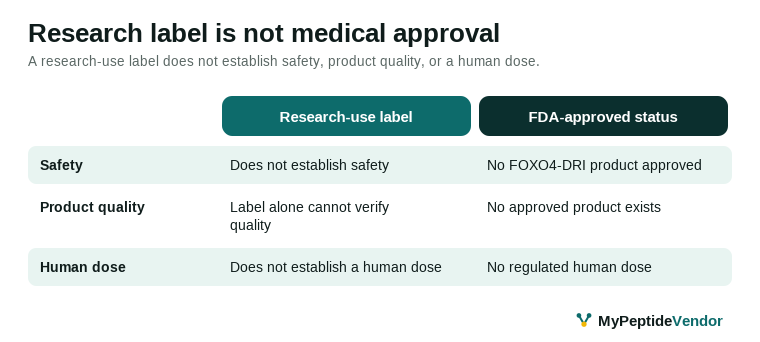
“Research use only” is a product label, not evidence that a substance is safe for human use. It also does not establish that the material is correctly identified, accurately measured, sterile, or made under the controls expected for an approved medicine. A product being offered online does not create an FDA-approved dose or treatment standard 4.
FDA describes a Category 2 framework for certain bulk drug substances nominated for compounding when potential significant safety risks have been identified. That framework concerns substances considered through FDA’s compounding process; it is not an approval pathway, and it does not itself establish that FOXO4-DRI is approved or cleared for compounding 1.
Buying a research-labeled injectable product for personal use carries quality uncertainties. A purchaser may not be able to verify identity, strength, sterility, contaminants, or storage history from the label alone. No approved product supplies a regulated human dose for FOXO4-DRI 14.
The difference between laboratory access and medical access matters. A product sold for research is not thereby a medicine with established human quality, dosing, or safety controls, and there is no approved treatment indication for FOXO4-DRI 14.
Use this chart
Free to reuse with a link back:
How it compares to its closest alternative
FOXO4-DRI, dasatinib plus quercetin, and fisetin are discussed in the broader senolytic field, but they are not interchangeable treatments. The comparison below separates peptide research from small-molecule approaches and distinguishes animal evidence from preliminary human findings 456.
| Option | Delivery and evidence | Known safety limits | US status and practical meaning |
|---|---|---|---|
| FOXO4-DRI | Experimental peptide studied preclinically; no human route, dose, or schedule is established. | Human side-effect rates and selectivity are unknown; senescent cells can have useful roles in wound healing. | Not FDA-approved and not clinically validated for human treatment. |
| Reviews note dose-limiting effects with small-molecule senolytics and discuss targeted delivery as a possible need. | Not established here as an approved treatment for clearing senescent cells in people. | ||
| Fisetin | A different senescence-targeting substance; a 2026 review summarizes preliminary human findings involving high-dose fisetin. | Preliminary findings do not establish a reliable rate of senescent-cell clearance or a validated senolytic dose. | Human findings remain preliminary and do not establish a proven senolytic treatment. |
This comparison does not identify a “best” senolytic. FOXO4-DRI lacks human clinical validation, fisetin findings are preliminary, and reviews describe safety limits for small-molecule senolytics 456.
No supplement has been shown to reliably clear senescent cells in people 6. Fisetin has preliminary human findings, but those findings do not establish a dependable senolytic effect or dose 6.
Before discussing any senolytic with a clinician, ask what evidence applies to your condition and whether the proposed product has human trial data. Ask how its identity and quality are verified, what interactions it may have with your current medicines, what benefit will be measured, and what safety checks would prompt stopping treatment. Those questions matter because FOXO4-DRI has no established human dose or adverse-event rate 4.
- Ask whether the evidence is from cells, animals, or people; each level answers a different question 46.
- Ask how the product’s identity, strength, sterility, and storage are checked before any injectable use 1.
- Ask about interactions with current medicines and what clinical endpoint would count as benefit; no FOXO4-DRI endpoint has been validated in people 4.
- Ask what monitoring would detect harm to tissue repair, since senescent cells can have useful roles in wound healing 5.
Frequently asked questions
What does FOXO4-DRI do?
It is designed to interrupt a FOXO4-p53 interaction that may help some senescent cells survive, potentially allowing those cells to undergo programmed cell death. Cell and animal research reports possible effects, but no human trial has shown that it treats disease or improves health in people 46.
What is the best supplement to get rid of senescent cells?
There is no validated supplement shown to reliably clear senescent cells in people. Fisetin has preliminary human findings, but they do not establish a proven senolytic effect or a dependable dose 6.
Is FOXO4-DRI a supplement?
No. It is an experimental peptide, not a dietary supplement with an established human benefit. No human regimen or approved product has been established 4.
References
- FDA: Certain bulk drug substances for use in compounding that may present significant safety risks
- van Willigenburg et al. Cellular senescence as a therapeutic target to improve renal transplantation outcome. Pharmacol Res. 2018.
- Liu et al. [Molecular regulative mechanisms of aging and interventional effects of Chinese herbal medicine]. Zhongguo Zhong Yao Za Zhi. 2017.
- Mateescu et al. FOXO4 as a Redox-Sensitive Regulator of Antioxidant Defense and Cellular Senescence: Cysteine-Based Signaling, p53 Interaction, and Therapeutic Targeting. Antioxidants (Basel). 2026.
- Valentijn et al. Cellular senescence in the aging and diseased kidney. J Cell Commun Signal. 2018.
- Alameen et al. Targeting the FOXO4-p53 axis by retro-inverso peptide senolytic agents: a pharmacological strategy to mitigate brain aging and cognitive decline. Naunyn Schmiedebergs Arch Pharmacol. 2026.
Written by the MyPeptideVendor editorial team from the FDA label, peer-reviewed studies and ClinicalTrials.gov records listed above, fact-checked line by line and reviewed 2026-11-12.
Cite this page
MyPeptideVendor Editorial Team. fox04 dri: Evidence, Safety & FDA Status. MyPeptideVendor. Updated November 12, 2026. https://mypeptidevendor.com/peptides/fox04-dri/MyPeptideVendor Editorial Team. (2026, November 12). fox04 dri: Evidence, Safety & FDA Status. MyPeptideVendor. https://mypeptidevendor.com/peptides/fox04-dri/Related peptides
Argireline (Acetyl Hexapeptide-3)
Not approvedA small 4-week trial found wrinkle improvements, but lasting effects, ideal concentration, and Argireline-specific side-effect rates remain unknown.
Learn moreAHK-Cu
Not approvedAHK-Cu has early lab findings related to hair follicles, but human hair benefits, safe dosing, and side-effect rates are not established.
Learn moreAHK (Tripeptide-3)
Not establishedAHK-Cu is a copper tripeptide used as a cosmetic ingredient, but human hair-growth benefit and a proven scalp dose remain unestablished.
Learn more