Chonluten Dosage 20mg: Protocol & Safety
No human Chonluten dose or titration schedule is established; the cited research tested cells, not people.
Quickstart highlights for a 20 mg vial
There is no established human chonluten dosage 20mg protocol. A 20 mg vial states the amount in the container; it does not show what dose is safe or effective for a person.
The 2022 study tested Chonluten in cultured THP-1 cells, not in people receiving injections 2. It does not establish a human dose, injection schedule, cycle length, side-effect rate, or mixed-vial storage period.
- Human dose: Not established. The cited publication is a laboratory cell study, not a dose-finding trial in people 2.
- Titration: No evidence-based week-by-week increase can be recommended from that study 2.
- Research finding: Avolio et al. tested Chonluten in THP-1 cells exposed to bacterial LPS; the cell experiment reported reduced TNF and IL-6 2.
- Vial math: A U-100 syringe has 100 units per mL. Dilution changes the concentration, but does not establish a human dose.
- Key unknowns: Human benefit, safety, injection method, and stability after reconstitution have not been established by the cited study 2.
Do not turn dose schedules shared online into personal treatment instructions. The cell concentration used in this setup describes a laboratory condition, not an amount to inject, and no concentration usable as a human dose is reported 2.
Key takeaways
- No approved human dose or titration schedule is established; the cited 2022 study reports cell-culture results 2.
- The study tested Chonluten in THP-1 cells with inflammatory stimulation; these cell-culture conditions are not a human injection dose 2.
- A 20 mg vial can be diluted to different concentrations; the listed U-100 math is for arithmetic, not a dosing recommendation.
- No human side-effect frequency or validated storage period after mixing is established by the cited cell study 2.
- FDA's bulk-substance page describes a category-based review; check its current listing for the exact substance rather than assuming approval or compounding eligibility 1.
Dosing schedule
Chonluten has no FDA-approved human dosing label or established human titration schedule; the cited 2022 study reports only cell-culture results 2. The cited study reports no human dose-finding results 2.
For arithmetic only, adding 1 mL to a 20 mg vial gives 20 mg/mL, 2 mL gives 10 mg/mL, and 2.5 mL gives 8 mg/mL. At these concentrations, one U-100 unit (0.01 mL) contains 200 mcg, 100 mcg, and 80 mcg, respectively.
| Week | Dose (mg) | Dose (mcg) | U-100 units | Frequency |
|---|---|---|---|---|
| Week 1 | Not established | Not established | Not calculable | No human schedule established |
| Week 2 | Not established | Not established | Not calculable | No human schedule established |
| Weeks 3–4 | Not established | Not established | Not calculable | No human schedule established |
| Weeks 5–8 | Not established | Not established | Not calculable | No human schedule established |
A U-100 syringe marks 100 units per mL. If a licensed pharmacist reviews a specific product, use its verified concentration and written instructions; a calculation cannot confirm identity, sterility, stability, or a safe dose.
Reconstitution calculator, for math only: “Doses per vial” is arithmetic at 100 mcg per dose, not a recommended dose or schedule.
| Diluent volume | Concentration | Units per 100 mcg | 100 mcg amounts per vial |
|---|---|---|---|
| 1 mL | 20 mg/mL | 0.5 | 200 |
| 2 mL | 10 mg/mL | 1.0 | 200 |
| 2.5 mL | 8 mg/mL | 1.25 | 200 |
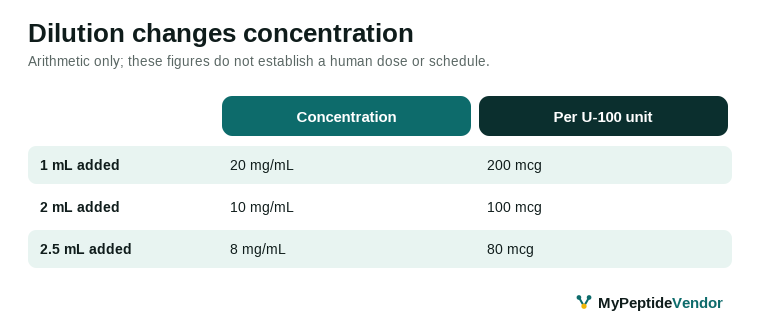
Use this chart
Free to reuse with a link back:
Syringe Unit Conversion Table
Units to draw on a U-100 insulin syringe (100 units = 1 mL) from a 20 mg vial. Find your dose, then read the column for the water you added. Every number is calculated, not estimated.
| Dose | 1 mL water 20 mg/mL · 1 unit = 200 mcg | 2 mL water 10 mg/mL · 1 unit = 100 mcg | 2.5 mL water 8 mg/mL · 1 unit = 80 mcg |
|---|---|---|---|
| 50 mcg | 0.25 · 400 doses | 0.5 · 400 doses | 0.62 · 400 doses |
| 100 mcg | 0.5 · 200 doses | 1 · 200 doses | 1.25 · 200 doses |
| 200 mcg | 1 · 100 doses | 2 · 100 doses | 2.5 · 100 doses |
| 250 mcg | 1.25 · 80 doses | 2.5 · 80 doses | 3.12 · 80 doses |
| 300 mcg | 1.5 · 66 doses | 3 · 66 doses | 3.75 · 66 doses |
| 500 mcg | 2.5 · 40 doses | 5 · 40 doses | 6.25 · 40 doses |
| 750 mcg | 3.75 · 26 doses | 7.5 · 26 doses | 9.38 · 26 doses |
| 1 mg | 5 · 20 doses | 10 · 20 doses | 12.5 · 20 doses |
| 1.5 mg | 7.5 · 13 doses | 15 · 13 doses | 18.75 · 13 doses |
| 1.7 mg | 8.5 · 11 doses | 17 · 11 doses | 21.25 · 11 doses |
| 2 mg | 10 · 10 doses | 20 · 10 doses | 25 · 10 doses |
| 2.4 mg | 12 · 8 doses | 24 · 8 doses | 30 · 8 doses |
| 2.5 mg | 12.5 · 8 doses | 25 · 8 doses | 31.25 · 8 doses |
| 3 mg | 15 · 6 doses | 30 · 6 doses | 37.5 · 6 doses |
| 4 mg | 20 · 5 doses | 40 · 5 doses | 50 · 5 doses |
| 5 mg | 25 · 4 doses | 50 · 4 doses | 62.5 · 4 doses |
| 7.5 mg | 37.5 · 2 doses | 75 · 2 doses | 93.75 · 2 doses |
| 10 mg | 50 · 2 doses | 100 · 2 doses | over 100 |
| 12.5 mg | 62.5 · 1 doses | over 100 | over 100 |
| 15 mg | 75 · 1 doses | over 100 | over 100 |
Chonluten 20 mg Vial Dosage Calculator
Shows the exact insulin-syringe units to draw. Pre-loaded with the 20 mg vial; change any value to match yours.
Total volume of your syringe?
How much mg is in the vial?
How much bacteriostatic water are you adding?
Dose per injection?
Educational tool only. Concentration = vial ÷ water; units = dose ÷ concentration × 100 (U-100 syringe). Confirm every dose with your prescriber. Different vial or peptide? Use the peptide calculator.
Reconstitution steps
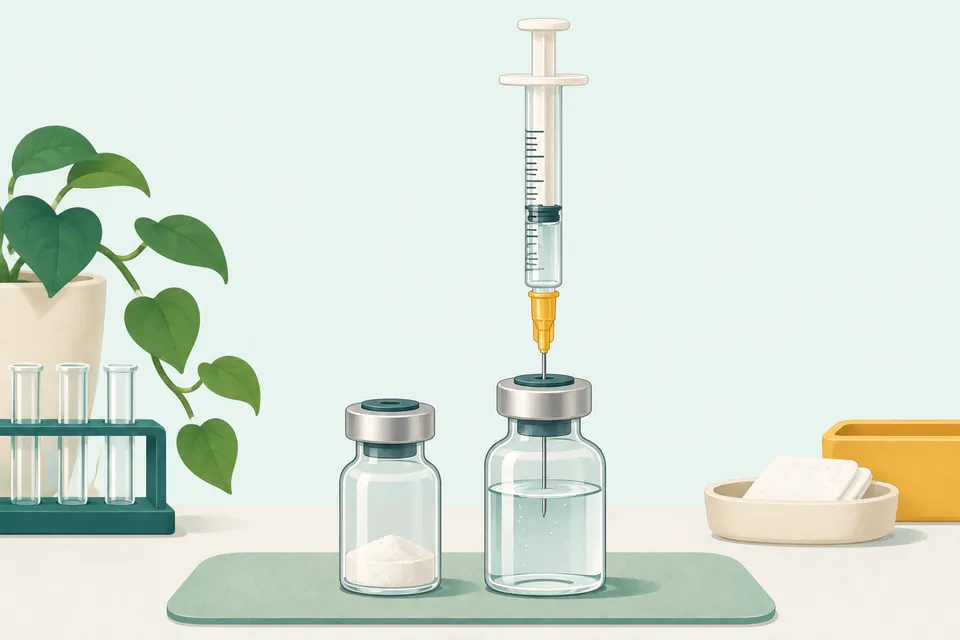
No human-use mixing method or post-mixing stability period is established by the cited cell study 2. These steps are checks before handling, not instructions to prepare Chonluten for injection.
- Keep the vial unopened while confirming its intended use. A 20 mg amount on a label does not establish that the contents are sterile or suitable for human injection.
- Check the label and certificate of analysis (COA) for the compound name, stated amount, lot number, purity information, and storage directions. Ask a pharmacist about missing or conflicting details.
- Request product-specific, validated preparation and stability instructions from a licensed pharmacist or manufacturer. Do not choose a diluent volume from a generic chart.
- If the vial is already mixed, do not guess how long it remains usable. Obtain written instructions for that exact product and its preparation date.
Different liquid volumes produce different concentrations, as the calculator shows. That arithmetic does not prove a preparation is sterile or safe, and the THP-1 study did not test vial preparation 2.
Supplies needed
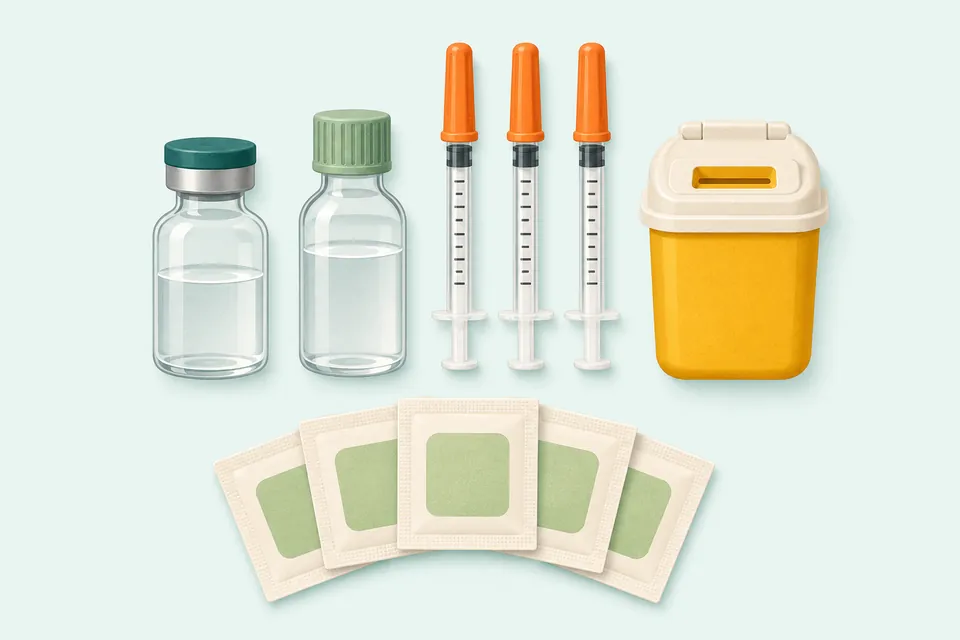
A safe supply quantity for a full vial cannot be set because no human dose or validated preparation method is established 2. For product review, keep 1 vial and its packaging together. No quantity of bacteriostatic water, U-100 syringes, or injection swabs is recommended for self-injection.
- Vial: Keep the 1 vial unopened until its identity and intended use are verified.
- Bacteriostatic water: No volume is specified; a product-specific diluent and preparation method have not been established by the cited study 2.
- U-100 syringes: No self-injection quantity is recommended. Their unit markings only measure volume.
- Alcohol swabs: No injection supply count is recommended because this page does not provide a human injection protocol.
- Documents: Request the COA and written storage and handling instructions for the lot.
FDA's bulk-substance page describes category 2 review for certain nominated substances and potential safety concerns 1. Check the current FDA listing for the exact substance and ask a pharmacist about applicable rules; online availability does not establish approval or compounding eligibility.
Protocol overview & cycle notes

The 2022 study examined five peptides in THP-1 cells, a human monocytic cell line used in laboratory research 2. Chonluten reduced TNF production in monocytes exposed to LPS, and the study reported reduced LPS-stimulated TNF and IL-6 expression in differentiated cells 2. These are cell responses, not proof of a treatment effect in people.
The study does not establish a human dose, respiratory indication, injection route, treatment duration, or repeat-cycle interval 2. No off-cycle period can be set from cell results. Do not delay prescribed care or replace respiratory treatment with an investigational peptide.
Evidence tiers: The cited primary evidence is in vitro, meaning it comes from a laboratory cell model 2. That publication does not report animal dosing or human clinical outcomes 2. Human benefit and human safety are therefore not established by this study.
Regulatory check: FDA's page explains category 2 review under interim policies for certain nominated bulk drug substances 1. That page is not a blanket approval or compounding permission. Check the current listing for the exact substance, then ask a pharmacist about what its status means for a specific product.
Identity check: The research identifies Chonluten as a tripeptide 2, but that does not verify the sequence or purity of a vial. Compare the claimed identity and lot information on the COA with the product label; a shared name alone does not confirm two products are the same.
Evidence-reading tip: Russian bioregulator reports should be assessed by their methods, comparison groups, measured outcomes, and independent replication, not by language alone. A cell result such as reduced TNF or IL-6 cannot establish a clinical outcome 2.
Pre-use checklist: Verify the label and COA, check the current FDA listing, confirm written storage directions for the lot, and ask a pharmacist whether validated preparation guidance exists. If any of these details are missing, do not guess at a dose or storage period.
Storage & handling
The cited study does not establish a storage temperature for a lyophilized vial or a validated use period after reconstitution 2. Do not assume freezing, refrigeration, or a commonly repeated discard date is correct for every product.
Keep the vial in its original packaging while seeking product-specific written instructions. If the label or COA lacks storage details, or the storage history is unclear, ask a pharmacist before use. A clear-looking solution cannot confirm sterility, potency, or stability.
No universal refrigerated shelf life is established by the cited study 2. A 28-day claim should not be treated as validated without product-specific stability data. Record the date a vial was prepared only if a qualified professional has directed its preparation, and follow the written discard instructions for that product.
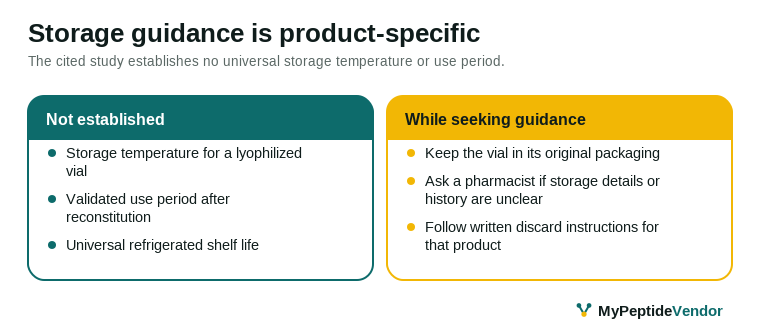
Use this chart
Free to reuse with a link back:
Injection & tracking tips
Do not inject Chonluten using a schedule inferred from cell research. The cited study did not test an injection technique, injection site, or human route 2. Clean technique cannot make an unverified product or dose safe.
If you discuss the research with a clinician, record the product name, lot, COA details, storage history, and any symptoms or treatments under review. Ask the clinician which breathing measures fit your condition; the THP-1 study does not validate a breathing test, walking test, or symptom score as a measure of response to Chonluten 2.
If you have already used a product and develop trouble breathing, swelling of the face or throat, fainting, or another severe reaction, seek emergency care. Keep the vial label available so the clinician can identify what may have been used.
Safety & side effects
Human side-effect frequencies, interactions, and long-term safety are not established by the cited cell study 2. The study measured cellular responses; it did not count adverse events in people 2. No reliable percentage can be given for nausea, allergy, injection reactions, or other human effects from this evidence.
Reduced TNF and IL-6 in LPS-exposed cells do not prove that Chonluten treats inflammation or lung disease in people 2. Those results also cannot predict the risk from a vial with uncertain identity, purity, sterility, or storage.
Do not substitute Chonluten for prescribed respiratory treatment or postpone care while considering an unapproved peptide. Ask a licensed clinician or pharmacist about any investigational product, especially if you take prescription medicines or have a chronic condition; the cited cell study does not establish human safety 2.
Frequently asked questions
What is a typical Chonluten dose for a 20 mg vial?
No typical human dose is established. The available cited study used cultured cells, so its laboratory concentration cannot be converted into a dose for a person 2.
How much bacteriostatic water should I add to a Chonluten vial?
No human-use reconstitution volume is validated by the cited study 2. Ask a licensed pharmacist to review the exact product and its written preparation instructions before handling it.
How should Chonluten be stored after mixing?
The cell study gives no validated mixed-vial temperature or use period 2. Request product-specific stability instructions instead of assuming a standard refrigerator period.
What side effects does Chonluten cause?
Human side-effect rates are not established; the cited research measured cell responses rather than reactions in people 2. Seek emergency care for a severe reaction after any exposure.
References
- FDA: Certain bulk drug substances for use in compounding that may present significant safety risks
- Avolio et al. Peptides Regulating Proliferative Activity and Inflammatory Pathways in the Monocyte/Macrophage THP-1 Cell Line. Int J Mol Sci. 2022.
Written by the MyPeptideVendor editorial team from the FDA label, peer-reviewed studies and ClinicalTrials.gov records listed above, fact-checked line by line and reviewed 2026-11-12.
Cite this page
MyPeptideVendor Editorial Team. chonluten dosage 20mg: Protocol & Safety. MyPeptideVendor. Updated November 12, 2026. https://mypeptidevendor.com/protocols/chonluten-dosing-20mg/MyPeptideVendor Editorial Team. (2026, November 12). chonluten dosage 20mg: Protocol & Safety. MyPeptideVendor. https://mypeptidevendor.com/protocols/chonluten-dosing-20mg/Related protocols
Cardiogen 20 mg
Research UseNo approved human dose or validated cycle exists for Cardiogen peptide; its published findings are preclinical, not a dosing protocol.
View protocolCortagen 20 mg
Research UseCortagen has no established human dose; this guide explains 20 mg vial math and the limits of the animal and laboratory evidence.
View protocolCrystagen 20 mg
Research UseNo approved human dose or validated vial instructions are established; the 20 mg label states vial content, not a treatment schedule.
View protocol