Healing Peptides: Evidence, Safety & Recovery
Healing peptides have promising animal findings, but human evidence is too limited to confirm they speed tissue repair or establish safe doses.
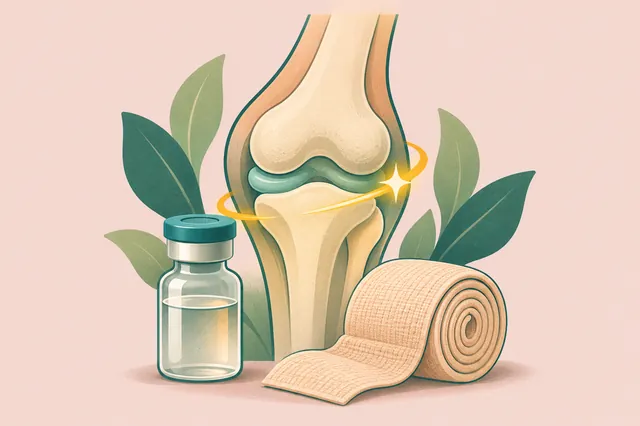
Healing peptides are compounds promoted to repair tendons, ligaments, muscles, and other tissues, but human research has not established them as reliable treatments for these injuries. BPC-157 has animal findings and one limited human knee-pain report; TB-500 has preclinical findings but no human orthopaedic data 23.
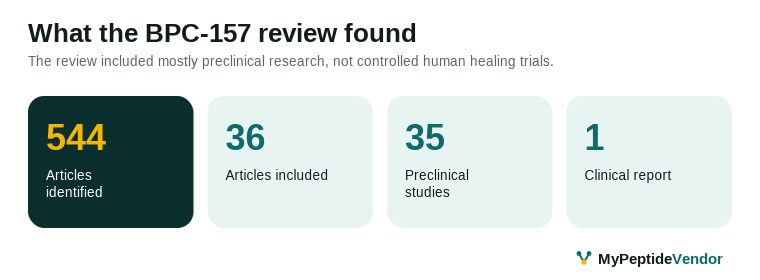
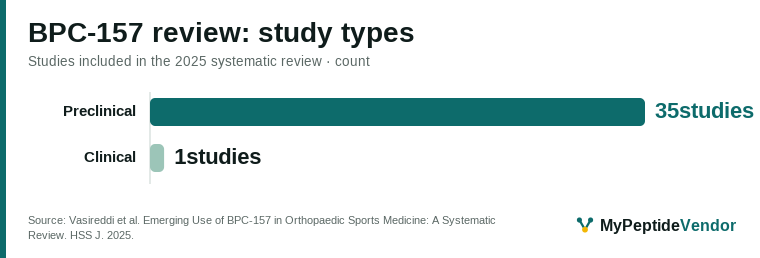
A 2025 systematic review identified 544 BPC-157 articles and included 36: 35 preclinical studies and just 1 clinical study 2. Animal findings showing improved biomechanical outcomes 2 do not establish shorter rehabilitation or better patient outcomes in people.
Key takeaways
- A BPC-157 review included 36 studies, with 35 preclinical studies and 1 clinical study 2.
- In the BPC-157 knee-pain case series, 7 of 12 people reported relief lasting more than 6 months; there was no control group 23.
- ClinicalTrials.gov lists a Phase 1 BPC-157 study after rotator cuff repair as not yet recruiting 12.
- Tesamorelin is approved for HIV-associated lipodystrophy, not tissue repair 3.
- No validated human dose or recovery timeline has been established for BPC-157 or TB-500 3.
Peptides for tissue repair & recovery
B7-33
Research UseB7-33 activates RXFP1 and has preclinical heart and fibrosis findings, but no established human dose, human trial results, or known human safety profile.
Learn moreBPC-157 + TB-500 Blend
Research UseA blend of BPC-157 and TB-500 has no established human dose or proven benefit for injury healing; key safety and stability questions remain unanswered.
Learn moreKPV
Research UseKPV is an experimental α-MSH tripeptide with laboratory and animal findings, no established human dose, and no proven human treatment benefit.
Learn morePE-22-28
Research UsePE 22-28 is a spadin-derived research peptide with cell and mouse findings, but no established human benefit, dose, or safety profile.
Learn moreTB-500 Fragment 17-23
Research UseTB-500 fragment 17-23 is Ac-LKKTETQ, but human dosing, safety, and healing effects have not been established.
Learn moreBPC-157
Not approvedBPC-157 is a 15-amino-acid peptide with mostly animal evidence and one small, uncontrolled human case series.
Learn moreKLOW Blend
Not establishedKLOW combines GHK-Cu, BPC-157, TB-500, and KPV; its proposed uses outpace the human evidence available for the blend.
Learn moreWhat peptide therapy for tissue repair means
Peptide therapy for tissue repair means using a short chain of amino acids in hopes of changing a signal involved in healing. Peptides are not one uniform treatment class: each has a different structure, biological target, evidence base, and regulatory status. An animal result for one peptide does not establish a benefit for another.
Some peptide medicines have FDA-approved uses for specific conditions. Tesamorelin, for example, is approved for HIV-associated lipodystrophy, but that approval does not extend to tendon, ligament, or muscle injuries 3. BPC-157 and TB-500 are promoted for recovery without established FDA-approved tissue-repair indications 234.
“Promoted for healing” is not the same as “shown to heal.” The human BPC-157 report involved knee pain, while the wider claims about tendon, ligament, and muscle repair come mainly from preclinical research 23. For someone with an injury, the central question is whether a peptide improves healing beyond time, rehabilitation, and other care.
How healing peptides may work
Tissue repair involves blood supply, movement of repair cells, rebuilding of tissue, and control of inflammation. Researchers have proposed that BPC-157 affects blood-vessel growth and cell-growth signals, while also reducing inflammatory cytokines 2. These findings come mainly from preclinical work; they do not prove that BPC-157 improves recovery in people.
Thymosin beta-4 binds actin, a protein involved in cell structure and movement 710. TB-500 is a thymosin beta-4-related product; animal research suggests repair-related activity, but human orthopaedic data are lacking 34. A possible mechanism is a reason to study a treatment, not proof of a clinical effect.
Pain relief and tissue repair are different outcomes. Someone may feel less pain without a tendon or ligament healing faster, and pain may improve naturally over time. The BPC-157 knee report assessed pain relief; it did not establish that the peptide repaired a specific joint structure 23.
Main peptides used for tissue repair
BPC-157: This gastric peptide has been studied in animal models of tendon, ligament, muscle, bone, and skin injury 2568. A retrospective knee-pain case series reported that 7 of 12 patients had relief lasting more than 6 months 2. The report had no control group and notable methodological flaws 3.
TB-500 and thymosin beta-4: TB-500 is marketed as a thymosin beta-4-related fragment. Thymosin beta-4 binds actin, which has a role in cell movement, and animal models suggest repair-related effects 3710. The best evidence for orthopaedic healing remains preclinical; human orthopaedic data and a validated human dose are lacking 3.
GHK-Cu: This copper-binding peptide has reported wound-healing and anti-inflammatory effects, but clinical data do not support its use for musculoskeletal conditions 3. The best evidence for this goal is preclinical, not a human trial showing repair of a tendon, ligament, or muscle injury.
CJC-1295 with ipamorelin: These peptides are marketed around growth-hormone signaling. In a mouse model of glucocorticoid-related muscle loss, the combination improved maximum tetanic tension, a measure of muscle force 3. That result does not establish faster rehabilitation or a safe treatment dose in people.
Tesamorelin: This is an FDA-approved medicine for HIV-associated lipodystrophy, not orthopaedic healing 3. That separate indication is the strongest regulatory evidence among the peptides in this section, but it is not evidence that tesamorelin repairs a sports injury.
BPC-157 plus TB-500: No human combination trial of BPC-157 plus TB-500 has been reported; combined use is unstudied 3. It is unknown whether combining them would work better than either alone, or better than standard injury care.
How strong is the evidence?

The evidence ladder runs from animal studies to one uncontrolled human knee-pain case series and one registered Phase 1 study that has not yet begun recruiting 2312. No randomized human trial result establishes that BPC-157 or TB-500 speeds musculoskeletal healing 23.
For BPC-157, researchers identified 544 articles and included 36; 35 were preclinical and 1 was clinical 2. The clinical report was a retrospective case series involving knee pain, not a controlled test of tendon or ligament healing 23. Because there was no comparison group, improvement could reflect expectation, the usual course of symptoms, or other factors.
ClinicalTrials.gov lists NCT07803250, a Phase 1 study of BPC-157 and recovery after rotator cuff repair. Its status is “not yet recruiting,” so it has no reported result to guide treatment 12. A trial registration means a study is planned; it does not show that a treatment works.
For TB-500, orthopaedic reviews describe preclinical evidence but no human orthopaedic data 3. GHK-Cu and growth-hormone-related combinations also lack evidence establishing a human musculoskeletal benefit 3. Animal findings justify further study, but they cannot predict an individual’s recovery time.
Use this chart
Free to reuse with a link back:
Use this chart
Free to reuse with a link back:
FDA-approved, compounded, and research-only

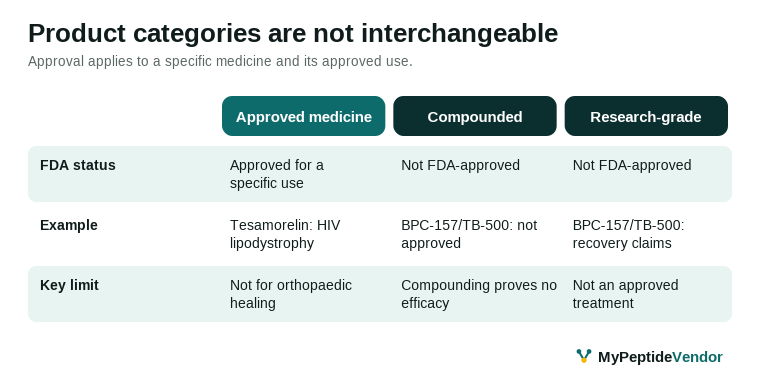
FDA approval applies to a specific medicine and its approved use; it does not transfer to a different peptide or condition. BPC-157 lacks FDA approval, and reviews describe TB-500 as unapproved 234. FDA’s Category 2 designation identifies certain nominated bulk substances that may present significant safety risks; it is not an approval or proof of effectiveness 1.
| Category | What it means | Examples and tissue-repair status |
|---|---|---|
| FDA-approved medicine | A specific product has an FDA-approved use and prescribing information. | Tesamorelin is approved for HIV-associated lipodystrophy, not orthopaedic healing. |
| Compounded medicine | A pharmacy prepares a medicine under applicable compounding rules. A compounded product is not FDA-approved. | Compounding does not establish that BPC-157 or TB-500 is approved or effective for tissue repair. |
| Research-grade or gray-market product | A product marketed for laboratory research or outside the approved drug process is not an FDA-approved treatment. | BPC-157 and TB-500 are promoted for recovery without established FDA-approved tissue-repair indications. |
A pharmacy’s involvement does not turn an unapproved peptide into an FDA-approved drug. Ask the prescriber and pharmacist which exact product is being offered, whether it is compounded, what use is proposed, and what quality checks apply. FDA Category 2 is a safety-risk designation for certain nominated bulk substances, not a finding that a peptide treats injuries 1.
Research-grade labeling is not proof of quality or suitability for injection. Reviews warn that unregulated manufacturing can create contamination risks, while unapproved products sit outside the oversight attached to approved medicines 24. An online listing, clinic recommendation, or product label does not establish effectiveness or safety.
Use this chart
Free to reuse with a link back:
Research-grade Tissue Repair & Recovery is available from American Peptides; code MYPEPTIDEVENDOR takes 15% off. Sold for laboratory research only, not for human use. Affiliate link
How to choose a recovery approach
Start with the injury, not a peptide name. Tendon pain, a ligament sprain, a muscle strain, and pain inside a joint can need different assessments and care. The BPC-157 human report involved knee pain and does not establish treatment for those different diagnoses 23.
If you are comparing BPC-157 with TB-500, BPC-157 has a limited human knee-pain report as well as animal research, while TB-500 has preclinical repair findings but no human orthopaedic data 23. Neither is a proven choice for human tissue repair, and no head-to-head human trial shows that one works better.
Ask the clinician to name the goal and how it will be measured: pain during a specific activity, strength, range of motion, or return to sport. Also ask what standard care fits the diagnosis and what would prompt a change in plan. No validated human dose, schedule, or duration has been established for BPC-157 or TB-500 3.
Be cautious of a promised healing date or a dose offered without a diagnosis. Reviews describe indications, dosing, frequency, and treatment duration as unknown for injectable peptides used in orthopaedics 3. A plan should not assume that animal results translate directly to your injury.
Costs: what can affect the bill

No standard price for peptide therapy for tissue repair has been established. A total bill may include the initial visit, examination, imaging, medication or pharmacy charges, shipping, and follow-up; physical therapy or other injury care may be billed separately.
Ask for an itemized estimate before agreeing to treatment. Confirm which product is being offered, whether it is FDA-approved for your diagnosis or compounded, and whether follow-up visits are included. Price alone cannot answer whether a product is appropriate for your injury.
Safety, product quality, and anti-doping risks
The BPC-157 systematic review found no clinical safety data, even though some preclinical studies did not report adverse effects 2. Animal safety findings cannot establish long-term safety in people. The orthopaedic review also reports that indications, dosing, frequency, and duration remain unknown 3.
Unregulated manufacturing can create contamination risks 24. With an injection, contamination or unsafe technique can lead to infection. A clear-looking vial cannot establish that its contents are correctly identified, sterile, or safe to inject.
Online products from different sellers cannot be assumed to be equivalent, because unregulated manufacturing can create contamination risks 24. It also does not establish a validated human dose for BPC-157 or TB-500 3. Ask a clinician and pharmacist about product identity, preparation, and quality checks rather than relying on a seller’s claim.
Athletes should check their sport’s current anti-doping rules before exposure. BPC-157 is described as banned in professional sports 2, and TB-4 and TB-500 are described as banned substances in sports 3. The fact that a product is used for recovery does not establish that it is permitted under an athlete’s rules.
Children and teens need an assessment from a qualified pediatric or sports-medicine clinician before any treatment decision. Safe peptide dosing and long-term safety in young athletes have not been established, as rigorous human safety data remain scarce 34. Adult experience cannot establish safety for a growing athlete.
After an injection, seek urgent care for trouble breathing, fainting, fever, or rapidly spreading redness. Tell the clinician what was injected and when; those details can help assess a possible reaction or infection.
How to get started: telehealth or clinic
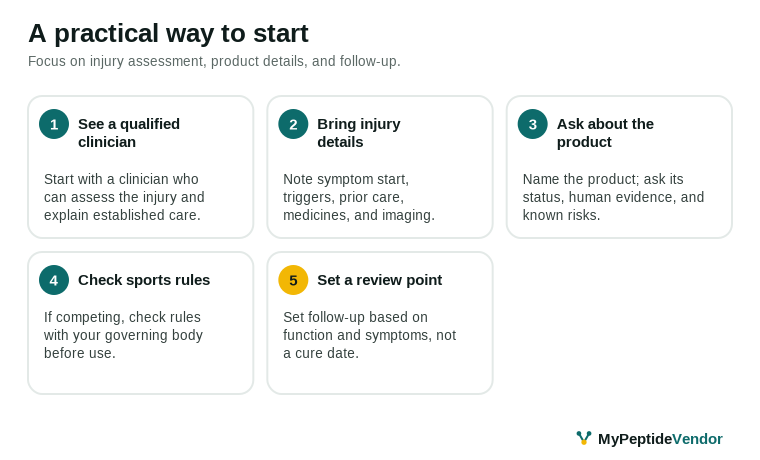
Start with a primary-care clinician, sports-medicine doctor, orthopaedic clinician, or physical therapist who can assess the injury and explain established care options. Bring the date symptoms began, what activities worsen them, prior treatment, current medicines, and any imaging. Those details help clarify whether the problem involves a tendon, ligament, muscle, bone, or joint.
Telehealth can help review symptoms and records, but an online visit may not replace an in-person examination when the diagnosis is unclear. Before a clinic offers a peptide, ask for the exact product, its regulatory status, the human evidence for your injury, known risks, and a written follow-up plan. Human dosing and treatment duration for BPC-157 and TB-500 have not been established 3.
Ask whether the clinician is discussing an approved medicine for its approved use, a compounded product, or a research-grade product. Ask who prepares it and what quality checks apply. If you compete in sports, check with your governing body or anti-doping contact before using a peptide; BPC-157 and TB-500 have anti-doping concerns 23.
Agree on a review point based on function and symptoms, not a promised cure date. The knee-pain case series does not provide a dependable tendon or ligament healing timeline, and the registered rotator cuff study has not yet begun recruiting 212. If symptoms worsen, contact the clinician rather than changing a dose or combining products on your own.
Use this chart
Free to reuse with a link back:
Dosing protocols
GLOW Blend
Research UseNo human dose is established for GLOW Blend; vial math and online schedules are not FDA-approved or clinically validated.
View protocolLL-37 5 mg
Not approvedA 5 mg LL-37 vial has no established human injection dose; concentration and syringe units depend on verified product instructions.
View protocolTB-500 10 mg
Research UseNo approved human TB-500 dose exists; this guide separates unvalidated schedules from 10 mg vial math, handling, evidence, and safety.
View protocolWhere to Buy Tissue Repair & Recovery for Research
American Peptides
US-made research peptides, every lot third-party tested with a lot-matched COA.
15% offMYPEPTIDEVENDOR at checkout
- ≥99% purity verified by HPLC + mass spec, endotoxin tested
- Ships tracked from Louisiana, free shipping over $300
- 15% off your first order with code MYPEPTIDEVENDOR
Certified-Pep
US-made research peptides with batch-specific lab reports (COA) and a QR code on every vial.
- Independent laboratory testing (Vanguard Laboratory)
- Made in the USA, ships in 1-2 business days
- Research use only, not for human or veterinary use
Affiliate disclosure: we may earn a commission if you order through the link above. Tissue Repair & Recovery is not approved by the FDA for human use.
Frequently asked questions
What is the best peptide for healing?
There is no established best peptide for human tissue repair. BPC-157 has the more substantial musculoskeletal research base, but most of it is preclinical 2; TB-500 has no human orthopaedic data 3. Neither has been shown in a controlled human trial to speed healing.
Do healing peptides really work?
Some animal studies report effects related to tissue repair, but those results do not prove a benefit in people 23. For joint pain, the available BPC-157 report cannot separate a peptide effect from expectation or the usual course of symptoms 23.
References
- FDA: Certain bulk drug substances for use in compounding that may present significant safety risks
- Vasireddi et al. Emerging Use of BPC-157 in Orthopaedic Sports Medicine: A Systematic Review. HSS J. 2025.
- Mayfield et al. Injectable Peptide Therapy: A Primer for Orthopaedic and Sports Medicine Physicians. Am J Sports Med. 2026.
- Mendias et al. Safety and Efficacy of Approved and Unapproved Peptide Therapies for Musculoskeletal Injuries and Athletic Performance. Sports Med. 2026.
- Gwyer et al. Gastric pentadecapeptide body protection compound BPC 157 and its role in accelerating musculoskeletal soft tissue healing. Cell Tissue Res. 2019.
- Seiwerth et al. Stable Gastric Pentadecapeptide BPC 157 and Wound Healing. Front Pharmacol. 2021.
- Hannappel et al. beta-Thymosins. Ann N Y Acad Sci. 2007.
- Seiwerth et al. BPC 157 and Standard Angiogenic Growth Factors. Gastrointestinal Tract Healing, Lessons from Tendon, Ligament, Muscle and Bone Healing. Curr Pharm Des. 2018.
- Staresinic et al. Stable Gastric Pentadecapeptide BPC 157 and Striated, Smooth, and Heart Muscle. Biomedicines. 2022.
- Skruber et al. Reconsidering an active role for G-actin in cytoskeletal regulation. J Cell Sci. 2018.
- Gupta et al. The role of Thymosin β4 in angiotensin II-induced cardiomyocytes growth. Expert Opin Biol Ther. 2018.
- ClinicalTrials.gov: 1 registered studies (search: Tissue Repair & Recovery)
Written by the MyPeptideVendor editorial team from the FDA label, peer-reviewed studies and ClinicalTrials.gov records listed above, fact-checked line by line and reviewed 2026-11-12.
Cite this page
MyPeptideVendor Editorial Team. Healing Peptides: Evidence, Safety & Recovery. MyPeptideVendor. Updated November 12, 2026. https://mypeptidevendor.com/treatment/tissue-repair-recovery/MyPeptideVendor Editorial Team. (2026, November 12). Healing Peptides: Evidence, Safety & Recovery. MyPeptideVendor. https://mypeptidevendor.com/treatment/tissue-repair-recovery/