TB-500 Fragment 17-23: Evidence & Safety
Synthetic peptide fragment
Brand names: TB-500; TB-500 fragment 17-23; Ac-LKKTETQ

TB-500 fragment 17-23 is the N-terminally acetylated peptide Ac-LKKTETQ, matching residues 17 through 23 of thymosin beta-4 2. The name is used inconsistently: it may mean this specific fragment, a product called TB-500, or, incorrectly, the full parent protein.
There is no established human dose, weekly injection schedule, time to benefit, or side-effect rate. A 2012 analytical paper identified the fragment in a suspected TB-500 product, and a Phase 1/2 trial is recruiting, but its registration excerpt does not show posted results 2,3.
Key takeaways
- Ac-LKKTETQ is a 7-amino-acid fragment with N-terminal acetylation 2.
- The 2012 analytical study identified the fragment in a suspected TB-500 product; it did not test healing in patients 2.
- NCT07487363 is listed as a recruiting Phase 1/2 study in stable ASCVD, but the excerpt does not show posted results 3.
- No human dose, injection frequency, safety rate, or time to effect has been established 2,3.
- FDA Category 2 describes certain bulk substances with potential significant safety risks under interim compounding policies; it is not a drug approval 1.
TB-500 Fragment 17-23 at a glance
- Class
- Synthetic, N-terminally acetylated peptide fragment
- Mechanism
- Proposed links to actin regulation, cell migration, and blood-vessel growth; fragment effects in people are unknown
- FDA Status
- No FDA-approved human use or labeled dose is established
- Brand names
- TB-500; TB-500 fragment 17-23; Ac-LKKTETQ
- Administration
- No established human route or schedule
- Typical Dose
- No clinical dose range established
- Half-life
- Unknown in humans
- Primary Uses
- Analytical identification and research; no established clinical use
What is it?

TB-500 fragment 17-23 is a short synthetic peptide called Ac-LKKTETQ. “Ac” means an acetyl group is attached at the amino end of the chain. The seven amino acids correspond to residues 17 through 23 of thymosin beta-4 2.
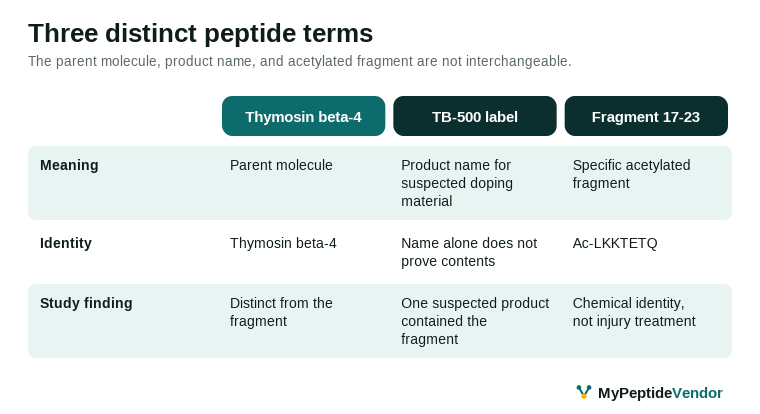
The names often get blurred. Thymosin beta-4 is the parent molecule. TB-500 is a product name used in connection with material suspected of doping potential. TB-500 fragment 17-23 means the specific acetylated fragment, Ac-LKKTETQ, identified in the analytical study 2. A vial labeled “TB-500” does not, by its name alone, prove which molecule it contains.
Esposito and colleagues identified Ac-LKKTETQ in a suspected TB-500 product using high-performance liquid chromatography and high-resolution Orbitrap mass spectrometry. They also made a reference sample through solid-phase peptide synthesis and used it to support the identification 2. That confirms a chemical identity in the tested product; it is not evidence that the peptide treats an injury.
Use this chart
Free to reuse with a link back:
What makes it different
The acetyl group is part of the molecule’s identity. A report that finds LKKTETQ without confirming the acetyl group does not, by itself, establish that the sample contains Ac-LKKTETQ. This matters when a buyer or laboratory is checking whether a material matches the fragment identified by Esposito et al. 2.
Evidence about the parent protein, a product sold as TB-500, and the isolated fragment cannot be swapped as if they were the same test article. A result for one form does not establish the right dose, safety, or effect of another. The 2012 paper was about chemical identification and detection, not treatment of a human condition 2.
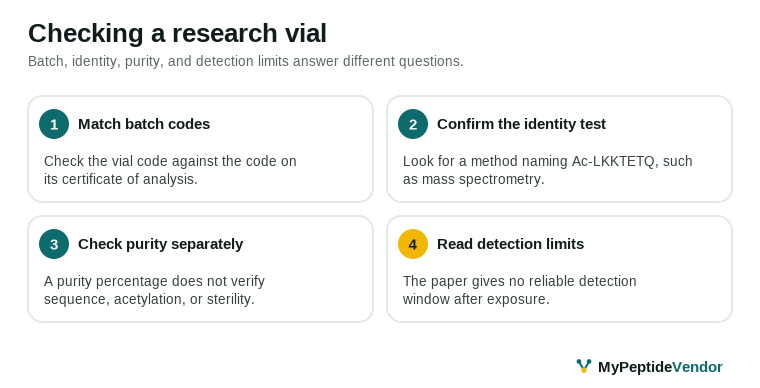
For a research vial, check that the vial’s batch code matches the batch code on its certificate of analysis (COA). Look for an identity test that names Ac-LKKTETQ and explains its method, such as mass spectrometry, and check separately how purity was measured. A purity percentage alone does not verify sequence, acetylation, sterility, or suitability for injection.
The paper’s proposed plasma and urine test used chromatography followed by triple-quadrupole mass spectrometry 2. In plain terms, the lab separates compounds in the sample, then looks for a signal consistent with the target peptide. The acetyl group helps distinguish the intended chemical form. The paper does not give a reliable detection window after exposure, so it cannot say how long a doping-control laboratory could find it.
Use this chart
Free to reuse with a link back:
How does it work?
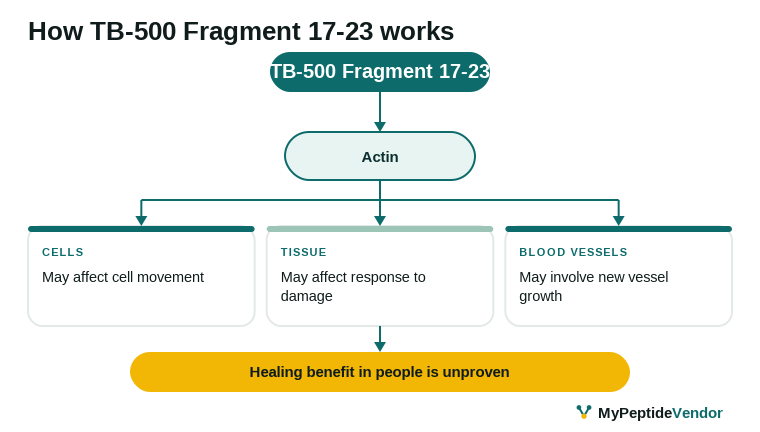
The simple idea is that a thymosin beta-4-related molecule might affect how cells move and respond to tissue damage. Researchers often discuss actin regulation, cell migration, and angiogenesis (the growth of new blood vessels) as possible parts of this biology. These are proposed mechanisms, not proven effects of injected Ac-LKKTETQ in people.
Actin is a protein that helps give cells shape and allows them to move. Cell migration means cells travel from one place to another; angiogenesis means new small blood vessels form. Those processes can be studied in relation to repair, but a plausible pathway does not show that a particular fragment improves healing or what dose might be needed.
The 2012 paper identified the fragment and proposed ways to detect it in plasma and urine; it did not test actin activity, cell movement, blood-vessel growth, or healing outcomes for Ac-LKKTETQ 2. Whether an injected dose stays intact, how quickly it leaves the body, and whether this fragment acts like full thymosin beta-4 have not been established in humans.
Use this chart
Free to reuse with a link back:
What the clinical evidence actually shows

The 2012 Esposito et al. paper was an analytical chemistry study, not a treatment trial. It identified Ac-LKKTETQ in a suspected TB-500 product with chromatography and high-resolution Orbitrap mass spectrometry, then compared the material with a synthesized reference 2. It did not report treated patients, a clinical dose, a treatment period, or a healing result.
ClinicalTrials.gov lists NCT07487363 as a recruiting Phase 1/2 study of TB-500, described as the thymosin beta-4 17-23 fragment, for cardiovascular biomarkers in people with stable atherosclerotic cardiovascular disease (ASCVD) 3. The excerpt does not show any posted results. The registration excerpt gives no participant count, study duration, dosing schedule, or expected results date 3. It therefore cannot yet tell patients whether the fragment changes biomarkers or improves health.
The analytical paper’s plasma and urine method shows how a laboratory might look for Ac-LKKTETQ in doping control 2. It does not establish how long after use the peptide remains detectable, what dose a positive test might reflect, or whether a positive result predicts a biological effect. Esposito et al. described TB-500 as suspected of doping potential; that wording is not proof of a current prohibition by every sport or governing body 2.
The main evidence gaps are practical ones: no published human dosing, pharmacokinetic, or healing result is established here. In particular, the fragment’s plasma half-life, intact survival after injection, safety with repeated injections, and activity relative to full thymosin beta-4 remain unknown.
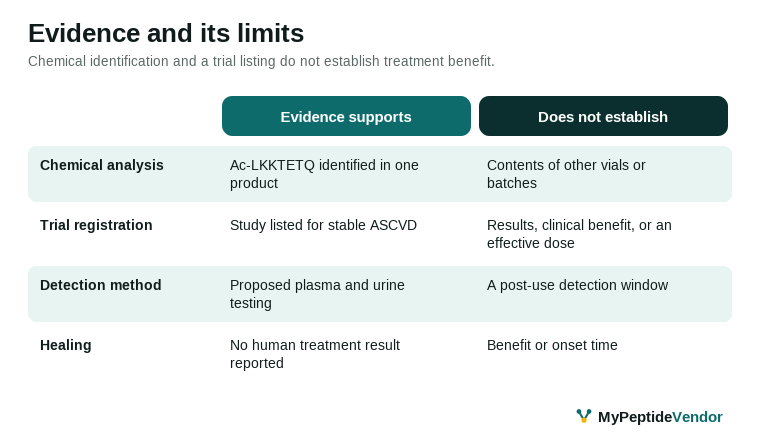
| Claim | Evidence type | What it supports | What it does not establish |
|---|---|---|---|
| Identity | Analytical chemistry | Ac-LKKTETQ was identified in one suspected product using a synthesized reference | Contents of other vials or batches |
| Plasma or urine testing | Proposed laboratory detection strategy | A mass-spectrometry approach for looking for the fragment | A post-use detection window |
| Cardiovascular biomarkers | Recruiting Phase 1/2 registration | A human study is listed for stable ASCVD | Results, clinical benefit, or an effective dose |
| Healing or time to effect | No reported human treatment result | No benefit or onset time can be concluded | Whether it helps, and when an effect might occur |
Use this chart
Free to reuse with a link back:
Typical dosing

No clinical dose range, injection frequency, route, or treatment duration is established for TB-500 fragment 17-23. The recruiting trial registration does not provide a schedule, and the analytical paper was not designed to find a safe or effective dose 2,3.
Do not treat online protocol numbers as clinical guidance. No cited study establishes those amounts or frequencies as treatment doses 2,3. There is no evidence-based answer to how many times per week a person should inject this fragment.
Research-use-only wording is not an instruction for human administration. Reconstitution and storage depend on the specific material and its safety data sheet (SDS); follow the SDS for laboratory handling. No standardized human-use preparation method has been established for Ac-LKKTETQ, and there is no evidence supporting repeated human subcutaneous injection.
Side effects: what to actually expect
No reliable percentage is available for side effects. The analytical paper did not report a human treatment group, and the ClinicalTrials. The NCT07487363 registration record does not show posted results 3. The rate is unknown, not zero.
There is no established human safety profile for repeated injection of Ac-LKKTETQ. Available human information does not tell us how often injection-site reactions or whole-body effects occur, which reactions to expect, or whether risk changes with dose or duration.
Product quality is separate from the peptide’s possible biological effects. A COA purity result does not, by itself, establish correct identity, sterility, or safe human use. If severe symptoms occur after an injection, seek urgent medical care rather than assuming the reaction is an expected peptide effect.
Regulatory & access status in the US
No FDA-approved human use or labeled dose for TB-500 fragment 17-23 is established. Products may be sold with research-use-only language, but that wording is not FDA approval and does not establish that a vial is safe, sterile, or suitable for human use.
FDA describes Category 2 as a category for certain bulk drug substances nominated for compounding when potential significant safety risks have been identified under interim policies 1. That is a risk-related compounding classification, not approval of a drug or general permission to compound a peptide. It should not be treated as proof that a product has been reviewed as safe for people.
The 2012 paper described TB-500 as suspected of doping potential and proposed plasma and urine detection for Ac-LKKTETQ 2. That paper does not establish the current prohibited status of the fragment in every sport. Athletes should check the current rules of their sport and anti-doping organization rather than relying on a product label or an older analytical paper.
Before relying on a research certificate, compare its batch code with the vial, confirm that the identity method targets acetylated Ac-LKKTETQ, and check that the purity method is stated. Follow the specific SDS for storage and handling; no universal reconstitution or storage procedure for human use is established.
Research-grade TB-500 Fragment 17-23 is available from American Peptides (TB-500, from $100.00); code MYPEPTIDEVENDOR takes 15% off. Sold for laboratory research only, not for human use. Affiliate link
How it compares with its closest alternative
The closest alternative for comparison is full thymosin beta-4, the parent molecule from which the fragment is derived. Thymosin beta-4 (the parent protein), the TB-500 product name, and the specific acetylated fragment Ac-LKKTETQ are distinct entities 2.
| Term | What it refers to | Sequence and acetylation | What the evidence establishes |
|---|---|---|---|
| Full thymosin beta-4 | The parent protein | Not the isolated Ac-LKKTETQ fragment | Evidence about the parent does not prove effects of the short fragment |
| TB-500 product label | A product name used for material suspected of doping potential | The name alone does not identify a specific sequence or acetylation | One suspected product contained the identified fragment |
| TB-500 fragment 17-23 | The specific short peptide | Ac-LKKTETQ, with N-terminal acetylation | Chemical identity and a detection approach; human dose and benefit remain unestablished |
No human comparison shows that Ac-LKKTETQ works like full thymosin beta-4, works at a lower dose, or has a more selective effect. Chemical identification does not answer those treatment questions 2.
Where to Buy TB-500 Fragment 17-23 for Research
American Peptides
TB-500 · from $100.00
US-made research peptides, every lot third-party tested with a lot-matched COA.
15% offMYPEPTIDEVENDOR at checkout
- ≥99% purity verified by HPLC + mass spec, endotoxin tested
- Ships tracked from Louisiana, free shipping over $300
- 15% off your first order with code MYPEPTIDEVENDOR
Certified-Pep
US-made research peptides with batch-specific lab reports (COA) and a QR code on every vial.
- Independent laboratory testing (Vanguard Laboratory)
- Made in the USA, ships in 1-2 business days
- Research use only, not for human or veterinary use
Affiliate disclosure: we may earn a commission if you order through the link above. TB-500 Fragment 17-23 is not approved by the FDA for human use.
Frequently asked questions
What is fragment 17-23?
It is the short peptide Ac-LKKTETQ, identified as the N-terminally acetylated form of thymosin beta-4 residues 17 through 23 2. The acetyl group is part of its chemical identity.
What does TB-500 fragment mean?
It usually means the short thymosin beta-4-related peptide rather than the parent molecule. The specifically identified fragment is Ac-LKKTETQ, but a TB-500 label alone does not confirm a vial’s contents 2.
How many times a week should I inject TB-500?
There is no established weekly injection frequency for this fragment. The identification study was not a dosing trial, and the recruiting human-study excerpt provides no schedule 2,3.
How long does it take for TB-500 to kick in?
No human onset time has been established. The analytical study tested chemical identity and proposed detection methods, not when a treatment effect begins 2.
References
- FDA: Certain bulk drug substances for use in compounding that may present significant safety risks
- Esposito et al. Synthesis and characterization of the N-terminal acetylated 17-23 fragment of thymosin beta 4 identified in TB-500, a product suspected to possess doping potential. Drug Test Anal. 2012.
- ClinicalTrials.gov: 1 registered studies (search: TB-500 Fragment 17-23)
Written by the MyPeptideVendor editorial team from the FDA label, peer-reviewed studies and ClinicalTrials.gov records listed above, fact-checked line by line and reviewed 2026-11-12.
Cite this page
MyPeptideVendor Editorial Team. TB 500 Fragment 17 23: Evidence & Safety. MyPeptideVendor. Updated November 12, 2026. https://mypeptidevendor.com/peptides/tb-500-fragment-17-23/MyPeptideVendor Editorial Team. (2026, November 12). TB 500 Fragment 17 23: Evidence & Safety. MyPeptideVendor. https://mypeptidevendor.com/peptides/tb-500-fragment-17-23/Related peptides
B7-33
Research UseB7-33 activates RXFP1 and has preclinical heart and fibrosis findings, but no established human dose, human trial results, or known human safety profile.
Learn moreBPC-157 + TB-500 Blend
Research UseA blend of BPC-157 and TB-500 has no established human dose or proven benefit for injury healing; key safety and stability questions remain unanswered.
Learn moreKPV
Research UseKPV is an experimental α-MSH tripeptide with laboratory and animal findings, no established human dose, and no proven human treatment benefit.
Learn more