Tb 500 Dosage 10mg: Protocol & Safety
No approved human TB-500 dose exists; this guide separates unvalidated schedules from 10 mg vial math, handling, evidence, and safety.
Quickstart Highlights for a 10 mg TB-500 Vial
There is no established human TB-500 dosage for a 10 mg vial. TB-500 is described as an investigational compound 9, and a safe, effective human dose, injection frequency, and treatment duration have not been established 2.
TB-500 is a synthetic fragment of thymosin beta-4 (Tβ4) corresponding to positions 17–23 10, distinct from full-length Tβ4 9. It is not the same as full-length Tβ4, and evidence for the full protein should not be treated as evidence for the fragment 9.
- Human dose: No approved or validated dose, loading phase, maintenance phase, or weekly total exists 23.
- What it is: TB-500 refers to the synthetic Tβ4 17–23 fragment 10. Full-length Tβ4 research cannot automatically be applied to this shorter fragment 9.
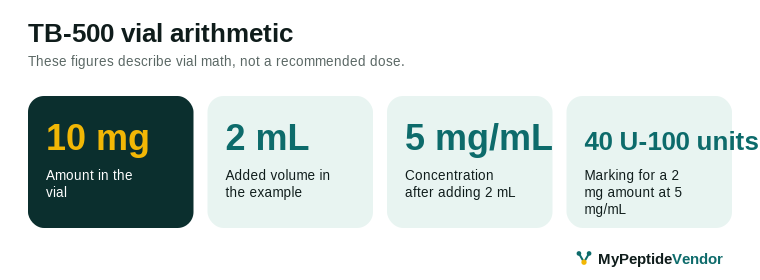
- Vial math: With 2 mL added to a 10 mg vial, the concentration is 5 mg/mL. A 2 mg amount corresponds to 40 U-100 units. This is arithmetic, not a recommended dose.
- Research: A recruiting Phase 1/2 study is examining TB-500 in stable atherosclerotic cardiovascular disease (ASCVD) 10. It does not provide an established soft-tissue treatment protocol.
- Sport: TB-500 is prohibited in sport 2. Analytical approaches have been described for detection in blood or urine 6, but those methods do not establish a dependable time until a test is negative.
Do not use a syringe conversion to choose a dose. A conversion gives the volume for a stated amount and concentration; it cannot show that the amount is safe, effective, or suitable for an injury.
Use this chart
Free to reuse with a link back:
Key takeaways
- No approved human dose, loading schedule, maintenance schedule, or weekly total is established for TB-500 23.
- A 10 mg vial mixed with 2 mL has a concentration of 5 mg/mL; 2 mg corresponds to 40 U-100 units.
- Tissue repair and angiogenesis findings are mainly preclinical; human orthopaedic evidence is lacking 24.
- A Phase 1/2 study of TB-500 in stable ASCVD is recruiting, but it does not establish an injury-treatment dose 10.
- TB-500 is prohibited in sport, and analytical methods have been described for detecting it in blood or urine 26.
Dosing Schedule: No Validated Week-by-Week Dose
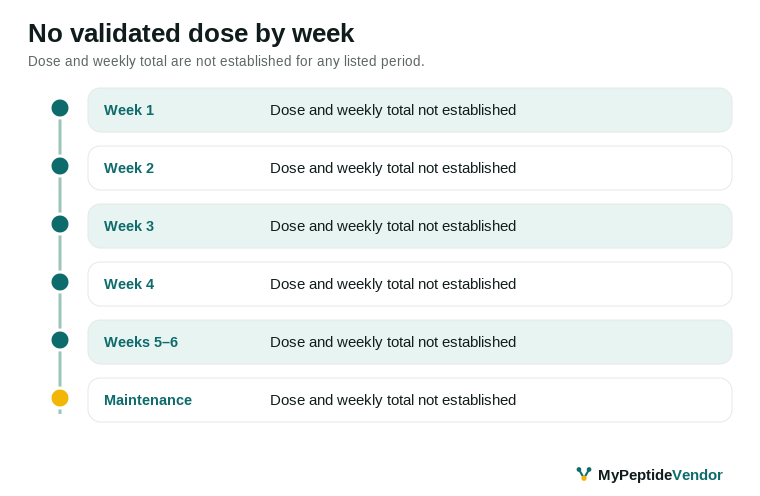
For an approved medicine, a titration schedule should follow its FDA labeling or the regimen tested in relevant trials. TB-500 is not approved for human injury treatment, and no approved human dose exists 23. Reviews describe the indications, dose, frequency, and treatment duration as unknown 2. No dose is established for any phase of TB-500 23.
No human TB-500 dose or community schedule is established in the reviewed literature 23. No validated mg amount, mcg amount, syringe units, injection frequency, or weekly total can be assigned. “Not established” does not mean zero risk or permission to choose a dose.
| Week or phase | Dose per injection (mg) | Dose per injection (mcg) | U-100 units | Frequency and weekly total |
|---|---|---|---|---|
| Week 1 | Not established | Not established | Not established | Not established |
| Week 2 | Not established | Not established | Not established | Not established |
| Week 3 | Not established | Not established | Not established | Not established |
| Week 4 | Not established | Not established | Not established | Not established |
| Weeks 5–6 | Not established | Not established | Not established | Not established |
| Maintenance | Not established | Not established | Not established | Not established |
A registered Phase 1/2 study is recruiting to examine TB-500 in people with stable ASCVD 10. The study is not a general injury protocol, and its registration does not establish a routine dose, a loading phase, or a maintenance schedule.
Use this chart
Free to reuse with a link back:
Syringe Unit Conversion Table
Units to draw on a U-100 insulin syringe (100 units = 1 mL) from a 10 mg vial. Find your dose, then read the column for the water you added. Every number is calculated, not estimated.
| Dose | 1 mL water 10 mg/mL · 1 unit = 100 mcg | 2 mL water 5 mg/mL · 1 unit = 50 mcg | 2.5 mL water 4 mg/mL · 1 unit = 40 mcg |
|---|---|---|---|
| 50 mcg | 0.5 · 200 doses | 1 · 200 doses | 1.25 · 200 doses |
| 100 mcg | 1 · 100 doses | 2 · 100 doses | 2.5 · 100 doses |
| 200 mcg | 2 · 50 doses | 4 · 50 doses | 5 · 50 doses |
| 250 mcg | 2.5 · 40 doses | 5 · 40 doses | 6.25 · 40 doses |
| 300 mcg | 3 · 33 doses | 6 · 33 doses | 7.5 · 33 doses |
| 500 mcg | 5 · 20 doses | 10 · 20 doses | 12.5 · 20 doses |
| 750 mcg | 7.5 · 13 doses | 15 · 13 doses | 18.75 · 13 doses |
| 1 mg | 10 · 10 doses | 20 · 10 doses | 25 · 10 doses |
| 1.5 mg | 15 · 6 doses | 30 · 6 doses | 37.5 · 6 doses |
| 1.7 mg | 17 · 5 doses | 34 · 5 doses | 42.5 · 5 doses |
| 2 mg | 20 · 5 doses | 40 · 5 doses | 50 · 5 doses |
| 2.4 mg | 24 · 4 doses | 48 · 4 doses | 60 · 4 doses |
| 2.5 mg | 25 · 4 doses | 50 · 4 doses | 62.5 · 4 doses |
| 3 mg | 30 · 3 doses | 60 · 3 doses | 75 · 3 doses |
| 4 mg | 40 · 2 doses | 80 · 2 doses | 100 · 2 doses |
| 5 mg | 50 · 2 doses | 100 · 2 doses | over 100 |
| 7.5 mg | 75 · 1 doses | over 100 | over 100 |
| 10 mg | 100 · 1 doses | over 100 | over 100 |
TB-500 10 mg Vial Dosage Calculator
Shows the exact insulin-syringe units to draw. Pre-loaded with the 10 mg vial; change any value to match yours.
Total volume of your syringe?
How much mg is in the vial?
How much bacteriostatic water are you adding?
Dose per injection?
Educational tool only. Concentration = vial ÷ water; units = dose ÷ concentration × 100 (U-100 syringe). Confirm every dose with your prescriber. Different vial or peptide? Use the peptide calculator.
MYPEPTIDEVENDORAffiliate link · we may earn a commission.
Reconstitution Steps and 10 mg Vial Math
Do not reconstitute or inject an online research vial at home. No standardized TB-500 preparation method or stability period is established. If a licensed pharmacy or clinical study is preparing a product, use that team’s written directions for the exact vial; do not assume that directions for another peptide apply.
- Confirm who is responsible for preparation. Ask whether the vial is being handled under an authorized study or by a licensed pharmacy. TB-500 is investigational, and human dosing and safety are not established 23.
- Match the product details. Compare the vial identity and lot number with its paperwork. A certificate of analysis (COA) documents specified testing, but it does not by itself prove that a vial is sterile or suitable for injection.
- Get product-specific preparation instructions. The pharmacy or study team must specify the diluent, volume, handling method, storage conditions, and discard date. If any of those details are missing, do not prepare the vial.
- Keep amount and volume distinct. A U-100 syringe has 100 markings per mL. The markings that correspond to an amount depend on the final concentration; the conversion does not make that amount a medically appropriate dose.
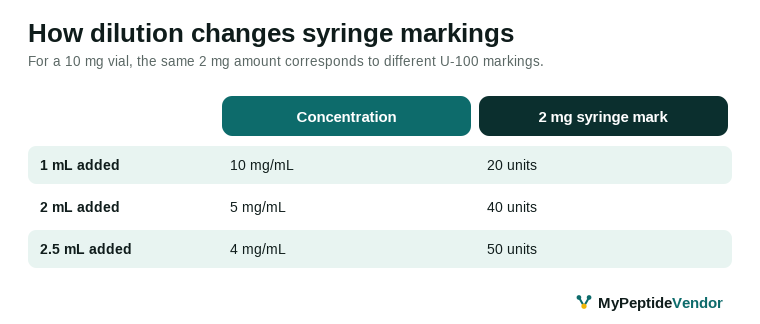
The table below gives arithmetic examples for a 10 mg vial and a U-100 syringe. The syringe markings are not treatment instructions.
| Liquid volume | Concentration | 2 mg / 2,000 mcg | 2.5 mg / 2,500 mcg | 5 mg / 5,000 mcg |
|---|---|---|---|---|
| 1 mL | 10 mg/mL (10,000 mcg/mL) | 20 units | 25 units | 50 units |
| 2 mL | 5 mg/mL (5,000 mcg/mL) | 40 units | 50 units | 100 units |
| 2.5 mL | 4 mg/mL (4,000 mcg/mL) | 50 units | 62.5 units | Not listed |
The same stated amount takes different syringe markings at different concentrations. For example, 2 mg corresponds to 20 units at the 1 mL dilution and 40 units at the 2 mL dilution. These figures explain vial math only; they do not establish an appropriate TB-500 dose.
Use this chart
Free to reuse with a link back:
Supplies Needed for a Full 10 mg Vial
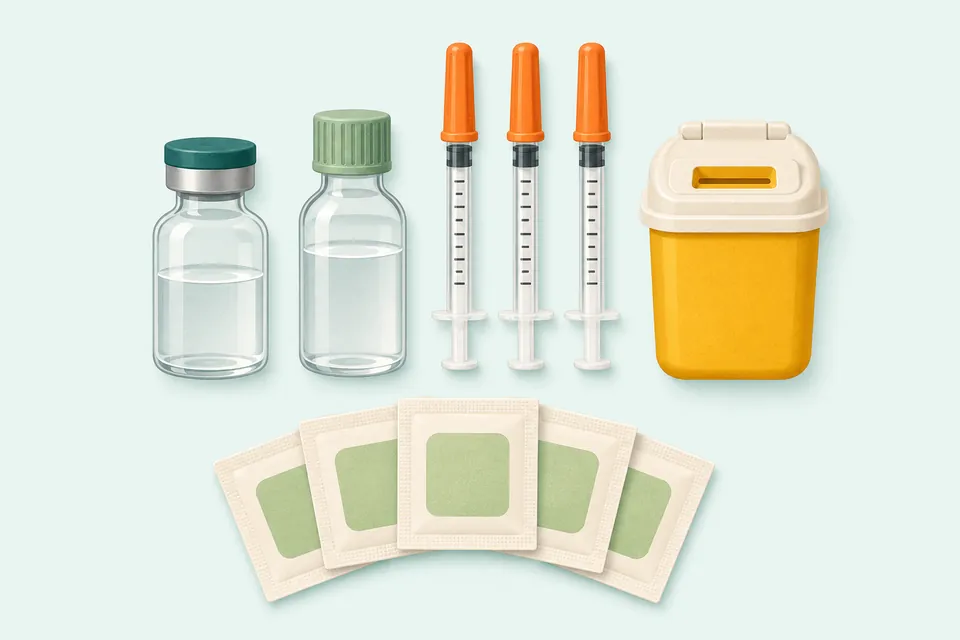
There is no safe do-it-yourself supply list for preparing a TB-500 vial because a standardized preparation method and validated human-use protocol are not established 23. For unsupervised home preparation, the right number of supplies is zero: do not reconstitute or inject an investigational vial at home.
If a licensed pharmacy or clinical-trial team prepares a product, ask that team for its exact list and quantities. It may call for 1 vial, a product-specific sterile diluent and measured volume, preparation equipment, single-use administration supplies, skin antiseptic, and a sharps container. The responsible team must select the products and quantities; vial size alone does not determine them.
Before preparation, match the vial identity and lot number to its paperwork. A COA may document testing for a particular lot, but it is not proof of sterility, correct labeling, or clinical safety. Compounded peptide quality and regulatory questions are discussed in pharmacy compounding analysis 8; patients should consult a licensed pharmacist.
Protocol Overview and Cycle Notes

TB-500 is discussed for tissue repair, blood-vessel formation (angiogenesis), and inflammation control. These effects are supported mainly by laboratory and animal research; human orthopaedic data are lacking 24. A proposed biological action does not prove that an injection improves a person’s tendon, muscle, or wound.
Keep TB-500 findings separate from full-length Tβ4 findings. TB-500 refers to the Tβ4 17–23 fragment 910, and a review specifically warns that evidence for the fragment should not be conflated with evidence for the full-length protein 9. How TB-500 moves through the body and reaches an injured target site remains uncertain 9.
No primary clinical evidence here establishes a loading course, a maintenance course, or the number of 10 mg vials an injury would require. Dosing, frequency, and duration remain unknown 2. The dose is not known to change with body weight or injury type because validated human dose-adjustment information is unavailable.
Some people pair TB-500 with BPC-157. The proposed rationale is that the peptides may act through different tissue-repair pathways, but a combined benefit is unproven; combination strategies remain hypothesis-generating rather than definitive 9. Using two investigational peptides at once can also make it harder to identify which product caused a reaction.
A Phase 1/2 study listed as recruiting is evaluating TB-500, described as the Tβ4 17–23 fragment, in stable ASCVD 10. This study is a research milestone, not evidence of benefit for tendon or muscle injuries and not a source of a general-use dose.
Storage and Handling
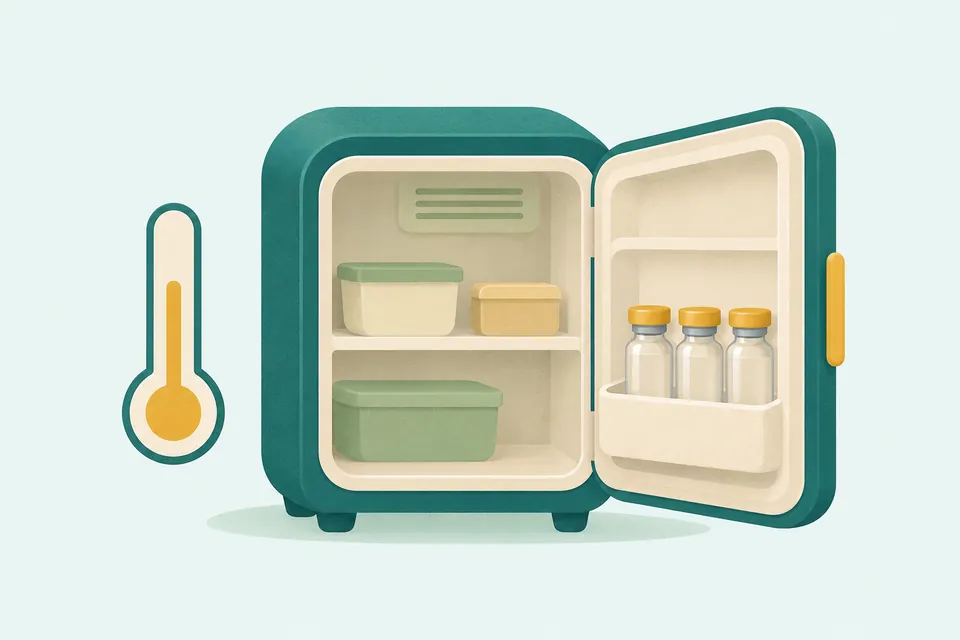
Follow the storage conditions and discard date provided by the licensed pharmacy or clinical-trial team for the exact product. No universal TB-500 storage temperature or post-reconstitution stability period is established. Do not borrow storage instructions from another peptide or product.
Keep the vial in its original labeled container and follow the responsible team’s preparation and handling directions. If the team directs you to track them, record the lot and preparation date. Do not use a vial with a broken seal, unreadable label, unexpected particles, or a lot number that does not match its paperwork.
Do not use a vial after its product-specific discard date, and do not share needles or syringes. If the product identity, preparation instructions, or storage directions are unclear, do not inject it. A COA is not a substitute for sterility testing or a clinical safety review.
Injection and Tracking Tips
Do not inject TB-500 outside an authorized clinical study or qualified medical care. Human dosing, injection frequency, and treatment duration remain unknown 2; the cited reviews do not establish a routine human route or injection site. Syringe conversion cannot make self-injection appropriate.
If you are enrolled in a study, follow its written protocol rather than an online schedule. Record the assigned amount, date, product lot, preparation details, and any symptoms. Those notes help the study team assess what happened; they do not replace medical monitoring.
Tell the investigator or clinician about medicines, supplements, and prior reactions to injectable products. Seek urgent care for trouble breathing, swelling of the face or throat, fainting, severe chest symptoms, or rapidly worsening redness and pain after an injection.
Athletes should check current anti-doping rules before any exposure. TB-500 is prohibited in sport 2. Analytical approaches for detecting TB-500 in blood or urine have been described 6; those approaches do not state how long after a dose a particular athlete may test positive.
Safety, Side Effects, and Regulatory Status
Reliable frequencies for TB-500 side effects in humans are not available. Rigorous human safety data for unapproved peptides are scarce, and serious harm is possible 3. An unapproved injectable may also pose risks from contamination, incorrect concentration, allergic reaction, or the injection itself; there is no established rate for these events with TB-500.
Angiogenesis and tissue repair are research hypotheses, not proven clinical benefits. Long-term human safety data for unapproved peptides are scarce, and long-term cancer-risk data for TB-500 are not established 3. People who are pregnant, breastfeeding, have cancer or an unexplained growth, or have a serious medical condition should discuss the uncertainty with a qualified clinician before considering any investigational injectable. These cautions are not a substitute for individualized medical advice.
TB-500 is among the unapproved peptides marketed to patients 3. Category 2 status does not establish that a substance is eligible for lawful compounding. Do not assume an online vial is FDA-reviewed, sterile, or suitable for injection; ask a licensed pharmacist to verify the specific product and its regulatory pathway 18.
TB-500 is prohibited in sport 2. Chromatographic-mass spectrometry approaches for detecting TB-500 in blood or urine have been described 6. Those analytical methods do not establish a reliable post-dose detection window.
Stop exposure and seek urgent medical care for breathing difficulty, face or throat swelling, fainting, severe chest symptoms, or a rapidly spreading injection-site reaction. These are urgent warning signs, not a complete list of possible harms; human adverse-event frequencies are not established 3.
Frequently Asked Questions
Vial conversions describe liquid volume, not medical suitability. No syringe marking can establish that a TB-500 dose is safe or effective.
Frequently asked questions
What is the correct TB-500 dosage for a 10 mg vial?
No approved or validated human dose exists, so a correct treatment dose cannot be stated 23. The 10 mg amount describes the vial contents, not an evidence-based dose.
How many units is 2 mg from a 10 mg vial?
It depends on the final concentration. At the 1 mL dilution, 2 mg corresponds to 20 U-100 units; at the 2 mL dilution, it corresponds to 40 units. These are arithmetic conversions, not dosing advice.
How many units are 2.5 mg or 5 mg?
At the 1 mL dilution, 2.5 mg corresponds to 25 units and 5 mg to 50 units. At the 2 mL dilution, those amounts correspond to 50 units and 100 units. Neither amount is an established TB-500 dose 23.
How often should TB-500 be injected, and is there a loading phase?
No human injection frequency, loading phase, maintenance phase, or cycle duration has been validated 2. Online schedules should not be treated as medical protocols.
Can TB-500 be combined with BPC-157?
The pairing has a proposed mechanistic rationale, but a combined benefit is unproven; combination strategies remain hypothesis-generating 9. Using two investigational peptides can also make it harder to identify which product caused a reaction.
How long can TB-500 be detected in an athlete?
Analytical approaches for detecting TB-500 in blood or urine have been described 6, but they do not give a reliable post-dose detection window. TB-500 is prohibited in sport 2.
How long is reconstituted TB-500 stable?
A universal stability period has not been established. Follow the exact product’s storage directions and discard date from the responsible pharmacy or clinical-trial team.
Is TB-500 FDA-approved or legally compounded?
TB-500 is not FDA-approved for human treatment 3. FDA lists the thymosin beta-4 fragment LKKTETQ in Category 2 under its interim policies for nominated bulk substances 1; ask a licensed pharmacist to verify the specific product and regulatory pathway.
Does TB-500 dosing change with body weight or injury type?
Validated human dosing information, including dose adjustments by body weight or injury type, is unavailable 2. No reliable dose adjustment can be recommended.
References
- FDA: Certain bulk drug substances for use in compounding that may present significant safety risks
- Mayfield et al. Injectable Peptide Therapy: A Primer for Orthopaedic and Sports Medicine Physicians. Am J Sports Med. 2026.
- Mendias et al. Safety and Efficacy of Approved and Unapproved Peptide Therapies for Musculoskeletal Injuries and Athletic Performance. Sports Med. 2026.
- Rahman et al. Therapeutic Peptides in Orthopaedics: Applications, Challenges, and Future Directions. J Am Acad Orthop Surg Glob Res Rev. 2026.
- Mavrych et al. Therapeutic peptides in gerontology: mechanisms and applications for healthy aging. Front Aging. 2026.
- Thevis et al. Analytical approaches for the detection of emerging therapeutics and non-approved drugs in human doping controls. J Pharm Biomed Anal. 2014.
- Pathak et al. Logistic regression analysis of environmental and other variables and incidences of tuberculosis in respiratory patients. Sci Rep. 2020.
- Willis et al. Synthetic Peptides in Pharmacy Compounding: Analysis of PCAC Recommendations and Industry Safety Standards. Int J Pharm Compd. 2026.
- Froum et al. Regenerative peptides for inferior alveolar nerve injury: a narrative review. Front Dent Med. 2026.
- ClinicalTrials.gov: 1 registered studies (search: TB-500)
Written by the MyPeptideVendor editorial team from the FDA label, peer-reviewed studies and ClinicalTrials.gov records listed above, fact-checked line by line and reviewed 2026-11-12.
Cite this page
MyPeptideVendor Editorial Team. tb 500 dosage 10mg: Protocol & Safety. MyPeptideVendor. Updated November 12, 2026. https://mypeptidevendor.com/protocols/tb-500-dosing-10mg/MyPeptideVendor Editorial Team. (2026, November 12). tb 500 dosage 10mg: Protocol & Safety. MyPeptideVendor. https://mypeptidevendor.com/protocols/tb-500-dosing-10mg/Related protocols
GLOW Blend
Research UseNo human dose is established for GLOW Blend; vial math and online schedules are not FDA-approved or clinically validated.
View protocolLL-37 5 mg
Not approvedA 5 mg LL-37 vial has no established human injection dose; concentration and syringe units depend on verified product instructions.
View protocol