Glow Blend Dosage: Protocol & Safety
No human dose is established for GLOW Blend; vial math and online schedules are not FDA-approved or clinically validated.
Quickstart Highlights: GLOW Blend Dosage
There is no established human glow blend dosage. GLOW is a name used for a peptide combination, not an FDA-approved medicine with a labeled dose, titration schedule, or injection instructions.
A label alone does not prove what a vial contains.
- No established human dose: GLOW has no FDA-approved label, dose, or titration plan. No human dose-finding study has established how much to use or how long to use it.
- Unverified vial description: Some commercial descriptions claim a 70 mg vial containing 50 mg GHK-Cu, 10 mg BPC-157, and 10 mg TB-500, a 5:1:1 ratio. The stated 70 mg composition (50/10/10 mg) has not been independently verified, and a seller's label is not an independent test.
- Conditional conversion: If a vial actually contained 70 mg and were mixed to 3 mL, its concentration would be about 23.3 mg/mL. On a U-100 syringe, 1 unit would represent about 233 mcg of total blend; neither figure establishes a safe dose.
- Human skin evidence is not injection evidence: One 8-week study assessed a topical multi-ingredient formula in 30 adults aged 35–70. It did not test injectable GHK-Cu, BPC-157, TB-500, or GLOW 7.
- Trial registry check: A ClinicalTrials.gov search for “GLOW Blend” returned 3 records about urinary incontinence, blue-light therapy, and facial oil, not this peptide blend 8. That search result does not prove no study exists anywhere.
- Research status: The three-peptide combination has no established FDA-approved use or human dosing schedule. For compounding, check the FDA’s current Category 2 information for each proposed bulk substance and intended use 1.
Key takeaways
- No FDA-approved dose or titration schedule exists for GLOW; no human trial has established a safe or effective dose.
- A vendor-described formula claims 50 mg GHK-Cu, 10 mg BPC-157, and 10 mg TB-500 per 70 mg vial, but those amounts remain unverified.
- At a hypothetical 3 mL dilution of a 70 mg vial, 1 U-100 unit represents about 233 mcg total blend; this is conversion math, not dosing advice.
- A topical skin study followed 30 adults for 8 weeks, but it did not test injected GHK-Cu or GLOW 7.
- A ClinicalTrials.gov search for “GLOW Blend” returned 3 registrations on unrelated topics, not a trial of this peptide combination 8.
Dosing Schedule: No Validated Week-by-Week Dose
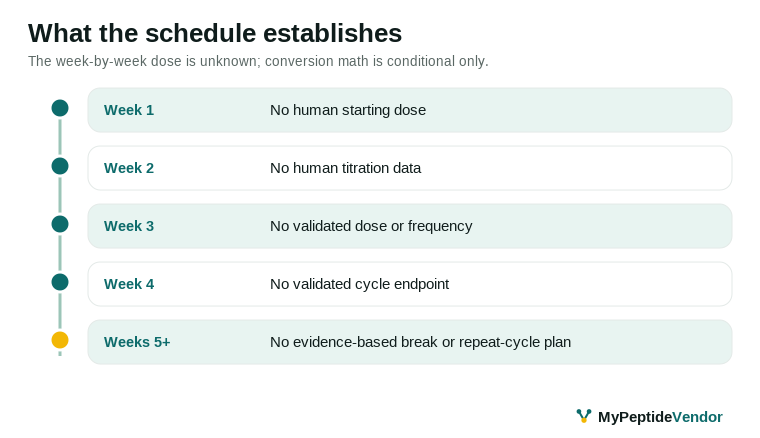
When a molecule is approved, its titration schedule should follow the FDA label; when a relevant human trial establishes a regimen, the trial schedule should be described. No registered human trial of GLOW was found 8, so no dose or titration can be recommended.
The schedule below distinguishes an unknown human dose from conditional conversion math. The 3 mL calculation assumes a hypothetical 70 mg vial; it does not verify the vial’s contents, sterility, stability, safety, or effect.
| Week | Dose in mg | Dose in mcg | U-100 units | What is established |
|---|---|---|---|---|
| Week 1 | Not established | Not established | Not established | No human starting dose |
| Week 2 | Not established | Not established | Not established | No human titration data |
| Week 3 | Not established | Not established | Not established | No validated dose or frequency |
| Week 4 | Not established | Not established | Not established | No validated cycle endpoint |
| Weeks 5 and later | Not established | Not established | Not established | No evidence-based break or repeat-cycle plan |
For arithmetic only, a hypothetical 70 mg vial diluted to 3 mL contains about 23.3 mg/mL. On a U-100 syringe, 5 units equal 0.05 mL and contain about 1.167 mg, or 1,167 mcg, total blend; 10 units equal 0.10 mL and contain about 2.333 mg, or 2,333 mcg; 15 units equal 0.15 mL and contain 3.5 mg, or 3,500 mcg. These calculated amounts assume the vial content and dilution are accurate. They are not recommended doses.
If the claimed 5:1:1 ratio were accurate, a total amount of 2,330 mcg would contain approximately 1,664 mcg GHK-Cu and 333 mcg each of BPC-157 and TB-500. Those component amounts are calculated from the claimed ratio, not confirmed by a product assay or human trial. The 2,330 mcg total is also not identical to the 2,333 mcg calculated from 10 U at 23.3 mg/mL; the difference comes from rounding.
Do not confuse milliliters, U-100 syringe units, and micrograms. Milliliters measure liquid volume, U-100 markings measure volume on a particular syringe, and micrograms measure peptide mass. The conversion above applies only to the hypothetical 3 mL dilution and a U-100 syringe; another dilution or syringe scale changes the calculation.
Online descriptions may list one total blend amount or separate amounts for each peptide. Those numbers are not interchangeable. A fixed-ratio mixture changes all three ingredients together, so it cannot independently match a separate target for BPC-157 or TB-500. No human dose-finding evidence shows how dose or duration affects benefit or harm for GLOW.
Use this chart
Free to reuse with a link back:
GLOW Blend Vial Dosage Calculator
Shows the exact insulin-syringe units to draw. Pre-loaded with the vial; change any value to match yours.
Total volume of your syringe?
How much mg is in the vial?
How much bacteriostatic water are you adding?
Dose per injection?
Educational tool only. Concentration = vial ÷ water; units = dose ÷ concentration × 100 (U-100 syringe). Confirm every dose with your prescriber. Different vial or peptide? Use the peptide calculator.
MYPEPTIDEVENDORAffiliate link · we may earn a commission.
Reconstitution Steps: What Is and Is Not Established
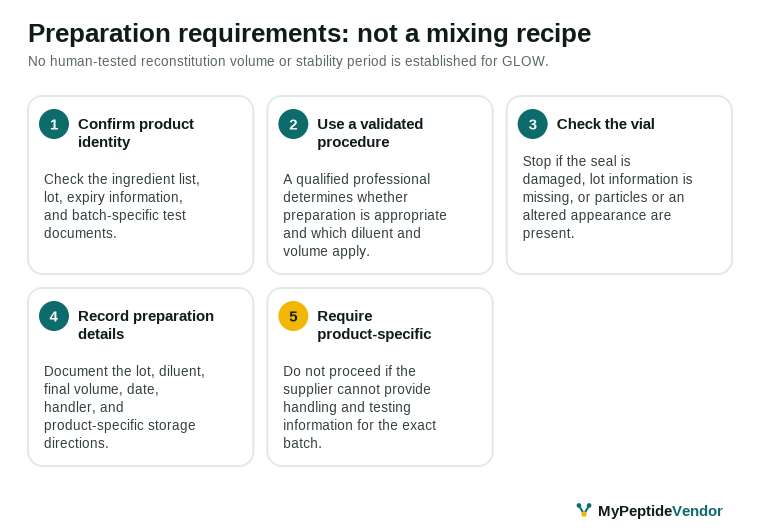
No human-tested reconstitution volume or stability period is established for GLOW. A 3 mL volume appears in circulating protocol descriptions, but it is not a validated human preparation instruction. Preparing a vial for injection requires product-specific sterile procedures and evidence that the product is suitable for that route.
- Confirm the product identity. Check the exact ingredient list, lot number, expiry information, and batch-specific test documents. The name “GLOW” does not guarantee a standard formula.
- Use a validated written procedure. A qualified professional in an authorized setting must determine whether a product may be prepared, which diluent and volume apply, and how it should be labeled and discarded. Do not select a volume from an online calculator.
- Check the vial before any handling. A damaged seal, missing lot information, unexpected particles, or an altered appearance is a reason to stop. A clear solution does not prove identity, purity, sterility, or acceptable endotoxin levels.
- Record preparation details. If preparation is part of a legitimate supervised protocol, document the product lot, diluent, final volume, preparation date, handler, and product-specific storage directions.
- Do not proceed without product-specific instructions. If the supplier cannot provide handling and testing information for the exact batch, there is no sound basis for preparing it for human injection.
Preparation instructions do not establish how long a mixed vial keeps its potency. Stability can depend on the actual ingredients, container, diluent, temperature, light exposure, and handling. No verified storage duration exists for a reconstituted GLOW vial.
Use this chart
Free to reuse with a link back:
Supplies Needed: Quantities for a Full Vial
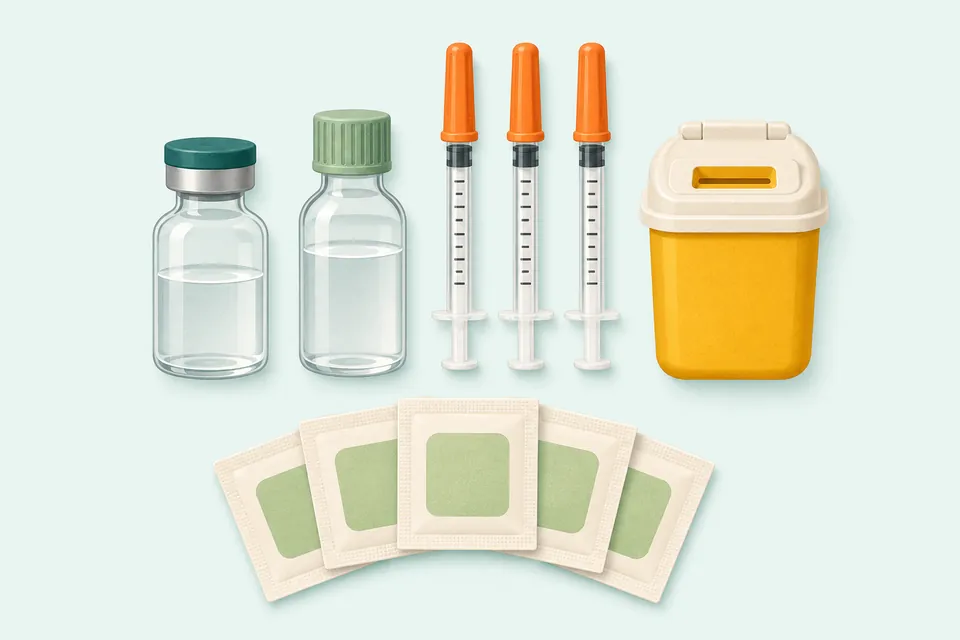
There is no validated home injection kit or full-vial preparation list for GLOW. For an authorized laboratory or clinician-managed process, the responsible team should select supplies to match the documented method. The following quantities are inventory prompts for one vial, not instructions to prepare or inject it.
- 1 vial: Keep the original, batch-identified container and its paperwork together.
- 1 written procedure: It should specify product-specific preparation, labeling, handling, storage, and discard directions.
- 1 appropriate diluent container, if required: The type and volume must come from a validated procedure; no human-tested GLOW volume is established.
- 1 sterile transfer device, if required: The responsible professional selects its type and size for the validated process.
- 1 designated clean work area and required protective supplies: Follow the facility’s sterile-handling procedure, not a household setup.
- 1 appropriate waste container: Follow the facility’s disposal procedure and local requirements.
Ask for a batch-specific certificate of analysis (COA) that names each ingredient and reports actual results. Check that the lot number matches the vial, the document identifies the testing laboratory and method, and identity and purity results are provided for each peptide rather than a general “purity” statement.
If a product is presented as injectable, ask whether sterility and endotoxin testing were performed on the specific batch. Ask how the GHK-Cu identity and copper content were measured. A COA can help evaluate a batch, but a certificate by itself does not prove that a product is suitable for injection.
- Pause if the vial has no lot number or the lot number differs from the COA.
- Pause if the report omits identity testing, purity results, or the test method.
- Pause if sterility and endotoxin results are missing for a product sold for injection.
- Pause if the seller promises a guaranteed skin, healing, or appearance result within a fixed timeframe.
Protocol Overview & Cycle Notes

GLOW is a product name used for blends that may combine GHK-Cu, BPC-157, and TB-500. A commonly claimed version uses a 5:1:1 ratio and amounts of 50 mg, 10 mg, and 10 mg in a 70 mg vial, but that formula is not verified by a primary source cited here. Confirming the label would still require a batch-specific independent test.
These roles describe research interest, not proven effects in people. There is no human trial of the three-peptide combination, and no evidence establishes that combining the peptides works better than any ingredient alone.
A ClinicalTrials.gov search for “GLOW Blend” returned 3 registrations concerning urinary incontinence, blue-light therapy, and facial oil, not the peptide combination 8. This registry result does not identify a GLOW trial, but it does not prove that no human research exists in every registry or publication.
The human skin study is a useful example of what a topical trial can measure, but it is not evidence for injected GLOW. It tested a topical formula containing low-dose retinol, a synthetic retinoid ester, a pea peptide, and antioxidants in 30 adults aged 35–70: 21 women and 9 men. Participants applied it nightly for 8 weeks, with assessments at baseline and weeks 1, 2, 4, and 8 7. The study reported significant improvements from baseline in hydration, transepidermal water loss, and elasticity, along with incremental improvements in nine self-assessed skin parameters 7. It cannot establish what injected GHK-Cu or a three-peptide blend does.
No evidence-based on-cycle period, off-cycle period, or repeat schedule can be given. Repetition of an online schedule does not make it a clinical regimen. There is no human dose-finding evidence showing how dose or duration affects benefit or harm for GLOW.
For someone tracking a skin concern with a clinician, the topical study’s assessment points offer a practical way to organize observations: record baseline photos and self-ratings, then repeat at weeks 1, 2, 4, and 8 under similar lighting and camera distance 7. Hydration, transepidermal water loss, and elasticity are measurable outcomes used in that topical study 7. Tracking these measures does not validate an injection or prove that a change came from GLOW.
FDA places certain bulk substances nominated for compounding in Category 2 when its interim policies identify potential significant safety risks 1. Check current FDA information for each substance and the intended compounded use. Do not assume that every GLOW ingredient has a particular Category 2 status based only on the blend name; an FDA category entry also does not test the contents of an individual vial 1.
Storage & Handling

No verified storage duration exists for a reconstituted GLOW vial. A familiar refrigerator temperature, a seller’s suggested discard date, or a clear appearance does not prove that a mixed product remains potent and sterile.
Keep the original container and batch paperwork together, away from children and anyone who could mistake a research product for a medicine. Do not use a vial with a broken seal, missing batch information, visible particles, or an unexpected appearance. Visual inspection cannot establish purity or sterility.
Do not assign a refrigerator life or assume that freezing is suitable without product-specific stability data and instructions from a qualified professional. Stability data for one peptide alone would not automatically establish stability for a three-peptide mixture in a particular container.
FDA’s Category 2 information concerns certain bulk substances nominated for compounding that may present significant safety risks 1. Check current FDA information for the individual ingredients and intended use, and discuss any proposed compounded product with a qualified clinician. That check does not replace testing of the actual vial.
Injection & Tracking Tips
The practical advice for a blend with no established human dose is not to self-inject it. A clinician can review the reason for use, health history, current medicines, and approved alternatives before discussing any unapproved product.
For skin tracking, take photos in consistent lighting and from the same distance, with a neutral expression. The topical study used baseline and weeks 1, 2, 4, and 8 for assessments, photos, and self-questionnaires 7. Those time points belong to a topical study, not to a GLOW injection schedule.
Record changes in skin products, sun exposure, and other factors that could affect photos or self-ratings. A single image or one-day change cannot separate a treatment effect from ordinary variation. Do not increase an unvalidated amount because a visible change has not appeared.
For a prescribed injectable medicine, follow the prescriber’s directions, use sterile single-use equipment, and never share needles or syringes. Those basic steps do not make an unapproved GLOW product safe or establish a dose.
Safety & Side Effects
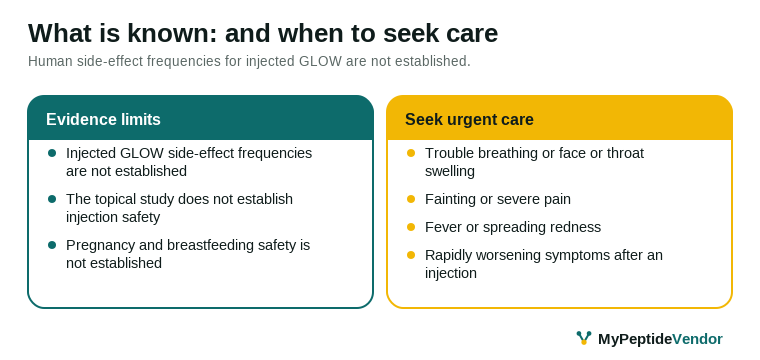
Reliable side-effect frequencies for injected GLOW are not established in human studies. The 3 ClinicalTrials.gov registrations returned by the “GLOW Blend” search concern unrelated topics, so they do not provide rates for injection-site reactions, allergy, infection, or other effects 8. It is not possible to call a reaction common or rare without relevant human safety data.
The topical study reported no irritation with its particular formulation during an 8-week assessment in 30 adults 7. That finding does not establish the safety of injected GHK-Cu, BPC-157, TB-500, or GLOW. A topical formula and an injected mixture have different routes of exposure.
Safety during pregnancy and breastfeeding has not been established for this blend. Avoid nonessential, unapproved peptide products in these situations unless the treating clinician specifically advises otherwise. If you have a current or past cancer diagnosis, discuss any proposed product with your oncology or treating clinician first; these cautions reflect missing safety data, not proof that GLOW causes pregnancy harm or cancer.
The long-term effects of repeated injected GHK-Cu, including copper exposure from a particular vial and schedule, have not been established. A stated peptide mass does not by itself show the amount of copper delivered or the safety of repeated exposure.
Athletes in tested sport should check the current WADA Prohibited List and their sport’s rules before using any peptide product. The WADA status of each GLOW ingredient is not established, so confirm it with the relevant anti-doping organization or team medical staff rather than relying on a seller's "research use" label.
Seek urgent medical care for trouble breathing, swelling of the face or throat, fainting, severe pain, fever, spreading redness, or rapidly worsening symptoms after an injection. Because human side-effect frequencies for GLOW are not established, a seller’s list cannot show how likely a reaction is.
Use this chart
Free to reuse with a link back:
Frequently asked questions
What is the recommended GLOW Blend dosage?
No human dose is established, and GLOW has no FDA-approved dosing label. The claimed 70 mg, 5:1:1 vial formula is an unverified product description, not a dose shown to be safe or effective.
How much bacteriostatic water should I use to reconstitute GLOW?
No human-tested reconstitution volume is established. A 3 mL volume is often circulated as an example, but it is not a validated injection instruction; preparation and stability require product-specific evidence and qualified oversight.
How often is GLOW taken, and how long is a cycle?
No human trial or FDA label establishes its frequency, cycle length, break, or repeat schedule. An online schedule is not equivalent to an approved label or a human dosing study.
Has GLOW Blend been studied in a human trial?
A ClinicalTrials.gov search for “GLOW Blend” returned 3 registrations on unrelated topics, not a trial of this peptide combination 8. A separate 8-week skin study tested a topical multi-ingredient product in 30 adults, not injectable GLOW 7.
Can GLOW improve skin because it contains GHK-Cu?
That has not been demonstrated for injected GLOW. The human skin study tested a topical formula containing retinol, a pea peptide, and antioxidants, so its results cannot establish what injected GHK-Cu or the blend does 7.
Is GLOW safe during pregnancy or after cancer?
Safety during pregnancy and breastfeeding has not been established, so avoid nonessential, unapproved peptide products unless your clinician specifically advises otherwise. If you have or had cancer, discuss any proposed use with your treating clinician before considering it.
How can I check whether a GLOW supplier is reliable?
Request a batch-specific COA with a matching lot number, named laboratory, test methods, and identity and purity results for each ingredient. For a product presented as injectable, ask for batch-specific sterility and endotoxin results; paperwork alone does not prove a vial is suitable for injection.
Is GLOW permitted in tested sport?
Check the current WADA Prohibited List and your sport’s rules before using any peptide product. Current status of each ingredient is not established by the available evidence; confirm with an anti-doping organization or team medical staff.
References
- FDA: Certain bulk drug substances for use in compounding that may present significant safety risks
- Farouk et al. Phase-Dependent Thermoluminescence Properties of Zinc Sulphide. J Fluoresc. 2025.
- Sharma et al. Comparing the optical properties and thermal stability of green (TbPO4), yellow (DyPO4), and red (PrPO4) emitting single crystal samples. Phys Chem Chem Phys. 2020.
- Sharma et al. Computational, optical and feasibility studies of organic luminescence TMB-PPT blend for photovoltaic application. Heliyon. 2024.
- Gerlach et al. Ion mass and energy selective hyperthermal ion-beam assisted deposition setup. Rev Sci Instrum. 2017.
- Carr et al. The ugliness-in-averageness effect: Tempering the warm glow of familiarity. J Pers Soc Psychol. 2017.
- Cook et al. Effects of Retinol, Natural Pea Peptide and Antioxidant Blend in a Topical Formulation: In Vitro and Clinical Evidence. Dermatol Ther (Heidelb). 2025.
- ClinicalTrials.gov: 3 registered studies (search: GLOW Blend)
Written by the MyPeptideVendor editorial team from the FDA label, peer-reviewed studies and ClinicalTrials.gov records listed above, fact-checked line by line and reviewed 2026-11-12.
Cite this page
MyPeptideVendor Editorial Team. glow blend dosage: Protocol & Safety. MyPeptideVendor. Updated November 12, 2026. https://mypeptidevendor.com/protocols/glow-blend-dosing/MyPeptideVendor Editorial Team. (2026, November 12). glow blend dosage: Protocol & Safety. MyPeptideVendor. https://mypeptidevendor.com/protocols/glow-blend-dosing/Related protocols
LL-37 5 mg
Not approvedA 5 mg LL-37 vial has no established human injection dose; concentration and syringe units depend on verified product instructions.
View protocolTB-500 10 mg
Research UseNo approved human TB-500 dose exists; this guide separates unvalidated schedules from 10 mg vial math, handling, evidence, and safety.
View protocol