PE-22-28: Evidence, Safety & FDA Status
Experimental spadin-derived peptide
Brand names: No FDA-approved brand name.

PE 22-28 is a 7-amino-acid peptide derived from spadin (PE 12-28) and studied for its effects on the TREK-1 potassium channel 2. The reported evidence comes from laboratory cells and mice, not human depression trials 2.
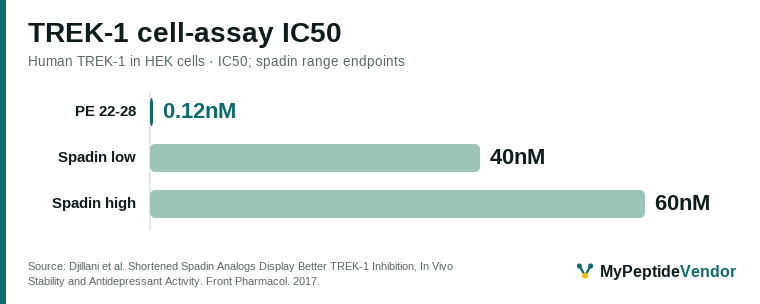
In a cell assay, PE 22-28 had an IC50 of 0.12 nM, compared with 40–60 nM for spadin 2. That result describes activity in a specific experiment; it does not establish a human dose or mood benefit.
Key takeaways
- PE 22-28 is a 7-amino-acid spadin-derived peptide tested as a TREK-1 blocker 2.
- Its cell-assay IC50 was 0.12 nM, compared with 40–60 nM for spadin 2.
- Mouse novelty-suppressed feeding results followed 4 days of treatment; no human mood outcomes were studied 2.
- Animal activity lasted up to 23 hours for PE 22-28 and related analogs, compared with spadin activity that disappeared beyond 7 hours 2.
- No human dose, human side-effect percentage, or FDA-approved product is established 2.
PE-22-28 at a glance
- Class
- Experimental spadin-derived peptide.
- Mechanism
- Blocks the TREK-1 potassium channel in cell experiments.
- FDA Status
- Not an FDA-approved treatment; research-only.
- Brand names
- No FDA-approved brand name.
- Administration
- No human route has been established.
- Typical Dose
- No human dose or schedule has been established.
- Half-life
- Human half-life is unknown; animal activity duration is not the same measure.
- Primary Uses
- Preclinical research on TREK-1 and mouse depression-related behavior.
What is it?

PE 22-28 is a shortened peptide derived from spadin, also called PE 12-28 2. Researchers designed it as a 7-amino-acid fragment after studying products formed when spadin degraded in blood 2.
The direct answer to “what does it do?” is limited: PE 22-28 blocked TREK-1 in laboratory cells and changed behavior in certain mouse tests 2. Those findings do not show that it treats depression or changes mood in people.
The primary study describes the peptide as 7 amino acids long but does not provide a CAS number, molecular formula, or molecular weight 2. Treat chemical identifiers from product listings as unverified unless a primary chemical record confirms them.
What makes it different
PE 22-28 was designed to address a weakness seen with spadin: in animals, spadin activity disappeared beyond 7 hours after administration 2. In the reported animal work, PE 22-28 and related analogs showed activity lasting up to 23 hours 2. That is an animal activity duration, not a human half-life or recommended dosing interval.
In human TREK-1 channels expressed in HEK cells, PE 22-28 had an IC50 of 0.12 nM, versus 40–60 nM for spadin 2. IC50 means the concentration that produces half of the measured effect in that assay; a lower value indicates greater potency in that test. It does not tell us how much of the peptide a person would need.
The researchers also altered the peptide’s N- or C-terminal ends. Some changes preserved TREK-1 activity, while others abolished it, without changing the measured affinity 2. That result helps explain how the peptide’s structure relates to its laboratory activity, but it does not establish a safe or effective medicine.
How does it work?
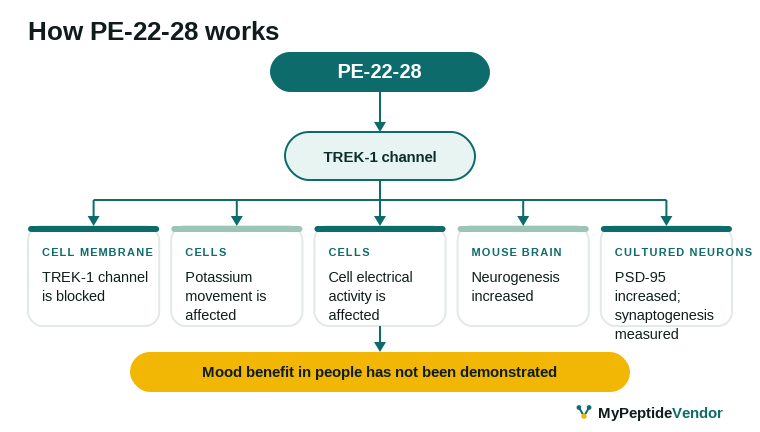
In plain terms, TREK-1 is a potassium channel: it helps control how potassium moves across a cell membrane and, in turn, how electrically active a cell is. PE 22-28 blocked this channel in patch-clamp tests using cells that expressed human TREK-1 2. Blocking the channel is the proposed mechanism; a mood effect in people has not been demonstrated.
The study examined two kinds of brain-cell change, in separate models. Neurogenesis was reported in mice after only a 4-day treatment, with a prominent effect for the G/A-PE 22-28 analog 2. Synaptogenesis means the formation of connections between neurons; researchers measured it in cultured mouse cortical neurons by looking at increased PSD-95 expression 2.
These findings do not show that PE 22-28 reaches a specific brain area after use in people. The hippocampus result came from mice, and the synaptogenesis result came from cultured cells rather than a living human brain 2.
Use this chart
Free to reuse with a link back:
What the clinical evidence actually shows

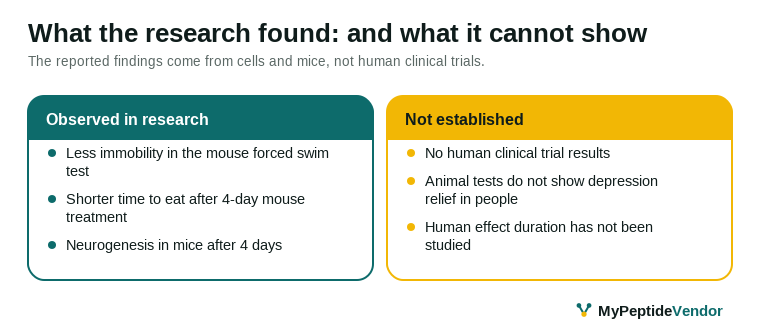
There are no human clinical trial results for PE 22-28 in the reported research 2. The study therefore provides no human participant count, clinical-trial duration, human mood score, or numerical human treatment effect. The abstract does not give the animal group sizes or numerical effect sizes, either 2.
In the forced swim test (FST), a mouse behavior test used in antidepressant research, treated mice showed significantly less immobility 2. In the novelty-suppressed feeding test (NSF), PE 22-28 significantly reduced the time mice took to eat a food pellet after 4 days of subchronic treatment 2. These tests measure animal behavior; they cannot establish relief of depression in people.
The study also reports increased neurogenesis in mice after 4 days, and increased PSD-95 expression in cultured neurons as a measure of synaptogenesis 2. The animal activity-duration result reached up to 23 hours for PE 22-28 and related analogs, while spadin activity disappeared beyond 7 hours 2. The duration of any effect in humans has not been studied.
Claims to avoid: The reported study does not establish improved muscle function, benefit for post-stroke depression, nasal-spray delivery to the brain, a happier mood in people, or fewer side effects than standard antidepressants 2. Those claims go beyond its cell and mouse experiments.
The evidence ladder stops before human testing: channel potency was measured in cells, while behavior and neurogenesis findings came from mice 2. The results support further research, not a treatment recommendation.
Use this chart
Free to reuse with a link back:
Use this chart
Free to reuse with a link back:
Typical dosing

There is no established human dose, dose range, route, or schedule for PE 22-28, and no approved product label provides instructions 2. The study reports a 4-day subchronic treatment period for the mouse novelty-suppressed feeding result, but no human-equivalent dose can be recommended from that experiment 2.
Trial range: The reported research gives no usable human dose range 2. A seller’s vial size or suggested schedule is not a clinical dose, and animal activity lasting up to 23 hours does not establish how often a person should take it 2.
Side effects: what to actually expect
No human side-effect percentages are available because PE 22-28 has not been tested in human trials 2. The reported research provides no human adverse-event rate and no approved product label with a side-effect frequency table 2. Missing safety data do not mean the peptide is harmless.
Human toxicity, effects on mood or brain function, drug interactions, and risks by route have not been established 2. The safety of any research product also depends on whether its identity, purity, sterility, and dose are accurate; a product label alone cannot establish those qualities. Anyone who has used an unapproved peptide and develops concerning symptoms should seek medical advice rather than take another dose.
Regulatory & access status in the US
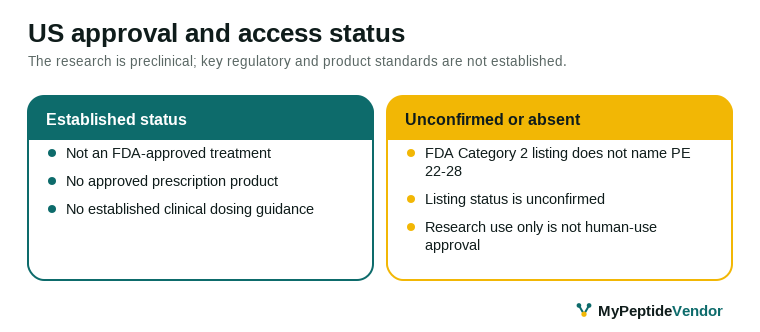
PE 22-28 is not an FDA-approved treatment; the reported research is preclinical 2. There is no approved prescription product or established clinical dosing guidance.
FDA describes Category 2 as bulk drug substances that may present significant safety risks when considered for compounding 1. FDA's Category 2 listing 1 does not name PE 22-28, so its listing status is unconfirmed. A compounding-list entry, if one exists, would not itself establish that a product is safe for self-use 1.
“Research use only” is not the same as approval for human use. The absence of human trials also means no human-grade safety, sterility, or dosing standard has been established for PE 22-28 2.
Use this chart
Free to reuse with a link back:
Research-grade PE-22-28 is available from American Peptides (PE-22-28, from $70.00); code MYPEPTIDEVENDOR takes 15% off. Sold for laboratory research only, not for human use. Affiliate link
How it compares with its closest alternative
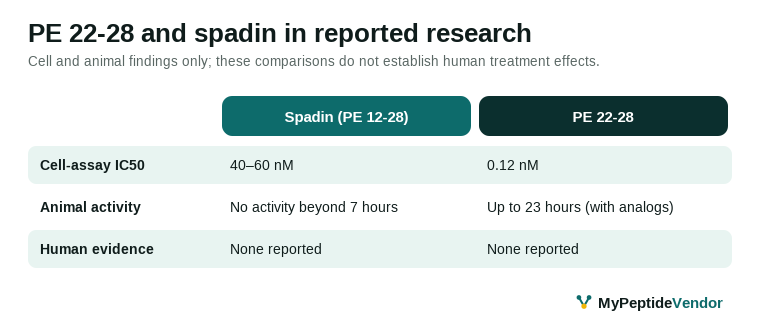
Spadin (PE 12-28) is the closest alternative because PE 22-28 was designed from spadin blood-degradation products. The comparison below reflects the reported cell and animal findings; it does not establish human treatment effects for either peptide 2.
| Feature | Spadin (PE 12-28) | PE 22-28 |
|---|---|---|
| Relationship | Spadin-derived peptide studied as a TREK-1 blocker | 7-amino-acid fragment designed from spadin blood-degradation products |
| Cell-assay IC50 | 40–60 nM on human TREK-1 in HEK cells | 0.12 nM in the same assay system |
| Animal activity duration | Activity disappeared beyond 7 hours | Up to 23 hours for PE 22-28 and related analogs |
| Behavioral findings | Compared with PE 22-28 in the reported research | Reduced immobility in the forced swim test and reduced feeding latency after 4-day treatment |
| Human evidence | No human results reported | No human results reported |
PE 22-28 was more potent in the reported cell assay and showed longer-lasting animal activity than spadin 2. Those differences make it a research candidate, not a proven antidepressant or a replacement for established treatment.
Use this chart
Free to reuse with a link back:
Where to Buy PE-22-28 for Research
American Peptides
PE-22-28 · from $70.00
US-made research peptides, every lot third-party tested with a lot-matched COA.
15% offMYPEPTIDEVENDOR at checkout
- ≥99% purity verified by HPLC + mass spec, endotoxin tested
- Ships tracked from Louisiana, free shipping over $300
- 15% off your first order with code MYPEPTIDEVENDOR
Affiliate disclosure: we may earn a commission if you order through the link above. PE-22-28 is not approved by the FDA for human use.
Frequently asked questions
What does PE 22-28 peptide do?
It is being studied as a way to block a potassium channel involved in cell electrical activity 2. Whether that action helps people with depression remains unanswered.
What peptides make you feel happy?
No peptide has been shown in the PE 22-28 research to reliably make people feel happy; the reported mood-related work used mice, not people 2. For persistent low mood, a clinician can discuss treatments with human evidence.
What peptide does Joe Rogan use?
There is no verifiable evidence in the reported PE 22-28 research that Joe Rogan uses this peptide 2. Celebrity-use claims should not be treated as evidence of safety or benefit.
What are the reviews of the PE-22-28 peptide?
The available research reports laboratory and mouse experiments, not human treatment reviews 2. Seller testimonials are anecdotes and cannot establish how well the peptide works or what risks it carries.
References
- FDA: Certain bulk drug substances for use in compounding that may present significant safety risks
- Djillani et al. Shortened Spadin Analogs Display Better TREK-1 Inhibition, In Vivo Stability and Antidepressant Activity. Front Pharmacol. 2017.
Written by the MyPeptideVendor editorial team from the FDA label, peer-reviewed studies and ClinicalTrials.gov records listed above, fact-checked line by line and reviewed 2026-11-12.
Cite this page
MyPeptideVendor Editorial Team. pe 22 28: Evidence, Safety & FDA Status. MyPeptideVendor. Updated November 12, 2026. https://mypeptidevendor.com/peptides/pe-22-28/MyPeptideVendor Editorial Team. (2026, November 12). pe 22 28: Evidence, Safety & FDA Status. MyPeptideVendor. https://mypeptidevendor.com/peptides/pe-22-28/Related peptides
B7-33
Research UseB7-33 activates RXFP1 and has preclinical heart and fibrosis findings, but no established human dose, human trial results, or known human safety profile.
Learn moreBPC-157 + TB-500 Blend
Research UseA blend of BPC-157 and TB-500 has no established human dose or proven benefit for injury healing; key safety and stability questions remain unanswered.
Learn moreKPV
Research UseKPV is an experimental α-MSH tripeptide with laboratory and animal findings, no established human dose, and no proven human treatment benefit.
Learn more