BPC 157 TB 500 Blend: Evidence & Safety
Investigational peptide blend
Brand names: BPC-157 + TB-500 blend; “Wolverine stack” is an informal nickname

A bpc 157 tb 500 blend combines BPC-157 and TB-500, two peptides marketed together for tissue-repair research. The pairing is also nicknamed the “Wolverine stack,” but that name is informal and does not show that the blend heals injuries.
No established human dose or clinical benefit has been demonstrated for the combination. The blend’s ratio, identity, stability, and safety can vary by product, and research-use labeling does not make a vial suitable for human injection.
Key takeaways
- The proposed role split is BPC-157 for more targeted signaling and TB-500 for broader cell movement; it is a hypothesis, not a proven clinical distinction.
- No controlled human trial has established that the blend heals an injury or shown how long treatment would take.
- A fixed-ratio blend ties the amount of each peptide together; a vial’s total weight does not identify the amount of either component.
- FDA describes Category 2 as an interim category for nominated bulk substances that may present significant safety risks in compounding 1.
- No reliable side-effect percentages or liver-safety estimates are established for the blend.
BPC-157 + TB-500 Blend at a glance
- Class
- Investigational peptide combination
- Mechanism
- Proposed effects on blood-vessel signaling, connective-tissue cells, and cell movement
- FDA Status
- Not an FDA-approved treatment; research-use products are not approved medicines
- Brand names
- BPC-157 + TB-500 blend; “Wolverine stack” is an informal nickname
- Administration
- No approved route for treating people
- Typical Dose
- No established human dose or schedule
- Half-life
- Not established in people for the blend
- Primary Uses
- Laboratory and preclinical research into tissue-repair signaling
What is it?

BPC-157 is a synthetic peptide associated with research into a protective compound described in gastric juice. TB-500 is a marketplace name associated with thymosin beta-4 research. The name on a vial does not, by itself, confirm the peptide’s sequence or exact identity.
People sometimes call the pairing the “Wolverine stack,” a reference to a fictional character known for healing quickly. The nickname describes a marketed combination, not a standardized medicine or clinical protocol. No blend standard sets one universal ratio.
A blend puts both ingredients in one preparation. Its total mass does not tell you how much BPC-157 or TB-500 it contains. A certificate of analysis should identify each component and its amount; a purity result alone does not establish identity, sterility, or the amount of each peptide.
What makes it different
The proposed role split is BPC-157 as the more targeted or “local” component and TB-500 as the more systemic component associated with cell movement and mobility. This division reflects separate research themes, not a demonstrated difference in how people heal after taking either peptide.
Separate vials let researchers handle each ingredient independently. A blend fixes the ratio, so changing the amount of the mixture changes the amounts of both peptides together. That makes it harder to test one compound alone or adjust the two independently.
TB-500 identity needs particular care. The marketplace name may refer to a thymosin beta-4-related fragment, while full-length thymosin beta-4 is a different material. Without a sequence or identity test, a label using “TB-500” alone does not settle what is in the vial.
Whether the two peptides remain stable together at labeled potency has not been established for every formulation or storage condition. Do not assume that a ratio, storage period, or handling method used for one product applies to another.
How does it work?
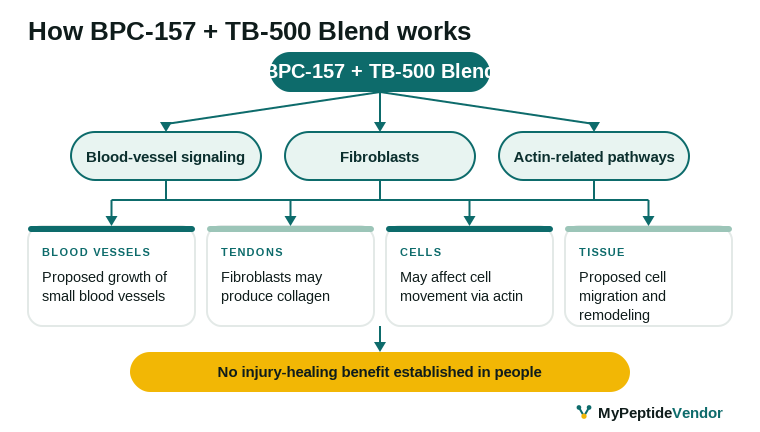
In plain terms, researchers are asking whether these peptides can affect how cells move to damaged tissue and how the body builds repair tissue. These proposed actions do not prove that a person using the blend will recover faster.
BPC-157 research examines angiogenesis, the growth of small blood vessels, and possible effects on fibroblasts. Fibroblasts help produce connective-tissue material, including collagen, the structural protein in tendons and other tissues. These are proposed mechanisms, not established treatment effects in people.
Thymosin beta-4 research includes actin, a protein that helps cells keep their shape and move. TB-500 is proposed to affect cell migration and tissue remodeling through related pathways. It has not been shown that a particular TB-500 product acts like full-length thymosin beta-4 or that adding it to BPC-157 improves healing.
Use this chart
Free to reuse with a link back:
What the clinical evidence actually shows

No controlled human trial of the BPC-157 plus TB-500 blend has established a benefit for tendon, ligament, muscle, or other injuries. There is no blend trial with a reported trial name, enrollment, treatment duration, and numerical result to compare with usual care. A human effect size for the combination is therefore not established.
Research on one peptide cannot establish how the combination works. Cell and animal studies can test biological ideas, but they do not show how much faster a human injury would heal or whether a person would improve. No reliable human time-to-effect is established for either peptide or the blend.
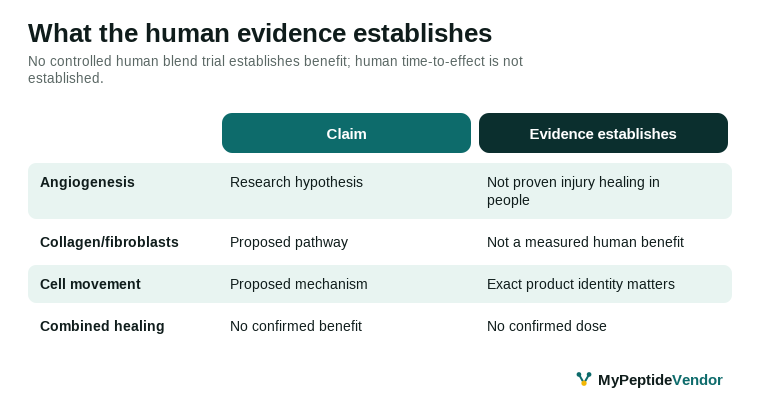
Claims involving new blood vessels, collagen, fibroblast activity, and cell migration remain proposed mechanisms in this context. The combined clinical benefit, best ratio, and comparative value have not been established. There is also no established evidence that the peptides work better together than either would work alone.
Other open questions include whether the peptides interact, whether a mixed vial keeps its stated potency, and whether either peptide interacts with anti-inflammatory drugs, anticoagulants, or other medicines. Human interaction data and a validated monitoring schedule have not been established. Human liver-safety data are also lacking.
| Claim | Evidence type | What it establishes |
|---|---|---|
| Blood-vessel signaling and angiogenesis | Preclinical mechanism research | A research hypothesis, not proven injury healing in people |
| Collagen and fibroblast activity | Preclinical mechanism research | A possible pathway, not a measured human treatment benefit |
| Cell movement through actin-related pathways | Thymosin beta-4-related research | A proposed mechanism; exact product identity matters |
| Improved healing from the combined blend | No controlled human blend trial established | No confirmed benefit, dose, or time-to-effect |
Use this chart
Free to reuse with a link back:
Typical dosing

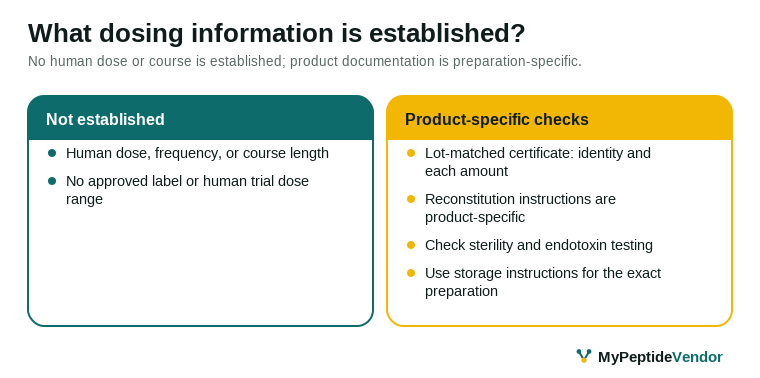
There is no evidence-based human dose, injection frequency, or course length for the blend. No approved label or human trial establishes a dosing range. A clinic schedule or online seller instruction is not a trial dose and cannot establish safety or effectiveness.
Do not infer a dose from the total amount printed on a vial. The component ratio and concentration determine how much of each peptide a given volume contains, and blend labels are not standardized. If a product does not disclose the amount of each component, its ratio cannot be verified from the total alone.
Reconstitution and storage instructions are product-specific. Use only validated handling information for the exact preparation; do not assume another product’s solvent, temperature, or storage period applies. A powder’s appearance does not establish that a reconstituted solution is sterile or stable.
For laboratory documentation, check that the certificate matches the vial’s lot and reports identity and the amount of each component. Also check for sterility and endotoxin testing, storage instructions, and a clear product identity. These checks do not make a research product an approved medicine for human injection.
Use this chart
Free to reuse with a link back:
Side effects: what to actually expect
No human trial of the blend or approved product label provides reliable side-effect percentages. There is no sound estimate for how often users would develop nausea, headache, injection pain, or another reaction. Missing rates do not mean the blend is safe.
Redness, tenderness, warmth, or swelling can occur after an injection, but the frequency for this blend is unknown. A contaminated or improperly handled injectable product can also create infection risk. Fever, spreading redness, drainage, or rapidly worsening pain after an injection calls for prompt medical assessment.
A new injury with severe pain, major swelling, numbness, deformity, or inability to use the affected area needs assessment rather than an experimental peptide. A fracture, tendon tear, or infection may need specific diagnosis and treatment. Do not use a peptide to delay care for a suspected serious injury.
Liver-safety outcomes for BPC-157 and the blend are not characterized in the available evidence, so the risk of liver injury cannot be determined. No evidence-based liver-panel schedule has been established for users. Jaundice, dark urine, or severe abdominal pain needs medical attention rather than self-monitoring alone.
Regulatory & access status in the US
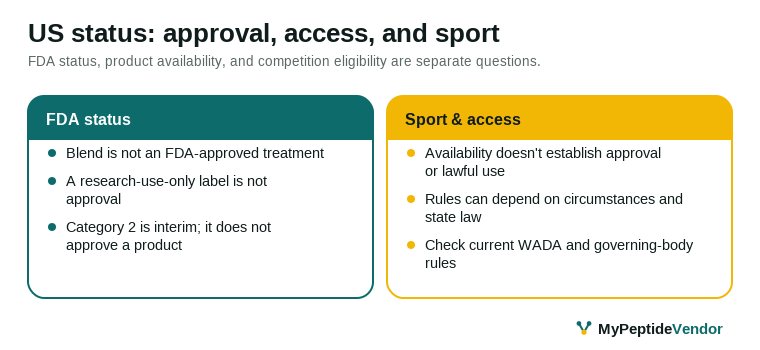
The blend is not an FDA-approved treatment, and a “research use only” label does not make it an approved medicine. FDA describes Category 2 as an interim category for bulk drug substances nominated under sections 503A or 503B that may present significant safety risks in compounding 1.
Category 2 lists substances that may present significant safety risks 1; it does not approve any product. Online availability does not establish that a product is approved or lawful for every intended use. Personal possession and sale rules can depend on circumstances and applicable state law.
For sport, do not assume either peptide is permitted. Athletes should check the current WADA Prohibited List and their governing body’s rules before use; FDA status and competition eligibility are separate questions. Confirm the current section and rules directly rather than relying on a seller’s description.
Before any laboratory use, compare the vial and lot-specific certificate, confirm the identity and amount of each component, and look for sterility and endotoxin documentation. FDA states that certain bulk drug substances used in compounding may present significant safety risks 1.
Use this chart
Free to reuse with a link back:
Research-grade BPC-157 + TB-500 Blend is available from American Peptides (BPC-157 + TB-500 Blend, from $195.00); code MYPEPTIDEVENDOR takes 15% off. Sold for laboratory research only, not for human use. Affiliate link
How it compares with its closest alternative
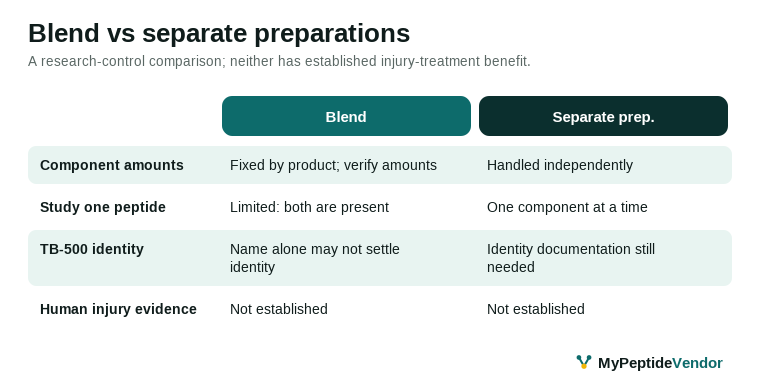
The closest alternative is studying the peptides in separate preparations rather than in a fixed-ratio blend. Neither approach has established clinical benefit for treating injuries. This comparison concerns research control, not treatment advice.
| Feature | BPC-157 + TB-500 blend | Separate preparations |
|---|---|---|
| Component amounts | Fixed by the product; verify each amount | Each preparation can be handled independently |
| Ability to study one peptide | Limited because both are present together | Allows study of one component at a time |
| TB-500 identity | Name alone may not establish the exact material | Each material still needs identity documentation |
| Human injury-treatment evidence | Not established | Not established for these preparations |
| Stability and storage | Requires product-specific data | Requires data for each preparation |
Use this chart
Free to reuse with a link back:
Where to Buy BPC-157 + TB-500 Blend for Research
American Peptides
BPC-157 + TB-500 Blend · from $195.00
US-made research peptides, every lot third-party tested with a lot-matched COA.
15% offMYPEPTIDEVENDOR at checkout
- ≥99% purity verified by HPLC + mass spec, endotoxin tested
- Ships tracked from Louisiana, free shipping over $300
- 15% off your first order with code MYPEPTIDEVENDOR
Certified-Pep
US-made research peptides with batch-specific lab reports (COA) and a QR code on every vial.
- Independent laboratory testing (Vanguard Laboratory)
- Made in the USA, ships in 1-2 business days
- Research use only, not for human or veterinary use
Affiliate disclosure: we may earn a commission if you order through the link above. BPC-157 + TB-500 Blend is not approved by the FDA for human use.
Frequently asked questions
What does BPC-157 TB 500 blend peptide do?
It is marketed as a combination for tissue-repair research. The proposed ideas involve blood-vessel signaling, connective-tissue cells, and cell movement, but the blend has not been shown to improve injury healing in people.
Can BPC-157 cause liver damage?
The risk in people is not known because human liver-safety data are lacking. No validated liver-test schedule has been set for users, so discuss symptoms or concerns with a clinician rather than relying on self-testing.
How long do BPC-157 and TB500 take to work?
There is no established human timeline for either peptide or their combination. A response time cannot be predicted from proposed mechanisms, and feeling better would not prove that an injury had healed.
How often do I take BPC-157 and TB 500?
No evidence-based human frequency has been established. A clinic or seller schedule is not a validated regimen, and a fixed-ratio blend may not let you adjust each component independently.
References
Written by the MyPeptideVendor editorial team from the FDA label, peer-reviewed studies and ClinicalTrials.gov records listed above, fact-checked line by line and reviewed 2026-11-12.
Cite this page
MyPeptideVendor Editorial Team. BPC 157 TB 500 Blend: Evidence & Safety. MyPeptideVendor. Updated November 12, 2026. https://mypeptidevendor.com/peptides/bpc-157-tb-500-blend/MyPeptideVendor Editorial Team. (2026, November 12). BPC 157 TB 500 Blend: Evidence & Safety. MyPeptideVendor. https://mypeptidevendor.com/peptides/bpc-157-tb-500-blend/Related peptides
B7-33
Research UseB7-33 activates RXFP1 and has preclinical heart and fibrosis findings, but no established human dose, human trial results, or known human safety profile.
Learn moreKPV
Research UseKPV is an experimental α-MSH tripeptide with laboratory and animal findings, no established human dose, and no proven human treatment benefit.
Learn morePE-22-28
Research UsePE 22-28 is a spadin-derived research peptide with cell and mouse findings, but no established human benefit, dose, or safety profile.
Learn more