KPV Ac Kpv nh2: Evidence & Safety
α-MSH-derived tripeptide
Brand names: No FDA-approved brand name.

KPV is a three-amino-acid fragment of α-melanocyte-stimulating hormone (α-MSH), corresponding to residues 11–13 5,9. Acetylation and amidation of the end groups do not establish a human benefit or a safe dose.
KPV has no FDA-approved indication or prescribing label. No completed human KPV trial reporting enrollment, duration, or numerical patient outcomes has been published 3,9. Most relevant findings are from laboratory work, reviews, or animal models.
Key takeaways
- KPV is the α-MSH 11–13 tripeptide; the acetyl and amide groups describe chemical ends, not proven improvements in human effects 5,9.
- The proposed anti-inflammatory biology includes NF-κB inhibition and changes in cytokine signaling, but KPV’s exact mechanism remains unsettled 2,5,9.
- Mouse contact-hypersensitivity research reports effects after systemic and topical KPV, but does not establish a human dose or patient benefit 9.
- No human KPV trial side-effect percentages or validated dosing range are established in the available clinical record 3,9.
- KPV is not FDA-approved, and its inclusion in FDA Category 2 for compounding is not established here 1.
KPV at a glance
- Class
- α-MSH-derived tripeptide
- Mechanism
- Proposed anti-inflammatory activity involving NF-κB and cytokine signaling; the exact KPV pathway is unresolved.
- FDA Status
- No FDA-approved KPV indication or label; Category 2 status is not established.
- Brand names
- No FDA-approved brand name.
- Administration
- Systemic and topical routes were reported in mouse contact-hypersensitivity research.
- Typical Dose
- No established human dose or validated dosing range.
- Half-life
- No KPV-specific human half-life is established.
- Primary Uses
- Experimental study of inflammatory and immune signaling; no human treatment use is established.
What is it?

KPV is a short peptide made from lysine, proline, and valine. It matches the final three amino acids of α-MSH, numbered 11–13 in the full 13-residue hormone 5,9. Researchers study KPV because this small fragment appears to retain some anti-inflammatory activity described for α-MSH 5.
“Ac” means an acetyl group is attached at the peptide’s amino end. “NH2” indicates an amide at the other end. These labels describe chemical structure; they do not, on their own, show that Ac-KPV-NH2 lasts longer in the body, is absorbed better, or works better in people.
It is useful to keep the forms separate. KPV, H-KPV-NH2, and Ac-KPV-NH2 are not interchangeable names for every research purpose. Findings for one form should not automatically be assigned to another. The cited anti-inflammatory reviews discuss KPV, but do not establish a human safety profile or clinical effect for the acetylated and amidated form 5,9.
Do not assume that acetylation makes Ac-KPV-NH2 resistant to breakdown. That result cannot establish improved stability for the acetylated form.
A product label also cannot prove what is inside a vial. For an unregulated product, identity, purity, and contamination are practical risks; peptide products may be mislabeled or contaminated 3. A lot-specific certificate of analysis is more useful than a generic product sheet, but it should be supported by independent identity and purity testing. For an injectable product, purity testing alone does not establish sterility.
Before considering any product, check whether its paperwork identifies the exact form (KPV, H-KPV-NH2, or Ac-KPV-NH2) and whether testing is tied to the same lot. A supplier that cannot explain how identity was checked, or that makes treatment promises without human outcome data, is a sourcing red flag 3.
What makes it different
KPV is only three amino acids long, while α-MSH is a 13-residue hormone with a wider range of biological activity 5,9. Researchers have asked whether the short fragment can retain anti-inflammatory effects without all of the parent hormone’s other actions. That possibility does not prove greater safety or selectivity in people.
There is a real disagreement about melanocortin receptor binding. Brzoska and colleagues say KPV lacks the sequence motif required to bind known melanocortin receptors, yet retains much of α-MSH’s anti-inflammatory capacity 5. Luger and colleagues report that KPV can bind MC1R and alter antigen-presenting cell function 9. The disagreement is unresolved, so receptor binding should not be presented as settled fact.
KPV has been described as retaining anti-inflammatory activity without α-MSH’s pigmentary action 5. That is not proof that KPV has no effect on pigmentation in people. It also does not establish that the peptide avoids every other effect related to melanocortin biology.
Another point of disagreement concerns antimicrobial activity. A review reports inhibitory effects of KPV against Staphylococcus aureus and Candida albicans 4. These results differ by the peptide form and experimental conditions; neither shows that KPV treats an infection in people.
Claims that KPV is “safer” because it is small, selective, or rarely reported to cause side effects go beyond the evidence. Without well-designed human studies, both benefit and harm may go unmeasured. A review of peptide use in sport identifies broader concerns such as cardiovascular strain, insulin resistance, dyslipidemia, psychiatric instability, and mislabeled or contaminated products; those are peptide-use concerns, not KPV-specific event rates 3.
KPV is also not established as an IBD treatment. Reviews discuss KPV among host-defense peptides of interest for inflammatory bowel disease and describe melanocortin-related findings in mouse colitis models 6,7. That is a research rationale, not evidence that KPV improves Crohn’s disease or ulcerative colitis in patients.
How does it work?
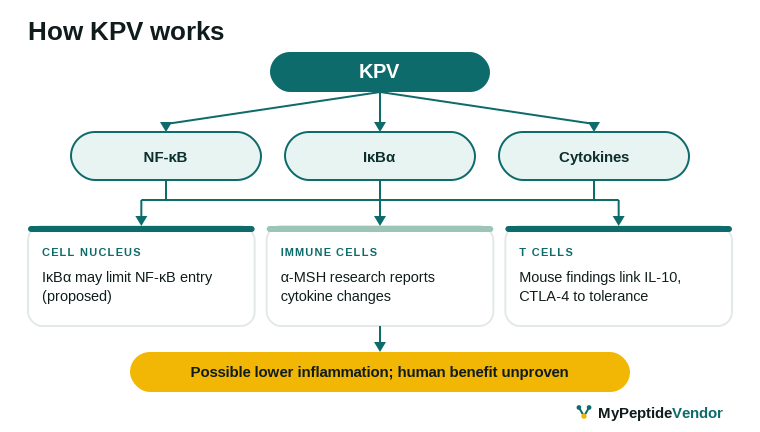
In plain words, KPV is being studied as a possible way to turn down some of the signals that help drive inflammation. One important cell-control system is NF-κB. When activated, NF-κB can move into a cell’s nucleus and help switch on genes involved in inflammatory responses. Research on α-MSH describes inhibition of NF-κB through preservation of IκBα, a protein that helps keep NF-κB from entering the nucleus 2.
KPV is an α-MSH fragment, and reviews describe anti-inflammatory activity that resembles some effects of the parent peptide 2,5. But the exact signaling route used by KPV has not been mapped. NF-κB inhibition is a plausible part of the proposed biology, not a fully established mechanism in people 5.
Cytokines are messenger proteins used by immune cells. α-MSH research reports changes in cytokines including IL-1, IL-6, and TNF-α, along with increased IL-10 in some settings 9. Those findings do not predict how a person will respond to KPV or how much would be needed to change symptoms.
The receptor question matters to this explanation. One review says KPV lacks the motif needed to bind known melanocortin receptors 5, while another reports MC1R binding and effects on antigen-presenting cells 9. Until that conflict is resolved, describing KPV as a confirmed MC1R agonist would overstate what is known.
Immune effects may depend on the tissue, route, and peptide form. Mouse contact-hypersensitivity research included systemic and topical KPV 9. It does not establish that a swallowed product, skin preparation, or injection sold for personal use reaches the right human tissue at a safe and effective level.
Use this chart
Free to reuse with a link back:
What the clinical evidence actually shows

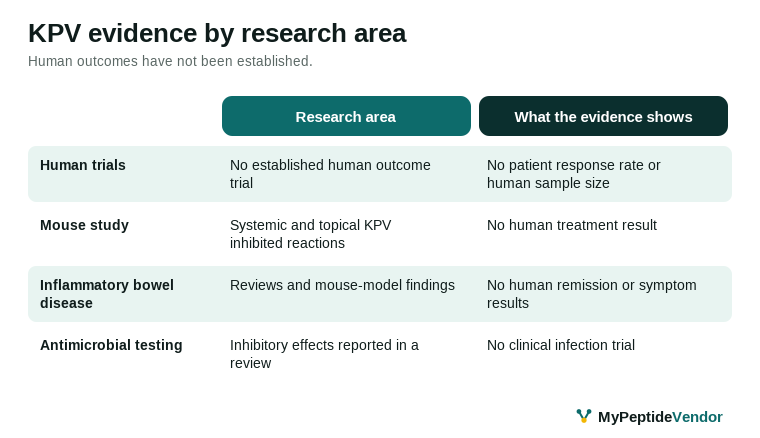
Human trials: No completed human KPV trial has established an enrollment number, treatment duration, and numerical patient outcome 3,9. The review of peptide use in sport describes clinical evidence for peptide use as limited and notes that research settings may differ from recreational or bodybuilding use 3. It does not report a KPV-specific treatment result. There is no patient response rate or human sample size to report.
Mouse contact hypersensitivity: Luger and colleagues report that systemic and topical KPV inhibited both the sensitization and elicitation phases of contact hypersensitivity in mice 9. In plain terms, the reported effects covered both immune priming and the later provoked reaction. The study also describes hapten-specific tolerance, meaning reduced reactivity to the particular substance used to provoke the response 9. Luger et al. 9 do not report an animal count, treatment duration, dose, or numerical effect size usable for human guidance.
The same mouse research connects tolerance with antigen-presenting cells and T cells that produce IL-10 and express CTLA-4 9. These findings offer possible clues about immune signaling. They do not show that KPV treats autoimmune disease in people or that reducing an immune response would be helpful in every condition.
Inflammatory bowel disease: A host-defense peptide review discusses KPV among peptides of interest for inflammatory bowel disease 6. A separate review describes melanocortin-system findings from mouse colitis models 7. The evidence described is preclinical and review-level. It does not provide human remission rates, endoscopic results, symptom scores, or a human dose and treatment duration for Crohn’s disease or ulcerative colitis.
Antimicrobial testing: One review reports inhibitory effects against S. aureus and C. albicans 4. Neither finding is a clinical infection trial, and neither supports replacing antibiotics or antifungal treatment with KPV.
Evidence-strength ladder: Laboratory findings can suggest a mechanism; animal models can test an effect in a whole organism; human trials are needed to measure patient benefit and harm. KPV has mechanistic and animal research, including mouse contact hypersensitivity, but no established human outcome trial 2,5,9. The IBD connection is also based on reviews and animal-model discussion, not clinical treatment results 6,7.
What remains unknown: It has not been established whether KPV improves symptoms in people, which route might work, how long an effect might last, or what dose would be safe. Small or absent human datasets also cannot identify uncommon harms or risks that may emerge after months or years 3,9.
Use this chart
Free to reuse with a link back:
Typical dosing

No established human dose exists. There is no validated human dose range, frequency, treatment length, or FDA dosing instruction for KPV 1,3,9. A vial size or seller’s suggested schedule is not a clinical dosing protocol.
Mouse contact-hypersensitivity research reports systemic and topical administration, but the available report does not provide a human regimen 9. A mouse dose should not be turned into a personal dose by simple body-weight arithmetic. Species, route, formulation, and study design can all change how much peptide reaches a tissue.
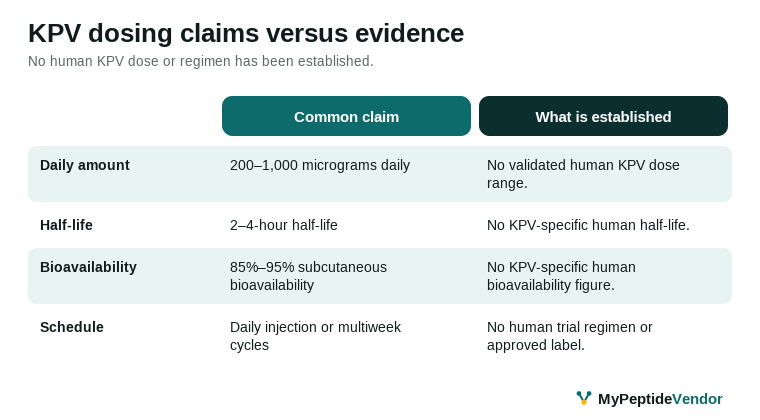
Those are unverified KPV figures, not validated human dosing or pharmacokinetic results 3,9. The review of peptide use discusses short half-lives as a general issue for peptide drugs; it does not establish a KPV-specific human half-life 3.
None of the figures below is a validated human KPV parameter 3,9.
| Common claim | What is established |
|---|---|
| 200–1,000 micrograms daily | No validated human KPV dose range. |
| 2–4-hour half-life | No KPV-specific human half-life. |
| 85%–95% subcutaneous bioavailability | No KPV-specific human bioavailability figure. |
| Daily injection or multiweek cycles | No human trial regimen or approved label. |
Do not treat a research-use label, online vial size, or suggested injection schedule as evidence that a product is suitable for injection, swallowing, or skin use. Do not self-dose an unapproved peptide in place of established care.
Use this chart
Free to reuse with a link back:
Side effects: what to actually expect
No reliable human side-effect percentages are available. There are no established KPV-specific human rates for injection-site reactions, nausea, abdominal symptoms, headache, or other adverse events 3,9. A percentage repeated online is not a clinical finding unless it comes from a defined human study with a reported denominator.
Injection-site and gastrointestinal symptoms are sometimes attributed to KPV in online discussions, but their frequency, onset, duration, and relationship to dose have not been established in human trials 3,9. No FDA KPV label provides an adverse-event table 1. Missing data do not mean these effects cannot happen.
Long-term human safety is unknown. Laboratory work and mouse models cannot show what happens after months or years of use in people. The peptide-use review describes long-term risks of unregulated peptide use as poorly defined 3.
Product quality can create risks separate from the peptide’s intended action. A mislabeled vial could contain the wrong substance or an unexpected amount; contamination could add further risk. Mislabeled and contaminated products are recognized concerns in largely unregulated peptide supply chains 3.
Before considering any product, look for a lot-specific certificate of analysis and independent identity and purity testing. For an injectable product, ask whether sterility was tested separately. A purity result alone does not confirm sterility, and a document bearing a vendor’s name is not the same as independent verification.
Be wary of a supplier that cannot provide lot-specific testing, cannot explain how identity was checked, or promises to treat disease without human trial evidence. Testing cannot make an unapproved peptide safe, but a missing or vague testing record is a practical reason to avoid a product 3.
Trouble breathing, fainting, severe swelling, or persistent vomiting after any drug or injection exposure needs urgent medical attention. These are general warning signs, not KPV-specific adverse events with known rates.
Regulatory & access status in the US
KPV has no FDA-approved treatment indication or prescribing label. There is no approved KPV label specifying a dose, contraindications, or adverse-event rates 1. A product sold online as “research use only” does not become an approved medicine because it is available for purchase.
FDA Category 2 is an interim compounding-policy category for bulk drug substances identified as potentially presenting significant safety risks during review of nominations for compounding 1. KPV’s inclusion in Category 2 is not established here; it should not be described as a confirmed listing without a verified FDA entry. Category 2 status, when applicable, is not FDA approval of a drug.
Regulatory status and retail availability are different questions. A seller’s “research only” wording does not establish that a product is appropriate for human use. A product marketed for personal use also does not establish a lawful, quality-controlled compounding pathway.
Competitive athletes should not infer sport eligibility from an online listing. The peptide-use review discusses doping and WADA’s expanded detection efforts, but does not establish KPV’s specific status on a current prohibited list 3. Athletes need to check the current WADA list and their sport’s rules before exposure.
As of 2026, KPV has no established FDA-approved treatment role, human dose, or long-term human safety profile 1,3. It should not delay proven care for an inflammatory, skin, or bowel condition.
Research-grade KPV is available from American Peptides (KPV, from $60.00); code MYPEPTIDEVENDOR takes 15% off. Sold for laboratory research only, not for human use. Affiliate link
How it compares to its closest alternative
α-MSH is the parent hormone, while KdPT is a related tripeptide corresponding to IL-1β residues 193–195 5. Parent hormone and KdPT findings come from separate research discussions 5,9, with no head-to-head clinical trial reported.
| Peptide | What it is | Evidence described | Main unknown |
|---|---|---|---|
| KPV | α-MSH residues 11–13 | Laboratory and animal research, including mouse contact hypersensitivity | No established human dose, clinical outcome, or human side-effect rate |
| α-MSH | The full 13-residue parent hormone | Research on NF-κB, cytokines, immune cells, and animal inflammation models | Its broader activity means parent-hormone findings cannot automatically be assigned to KPV |
| KdPT | A related tripeptide corresponding to IL-1β residues 193–195 | Reviewed as an emerging anti-inflammatory peptide | No established human dosing comparison or head-to-head safety trial with KPV |
There is no shared clinical safety dataset that ranks KPV against α-MSH or KdPT 5,9. The available evidence does not justify calling KPV the safest peptide. A short sequence and a lack of measured adverse-event rates do not demonstrate lower risk; they can also reflect limited human testing 3,5,9.
BPC-157 is sometimes discussed alongside experimental peptides, but the cited research does not provide a direct comparison with KPV. There is no supported basis here to rank the two by effectiveness or safety 3.
Where to Buy KPV for Research
American Peptides
KPV · from $60.00
US-made research peptides, every lot third-party tested with a lot-matched COA.
15% offMYPEPTIDEVENDOR at checkout
- ≥99% purity verified by HPLC + mass spec, endotoxin tested
- Ships tracked from Louisiana, free shipping over $300
- 15% off your first order with code MYPEPTIDEVENDOR
Certified-Pep
US-made research peptides with batch-specific lab reports (COA) and a QR code on every vial.
- Independent laboratory testing (Vanguard Laboratory)
- Made in the USA, ships in 1-2 business days
- Research use only, not for human or veterinary use
Affiliate disclosure: we may earn a commission if you order through the link above. KPV is not approved by the FDA for human use.
Frequently asked questions
Who shouldn't take KPV peptide?
No KPV-specific human contraindication list has been established 3,9. Pregnancy or breastfeeding, a cancer history, autoimmune disease, or use of immune-suppressing medicine are reasons to avoid self-experimentation and discuss any proposed exposure with a clinician; these are precautions under uncertainty, not proven KPV-specific contraindications. A clinician can also review your diagnosis and other medicines before you consider an unapproved product.
What is KPV peptide good for?
KPV is being studied for possible effects on inflammatory and immune signaling, including NF-κB-related pathways 2,5. Mouse contact-hypersensitivity research and reviews discussing IBD-related animal models provide research leads, not proof that KPV treats a human condition 6,7,9.
Is KPV the safest peptide?
There is no evidence that ranks KPV as the safest peptide. Human safety comparisons are not established, and unregulated peptide products may be mislabeled or contaminated 3.
How long does it take KPV peptide to work?
A human onset time has not been established. Mouse contact-hypersensitivity findings do not provide a timeline that can predict when a person might respond 9.
References
- FDA: Certain bulk drug substances for use in compounding that may present significant safety risks
- Ichiyama et al. The neuroimmunomodulatory peptide alpha-MSH. Ann N Y Acad Sci. 2000.
- Coutinho et al. A new era of doping? Use of peptide and peptide-analog drugs in recreational and professional sport and bodybuilding: a critical review. J Sports Med Phys Fitness. 2026.
- Catania et al. The neuropeptide alpha-MSH in host defense. Ann N Y Acad Sci. 2000.
- Brzoska et al. Terminal signal: anti-inflammatory effects of α-melanocyte-stimulating hormone related peptides beyond the pharmacophore. Adv Exp Med Biol. 2010.
- Rodrigues et al. Host defense peptides as a new drug lead to a strategy for inflammatory bowel disease. Drug Discov Today. 2025.
- Gravina et al. The Melanocortin System in Inflammatory Bowel Diseases: Insights into Its Mechanisms and Therapeutic Potentials. Cells. 2023.
- Adnan et al. Exploring the Role of Tripeptides in Wound Healing and Skin Regeneration: A Comprehensive Review. Int J Med Sci. 2025.
- Luger et al. New insights into the functions of alpha-MSH and related peptides in the immune system. Ann N Y Acad Sci. 2003.
Written by the MyPeptideVendor editorial team from the FDA label, peer-reviewed studies and ClinicalTrials.gov records listed above, fact-checked line by line and reviewed 2026-11-12.
Cite this page
MyPeptideVendor Editorial Team. kpv ac kpv nh2: Evidence & Safety. MyPeptideVendor. Updated November 12, 2026. https://mypeptidevendor.com/peptides/kpv-ac-kpv-nh2/MyPeptideVendor Editorial Team. (2026, November 12). kpv ac kpv nh2: Evidence & Safety. MyPeptideVendor. https://mypeptidevendor.com/peptides/kpv-ac-kpv-nh2/Related peptides
B7-33
Research UseB7-33 activates RXFP1 and has preclinical heart and fibrosis findings, but no established human dose, human trial results, or known human safety profile.
Learn moreBPC-157 + TB-500 Blend
Research UseA blend of BPC-157 and TB-500 has no established human dose or proven benefit for injury healing; key safety and stability questions remain unanswered.
Learn morePE-22-28
Research UsePE 22-28 is a spadin-derived research peptide with cell and mouse findings, but no established human benefit, dose, or safety profile.
Learn more