Ll 37 Dosage 5mg: Protocol & Safety
A 5 mg LL-37 vial has no established human injection dose; concentration and syringe units depend on verified product instructions.
Quickstart Highlights for LL-37 Dosage 5mg
No human injection dose is established for LL-37, including for a 5 mg vial. LL-37 is the only human cathelicidin, a 37-amino-acid peptide cleaved from the larger hCAP-18 precursor.
A vial’s 5 mg content does not tell you how much liquid to add or how many syringe units to use. The ClinicalTrials.gov search identified 61 registered LL-37 studies, but the sampled records cover biomarkers, microbiome, allergy and immune function, and oral health, not injectable dose-finding 10.
- What it is: LL-37 is the only human cathelicidin and contains 37 amino acids; it is released from the larger hCAP-18 protein.
- Human injection dose: No approved human injectable dose or trial-based titration schedule is established. Do not treat an online schedule as a prescription.
- Trial context: The sampled registered studies include biomarker, microbiome, allergy and immune-function, and oral-health research, not injectable dose-finding 10. A registry count does not show that a product is approved or effective.
- Vial math: A 5 mg vial mixed with 1 mL yields 5 mg/mL; mixed with 2 mL, it yields 2.5 mg/mL. The syringe-unit amount for a given peptide mass changes with concentration.
- Regulatory check: FDA Category 2 is an interim compounding-policy category for bulk substances FDA identified as potentially presenting significant safety risks 1. It is not an approval. The FDA Category 2 status of LL-37 is not confirmed and should be verified against the current FDA list 1.
These calculations are concentration examples, not instructions for preparing or injecting a vial. Follow product-specific directions from a licensed dispensing pharmacy; if the route, diluent, concentration, or beyond-use date is unclear, do not prepare or use the vial until a pharmacist resolves the question.
Key takeaways
- LL-37 is a 37-amino-acid human cathelicidin derived from hCAP-18; that identity does not establish an injection dose.
- No human injection dose or titration schedule is established; the sampled registry records do not provide injection dose-finding data 10.
- A 5 mg vial mixed with 1 mL gives 5 mg/mL, while 2 mL gives 2.5 mg/mL; the same peptide amount therefore maps to different syringe units.
- LL-37-related pathways are discussed in rosacea, psoriasis, nasal polyps, and oral tumorigenesis, but those findings do not prove that an injection causes these conditions 2568.
- The sampled registry records provide no injectable side-effect frequency, and no source here addresses storage temperature or discard periods 10.
LL-37 Dosing Schedule: No Established Injection Titration
LL-37 is not an approved human injectable medicine with an FDA label to guide titration, and no human injection trial establishes a week-by-week dose. The ClinicalTrials.gov search returned 61 registered studies; the sampled records concern biomarkers, microbiome, allergy and immune function, and oral health rather than injection dose-finding 10.
| Week | Dose (mg) | Dose (mcg) | U-100 units | What is established |
|---|---|---|---|---|
| 1 | Not established | Not established | Not established | No validated starting dose or injection schedule |
| 2 | Not established | Not established | Not established | No human-trial titration step |
| 3 | Not established | Not established | Not established | No injection dose established |
| 4 | Not established | Not established | Not established | No evidence-based cycle or escalation plan |
No primary human injection study establishes a dose range for this use 10. For that reason, this page does not turn informal reports into a week-by-week injection protocol.
The human exercise study by Ito and colleagues measured salivary LL-37 in 14 young, healthy, untrained men. Salivary LL-37 did not change after 30 minutes of cycling at 35%, 55%, or 75% of maximal oxygen uptake. At 55%, the change from baseline was greater after 60 and 90 minutes than after 30 minutes 9. These saliva measurements do not set an injectable dose or predict the level produced by a vial.
The exercise study tested a short-term biomarker response, not treatment, injection safety, or wound healing 9. Exercise duration cannot be converted into a syringe amount. Do not use exercise findings to choose or adjust a dose.
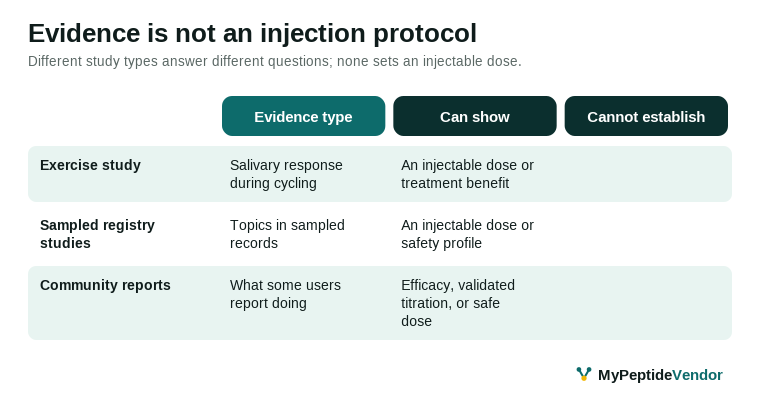
Trial findings versus an injection protocol
ClinicalTrials.gov records are not all treatment trials, and the sampled records do not describe an injectable dosing study 10. A biomarker study measures a biological signal; it does not show that an injection improves a health outcome.
| Evidence context | Route or measure | What it can show | What it cannot establish |
|---|---|---|---|
| Exercise study | Saliva sampled around cycling | Salivary LL-37 response under the tested conditions | An injectable dose, blood exposure, or treatment benefit |
| Sampled registry studies | Biomarker, microbiome, allergy/immune-function, and oral-health topics | The topics being studied in the sampled records | An injectable dose or an injection safety profile |
| Community injection reports | What some users or write-ups report doing | Clinical efficacy, a validated titration, or a safe dose |
A concentration applied to a wound surface cannot be converted into a subcutaneous dose: the route, local exposure, and purpose differ. Do not infer an injection amount from a topical concentration.
Use this chart
Free to reuse with a link back:
Syringe Unit Conversion Table
Units to draw on a U-100 insulin syringe (100 units = 1 mL) from a 5 mg vial. Find your dose, then read the column for the water you added. Every number is calculated, not estimated.
| Dose | 1 mL water 5 mg/mL · 1 unit = 50 mcg | 2 mL water 2.5 mg/mL · 1 unit = 25 mcg | 2.5 mL water 2 mg/mL · 1 unit = 20 mcg |
|---|---|---|---|
| 50 mcg | 1 · 100 doses | 2 · 100 doses | 2.5 · 100 doses |
| 100 mcg | 2 · 50 doses | 4 · 50 doses | 5 · 50 doses |
| 200 mcg | 4 · 25 doses | 8 · 25 doses | 10 · 25 doses |
| 250 mcg | 5 · 20 doses | 10 · 20 doses | 12.5 · 20 doses |
| 300 mcg | 6 · 16 doses | 12 · 16 doses | 15 · 16 doses |
| 500 mcg | 10 · 10 doses | 20 · 10 doses | 25 · 10 doses |
| 750 mcg | 15 · 6 doses | 30 · 6 doses | 37.5 · 6 doses |
| 1 mg | 20 · 5 doses | 40 · 5 doses | 50 · 5 doses |
| 1.5 mg | 30 · 3 doses | 60 · 3 doses | 75 · 3 doses |
| 1.7 mg | 34 · 2 doses | 68 · 2 doses | 85 · 2 doses |
| 2 mg | 40 · 2 doses | 80 · 2 doses | 100 · 2 doses |
| 2.4 mg | 48 · 2 doses | 96 · 2 doses | over 100 |
| 2.5 mg | 50 · 2 doses | 100 · 2 doses | over 100 |
| 3 mg | 60 · 1 doses | over 100 | over 100 |
| 4 mg | 80 · 1 doses | over 100 | over 100 |
| 5 mg | 100 · 1 doses | over 100 | over 100 |
LL-37 5 mg Vial Dosage Calculator
Shows the exact insulin-syringe units to draw. Pre-loaded with the 5 mg vial; change any value to match yours.
Total volume of your syringe?
How much mg is in the vial?
How much bacteriostatic water are you adding?
Dose per injection?
Educational tool only. Concentration = vial ÷ water; units = dose ÷ concentration × 100 (U-100 syringe). Confirm every dose with your prescriber. Different vial or peptide? Use the peptide calculator.
Affiliate link · we may earn a commission.
Reconstitution Steps and 5 mg Vial Math
- Check the product-specific directions. Confirm the vial contents, intended route, named diluent, concentration, storage directions, and beyond-use date. A 5 mg amount alone does not specify any of those details.
- Do not guess the mixing volume. The arithmetic differs by dilution: 5 mg in 1 mL is 5 mg/mL, while 5 mg in 2 mL is 2.5 mg/mL. These are examples of concentration math, not recommendations for how much liquid to add.
- Confirm the syringe type and concentration with a pharmacist. A U-100 syringe has 100 units per mL. Its marks indicate liquid volume; they do not directly measure peptide mass.
- Do not prepare the vial if directions are missing or conflict. Ask the dispensing pharmacist to confirm the correct product, route, diluent, preparation method, and date for use before handling it.
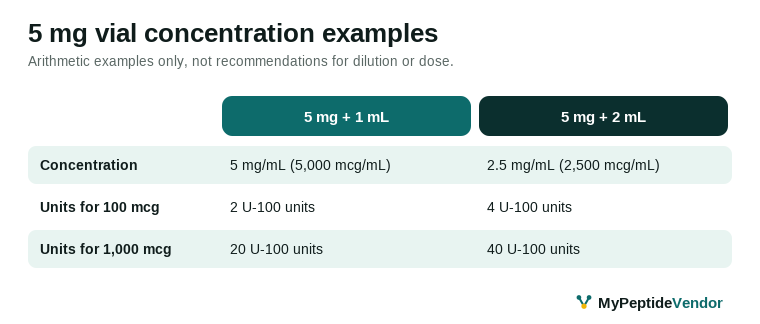
The comparison is arithmetic for a 5 mg vial and a U-100 syringe. It is not a recommended dilution or dose. A different volume changes the concentration and the units corresponding to the same peptide amount.
| Liquid volume used in the example | Resulting concentration | Units for 100 mcg | Units for 1,000 mcg |
|---|---|---|---|
| 1 mL | 5 mg/mL (5,000 mcg/mL) | 2 | 20 |
| 2 mL | 2.5 mg/mL (2,500 mcg/mL) | 4 | 40 |
| 2.5 mL | 2 mg/mL (2,000 mcg/mL) | 5 | 50 |
Worked math example: In the 1 mL example, 100 mcg corresponds to 2 U-100 units. In the 2 mL example, the same 100 mcg corresponds to 4 units. The vial still contains 5 mg in either example; only the concentration has changed.
Instructions stating 1 mL and 2 mL for the same vial produce different concentrations and unit marks. They cannot both describe the same final concentration. Verify the directions for the exact product instead of borrowing a volume or syringe mark from another vial or website.
BAC water means bacteriostatic water, a diluent containing a preservative. Its name does not establish that it is suitable for a particular product. Use a diluent only when the pharmacy’s directions identify it for that exact vial.
Use this chart
Free to reuse with a link back:
Supplies Needed for a Full 5 mg Vial
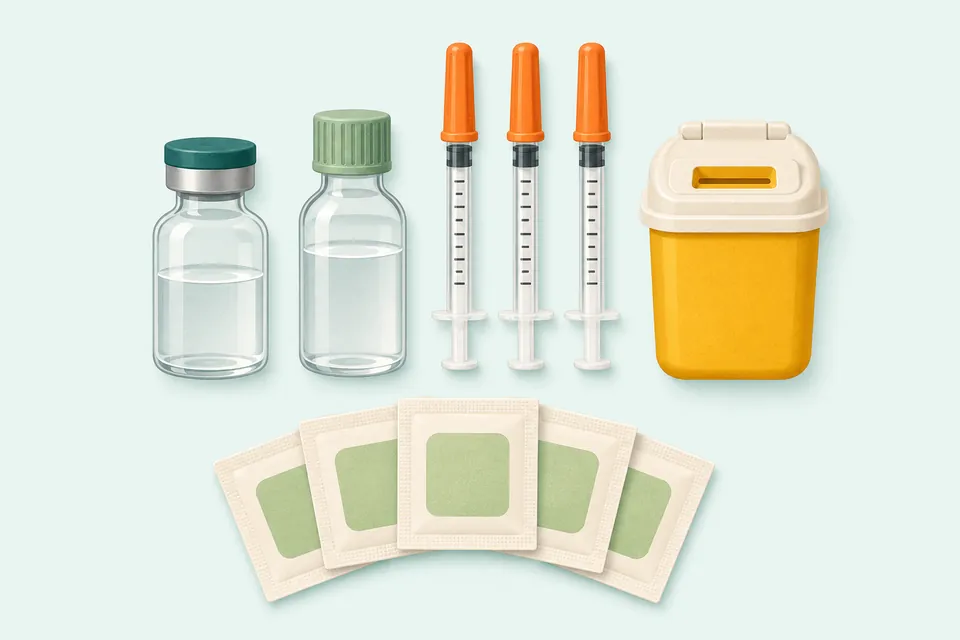
No evidence-based home injection supply quantity can be set for a full vial because no human injection schedule is established. The 5 mg amount alone cannot tell you how many injections a vial would contain; that would require a validated dose and a confirmed concentration.
- 1 original vial: Keep the vial and complete label available for review by the dispensing pharmacist.
- 1 set of product-specific directions: Confirm that they identify the route, diluent, concentration, storage conditions, and beyond-use date.
- Diluent: Use only the liquid and volume specified for that exact product by the dispensing pharmacy. There is no universal volume for all 5 mg LL-37 vials.
- Syringes and alcohol swabs: The type and quantity depend on whether a licensed clinician has prescribed a product and supplied a specific schedule. This page cannot set a safe number for an unvalidated injection protocol.
- Sharps container: Ask the clinician or pharmacist how to dispose of any prescribed injection supplies safely before use.
Do not buy supplies on the assumption that one vial equals a set number of injections. That count depends on dose and concentration, and neither is established here for human injection.
Protocol Overview and Cycle Notes

LL-37 is part of innate host defense, the body’s early response to microbes and tissue injury. Its effects depend on the setting: antimicrobial peptides can take part in defense, while the same broad immune system can also contribute to inflammation. That biology does not prove that injected LL-37 improves infection, wound healing, or general immune function.
The exercise study measured saliva, not injection exposure or a clinical outcome 9. A salivary change after longer exercise cannot be used to estimate the amount of LL-37 in blood or tissue after an injection.
The search returned 61 registered LL-37 studies, but the sampled records cover biomarker, microbiome, allergy and immune-function, and oral-health questions 10. The total registry count is not a count of injection trials. A registered study also does not, by itself, establish that a treatment works or is safe.
No evidence-based human injection cycle length, time off, or dose-escalation plan is established. A schedule measured in weeks on and weeks off should not be presented as a tested protocol. A change in symptoms over a short period would not prove that a dose is safe or effective.
FDA Category 2 describes bulk substances FDA identified as potentially presenting significant safety risks while reviewing nominations for compounding lists 1. Category 2 is not drug approval, and it does not establish that a particular vial is approved or suitable for injection. Source 1 does not list LL-37 in its Category 2 table; its current listing status must be checked against the current FDA list. No FDA-approved human injectable LL-37 product exists; FDA Category 2 is a compounding-policy category, not an approval designation 1.
What the evidence can and cannot show
These evidence types answer different questions. A proposed mechanism, a disease association, and a human trial are not interchangeable evidence for an injection dose.
| Topic | Evidence type | What is reported | What is not established |
|---|---|---|---|
| Exercise and salivary LL-37 | Randomized crossover human study | Salivary biomarker response under tested exercise conditions | An injection dose, blood exposure, or treatment benefit |
| Rosacea | Review of disease mechanisms | A TLR2/LL-37/mTORC1 signaling axis is discussed | That injection causes rosacea or treats it |
| Psoriasis | Review of inflammatory mechanisms | LL-37-containing NETs are linked with Th17-related inflammation | An injection-specific flare rate or safe dose |
| Nasal polyps | Review of chronic rhinosinusitis mechanisms | LL-37 is reported to induce NET production in CRS with nasal polyps | That injected LL-37 causes or improves nasal polyps |
| Oral tumorigenesis | Review of innate host-defense proteins | Potential mechanisms include binding growth-stimulating cell-surface receptors | A quantified cancer risk from injection |
| Infection and inflammation | Reviews of host-microbe and influenza biology | Host defense can coexist with pathogen resistance or harmful inflammation | That a vial safely or effectively treats infection |
LL-37 is a neutrophil-derived host-defense effector discussed in cystic fibrosis airway disease, but Pseudomonas aeruginosa can resist innate immune effectors, including antimicrobial peptides 3. This is one reason not to equate antimicrobial activity in biological research with a proven infection treatment.
Innate immune responses can help defend against influenza and can also contribute to inflammatory lung injury 7. These competing effects make a broad claim that LL-37 simply “boosts immunity” inaccurate. No injection trial in the sampled records resolves the balance of benefit and harm 10.
Storage and Handling
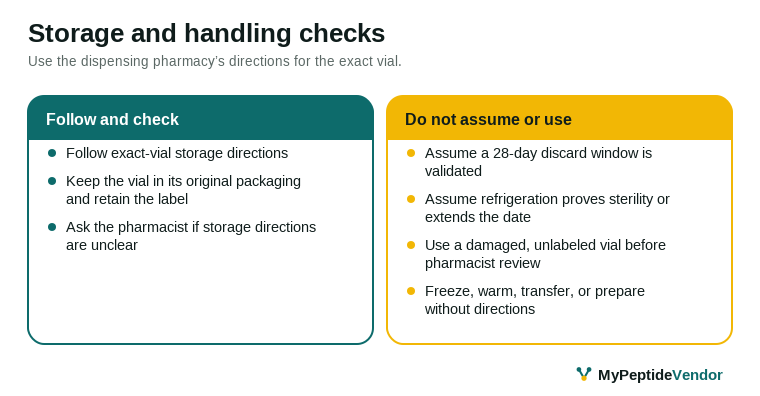
Follow the storage and beyond-use directions printed by the dispensing pharmacy for the exact vial. The cited evidence does not address storage temperature or discard periods for LL-37 preparations. Do not assume a 28-day discard window, or any other period, is validated for this product.
Lyophilized powder and reconstituted liquid are different product states. Do not apply storage instructions for one state to the other. Check whether the unopened vial requires refrigeration and what the pharmacy directs after preparation; if the label does not answer either question, ask the pharmacist.
Keep the vial in its original packaging and retain the product label. If the container is damaged, the label is missing, the solution changes appearance, or the storage history is uncertain, do not use it until the dispensing pharmacist has reviewed it.
Refrigeration does not prove sterility or extend a labeled beyond-use date. Do not freeze, warm, transfer, or prepare the product unless the pharmacy’s directions for that specific vial say to do so.
Use this chart
Free to reuse with a link back:
Injection and Tracking Tips

Do not inject a vial if a pharmacist or clinician cannot confirm its label, concentration, and route. No human injection dose, injection site, or frequency is established here, so an online schedule cannot replace product-specific professional directions.
If a licensed clinician is managing a prescribed product, record the product name, concentration, prescribed amount, date, route, and symptoms after each administration. Those details give the clinician a clearer record than a note that only says “one shot.”
Do not treat redness, warmth, or a brief symptom change as proof of benefit. An inflammatory response can be harmful as well as noticeable, and the sampled registry records provide no injectable adverse-event rate 10.
Seek urgent medical care for trouble breathing, facial or throat swelling, fainting, rapidly spreading redness, or severe symptoms after an injection. Do not take another dose while waiting for medical assessment.
Safety, Side Effects, and Conditions to Discuss
No injection side-effect frequencies are established in the sampled human evidence. The sampled ClinicalTrials.gov records provide no injectable adverse-event rate 10. Redness, warmth, and systemic symptoms therefore cannot be described as common, rare, or expected effects of an LL-37 injection.
- Current or past cancer: A review describes possible ways LL-37 may initiate or support oral tumorigenesis, including binding growth-stimulating cell-surface receptors 6. This is a biological risk signal, not proof that an injection causes cancer. Discuss any proposed exposure with the treating oncologist.
- Rosacea: A review identifies a TLR2/LL-37/mTORC1 signaling axis in rosacea pathogenesis 2. It does not show what an injection would do, but it is a reason to ask a dermatologist rather than assume LL-37 will help.
- Psoriasis or autoimmune inflammation: LL-37-containing neutrophil extracellular traps (NETs) can promote Th17-related inflammation in psoriasis 8. The psoriasis review links the Köbner phenomenon to damage signals released by skin injury and their enhanced recognition by antimicrobial peptides 8. These mechanisms do not prove that an injection triggers psoriasis.
- Chronic rhinosinusitis with nasal polyps: LL-37 has been reported to induce NET production in chronic rhinosinusitis with nasal polyps 5. Discuss that uncertainty with an allergy or ear, nose, and throat clinician.
- Active or recurring infection: LL-37 is discussed among neutrophil-derived host-defense effectors, while Pseudomonas aeruginosa can resist innate immune effectors 3. This does not show that injected LL-37 treats infection.
- Influenza or inflammatory lung disease: Innate immune responses can help defend against influenza and can also contribute to inflammatory lung injury 7. Do not use LL-37 in place of diagnosis or established infection care.
- Pregnancy or breastfeeding: Human safety of injected LL-37 during pregnancy or breastfeeding is not established. Ask a qualified clinician to review the specific product and situation before any exposure.
These disease findings describe mechanisms or associations; they do not quantify injection risk. A route-specific safety profile and injection dose have not been established.
Plain-language terms
- Cathelicidin: A family of host-defense peptides; LL-37 is the only human cathelicidin.
- hCAP-18: The larger precursor protein from which LL-37 is released.
- NETs: Neutrophil extracellular traps, webs of DNA and proteins released by neutrophils; LL-37-containing NETs are discussed in psoriasis and nasal-polyp inflammation 58.
- Th17: A type of immune response involved in psoriasis-related inflammation 8.
- FPRL1: A receptor name sometimes used in discussions of LL-37 signaling; the sources cited on this page do not establish an injection dose through this pathway.
- BAC water: Bacteriostatic water is a diluent used in some medication preparations. Use it only if the dispensing pharmacy names it for the exact product.
Medical disclaimer: This page is educational, not a prescription, diagnosis, or treatment recommendation. No approved human injection dose is established. Ask a licensed clinician and dispensing pharmacist to review the exact vial and labeling before preparation or use.
Frequently asked questions
What is a typical LL-37 dosage for a 5 mg vial?
No approved or human-trial-established injection dose is available for a 5 mg vial. Informal community reports do not establish a safe dose, so a vial’s peptide amount should not be used to create a personal injection schedule.
How much bacteriostatic water should I add to a 5 mg LL-37 vial?
There is no universal volume for every 5 mg vial. For example, 1 mL and 2 mL produce different concentrations, so follow only the directions for the exact product from its dispensing pharmacy.
How many U-100 syringe units equal 100 mcg of LL-37?
It depends on the verified concentration: 100 mcg corresponds to 2 units at 5 mg/mL, 4 units at 2.5 mg/mL, or 5 units at 2 mg/mL. Those are math conversions, not a recommendation to inject 100 mcg.
Is LL-37 FDA-approved for injection?
No source here shows an FDA-approved human injectable LL-37 product. FDA Category 2 is an interim compounding-policy category for certain nominated bulk substances that may present significant safety risks; it is not drug approval 1.
Do human studies show that injecting LL-37 heals wounds?
The sampled registered studies do not establish an injectable dose or an injection wound-treatment effect 10. Topical application and injection are different routes, so a topical concentration cannot be used to set an injection dose.
Can exercise raise LL-37 levels?
In a randomized crossover study of 14 young, healthy, untrained men, salivary LL-37 did not change after 30 minutes of cycling at 35%, 55%, or 75% of maximal oxygen uptake. At 55%, the change from baseline was greater after 60 and 90 minutes than after 30 minutes; saliva results do not predict injection effects 9.
Should someone with psoriasis, rosacea, cancer, or nasal polyps avoid LL-37?
Reviews describe LL-37-related pathways in rosacea, psoriasis, oral tumorigenesis, and chronic rhinosinusitis with nasal polyps 2568. They do not prove that an injection causes a flare or cancer, but anyone with these conditions should discuss the uncertainty with a clinician before exposure.
References
- FDA: Certain bulk drug substances for use in compounding that may present significant safety risks
- Wang et al. Advances in the pathogenesis of rosacea. Front Immunol. 2025.
- Malhotra et al. Cystic Fibrosis and Pseudomonas aeruginosa: the Host-Microbe Interface. Clin Microbiol Rev. 2019.
- Vitale et al. Targeting Cancer Heterogeneity with Immune Responses Driven by Oncolytic Peptides. Trends Cancer. 2021.
- Zhang et al. An Emerging Role of Extracellular Traps in Chronic Rhinosinusitis. Curr Allergy Asthma Rep. 2023.
- Winter et al. Role of innate host defense proteins in oral cancerogenesis. Periodontol 2000. 2024.
- Hartshorn et al. Innate Immunity and Influenza A Virus Pathogenesis: Lessons for COVID-19. Front Cell Infect Microbiol. 2020.
- Takahashi et al. Psoriasis and Antimicrobial Peptides. Int J Mol Sci. 2020.
- Ito et al. Acute salivary antimicrobial peptide secretion response to different exercise intensities and durations. Am J Physiol Regul Integr Comp Physiol. 2024.
- ClinicalTrials.gov: 61 registered studies (search: LL-37)
Written by the MyPeptideVendor editorial team from the FDA label, peer-reviewed studies and ClinicalTrials.gov records listed above, fact-checked line by line and reviewed 2026-11-12.
Cite this page
MyPeptideVendor Editorial Team. ll 37 dosage 5mg: Protocol & Safety. MyPeptideVendor. Updated November 12, 2026. https://mypeptidevendor.com/protocols/ll-37-dosing-5mg/MyPeptideVendor Editorial Team. (2026, November 12). ll 37 dosage 5mg: Protocol & Safety. MyPeptideVendor. https://mypeptidevendor.com/protocols/ll-37-dosing-5mg/Related protocols
GLOW Blend
Research UseNo human dose is established for GLOW Blend; vial math and online schedules are not FDA-approved or clinically validated.
View protocolTB-500 10 mg
Research UseNo approved human TB-500 dose exists; this guide separates unvalidated schedules from 10 mg vial math, handling, evidence, and safety.
View protocol