BPC-157: Evidence, Uses & FDA Status
Experimental synthetic peptide
Brand names: No FDA-approved brand name

BPC-157 is an experimental 15-amino-acid peptide isolated from human gastric juice 2. It is promoted for tissue repair, but human evidence is thin: one systematic review included just 1 clinical study among 36 studies 3.
Animal studies suggest possible effects on gut and musculoskeletal tissue, but they do not prove that BPC-157 heals injuries in people or establish a safe human dose 347. It is not FDA-approved 23. BPC-157 does not appear in FDA Category 2 1.
Key takeaways
- A systematic review included 36 studies: 35 were preclinical and 1 was clinical 3.
- In the only human orthopedic case series, 7 of 12 people reported knee-pain relief lasting more than 6 months 3.
- No validated human dose, oral-to-injection conversion, or reliable human side-effect rate has been established 36.
- BPC-157 is not FDA-approved; its inclusion in FDA Category 2 could not be confirmed from the FDA information available here 12.
- A review reports that WADA temporarily banned BPC-157 in 2022; it is not currently listed as banned by WADA, though professional-sports rules may differ 23.
BPC-157 at a glance
- Class
- Experimental synthetic pentadecapeptide, a chain of 15 amino acids
- Mechanism
- Proposed effects on blood-vessel growth, nitric oxide signaling, growth hormone receptor expression, and inflammatory pathways
- FDA Status
- Not FDA-approved; BPC-157's inclusion in FDA Category 2 could not be confirmed from the FDA information available here
- Brand names
- No FDA-approved brand name
- Administration
- Routes have been studied preclinically; the human orthopedic case series involved an injection into the knee joint
- Typical Dose
- No established or validated human dose
- Half-life
- Less than 30 minutes in the metabolism findings summarized by the orthopedic systematic review
- Primary Uses
- Investigational; promoted for tissue repair, but human benefit is unproven
What is it?

BPC-157 stands for Body Protection Compound-157. It is a pentadecapeptide, meaning a chain of 15 amino acids, isolated from human gastric juice 2. That origin does not establish that BPC-157 is a normal signaling peptide that circulates through the body. “Naturally occurring” claims should be read carefully: gastric-juice origin is not proof of a routine role in human physiology 2.
Researchers have investigated BPC-157 as a possible tissue-protective compound. Claimed areas include tendon, muscle, ligament, bone, skin, and gastrointestinal repair, but most findings come from animal models rather than treatment trials in people 3478.
An animal result can show that a biological effect is possible under a particular laboratory condition. It cannot tell someone with a tendon tear, fracture, or digestive illness how likely BPC-157 is to help, or what dose would be safe. Human effectiveness and safety remain unproven 36.
What makes it different
BPC-157 stands out in research because investigators have studied it across several tissue types, from the gut lining to tendon and muscle. That breadth is a research finding, not proof that one peptide reliably repairs all of those tissues in people 347.
BPC-157 is described as an antiulcer peptide, and research reviews discuss animal wound-healing models in skin and other tissues 8. Animal studies also report healing of intestinal connections and fistulas, but those findings do not establish treatment for human inflammatory bowel disease or surgical complications 4.
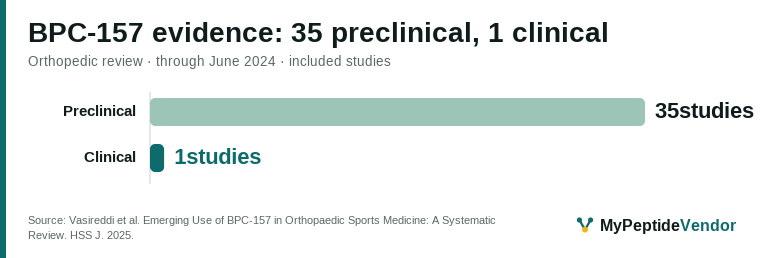
The size of the evidence gap is easy to miss in online marketing. In an orthopedic systematic review, researchers identified 544 articles published from 1993 through June 3, 2024; 36 met the review’s inclusion criteria, and only 1 was a clinical study 3. The other 35 were preclinical studies, mostly in animals 3.
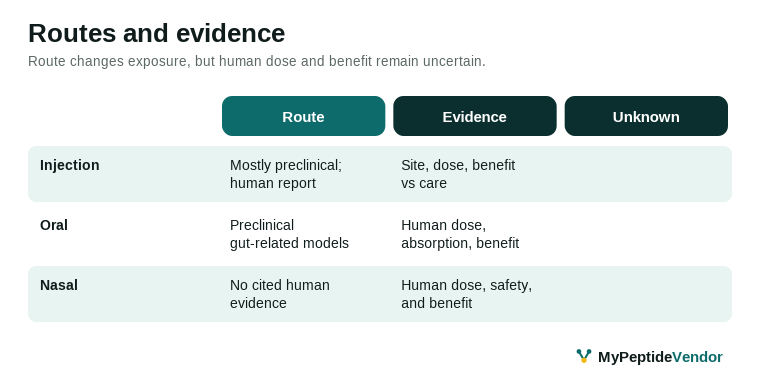
Route matters, but it does not fill that evidence gap. A joint injection, a swallowed product, and a nasal spray do not create the same exposure. The only human orthopedic report involved an injection into the knee; the cited reviews do not establish a human nasal dose or benefit 36. The often-repeated estimate that oral BPC-157 has 10% to 30% of injectable bioavailability is not supported by the cited reviews 367.
Animal findings do not prove that a route has the same effect in people 3468.
| Route | Evidence level | Where it goes | What remains unknown |
|---|---|---|---|
| Injection | Mostly preclinical; one human orthopedic case series | Given into tissue or a joint; distribution beyond the injection area is not established | Best injection site, dose, and benefit compared with standard care |
| Oral | Preclinical research includes gut-related models | Swallowed, so it first contacts the digestive tract; human absorption and systemic exposure are not established | Human dose, bioavailability, and benefit for gut or other conditions |
| Nasal | No supporting human evidence in the cited reviews | Delivered through nasal tissue; distribution and absorption are not established | Human dose, safety, and benefit |
Use this chart
Free to reuse with a link back:
How does it work (mechanism, plain words first)
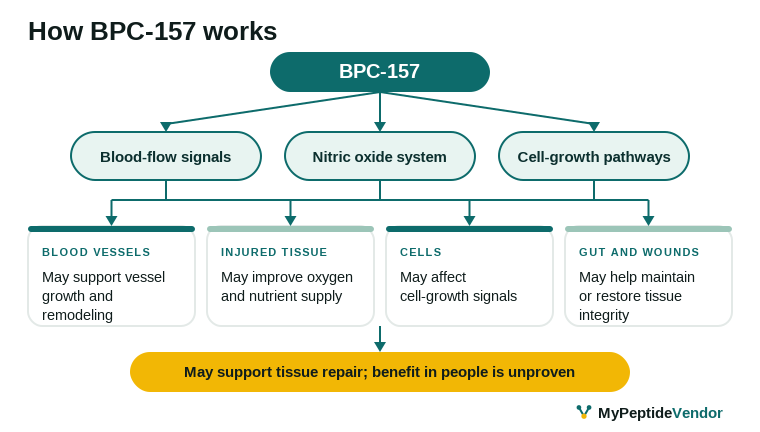
In plain terms, researchers think BPC-157 may change signals involved in blood flow, inflammation, and cell repair. Those signals help injured tissue respond, but a proposed mechanism is not proof that a treatment heals an injury in a patient 35.
One proposed effect is on angiogenesis, the growth and remodeling of small blood vessels. A better blood supply could help injured tissue receive oxygen and nutrients. Preclinical studies also report changes in growth hormone receptor expression and pathways involved in cell growth 3. These findings do not show that BPC-157 raises growth hormone levels or speeds recovery in people.
Researchers have also examined the nitric oxide system, which helps regulate blood vessel behavior. Reviews describe BPC-157 as affecting this system in ways that may support tissue protection in animal models 5. The effects may differ with the biological setting, so it is too simple to say that BPC-157 always raises or always lowers nitric oxide 5.
For gut and wound models, proposed actions include helping maintain or restore tissue integrity. Animal studies report effects on intestinal healing and wound repair, but there is no established human mechanism that predicts a clinical benefit or identifies who might respond 48.
Use this chart
Free to reuse with a link back:
What the clinical evidence actually shows

The orthopedic systematic review provides the clearest count of the evidence: 544 articles were identified, 36 studies were included, and 35 of those were preclinical 3. The single clinical study was a retrospective case series, not a randomized or controlled trial 3. A separate sports-medicine review also describes the human orthopedic evidence as one case series with major limitations 6.
The case series involved 12 people with unspecified chronic knee pain who received an injection into the knee joint. Seven of the 12 reported pain relief lasting more than 6 months, or about 58% of that small group 3. Without a control group, the result cannot show that BPC-157 caused the relief or estimate how often it would help other patients 36.
The case-series dose, treatment schedule, and onset of relief are not reported 3. It also does not provide a reliable count of side effects. That leaves major unanswered questions about dose, duration, safety, and whether the peptide performs better than rehabilitation, time, or another treatment 36.
There are 4 BPC-157 studies registered on ClinicalTrials.gov 10. A registration is not proof that a treatment works, and the listings do not report participant counts, treatment durations, or outcomes 10.
The registrations and their listed conditions and statuses are summarized below 10.
| Study | Phase | Listed status | Condition or question |
|---|---|---|---|
| NCT07803250 | Phase 1 | Not yet recruiting | Recovery following rotator cuff repair surgery |
| NCT07437547 | Phase 2 | Recruiting | Repair of an acute hamstring muscle strain |
| NCT02637284 | Phase 1 | Unknown | PCO-02 safety and pharmacokinetics |
| NCT07752381 | Not applicable | Completed | Peptide gummies and markers of inflammation, physical performance, and recovery |
The rotator cuff and hamstring studies could add information about early safety or possible benefit, depending on their design and results. Results are not reported for these studies, and a completed study is not automatically a positive one 10.
Reviews describe animal findings in tendon, muscle, ligament, bone, and gut models 347. They do not establish a confirmed human benefit for those conditions. Claims that BPC-157 heals a specific injury in people go beyond the clinical evidence described here 36.
Use this chart
Free to reuse with a link back:
Typical dosing

There is no established human dose for BPC-157. The sports-medicine review says that indications, dose, frequency, and treatment duration remain unknown 6. The only human knee case series does not provide a dose in the review summary 3. BPC-157 has no FDA-approved label, so no approved dosing schedule exists 23.
No human microgram dosing range or oral-to-injectable conversion is established 36. A number promoted by a clinic or website should not be treated as a trial-tested dose unless it is tied to a specific human study with a reported regimen.
Animal doses cannot be converted directly into a safe human regimen. Species, injury model, route, and study outcome all affect how a result should be interpreted 348. Clinician oversight can help assess risks, but it does not make an unapproved product proven or remove uncertainty about dose and quality 26.
If you are considering BPC-157, discuss the specific product and your health history with a licensed clinician before use. Do not inject a product sold as “research use only,” and do not replace established care for an injury or digestive condition with an unapproved peptide.
Side effects: what to actually expect
There is no dependable percentage for side effects in humans. The orthopedic systematic review found no clinical safety data, and the small knee case series does not provide a reliable adverse-effect rate 36. BPC-157 has no FDA-approved label, so no approved side-effect frequencies exist 23.
A 2025 review reports few side effects, but it does not name specific effects or give a human rate 2. It would be inaccurate to turn “few reported” into “no side effects.” Limited reporting can reflect limited formal study, not established safety.
Animal safety findings also need careful limits. Reviews report that an LD1, a dose associated with death in 1% of test animals, was not achieved in animal studies 58. A wound-healing review also notes no reported toxicity in earlier ulcerative colitis and multiple sclerosis trials, but the review does not provide enough detail here to calculate a human risk or a side-effect rate 8.
Product quality adds a separate concern. Reviews warn that unregulated manufacturing, contamination, or unknown clinical safety may create risks 3. Human rates for reactions linked to a particular route or product have not been established 36.
Regulatory & access status in the US (as of 2026)
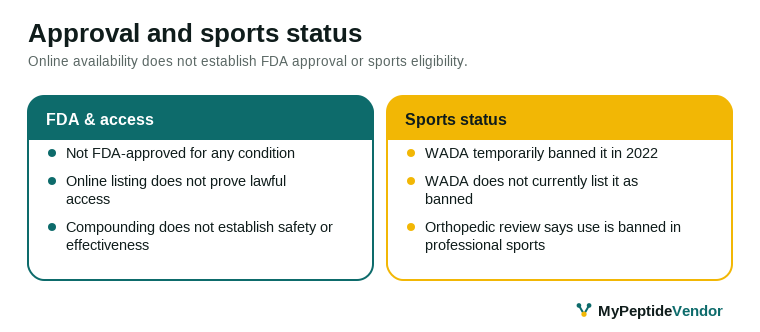
BPC-157 is not FDA-approved for any condition 23. FDA has a Category 2 process for certain bulk drug substances nominated for compounding, but BPC-157's inclusion and date added could not be confirmed from the FDA information available here 1. A Category 2 designation is not FDA approval and does not establish that a compounded product is safe or effective 1.
That status matters for access. A clinic or website describing a product as “compounded” does not make it FDA-approved or establish that it can be routinely prepared under federal and state rules 12. Ask a licensed prescriber and a state-licensed pharmacy to explain the product’s status before considering it.
For a buyer safety check, verify that the prescriber is licensed and that the pharmacy is licensed in your state, including whether it operates as a 503A or 503B pharmacy. Ask what the product contains, how it was prepared, and whether batch-specific quality documents are available. A certificate of analysis may describe a batch, but it does not show FDA approval or prove that BPC-157 works.
Be cautious of direct-to-consumer injectable products, guaranteed healing claims, or “research use only” products sold with instructions for human use. BPC-157 is widely offered on websites despite lacking FDA approval 2. A website listing is not proof of lawful access, product quality, or medical effectiveness.
Sports eligibility is a separate question. A review reports that WADA temporarily banned BPC-157 in 2022 and does not currently list it as banned 2. The orthopedic systematic review says its use is banned in professional sports 3. Athletes should check the rules of their own organization rather than assuming that one list settles eligibility.
In practical terms, “available online” does not mean “FDA-approved.” BPC-157 remains an unapproved peptide, and its compounding status should be checked with a licensed prescriber and pharmacy 12.
Use this chart
Free to reuse with a link back:
Research-grade BPC-157 is available from American Peptides (BPC-157, from $60.00); code MYPEPTIDEVENDOR takes 15% off. Sold for laboratory research only, not for human use. Affiliate link
How it compares with its closest alternative
TB-4 and TB-500 are close alternatives in the tissue-repair discussions because they are also marketed around recovery. The sports-medicine review describes preclinical repair findings for TB-4 and its derivative TB-500, but says human orthopedic data are lacking 6. The same review says both remain banned substances in sports 6.
| Feature | BPC-157 | TB-4 / TB-500 |
|---|---|---|
| Research base | Mostly animal studies; one human orthopedic case series | Preclinical repair findings; human orthopedic data lacking |
| Human result | Seven of 12 people in an uncontrolled knee case series reported relief lasting more than 6 months | No human orthopedic benefit established in the review |
| FDA status | Not FDA-approved | FDA approval for orthopedic use is not established. |
| Sports status | WADA and individual sport rules may differ | The review says TB-4 and TB-500 remain banned substances in sports |
| Bottom line | Human benefit and safe dosing remain unproven | Human orthopedic benefit and safe dosing remain unproven |
The phrase “big 3 peptides” is not a standard medical category. It is an informal label, so it does not identify a medically accepted group or tell you which products have stronger evidence.
Where to Buy BPC-157 for Research
American Peptides
BPC-157 · from $60.00
US-made research peptides, every lot third-party tested with a lot-matched COA.
15% offMYPEPTIDEVENDOR at checkout
- ≥99% purity verified by HPLC + mass spec, endotoxin tested
- Ships tracked from Louisiana, free shipping over $300
- 15% off your first order with code MYPEPTIDEVENDOR
Certified-Pep
US-made research peptides with batch-specific lab reports (COA) and a QR code on every vial.
- Independent laboratory testing (Vanguard Laboratory)
- Made in the USA, ships in 1-2 business days
- Research use only, not for human or veterinary use
Affiliate disclosure: we may earn a commission if you order through the link above. BPC-157 is not approved by the FDA for human use.
Ranked in our guides
Frequently asked questions
Where can I buy BPC-157 peptide?
Some clinics and websites advertise it, but online availability does not make BPC-157 FDA-approved 2. If you are considering access, speak with a licensed prescriber and ask a state-licensed pharmacy to explain whether the specific product can be prepared and supplied under applicable rules 1. Avoid products labeled “research use only” that are marketed for human injection.
What are the benefits of BPC peptide?
Animal studies suggest possible effects on tendon, muscle, ligament, bone, wound, and gut healing 3478. For people, the reported knee-pain case series had 12 participants and no control group, so it cannot prove those benefits or show that BPC-157 treats a condition 3.
What are the big 3 peptides?
There is no medically standardized “big 3” list. The phrase is an informal grouping, and the third peptide can vary; it does not indicate that the products have similar evidence or are approved treatments.
What peptide does Joe Rogan take?
I can’t confirm that Joe Rogan takes BPC-157 or another specific peptide. A celebrity-use claim, even if repeated online, would not establish that a peptide is safe or effective.
Is oral BPC-157 better than an injection?
No human study described in the clinical reviews establishes that one route works better. The human orthopedic report involved an injection into the knee, while oral research is preclinical; the often-repeated 10% to 30% oral bioavailability estimate is not supported by the cited reviews 367.
How long does BPC-157 take to work?
A human timeline has not been established. In the knee-pain case series, 7 of 12 participants reported relief lasting more than 6 months, but the report does not establish when relief began or whether BPC-157 caused it 3.
Can BPC-157 be combined with GLP-1 drugs or hormone replacement therapy?
Interaction safety with GLP-1 medicines or hormone therapy has not been established in the clinical reviews 236. Ask the clinician managing those medicines before considering BPC-157; missing interaction data does not mean a combination is safe.
References
- FDA: Certain bulk drug substances for use in compounding that may present significant safety risks
- Józwiak et al. Multifunctionality and Possible Medical Application of the BPC 157 Peptide-Literature and Patent Review. Pharmaceuticals (Basel). 2025.
- Vasireddi et al. Emerging Use of BPC-157 in Orthopaedic Sports Medicine: A Systematic Review. HSS J. 2025.
- Bajramagic et al. Stable Gastric Pentadecapeptide BPC 157 and Intestinal Anastomoses Therapy in Rats-A Review. Pharmaceuticals (Basel). 2024.
- Sikiric et al. Stable Gastric Pentadecapeptide BPC 157 as a Therapy and Safety Key: A Special Beneficial Pleiotropic Effect Controlling and Modulating Angiogenesis and the NO-System. Pharmaceuticals (Basel). 2025.
- Mayfield et al. Injectable Peptide Therapy: A Primer for Orthopaedic and Sports Medicine Physicians. Am J Sports Med. 2026.
- Gwyer et al. Gastric pentadecapeptide body protection compound BPC 157 and its role in accelerating musculoskeletal soft tissue healing. Cell Tissue Res. 2019.
- Seiwerth et al. Stable Gastric Pentadecapeptide BPC 157 and Wound Healing. Front Pharmacol. 2021.
- Rahman et al. Therapeutic Peptides in Orthopaedics: Applications, Challenges, and Future Directions. J Am Acad Orthop Surg Glob Res Rev. 2026.
- ClinicalTrials.gov: 4 registered studies (search: BPC-157)
Written by the MyPeptideVendor editorial team from the FDA label, peer-reviewed studies and ClinicalTrials.gov records listed above, fact-checked line by line and reviewed 2026-11-12.
Cite this page
MyPeptideVendor Editorial Team. bpc 157: Evidence, Uses & FDA Status. MyPeptideVendor. Updated November 12, 2026. https://mypeptidevendor.com/peptides/bpc-157/MyPeptideVendor Editorial Team. (2026, November 12). bpc 157: Evidence, Uses & FDA Status. MyPeptideVendor. https://mypeptidevendor.com/peptides/bpc-157/Related peptides
B7-33
Research UseB7-33 activates RXFP1 and has preclinical heart and fibrosis findings, but no established human dose, human trial results, or known human safety profile.
Learn moreBPC-157 + TB-500 Blend
Research UseA blend of BPC-157 and TB-500 has no established human dose or proven benefit for injury healing; key safety and stability questions remain unanswered.
Learn moreKPV
Research UseKPV is an experimental α-MSH tripeptide with laboratory and animal findings, no established human dose, and no proven human treatment benefit.
Learn more