Semaglutide 20 mg Vial Dosing Protocol
A 20 mg vial states total drug content, not a weekly dose; confirm its concentration and instructions with your prescriber and pharmacy.
Quickstart highlights for a 20 mg semaglutide vial
Semaglutide dosage 20mg refers to the total amount in a vial, not the amount to inject each week. FDA-approved Wegovy injection starts at 0.25 mg once weekly for 4 weeks, then increases in 4-week steps; a compounded 20 mg vial does not have an FDA-approved vial dosing schedule. 12
Before drawing any dose, confirm the prescribed amount in mg, the vial concentration in mg/mL, the syringe type, and the matching syringe marking with the dispensing pharmacy. FDA has received reports of dosing errors with compounded injectable semaglutide, including errors by patients measuring doses and by health professionals calculating them. 2
- 20 mg is total vial content, not the weekly injection dose. The concentration depends on the final volume and must be stated on the pharmacy label. FDA-approved Wegovy injection is a clear, colorless solution supplied in single-dose pens, single-dose syringes, or a FlexTouch pen. 1
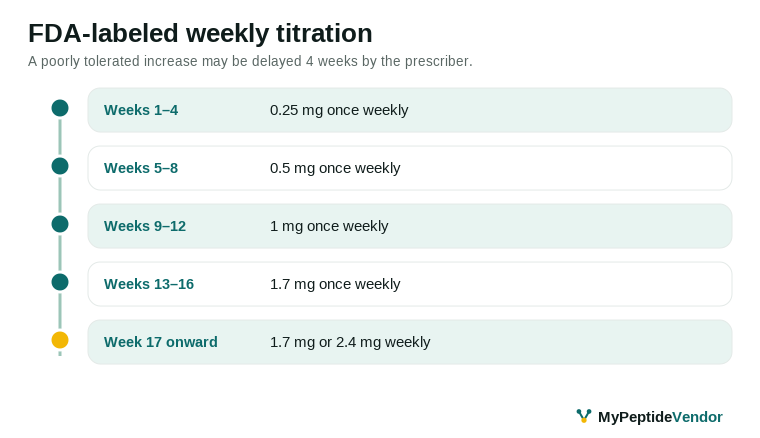
- The FDA-labeled injectable starting dose is 0.25 mg (250 mcg) once weekly for 4 weeks. The usual escalation continues in 4-week blocks at 0.5 mg, 1 mg, and 1.7 mg. 1
- For adult weight reduction, labeled maintenance is 1.7 mg or 2.4 mg once weekly. The label recommends 2.4 mg and directs prescribers to consider response and tolerability. 1
- 7.2 mg is not a starting dose. The FDA label allows selected adults who have tolerated 2.4 mg for at least 4 weeks to increase to 7.2 mg when additional weight reduction is clinically indicated. 1
- Do not guess syringe units from “20 mg.” Confirm the vial’s mg/mL concentration and the exact U-100 syringe mark for your prescribed dose with the pharmacist. FDA reports dosing errors linked to measuring and dose-calculation mistakes. 2
- A multi-dose vial has a limited use period after first puncture. FDA recommends discarding it within 28 days after first use, even if medication remains. 2
The dosing schedule below follows the FDA-labeled Wegovy injection titration for its approved indications. It is not an FDA-approved dosing schedule for a compounded vial; use a compounded product only with a clinician’s prescription and pharmacy-specific directions. 12
Key takeaways
- The Wegovy injection schedule begins at 0.25 mg (250 mcg) weekly for 4 weeks and advances in 4-week steps. 1
- For adult weight reduction, labeled maintenance is 1.7 mg or 2.4 mg weekly; selected adults may increase to 7.2 mg after tolerating 2.4 mg for at least 4 weeks. 1
- A vial’s total 20 mg content does not tell you the concentration; syringe units depend on the labeled mg/mL and prescribed dose.
- FDA says compounded drugs should be used only when an FDA-approved drug cannot meet a patient’s medical needs; compounded semaglutide is not an FDA-approved finished product. 2
- In adult weight-reduction trials, nausea affected 44% and vomiting 24% of Wegovy injection users; severe or persistent symptoms need medical attention. 1
Dosing schedule: FDA-labeled weekly titration
The FDA label starts Wegovy injection at 0.25 mg once weekly and increases the dose in 4-week steps to reduce gastrointestinal reactions. If a patient does not tolerate a dose during escalation, the label says the prescriber may delay the next increase for 4 weeks. 1
| Weeks | Weekly dose | Dose in mcg | U-100 units at 20 mg/mL | U-100 units at 10 mg/mL | U-100 units at 8 mg/mL | What to watch for |
|---|---|---|---|---|---|---|
| 1–4 | 0.25 mg | 250 mcg | 1.25 | 2.5 | 3.12 | Track nausea, vomiting, diarrhea, constipation, and fluid intake. |
| 5–8 | 0.5 mg | 500 mcg | 2.5 | 5 | 6.25 | Contact the prescriber if stomach symptoms are severe or make it hard to drink. |
| 9–12 | 1 mg | 1,000 mcg | 5 | 10 | 12.5 | Review ongoing symptoms with the prescriber before the next planned increase. |
| 13–16 | 1.7 mg | 1,700 mcg | 8.5 | 17 | 21.25 | For adult weight reduction, 1.7 mg is one labeled maintenance option. |
| 17 and onward | 1.7 mg or 2.4 mg | 1,700 or 2,400 mcg | 8.5 or 12 | 17 or 24 | 21.25 or 30 | For adult weight reduction, 2.4 mg is recommended; 1.7 mg is also a labeled option. |
| After tolerating 2.4 mg for at least 4 weeks | Up to 7.2 mg | 7,200 mcg | Not listed in the conversion table | Not listed in the conversion table | Not listed in the conversion table | Only selected adults may increase when additional weight reduction is clinically indicated. Ask the pharmacy for product-specific instructions. |
The unit values above apply only to the listed concentrations on a U-100 syringe, where 100 units equal 1 mL. A unit mark is a volume, not a drug dose; the same dose can require a different mark when the concentration changes. Do not use a table entry unless the concentration on your vial matches it.
For a U-100 syringe, the calculation is: units = (prescribed dose in mg ÷ concentration in mg/mL) × 100. For example, at 10 mg/mL (100 mcg per unit), 0.25 mg equals 2.5 units and 2.4 mg equals 24 units, calculated as units = (mg ÷ mg/mL) × 100.
Do not treat online schedules such as 300–2,000 mcg or 250–1,000 mcg as interchangeable titration plans. Those ranges do not match the FDA-labeled start and 4-week escalation schedule. 1 FDA attributes reported compounded-semaglutide dosing errors to incorrect measurement and dose calculation, so an unverified chart can add risk. 2
A vial’s unit conversion does not make it equivalent to a Wegovy pen. Wegovy devices deliver labeled doses in specific presentations, while a vial requires manual measurement based on its concentration. Have the prescriber and pharmacist set the dose and timing when changing products; do not carry a vial’s unit mark over to a pen. 12
Use this chart
Free to reuse with a link back:
Syringe Unit Conversion Table
Units to draw on a U-100 insulin syringe (100 units = 1 mL) from a 20 mg vial. Find your dose, then read the column for the water you added. Every number is calculated, not estimated.
| Dose | 1 mL water 20 mg/mL · 1 unit = 200 mcg | 2 mL water 10 mg/mL · 1 unit = 100 mcg | 2.5 mL water 8 mg/mL · 1 unit = 80 mcg |
|---|---|---|---|
| 50 mcg | 0.25 · 400 doses | 0.5 · 400 doses | 0.62 · 400 doses |
| 100 mcg | 0.5 · 200 doses | 1 · 200 doses | 1.25 · 200 doses |
| 200 mcg | 1 · 100 doses | 2 · 100 doses | 2.5 · 100 doses |
| 250 mcg | 1.25 · 80 doses | 2.5 · 80 doses | 3.12 · 80 doses |
| 300 mcg | 1.5 · 66 doses | 3 · 66 doses | 3.75 · 66 doses |
| 500 mcg | 2.5 · 40 doses | 5 · 40 doses | 6.25 · 40 doses |
| 750 mcg | 3.75 · 26 doses | 7.5 · 26 doses | 9.38 · 26 doses |
| 1 mg | 5 · 20 doses | 10 · 20 doses | 12.5 · 20 doses |
| 1.5 mg | 7.5 · 13 doses | 15 · 13 doses | 18.75 · 13 doses |
| 1.7 mg | 8.5 · 11 doses | 17 · 11 doses | 21.25 · 11 doses |
| 2 mg | 10 · 10 doses | 20 · 10 doses | 25 · 10 doses |
| 2.4 mg | 12 · 8 doses | 24 · 8 doses | 30 · 8 doses |
| 2.5 mg | 12.5 · 8 doses | 25 · 8 doses | 31.25 · 8 doses |
| 3 mg | 15 · 6 doses | 30 · 6 doses | 37.5 · 6 doses |
| 4 mg | 20 · 5 doses | 40 · 5 doses | 50 · 5 doses |
| 5 mg | 25 · 4 doses | 50 · 4 doses | 62.5 · 4 doses |
| 7.5 mg | 37.5 · 2 doses | 75 · 2 doses | 93.75 · 2 doses |
| 10 mg | 50 · 2 doses | 100 · 2 doses | over 100 |
| 12.5 mg | 62.5 · 1 doses | over 100 | over 100 |
| 15 mg | 75 · 1 doses | over 100 | over 100 |
Semaglutide 20 mg Vial Dosage Calculator
Shows the exact insulin-syringe units to draw. Pre-loaded with the 20 mg vial; change any value to match yours.
Total volume of your syringe?
How much mg is in the vial?
How much bacteriostatic water are you adding?
Dose per injection?
Educational tool only. Concentration = vial ÷ water; units = dose ÷ concentration × 100 (U-100 syringe). Confirm every dose with your prescriber. Different vial or peptide? Use the peptide calculator.
Affiliate link · we may earn a commission.
What the Evidence Shows
Use this chart
Free to reuse with a link back:
Use this chart
Free to reuse with a link back:
Reconstitution steps
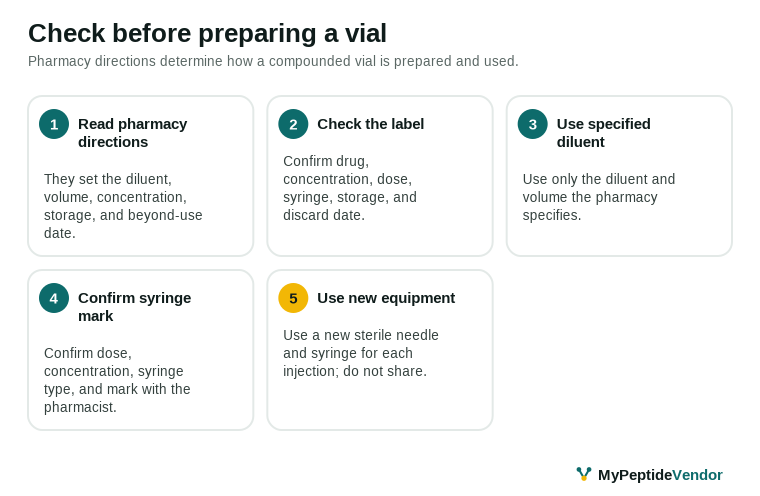
There is no single reconstitution method for every compounded semaglutide vial. The pharmacy’s directions determine the diluent, volume, final concentration, storage conditions, and beyond-use date. FDA-approved Wegovy injection is supplied as a solution and does not need reconstitution. 12
- Read the pharmacy label and instructions before opening the vial. Confirm the drug name, total vial amount, final concentration in mg/mL, prescribed dose in mg, syringe type, storage directions, and discard date. If anything is missing or conflicts with the prescription, pause and call the pharmacy. 2
- Confirm the pharmacy and active ingredient. FDA recommends obtaining a prescription from a doctor and filling it at a state-licensed pharmacy. FDA also warns that semaglutide sodium and semaglutide acetate are different active ingredients from those used in FDA-approved products. 2
- Use only the diluent and volume the dispensing pharmacy specifies. Do not select a water volume based on the vial’s 20 mg total or an online chart. Do not assume a vial needs reconstitution; the product may be supplied in another form. 2
- Have the pharmacist confirm the concentration and syringe mark. Read back the prescribed dose in mg, vial concentration in mg/mL, syringe type, and exact mark on the syringe. Do not inject if the label or directions are unclear. 2
- Use clean, single-use equipment. Use a new sterile needle and syringe for each injection, and do not reuse or share them. Follow the pharmacy’s vial-access instructions and discard the vial within the applicable period. 2
If a vial arrives warm, in damaged packaging, or without adequate cold packaging, contact the pharmacy before using it. FDA warns that inadequate refrigeration during shipping can affect injectable GLP-1 product quality. 2
Use this chart
Free to reuse with a link back:
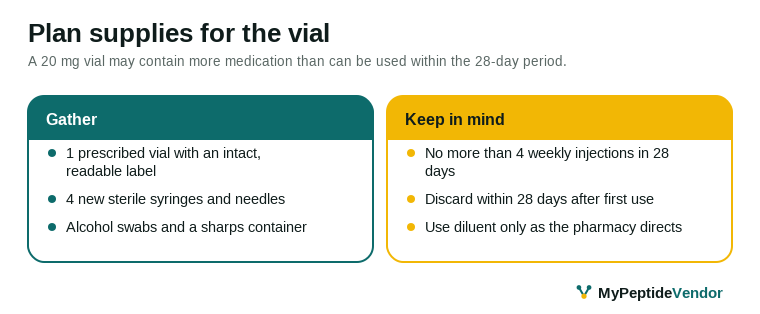
Supplies needed for a full 20 mg vial
For the first 28 days after opening a multi-dose vial, plan supplies for no more than 4 once-weekly injections. FDA recommends discarding a multi-dose sterile vial within 28 days after first use because contamination risk increases after opening. 2
- 1 prescribed vial with an intact, readable pharmacy label.
- 4 new sterile syringes and needles for 4 weekly injections; do not reuse either. 2
- Alcohol swabs in the quantity directed by the pharmacy or clinician.
- 1 sharps container for used needles and syringes.
- The exact diluent and amount on the pharmacy instructions, only if reconstitution is directed. Do not substitute a diluent or choose a volume yourself. 2
- 1 dose log with space for the date, prescribed dose in mg, confirmed syringe mark, vial concentration, injection site, and symptoms.
A 20 mg vial may contain more medication than can be used within the FDA’s 28-day recommendation after first use. Leftover volume does not extend that period; do not continue injecting from the vial just to use its remaining contents. 2
Use this chart
Free to reuse with a link back:
Protocol overview and cycle notes

What the labeled schedule means
Semaglutide is a glucagon-like peptide-1 receptor agonist (GLP-1 receptor agonist). It reduces calorie intake and delays stomach emptying; its blood-glucose effects include glucose-dependent stimulation of insulin secretion and reduced glucagon secretion. 1 The FDA weight-management indication is used with reduced-calorie eating and increased physical activity, rather than as a short cycle with a proven off-period. 1
For adult weight reduction, labeled maintenance choices are 1.7 mg or 2.4 mg weekly, with 2.4 mg recommended. Selected adults who tolerate 2.4 mg for at least 4 weeks may increase to a maximum of 7.2 mg weekly if more weight reduction is clinically indicated. 1 The label does not set a universal schedule of intermediate doses or time at each step between 2.4 mg and 7.2 mg, so do not create one yourself.
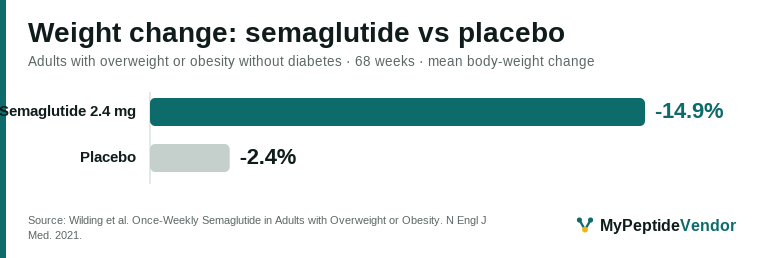
STEP 1 studied 1,961 adults with overweight or obesity without diabetes for 68 weeks. Mean body-weight change was −14.9% with semaglutide 2.4 mg and −2.4% with placebo. For an illustrative starting weight of 225 lb, 14.9% is about 34 lb; this is arithmetic based on the trial mean 8, not a prediction for any individual.
In the STEP 1 extension, participants who stopped treatment at week 68 regained an average 11.6 percentage points of lost weight by week 120. Their net change from the beginning of the study was −5.6% at week 120, compared with −0.1% for the placebo group. 9 The extension does not establish the exact week when appetite returns for each person.
Compounded vial versus FDA-approved product
| Feature | FDA-approved Wegovy injection | Compounded semaglutide vial |
|---|---|---|
| Presentation | Clear, colorless solution in single-dose pens, single-dose syringes, or a FlexTouch pen. | May be dispensed in a multi-dose vial; use the directions on that pharmacy’s label. |
| Dose measurement | Use the labeled dose and instructions for the supplied device. | Manual measurement depends on the vial concentration and prescribed dose. |
| FDA review | FDA-approved product with labeled directions and indications. | Not an FDA-approved finished drug and not reviewed by FDA for safety, effectiveness, or quality before marketing. |
| When used | Use when prescribed and appropriate for the patient’s indication. | FDA says compounded drugs should be used only when an FDA-approved drug cannot meet the patient’s medical needs. |
| Questions for the pharmacy | Confirm device technique, prescribed dose, and storage directions. | Confirm the state-licensed pharmacy, active ingredient, concentration, diluent, syringe type, exact syringe mark, storage, and discard date. |
Compounded products do not receive FDA premarket review for safety, effectiveness, or quality. FDA recommends using them only when an FDA-approved option cannot meet the patient’s medical needs and warns patients to ask the prescriber or compounder about measuring and administering the intended dose. 2
Other treatment results are not dose instructions
In SURMOUNT-5, a 72-week head-to-head trial of adults with obesity but without type 2 diabetes, mean weight change was −20.2% with maximum tolerated tirzepatide and −13.7% with maximum tolerated semaglutide. 6 The comparison does not show that either medicine suits every patient or provide a reason to switch without a prescriber.
In SUSTAIN-6, adults with type 2 diabetes and high cardiovascular risk taking semaglutide had a hazard ratio of 0.74 for major cardiovascular events versus placebo, with a 95% confidence interval of 0.58–0.95. 11 That result applies to the studied population. Wegovy also has an FDA-labeled cardiovascular-risk-reduction indication for adults with established cardiovascular disease and overweight or obesity. 1
Monitoring to discuss with the clinician
| Before treatment | During treatment | Why it may matter |
|---|---|---|
| Review personal or family history of medullary thyroid carcinoma (MTC) and multiple endocrine neoplasia syndrome type 2 (MEN 2). | Report a neck mass, difficulty swallowing, shortness of breath, or persistent hoarseness. | Those histories are contraindications; whether semaglutide causes thyroid C-cell tumors in humans is unknown. |
| For diabetes, review blood-glucose control and use of insulin or an insulin secretagogue. | Monitor blood glucose before and during treatment in patients with diabetes. | Semaglutide can lower glucose, and insulin or sulfonylureas can increase hypoglycemia risk. |
| Ask whether renal function, A1c, or lipids should be checked for your conditions and medicines. | Check renal function if vomiting, diarrhea, or other effects could cause volume depletion. | The label specifically advises renal-function monitoring when adverse effects may cause dehydration. |
| Review thyroid nodules or prior thyroid findings with the clinician. | Routine calcitonin testing or thyroid ultrasound solely to screen for MTC has uncertain value. | A known thyroid nodule or raised calcitonin needs clinical assessment. |
There is no single lab schedule for every patient. The label specifically calls for blood-glucose monitoring in people with diabetes and renal-function monitoring when symptoms could cause volume depletion; other tests depend on medical history and treatment. 1
Storage and handling
For FDA-approved Wegovy injection, follow the instructions for the supplied presentation. Inspect the solution before use; the label says to use it only if it is clear, colorless, and free of particles. 1
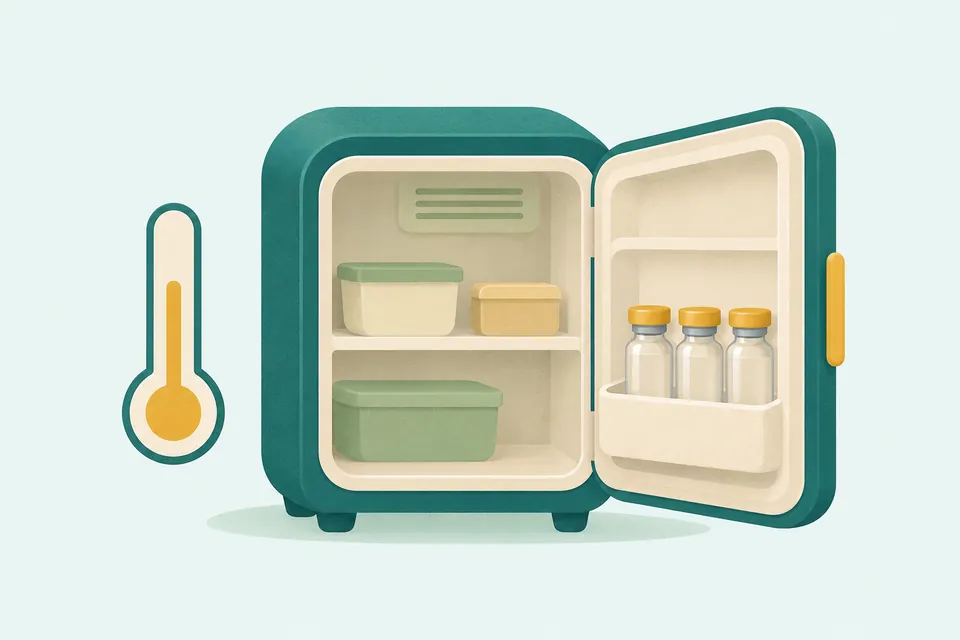
For a compounded vial, follow the pharmacy’s storage directions because formulations and beyond-use dates can differ. FDA says injectable GLP-1 medicines require refrigeration as indicated in their package inserts and warns that a product arriving warm or without adequate refrigeration may have quality problems. Contact the pharmacy before using a vial that arrived warm or in damaged packaging. 2
FDA generally recommends using a multi-dose sterile vial within 28 days after first use and advises discarding it at that point even if medication remains. Do not extend the period because the vial still contains medication or because an informal online instruction gives a longer period. 2
Use a new sterile needle and syringe for each injection, and do not share them. Follow the label and pharmacy directions for storage and discard timing. 2
Injection and tracking tips
FDA-approved Wegovy injection is given under the skin (subcutaneously) in the abdomen, thigh, or upper arm once weekly on the same day each week. The time of day and injection site may change without a dose adjustment, and the label directs patients to rotate injection sites. 1 A compounded vial may require different device steps, so use the method taught by the pharmacy or clinician.
- Before drawing, match the prescribed dose in mg to the vial’s labeled concentration. 2
- Check that the syringe is U-100 before using a U-100 unit marking; a different syringe scale will give different unit marks for the same volume.
- Ask the pharmacist to confirm the prescribed mg, vial concentration in mg/mL, syringe type, and exact unit mark. FDA reports dosing errors from patient measurement and health professional calculation mistakes. 2
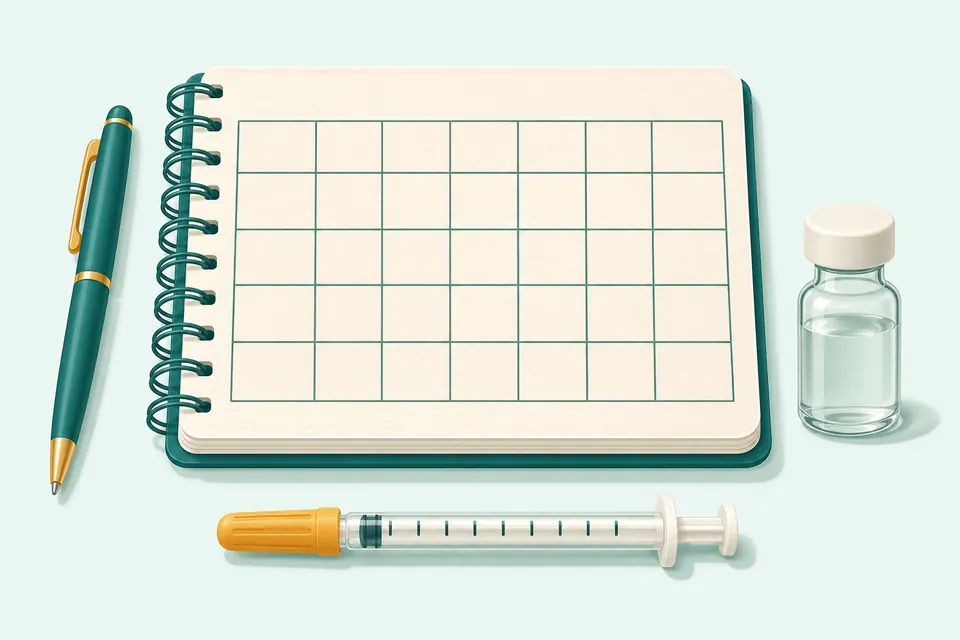
- Record the injection date, prescribed dose in mg, syringe mark, injection site, vial concentration, and symptoms. A written record can help identify a missed or late dose.
- Do not use Wegovy with another semaglutide-containing product or another GLP-1 receptor agonist; the label does not recommend taking them together. 1
- Tell the care team about insulin, sulfonylureas, other medicines, and planned surgery or deep sedation. The label warns about hypoglycemia with insulin or insulin secretagogues and reports pulmonary aspiration during anesthesia or deep sedation. 1
If you miss one Wegovy injection, whether you take it or skip it depends on how soon the next dose is due. If 2 or more consecutive doses are missed, the label says restarting at a lower dose with dose escalation may reduce gastrointestinal reactions; ask the prescriber for a restart plan. 1
Safety and side effects
Common effects and how often they occurred
In adult weight-reduction trials of Wegovy injection at 2.4 mg weekly, nausea occurred in 44%, diarrhea in 30%, vomiting in 24%, constipation in 24%, and abdominal pain in 20%. Headache occurred in 14% and fatigue in 11%. 1 These are trial-group rates, not an individual prediction.
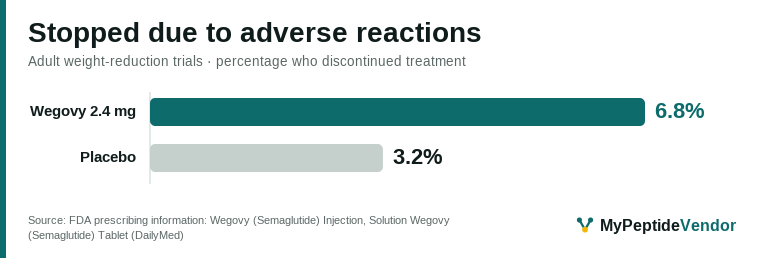
In those trials, 6.8% of people taking Wegovy injection stopped because of adverse reactions, compared with 3.2% taking placebo; severe gastrointestinal reactions occurred in 4.1% and 0.9%, respectively. 1 A meta-analysis of 4 trials in adults without diabetes found gastrointestinal events were 1.59 times as likely and discontinuation due to adverse events 2.19 times as likely with semaglutide as with control. 7
In adult weight-reduction trials, gallstones were reported in 1.6% of Wegovy injection users and 0.7% of placebo users; gallbladder inflammation occurred in 0.6% and 0.2%, respectively. 1 Substantial or rapid weight loss can also increase gallstone risk, so report symptoms that may indicate gallbladder disease. 1
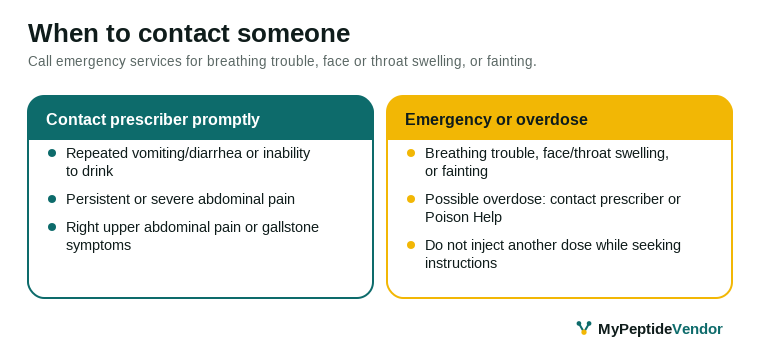
Contact the prescriber promptly
- Repeated vomiting or diarrhea, inability to keep fluids down, dizziness, or very low urine output: gastrointestinal effects can lead to dehydration and kidney injury; the label advises renal monitoring when such effects may cause volume depletion. 1
- Persistent or severe abdominal pain, with or without vomiting: seek prompt assessment for possible pancreatitis. The label says to discontinue Wegovy if pancreatitis is suspected. 1
- Right upper abdominal pain or symptoms that may indicate gallstones: contact a clinician for evaluation; gallbladder studies and clinical follow-up are indicated when gallstones are suspected. 1
- Shakiness, sweating, confusion, or weakness: follow the glucose plan from the diabetes care team, especially if taking insulin or a sulfonylurea. 1
- A new neck lump, trouble swallowing, trouble breathing, or persistent hoarseness: contact a clinician promptly. 1
Emergency symptoms and possible overdose
Call emergency services for trouble breathing, swelling of the face or throat, fainting, or another possible severe allergic reaction. Anaphylaxis and angioedema have been reported with Wegovy. 1
If you may have injected several times the prescribed dose, contact your prescriber or Poison Help at 1-800-222-1222. Do not inject another dose while seeking instructions. Overdose reports involving GLP-1 medicines include severe nausea, severe vomiting, and severe hypoglycemia; supportive care and prolonged observation may be needed because semaglutide’s half-life is about 1 week. 1 Seek emergency care for severe symptoms, confusion, fainting, inability to keep fluids down, or a possible allergic reaction.
Boxed warning and key contraindication
Wegovy carries a boxed warning because semaglutide caused thyroid C-cell tumors in rodents; whether it causes medullary thyroid carcinoma in humans is unknown. Wegovy is contraindicated for a person with a personal or family history of MTC or with MEN 2. 1 Routine calcitonin testing or thyroid ultrasound solely to screen for MTC has uncertain value. 1
Other serious risks include pancreatitis, gallbladder disease, hypoglycemia with certain diabetes medicines, kidney injury related to volume depletion, severe gastrointestinal reactions, and diabetic retinopathy complications in people with type 2 diabetes. Wegovy is not recommended for patients with severe gastroparesis. 1
For weight reduction, the label advises stopping Wegovy when pregnancy is recognized and stopping at least 2 months before a planned pregnancy because semaglutide has a long half-life. 1 Discuss pregnancy plans with the prescriber before treatment.
Use this chart
Free to reuse with a link back:
Frequently asked questions
How many units should I draw from a 20 mg semaglutide vial?
There is no single unit amount for every 20 mg vial. The mark depends on the prescribed dose, the vial’s labeled concentration, and the syringe scale. Ask the pharmacy to confirm the exact U-100 mark before injecting; FDA has received reports of measurement and calculation errors. 2
How much bacteriostatic water should I add to a 20 mg vial?
Do not choose a diluent or volume from a general online guide. Use the pharmacy’s written preparation instructions; FDA-approved Wegovy injection is supplied as a solution and does not require reconstitution. 12
What should I do if I miss a weekly Wegovy injection?
If the next scheduled dose is more than 2 days away, take the missed injection as soon as possible. If it is less than 2 days away, skip it and resume on the regular day. After 2 or more consecutive missed doses, ask the prescriber whether to restart at a lower dose. 1
Can I switch from a compounded vial to a Wegovy pen using the same units?
No. Vial units represent a volume tied to that vial’s concentration, while a Wegovy device delivers a labeled dose through its own presentation. Have the prescriber set the new dose and timing rather than carrying over the syringe mark. 12
Can I use a 20 mg vial for 16 weeks or longer?
Do not use it beyond the pharmacy’s directions. FDA recommends discarding a multi-dose sterile vial within 28 days after first use, even if medication remains. 2
How long do I stay at each dose before increasing to 7.2 mg?
The labeled escalation uses 4-week steps through 1.7 mg, and the prescriber may delay an increase for 4 weeks if a dose is not tolerated. Before moving to 7.2 mg, the label requires tolerating 2.4 mg for at least 4 weeks and says additional weight reduction must be clinically indicated; it does not give a universal schedule for intermediate steps. 1
What if I accidentally inject too much semaglutide?
Contact your prescriber or Poison Help at 1-800-222-1222 and do not take another dose until advised. Severe nausea, vomiting, hypoglycemia symptoms, dehydration, or severe abdominal pain needs urgent medical assessment; call emergency services for severe symptoms or a possible allergic reaction. 1
Can I take semaglutide with alcohol or another GLP-1 medicine?
Ask your clinician how alcohol fits your health and diabetes plan; do not change your dose based on drinking. The Wegovy label does not recommend taking it with another semaglutide product or another GLP-1 receptor agonist. 1
How quickly does appetite return after stopping semaglutide?
The timing for an individual has not been established. In the STEP 1 extension, participants regained an average 11.6 percentage points of lost weight by week 120 after stopping at week 68, but the extension did not report when each person’s appetite returned. 9
Do I need thyroid blood tests while taking semaglutide?
Routine calcitonin testing or thyroid ultrasound solely to screen for MTC has uncertain value according to the Wegovy label. A personal or family history of MTC or MEN 2 is a contraindication, and a new thyroid lump or persistent hoarseness should be assessed. 1
References
- FDA prescribing information: Wegovy (Semaglutide) Injection, Solution Wegovy (Semaglutide) Tablet (DailyMed)
- FDA: Concerns with unapproved GLP-1 drugs used for weight loss
- FDA: Certain bulk drug substances for use in compounding that may present significant safety risks
- McGuire et al. Oral Semaglutide and Cardiovascular Outcomes in High-Risk Type 2 Diabetes. N Engl J Med. 2025.
- Weghuber et al. Once-Weekly Semaglutide in Adolescents with Obesity. N Engl J Med. 2022.
- Aronne et al. Tirzepatide as Compared with Semaglutide for the Treatment of Obesity. N Engl J Med. 2025.
- Tan et al. Efficacy and Safety of Semaglutide for Weight Loss in Obesity Without Diabetes: A Systematic Review and Meta-Analysis. J ASEAN Fed Endocr Soc. 2022.
- Wilding et al. Once-Weekly Semaglutide in Adults with Overweight or Obesity. N Engl J Med. 2021.
- Wilding et al. Weight regain and cardiometabolic effects after withdrawal of semaglutide: The STEP 1 trial extension. Diabetes Obes Metab. 2022.
- Tan et al. Efficacy and safety of tirzepatide for treatment of overweight or obesity. A systematic review and meta-analysis. Int J Obes (Lond). 2023.
- Marso et al. Semaglutide and Cardiovascular Outcomes in Patients with Type 2 Diabetes. N Engl J Med. 2016.
- ClinicalTrials.gov: 832 registered studies (search: Semaglutide)
Written by the MyPeptideVendor editorial team from the FDA label, peer-reviewed studies and ClinicalTrials.gov records listed above, fact-checked line by line and reviewed 2026-11-12.
Cite this page
MyPeptideVendor Editorial Team. Semaglutide 20 mg Vial Dosing Protocol. MyPeptideVendor. Updated November 12, 2026. https://mypeptidevendor.com/protocols/semaglutide-dosing-20mg/MyPeptideVendor Editorial Team. (2026, November 12). Semaglutide 20 mg Vial Dosing Protocol. MyPeptideVendor. https://mypeptidevendor.com/protocols/semaglutide-dosing-20mg/Related protocols
5-Amino-1MQ 50 mg
Not approvedNo approved human dose exists; this guide separates 50 mg vial math from dosing advice and explains evidence, handling, and safety limits.
View protocolAICAR 50 mg
Research UseAICAR has no approved human dose or validated injection schedule; a 50 mg vial does not establish a safe dose, dilution, or cycle.
View protocolAOD-9604 10 mg
Not approvedAOD-9604 is not FDA-approved, and no validated human subcutaneous dose, titration schedule, or cycle is established.
View protocol