AOD-9604: Evidence, Dosing & US Status
Growth hormone fragment
Brand names: No FDA-approved AOD-9604 brand is established

AOD-9604 is a fragment of human growth hormone studied as a possible obesity treatment. It is not FDA-approved, and the human evidence does not establish that it produces clinically meaningful weight loss. 3,5,7
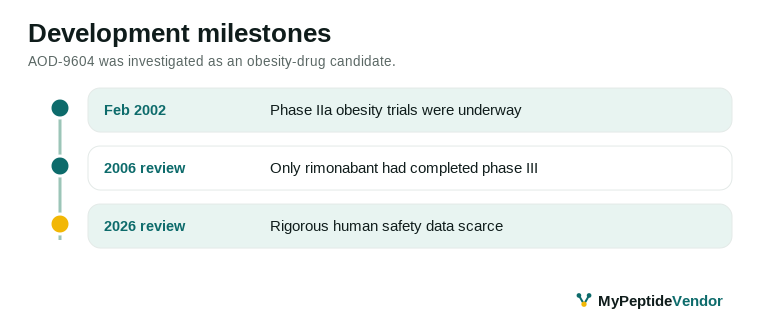
Metabolic had phase IIa obesity trials underway by February 2002. A 2006 review reported that only rimonabant among the obesity-drug candidates it discussed had completed phase III; it did not report a numerical AOD-9604 weight-loss result. 5,7
Key takeaways
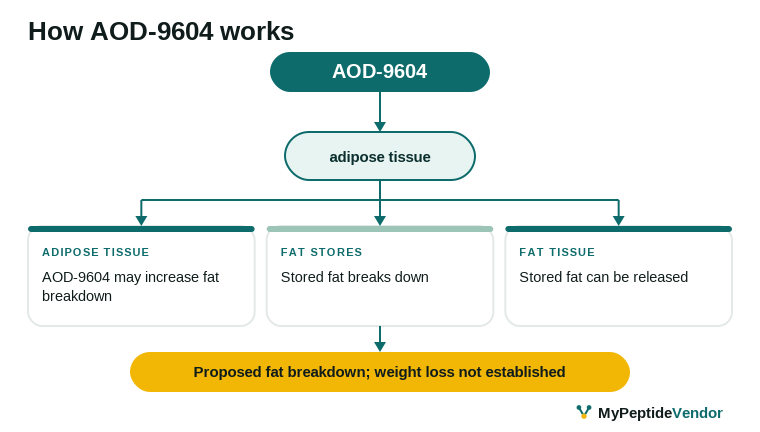
- AOD-9604 is a growth hormone fragment described as increasing fat breakdown in adipose tissue. 7
- Phase IIa obesity trials were underway by February 2002; the 2006 review reported only rimonabant had completed phase III among the candidates it covered. 5,7
- 8
- Neither the development reviews nor the 2006 review establishes a dose range, fasted timing, injection route, or cycle length. 5,7
- A 2026 review says rigorous human safety data for unapproved peptides are scarce and that serious harm is possible. 3
AOD-9604 at a glance
- Class
- Human growth hormone fragment
- Mechanism
- Described as increasing adipose-tissue breakdown (lipolysis)
- FDA Status
- Not FDA-approved
- Brand names
- No FDA-approved AOD-9604 brand is established
- Administration
- No FDA-approved route or administration instructions
- Typical Dose
- No approved or substantiated typical dose
- Half-life
- Not established in the cited development reviews
- Primary Uses
- Investigated as a possible obesity treatment
What is it?

AOD-9604 is a synthetic peptide fragment derived from human growth hormone (hGH). A 2006 review describes it as a human growth hormone fragment that increases adipose-tissue breakdown. Adipose tissue is the body’s stored-fat tissue; breakdown of stored fat is called lipolysis. 7
The name is short for “anti-obesity drug,” reflecting the reason it was investigated rather than an approved use. The development reviews describe AOD-9604 as an obesity-drug candidate, not as a prescription weight-loss medicine with an FDA-reviewed label. 5,7
Metabolic had phase IIa trials for obesity underway by February 2002. A phase IIa study tests a treatment in people and can help assess early effectiveness and safety, but this milestone alone does not show that the drug works. 5
In 2006, a review of obesity medicines in development said that only rimonabant among the candidates it covered had completed phase III. That review did not report AOD-9604 completing phase III or provide a trial-by-trial account of its later development. 7
A 2026 review lists AOD-9604 among approved and unapproved peptides and says rigorous human safety data for unapproved peptides are scarce 3. That assessment is a reason to treat online claims cautiously, not evidence that every possible harm has already been identified. 3
Use this chart
Free to reuse with a link back:
What makes it different
The 2006 obesity-drug review describes AOD-9604 as a growth hormone fragment that increases adipose-tissue breakdown. That proposed action differs from using a medicine described by FDA as a GLP-1 drug, such as semaglutide or tirzepatide. 1,7
Fat breakdown is not the same outcome as sustained weight loss. A change in how fat is used would still need to translate into a meaningful change in body weight, and the development reviews do not provide a reliable placebo-adjusted result in pounds or percentage of body weight. 5,7
The development stage also separates AOD-9604 from FDA-approved weight-management medicines. By 2006, the review of candidates in development reported only rimonabant had completed phase III; FDA distinguishes approved GLP-1 medicines from unapproved versions sold outside its safety, effectiveness, and quality review. 1,7
Those safety observations do not show that AOD-9604 causes weight loss. 8
Claims that AOD-9604 is a “clean” or risk-free alternative go beyond what these findings can show. Six trials summarized for safety do not establish uncommon risks, effects after prolonged use, or the safety of a product bought online with uncertain identity or handling. 3,8
How does it work?
In plain words: AOD-9604 was investigated because it was thought to encourage stored fat to break down. The technical term for that process is lipolysis. The 2006 review describes AOD-9604 as a human growth hormone fragment that increases adipose-tissue breakdown. 7
That description explains the proposed target, not a proven result in a person. Fat tissue can release stored fat, but that alone does not tell us how much body weight someone will lose, whether the change will last, or whether the effect outweighs food intake and other influences on weight. Weight loss versus placebo for AOD-9604 is not reported in the development reviews. 5,7
For comparison, FDA describes semaglutide and tirzepatide as GLP-1 drugs used for weight loss. The mechanism described for AOD-9604 in the obesity-drug review is adipose-tissue breakdown, rather than the GLP-1 drug category FDA names for those medicines. 1,7
More detailed claims about a specific receptor pathway, a reliable dose-response relationship, or a predictable amount of fat loss are not established by the development reviews. They also do not establish subcutaneous injection or fasted timing as patient-use instructions. 5,7
Use this chart
Free to reuse with a link back:
What the clinical evidence actually shows

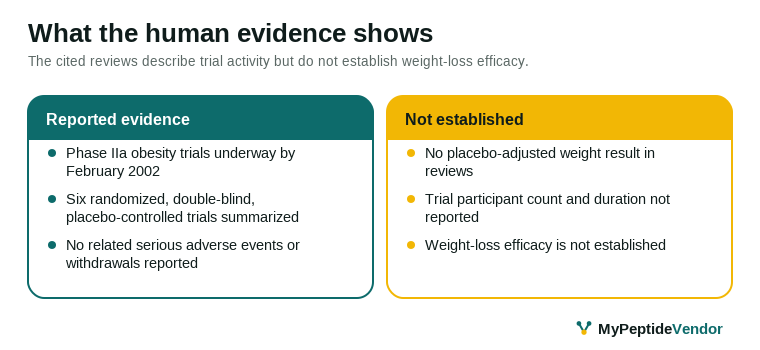
Direct answer: Human evidence does not establish AOD-9604 as an effective weight-loss treatment 5,7. The development record includes phase IIa obesity trials, but the reviews do not report a dependable placebo-adjusted change in pounds or percentage of body weight. 5,7
What the trial record tells us
Metabolic had phase IIa obesity trials underway by February 2002. The 2004 review does not give a trial name, participant count, treatment duration, dose, or numerical weight change, so it cannot tell a reader how much weight participants lost. 5
The 2006 review places AOD-9604 among obesity medicines in development and describes it as a growth hormone fragment that increases adipose-tissue breakdown. It says only rimonabant among the candidates it covered had completed phase III. This supports a limited conclusion about the development status reported in 2006; it does not provide a later, complete history of every development effort. 7
Neither 5 nor 7 reports a placebo-adjusted weight-loss result, participant count, or dose range for AOD-9604. They also do not state how many people reached a clinically meaningful weight-loss target or whether any change remained after treatment ended. 5,7
What the safety trials add
A 2013 paper summarized six randomized, double-blind, placebo-controlled trials. It focused on possible problems associated with full-length growth hormone treatment, including higher IGF-1, insulin resistance, and impaired glucose tolerance. 8
The same summary says no anti-AOD-9604 antibodies were detected in patients selected for antibody testing. These are reassuring findings within the trials described, but the summary does not give the total number of participants, duration, or event percentages needed to estimate the frequency of individual symptoms. 8
Those six trials are evidence about selected safety outcomes, not proof of weight-loss efficacy. The development reviews still do not provide a numerical weight-loss comparison against placebo, a duration of benefit after stopping, or evidence for combining AOD-9604 with semaglutide or tirzepatide. 5,7,8
Evidence tiers
- Human development: phase IIa obesity trials were underway by February 2002, but the cited review does not report trial-level weight results or participant counts. 5
- Human safety: six randomized, double-blind, placebo-controlled trials were summarized; the paper reports no IGF-1 change, no negative oral glucose-tolerance effect, and no related serious adverse events or withdrawals. 8
- Development stage: in 2006, a review reported that only rimonabant among the obesity-drug candidates it discussed had completed phase III. 7
- Proposed mechanism: a review describes increased adipose-tissue breakdown. A proposed mechanism is not proof of meaningful weight loss. 7
- Unapproved peptide safety: a 2026 review says rigorous human safety data are scarce and that serious harm is possible. 3
- Unverified online claims: no dose range or cycle length is established in the cited development reviews. 5,7
There is no established answer here about safe continuous use, the effects of stopping, or interaction with GLP-1 medicines. The absence of interaction data does not show that a combination is safe. 3,5,7
Use this chart
Free to reuse with a link back:
Typical dosing

There is no approved typical dose. The development reviews do not provide a verified dose range or a complete trial dosing schedule, and AOD-9604 has no FDA-approved label giving instructions for use. 3,5,7
Online claims such as 250–500 mcg daily, a 1 mg ceiling, or cycles lasting 12–24 weeks are not established by the cited development reviews. Do not treat those figures as trial-backed instructions: neither 5 nor 7 reports those dose limits or cycle lengths. 5,7
Subcutaneous injection and fasted timing are not established as patient-use instructions in 5,7. Do not infer an injection method, mixing directions, storage conditions, or dose from a research-vial label or an online calculator. 3,5,7
How long can someone stay on it? No approved treatment duration or evidence-based cycle length is established in the development reviews. They also do not report whether any weight change lasts after treatment stops, so an advertised cycle should not be mistaken for a tested long-term plan. 5,7
A clinician can help compare approved weight-management options and review a person’s medical history. Medical supervision does not make an unapproved product FDA-approved or supply missing dose and duration evidence. 1,3
Side effects: what to actually expect
AOD-9604 side-effect percentages cannot be stated from the clinical summaries. The 2013 safety paper describes six randomized, double-blind, placebo-controlled trials, but does not report percentages for nausea, headache, injection-site reactions, or other individual symptoms in its summary. 8
That paper reports no change in serum IGF-1, no negative effect on oral glucose-tolerance results, no detected anti-AOD-9604 antibodies among patients selected for testing, and no withdrawals or serious adverse events related to intake. These findings describe the outcomes reported in those trials; they do not show that every user will avoid side effects. 8
The summary does not provide the total number of participants or treatment duration, so it cannot tell us how often less serious symptoms occurred or estimate uncommon harms. A 2026 review separately warns that rigorous human safety data for unapproved peptides are scarce and that serious harm is possible. 3,8
FDA’s reports of nausea, vomiting, diarrhea, abdominal pain, and constipation concern dosing problems with compounded semaglutide or tirzepatide, not AOD-9604. Those symptoms should not be presented as known AOD-9604 event rates. 1
If you have used an unapproved peptide and develop severe or rapidly worsening symptoms, contact a clinician or emergency services as appropriate. AOD-9604-specific rates for serious reactions are not established in the trial summary. 3,8
Regulatory & access status in the US (as of 2026)
AOD-9604 is not an FDA-approved weight-loss medicine. A 2026 review lists it among unapproved peptides and notes that rigorous human safety data for such compounds are scarce. There is no FDA-approved AOD-9604 label setting a standard dose, route, or duration. 3
Products advertised as “research use only” or “not for human consumption” are not FDA-approved medicines. FDA has warned about certain unapproved drugs sold to consumers under research-use labels for human use, including some GLP-1 products; that warning does not establish the quality or regulatory history of a specific AOD-9604 product. 1
A seller’s webpage or certificate of analysis cannot by itself establish that a vial is FDA-approved, correctly labeled, sterile, or identical to the material tested. FDA says unapproved versions of GLP-1 drugs do not undergo its review for safety, effectiveness, and quality before marketing; the same statement should not be mistaken for an AOD-9604-specific FDA action. 1
Neither 1 nor 3 establishes whether a particular online AOD-9604 sale is legal, nor can either confirm a vial’s identity, concentration, sterility, or handling history. A clinician’s involvement cannot replace regulatory review or independently verify a product’s contents. 1,3
Athletes: A 2014 anti-doping review lists AOD-9604 among peptides classified as doping agents by WADA 6. Athletes should check current rules with their sport’s governing body before using a peptide. 6
Red flags: Be cautious about promises of rapid fat loss, precise dosing claims without traceable clinical evidence, or products offered without a credible quality-control process. FDA also identifies research-use labeling on certain unapproved drugs marketed to consumers for human use as a concern. 1
Questions for a clinician: Ask which FDA-approved treatments fit your health history, what monitoring is appropriate, and what evidence supports a proposed AOD-9604 dose or duration. Ask how product identity and supply chain could be independently checked; no available AOD-9604 label establishes a tested regimen. 1,3,5,7
Research-grade AOD-9604 is available from American Peptides (AOD-9604, from $60.00); code MYPEPTIDEVENDOR takes 15% off. Sold for laboratory research only, not for human use. Affiliate link
How it compares with semaglutide and tirzepatide
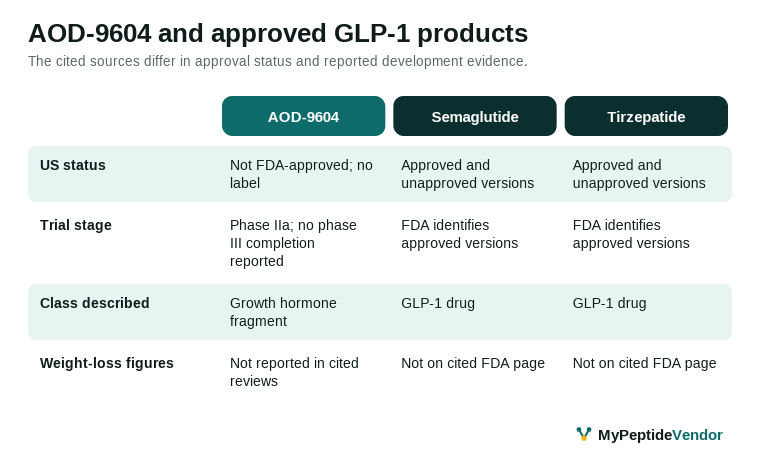
Semaglutide and tirzepatide are the closest alternatives for a practical comparison because FDA discusses approved versions of both as GLP-1 drugs used for weight loss. AOD-9604 remains an unapproved peptide, and its cited development record does not provide a comparable numerical weight-loss result. 1,3,5,7
The table separates approval status, development stage, and the type of evidence available. FDA’s page addresses unapproved GLP-1 products but does not provide a head-to-head weight-loss comparison of semaglutide and tirzepatide; the AOD-9604 development reviews do not provide a comparable weight-loss estimate. 1,5,7
These differences in approval and reported development evidence are described in FDA’s GLP-1 information and the AOD-9604 development reviews. 1,5,7
| Feature | AOD-9604 | Semaglutide | Tirzepatide |
|---|---|---|---|
| US status | Not FDA-approved; no approved AOD-9604 label | FDA discusses approved products and unapproved versions | FDA discusses approved products and unapproved versions |
| Human development evidence | Phase IIa obesity trials were underway; no phase III completion was reported in the 2006 review | FDA identifies approved versions | FDA identifies approved versions |
| Mechanism or drug class described | Growth hormone fragment described as increasing adipose-tissue breakdown | GLP-1 drug | GLP-1 drug |
| Comparable weight-loss numbers | Not reported in the cited development reviews | Not provided on the cited FDA page | Not provided on the cited FDA page |
| Key evidence issue | No approved dose or duration; weight-loss effect is not established | Unapproved versions do not receive FDA premarket review for safety, effectiveness, and quality | Unapproved versions do not receive FDA premarket review for safety, effectiveness, and quality |
No head-to-head efficacy or numerical weight-loss comparison of semaglutide and tirzepatide is reported in 1. If “strongest” means the best-supported choice among these three, the FDA-approved versions of semaglutide and tirzepatide have a stronger regulatory footing than AOD-9604, but neither has been ranked against the other by weight lost. 1,3,5,7
FDA approval applies to specific products, not automatically to every vial sold online or every compounded version. FDA advises patients to obtain a prescription from a doctor and use a state-licensed pharmacy; it also warns that unapproved GLP-1 products do not undergo agency review for safety, effectiveness, and quality before marketing. 1
No interaction evidence for taking AOD-9604 with semaglutide or tirzepatide is established in the cited clinical summaries. Do not combine them on the assumption that one affects fat breakdown while the other belongs to a GLP-1 drug class; the benefit and safety of that combination have not been established. 1,3,5,7
Medical note: This profile is educational, not a personal treatment plan. Discuss weight-management choices with a licensed clinician, especially before using an unapproved peptide or changing a prescribed medicine. The 2026 review cautions that serious harm is possible with unapproved peptides. 3
Use this chart
Free to reuse with a link back:
Where to Buy AOD-9604 for Research
American Peptides
AOD-9604 · from $60.00
US-made research peptides, every lot third-party tested with a lot-matched COA.
15% offMYPEPTIDEVENDOR at checkout
- ≥99% purity verified by HPLC + mass spec, endotoxin tested
- Ships tracked from Louisiana, free shipping over $300
- 15% off your first order with code MYPEPTIDEVENDOR
Certified-Pep
US-made research peptides with batch-specific lab reports (COA) and a QR code on every vial.
- Independent laboratory testing (Vanguard Laboratory)
- Made in the USA, ships in 1-2 business days
- Research use only, not for human or veterinary use
Affiliate disclosure: we may earn a commission if you order through the link above. AOD-9604 is not approved by the FDA for human use.
Ranked in our guides
Frequently asked questions
Is AOD9604 effective for weight loss?
AOD-9604 has not been shown in the cited development record to produce clinically meaningful weight loss. Phase IIa obesity trials were underway by February 2002, but the published reviews do not give a placebo-adjusted result that can quantify benefit. 5,7
How long can you stay on AOD9604?
There is no established safe duration or tested cycle length in the clinical development reviews. They also do not tell us whether any weight change persists once use ends. 5,7
What are the potential side effects of AOD9604?
A 2013 summary of six controlled trials reports no related serious adverse events or withdrawals, but it does not give percentages for individual symptoms. It also reports no IGF-1 change and no negative oral glucose-tolerance effect; those findings cannot rule out uncommon or longer-term harms. 8
References
- FDA: Concerns with unapproved GLP-1 drugs used for weight loss
- FDA: Certain bulk drug substances for use in compounding that may present significant safety risks
- Mendias et al. Safety and Efficacy of Approved and Unapproved Peptide Therapies for Musculoskeletal Injuries and Athletic Performance. Sports Med. 2026.
- Rahman et al. Therapeutic Peptides in Orthopaedics: Applications, Challenges, and Future Directions. J Am Acad Orthop Surg Glob Res Rev. 2026.
- Wilding et al. AOD-9604 Metabolic. Curr Opin Investig Drugs. 2004.
- Thevis et al. Analytical approaches for the detection of emerging therapeutics and non-approved drugs in human doping controls. J Pharm Biomed Anal. 2014.
- Halford et al. Obesity drugs in clinical development. Curr Opin Investig Drugs. 2006.
Written by the MyPeptideVendor editorial team from the FDA label, peer-reviewed studies and ClinicalTrials.gov records listed above, fact-checked line by line and reviewed 2026-11-12.
Cite this page
MyPeptideVendor Editorial Team. aod 9604: Evidence, Dosing & US Status. MyPeptideVendor. Updated November 12, 2026. https://mypeptidevendor.com/peptides/aod-9604/MyPeptideVendor Editorial Team. (2026, November 12). aod 9604: Evidence, Dosing & US Status. MyPeptideVendor. https://mypeptidevendor.com/peptides/aod-9604/Related peptides
5-Amino-1MQ
Not approved5-Amino-1MQ is a small molecule, not a peptide; its human benefits, dose, side effects, and long-term safety are not established.
Learn moreAdipotide (FTPP)
Not approvedAdipotide is an experimental fat-vessel-targeting peptide with animal findings, kidney concerns, and no established human dose or benefit.
Learn moreCagrilintide
Not approvedCagrilintide is an investigational weekly amylin analogue; FDA says it has not been found safe and effective for any condition.
Learn more