HGH: Uses, Dosing, Risks & FDA Status
Peptide protein hormone
HGH is human growth hormone, a protein hormone released by the pituitary gland. It supports childhood growth and affects metabolism throughout life, partly through IGF-I 4.
Prescription HGH is recombinant human growth hormone (rhGH) 4. Inhaled protein absorption was under 5% in pediatric patients 3.
Key takeaways
- HGH acts directly and through IGF-I, which carries out many of its growth-related effects 4.
- IGFBP-3 carries over 95% of IGFs in the blood 5.
- Inhaled HGH absorption was under 5% in pediatric patients 3.
- HGH remains in circulation for 20–30 minutes, but its biological effects last 9–17 hours 4.
- A single HGH blood level cannot prove use because natural release is pulsatile 4.
HGH at a glance
- Class
- Peptide protein hormone
- Mechanism
- Binds growth hormone receptors and acts directly or through IGF-I
- FDA Status
- Prescription injectable HGH products are approved for specific medical conditions; indications vary by product.
- Brand names
- Somatropin and somatrem are synthetic forms; Somaderm claims are not evaluated by the FDA.
- Administration
- Prescription HGH is given by injection.
- Typical Dose
- A DEA reference lists 40 mcg/kg/day for children and 25 mcg/kg/day for adults; these are not individualized doses.
- Half-life
- Circulating half-life: 20–30 minutes; biological half-life: 9–17 hours.
- Primary Uses
- Selected pediatric growth disorders, growth hormone deficiency, and AIDS-related wasting.
What is it?

HGH, also called somatotropin, is a protein hormone made and released by the pituitary gland at the base of the brain 4. It has two main jobs: supporting growth in children and helping regulate metabolism and body composition in children and adults 4.
The pituitary releases HGH in bursts rather than at a steady level. A single blood measurement can therefore vary widely and cannot, by itself, prove that someone has used synthetic HGH 4. A clinician may use IGF-I, a growth-related hormone made mainly by the liver, to help assess HGH activity 5.
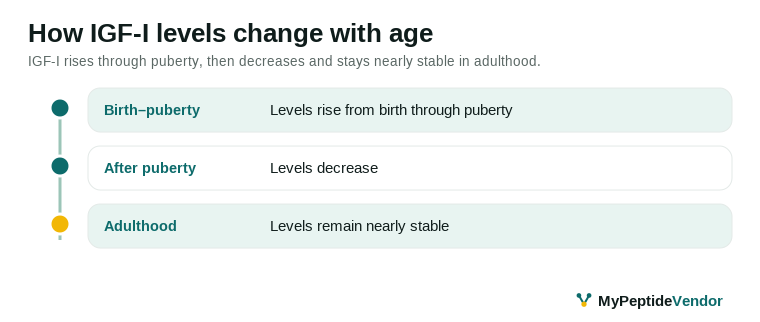
There is no universal sex- and age-specific HGH reference range that applies to every person or laboratory. IGF-I follows a clearer age pattern: levels rise from birth through the end of puberty, then decrease and remain nearly stable during adulthood 5. More than 95% of blood IGFs are carried by IGFBP-3, a binding protein stimulated by HGH 5.
Natural HGH comes from the pituitary; synthetic HGH is made using recombinant technology. Somatropin matches the major 22,000-dalton form of pituitary HGH, while somatrem has an extra amino acid at its starting end 4. HGH is a protein hormone, not an anabolic steroid.
Use this chart
Free to reuse with a link back:
What makes it different
HGH can increase height only while a child’s growth plates remain open. Once those plates fuse, HGH does not make a person taller; treatment in adults is aimed at other effects and is reserved for specific medical conditions.
Prescription HGH is injectable. Inhaled HGH was studied, but absorption from the lungs was under 5% in pediatric patients, too low for that route to work as a medical product 3. Pills and sprays marketed as HGH are not interchangeable with prescription injections.
A product’s name or advertising does not establish that it contains effective HGH or has FDA approval. Somaderm lists claims about bone and joint health, muscle and fat, and sleep, while stating that those claims have not been evaluated by the FDA 1. Claims of muscle building or anti-aging, pills or sprays sold as HGH, and sales without a prescription are reasons to be cautious.
People misuse HGH to enhance athletic performance 4.
How does it work?
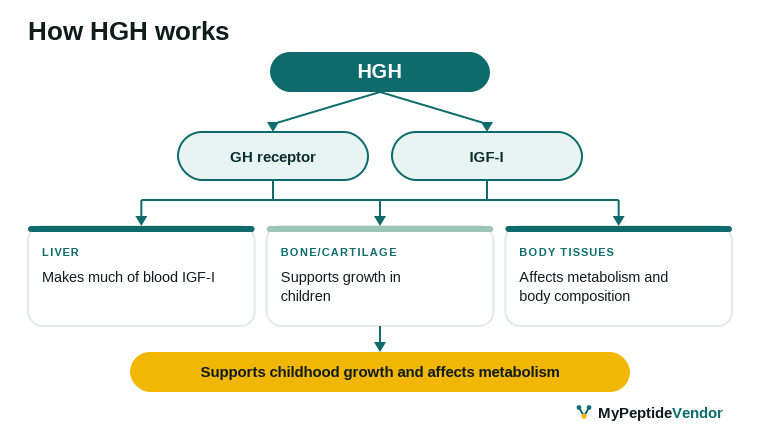
In plain terms, HGH sends growth and metabolism signals to tissues. Some effects happen directly; others happen after HGH prompts the body to make IGF-I, a major messenger for HGH’s effects 4.
Technically, HGH attaches to growth hormone receptors on cells and can trigger IGF-I production 4. The liver makes much of the IGF-I in blood, though other tissues make it too 5. IGFBP-3 carries over 95% of circulating IGFs 5.
In children, the HGH–IGF-I pathway supports bone and cartilage growth. In people with confirmed HGH deficiency, replacement has been linked with increased fat breakdown and lean body mass, decreased fat mass, and improved maximal oxygen uptake and maximal power output 4. Those findings in deficient patients should not be assumed to apply to healthy athletes.
HGH has a very short circulating half-life, and its effects are not limited to that short window 4. These natural influences do not replace medical treatment for a diagnosed deficiency.
Use this chart
Free to reuse with a link back:
What the clinical evidence actually shows

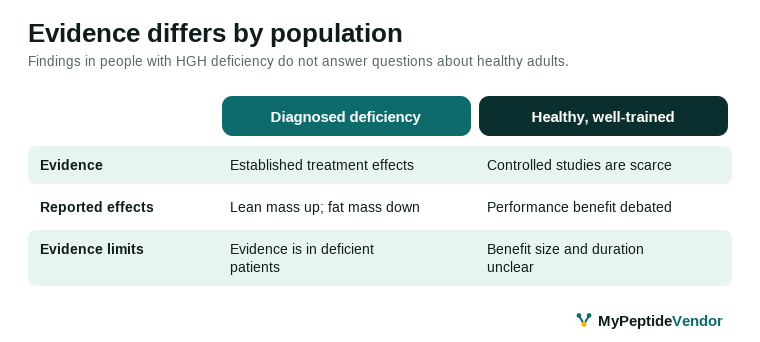
For people with diagnosed HGH deficiency, recombinant HGH treatment has established effects. A pharmacology review describes increased lean body mass and fat breakdown, decreased fat mass, and improved maximal oxygen uptake and maximal power output in deficient patients 4.
For healthy, well-trained people, controlled studies are scarce, and HGH’s ability to improve athletic performance remains debatable 4. Exercise research is also not a substitute for HGH trials: a systematic review included 33 studies in adults over 40, with results on hormone changes varying across training programs 6.
Trial-level estimates for healthy adults (including how large any benefit is, how long it lasts, and whether it improves strength) remain uncertain. Evidence from people with deficiency cannot answer those questions, because the patients and treatment goals differ 4.
HGH can be hard to detect in blood or urine because somatropin is chemically indistinguishable from natural HGH in those tests 4. Natural HGH release is pulsatile, so one serum level cannot prove exogenous use; testing approaches instead look at HGH-related markers or the mix of HGH forms in circulation 4.
Use this chart
Free to reuse with a link back:
Typical dosing

There is no single dose for every diagnosis, age, product, or patient. These are general reference doses, not a personal prescription or a universal current label regimen; the treating clinician must follow the specific product’s prescribing information.
Those reference figures are weight-based daily doses, not instructions for anti-aging, muscle gain, or sports use 4. Do not use an online seller’s dose or transfer a dose from one diagnosis to another. Prescription HGH requires medical supervision and dose decisions based on the condition being treated.
The short 20–30-minute circulating half-life does not mean doses should be repeated every half hour; HGH’s biological effects last 9–17 hours 4. Timing and dose belong to the prescribed treatment plan.
Side effects: what to actually expect
The size of those risks is not quantified in the clinical summary, so a personal risk estimate requires a clinician’s review of health history and treatment need.
New swelling, persistent joint or muscle pain, hand numbness, or tingling warrants discussion with the prescriber 4. Long-term effects of ongoing HGH use in healthy people are not established by the evidence summarized in clinical reviews 4.
Regulatory & access status in the US
Prescription injectable HGH is used to treat specific medical conditions 4. A clinician must determine whether a diagnosis and a particular product’s indication fit.
Anti-aging, bodybuilding, and athletic enhancement are not the medical uses described for prescription HGH 4. A clinic visit or an online prescription does not prove that a product or use is appropriate.
Somaderm’s claims about bone and joint health, muscle and fat, and sleep are explicitly marked as not evaluated by the FDA 1. Be wary of products sold as HGH in pill or spray form, sellers who do not require a prescription, and “FDA-approved” claims that do not identify a prescription injectable product.
For natural HGH release, sleep and exercise are practical influences; stress also raises secretion, while high blood sugar suppresses it 4. A review of exercise training in adults over 40 reported increases in testosterone and other hormones across training studies, though results varied by design 6. These measures support health but do not replace prescribed treatment for a confirmed deficiency.
How it compares to its closest alternative
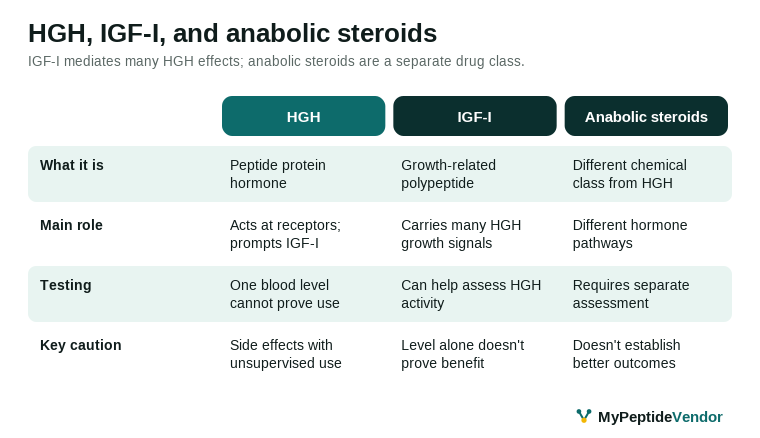
IGF-I is the closest biological comparison because it mediates many HGH effects; anabolic steroids are a separate drug class 45. HGH acts at growth hormone receptors and stimulates IGF-I, while IGF-I carries out many growth-related signals 4.
| Feature | HGH | IGF-I | Anabolic steroids |
|---|---|---|---|
| What it is | Peptide protein hormone | Growth-related polypeptide and HGH mediator | A different chemical class from HGH |
| Main role | Acts at growth hormone receptors and can stimulate IGF-I | Carries out many growth-related effects of HGH | Acts through different hormone pathways |
| Testing and detection | Natural release is pulsatile; one blood level cannot prove use | Blood levels can help assess HGH activity | Requires separate assessment |
| Key caution | Unsupervised use can cause side effects | A measured level is not proof of a treatment benefit | Use alongside HGH does not establish better outcomes |
Use this chart
Free to reuse with a link back:
Ranked in our guides
Frequently asked questions
What does HGH do to a person?
HGH supports bone and cartilage growth in children and affects metabolism and body composition throughout life 4. The body releases it in pulses, and its effects depend on age and health 4.
Can you legally take HGH?
Prescription injectable HGH is used for specific medical conditions, including HGH deficiency and certain growth disorders 4. Buying products from online sellers or using HGH for bodybuilding or anti-aging can involve illicit distribution or uses outside the listed medical indications 4.
References
- FDA prescribing information: Somaderm (Glandula Suprarenalis Suis, Thyroidinum (Bovine), Hgh) Gel (DailyMed)
- FDA: Certain bulk drug substances for use in compounding that may present significant safety risks
- Wolff et al. Preclinical Safety. J Aerosol Med Pulm Drug Deliv. 2025.
- Bidlingmaier et al. Growth hormone. Handb Exp Pharmacol. 2010.
- Chevenne et al. [Somatomedins]. Ann Biol Clin (Paris). 1991.
- Zouhal et al. Effects of Exercise Training on Anabolic and Catabolic Hormones with Advanced Age: A Systematic Review. Sports Med. 2022.
- ClinicalTrials.gov: 7542 registered studies (search: HGH)
Written by the MyPeptideVendor editorial team from the FDA label, peer-reviewed studies and ClinicalTrials.gov records listed above, fact-checked line by line and reviewed 2026-11-12.
Cite this page
MyPeptideVendor Editorial Team. HGH: Uses, Dosing, Risks & FDA Status. MyPeptideVendor. Updated November 12, 2026. https://mypeptidevendor.com/peptides/hgh/MyPeptideVendor Editorial Team. (2026, November 12). HGH: Uses, Dosing, Risks & FDA Status. MyPeptideVendor. https://mypeptidevendor.com/peptides/hgh/Related peptides
CJC-1295
Not approvedCJC-1295 raises GH and IGF-1 in a short human trial, but benefits, long-term safety, and a standard dose remain unproven.
Learn moreFollistatin-315
Research UseFollistatin-315 binds activin and is proposed to affect myostatin, but injectable peptide benefits, doses, and risks are not established in controlled human trials.
Learn moreGonadorelin
Not approvedGonadorelin signals the pituitary to release LH and FSH; US Factrel is 50 mcg/mL and labeled for animals, not people. [1]
Learn more