Ghrp 6 Dosage 5mg: Protocol & Safety
GHRP-6 has no established human dose or cycle; this guide separates syringe arithmetic from clinical evidence and safety limits.
Quickstart highlights for a 5 mg vial
There is no established ghrp 6 dosage 5mg protocol for human treatment. GHRP-6 has no FDA-approved human dose or titration schedule, so the figures below are arithmetic examples, not directions to use it.
Researchers have studied GHRP-6 as a growth hormone (GH) stimulus and an intravenous diagnostic test, but those studies do not establish a safe self-treatment plan 24. Diagnosing adult GH deficiency can be difficult, so a possible deficiency should be evaluated by a clinician 5.
- No approved schedule: No FDA-approved labeling establishes a human GHRP-6 dose or titration schedule. Research and diagnostic testing do not set a self-treatment regimen 24.
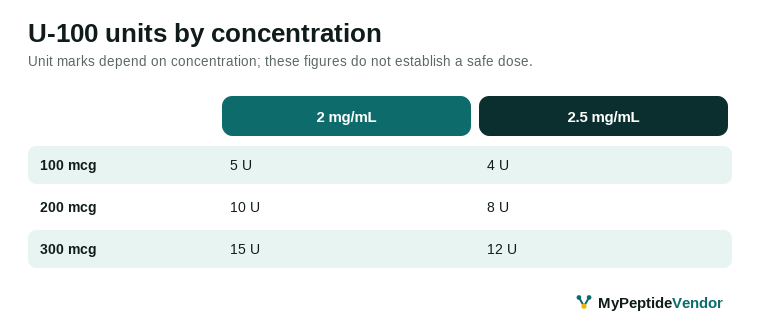
- One concentration example: If a 5 mg vial is mixed to 2 mg/mL, 100 mcg is 5 U, 200 mcg is 10 U, and 300 mcg is 15 U on a U-100 syringe.
- Another concentration example: If the vial is mixed to 2.5 mg/mL, 100 mcg is 4 U, 200 mcg is 8 U, and 300 mcg is 12 U.
- Appetite can be a concern: Increased appetite is a recognized effect associated with GHRP-6, but a dependable frequency or size of effect is not established.
- Cycle claims are unvalidated: Partial desensitization has been described, especially during continuous infusion, but no specific cycle length or break is established 2.
Key takeaways
- No FDA-approved human dose, titration schedule, cycle length, or off-period is established.
- If a 5 mg vial were mixed to 2 mg/mL, 200 mcg would equal 10 U on a U-100 syringe; that is conversion math, not a recommended dose.
- A hypothetical 300 mcg three-times-daily schedule would use 6 whole 5 mg vials over 4 weeks by vial-content arithmetic.
- GH responses to GHRP-6 are lower in people with obesity than in lean subjects 8.
- Reliable rates for appetite effects, cortisol changes, or prolactin changes are not established 23.
GHRP-6 dosing schedule and U-100 conversions
GHRP-6 is not an FDA-approved human medicine, so there is no FDA label or trial-based human titration schedule to follow. No validated starting, escalation, or maintenance dose is established for any period. The research and community figures sometimes discussed online have not established a safe or effective self-use plan.
| Period | Dose (mg) | Dose (mcg) | U-100 units | Evidence status |
|---|---|---|---|---|
| Weeks 1–4 | Not established | Not established | Not established | No validated starting dose or titration |
| Weeks 5–8 | Not established | Not established | Not established | No validated escalation or maintenance dose |
| Weeks 9–12 | Not established | Not established | Not established | No validated long-term schedule |
At 2 mg/mL, 100 mcg is 5 U, 200 mcg is 10 U, and 300 mcg is 15 U. At 2.5 mg/mL, 100 mcg is 4 U, 200 mcg is 8 U, and 300 mcg is 12 U. Dose counts are vial-content arithmetic (5 mg divided by the dose) and do not account for material lost during handling.
A U-100 syringe has 100 units per milliliter. The concentration changes the amount of peptide represented by each unit, so a unit mark cannot be interpreted without knowing the actual concentration. These calculations do not show that any listed amount is appropriate or safe to inject.
Use this chart
Free to reuse with a link back:
Syringe Unit Conversion Table
Units to draw on a U-100 insulin syringe (100 units = 1 mL) from a 5 mg vial. Find your dose, then read the column for the water you added. Every number is calculated, not estimated.
| Dose | 1 mL water 5 mg/mL · 1 unit = 50 mcg | 2 mL water 2.5 mg/mL · 1 unit = 25 mcg | 2.5 mL water 2 mg/mL · 1 unit = 20 mcg |
|---|---|---|---|
| 50 mcg | 1 · 100 doses | 2 · 100 doses | 2.5 · 100 doses |
| 100 mcg | 2 · 50 doses | 4 · 50 doses | 5 · 50 doses |
| 200 mcg | 4 · 25 doses | 8 · 25 doses | 10 · 25 doses |
| 250 mcg | 5 · 20 doses | 10 · 20 doses | 12.5 · 20 doses |
| 300 mcg | 6 · 16 doses | 12 · 16 doses | 15 · 16 doses |
| 500 mcg | 10 · 10 doses | 20 · 10 doses | 25 · 10 doses |
| 750 mcg | 15 · 6 doses | 30 · 6 doses | 37.5 · 6 doses |
| 1 mg | 20 · 5 doses | 40 · 5 doses | 50 · 5 doses |
| 1.5 mg | 30 · 3 doses | 60 · 3 doses | 75 · 3 doses |
| 1.7 mg | 34 · 2 doses | 68 · 2 doses | 85 · 2 doses |
| 2 mg | 40 · 2 doses | 80 · 2 doses | 100 · 2 doses |
| 2.4 mg | 48 · 2 doses | 96 · 2 doses | over 100 |
| 2.5 mg | 50 · 2 doses | 100 · 2 doses | over 100 |
| 3 mg | 60 · 1 doses | over 100 | over 100 |
| 4 mg | 80 · 1 doses | over 100 | over 100 |
| 5 mg | 100 · 1 doses | over 100 | over 100 |
GHRP-6 5 mg Vial Dosage Calculator
Shows the exact insulin-syringe units to draw. Pre-loaded with the 5 mg vial; change any value to match yours.
Total volume of your syringe?
How much mg is in the vial?
How much bacteriostatic water are you adding?
Dose per injection?
Educational tool only. Concentration = vial ÷ water; units = dose ÷ concentration × 100 (U-100 syringe). Confirm every dose with your prescriber. Different vial or peptide? Use the peptide calculator.
Affiliate link · we may earn a commission.
Reconstitution steps
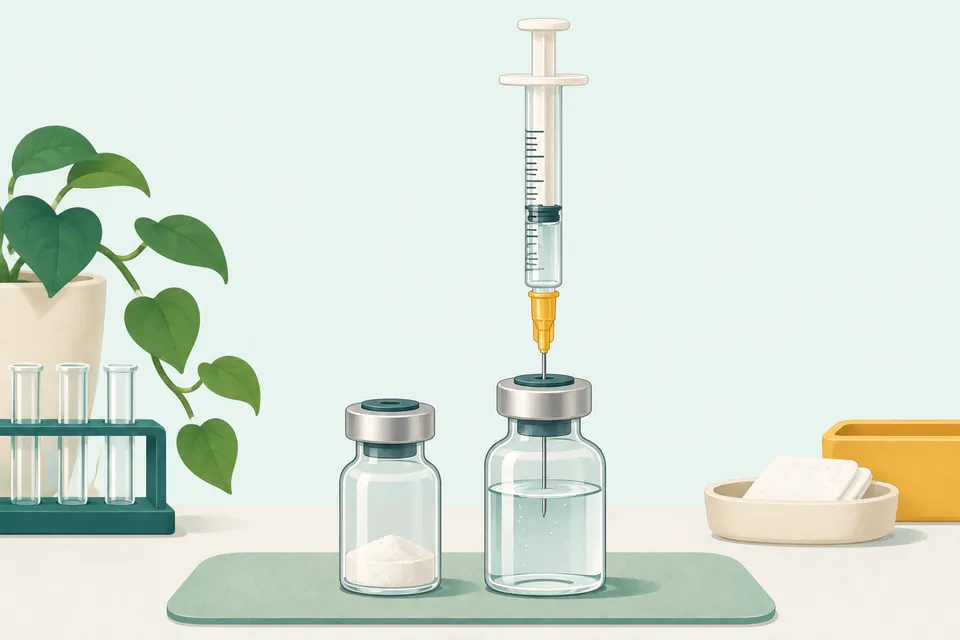
Mixing instructions cannot confirm that a vial is sterile, correctly labeled, suitable for injection, or stable after mixing. Do not prepare or inject an unapproved product on your own; follow a licensed pharmacy's product-specific directions and ask the prescriber or pharmacist to confirm the concentration before any use.
- Check the product name, vial contents, packaging, and pharmacy instructions. Do not use a vial with a damaged seal or unexpected appearance.
- Wash and dry your hands. If a pharmacist has directed preparation, clean the vial stoppers with alcohol and let them dry before handling.
- Use only the diluent and volume specified for that exact product. For example, 2.5 mL in a 5 mg vial gives a calculated concentration of 2 mg/mL; this is concentration arithmetic, not a preparation recommendation.
- If directed by the pharmacy, add diluent slowly down the inside wall rather than aiming it at the powder.
- Gently swirl or roll the vial until dissolved; do not shake it.
- Label the vial with the preparation date and concentration, then follow the pharmacy's refrigeration and discard directions. Do not assume a universal beyond-use date.
Supplies needed and vial-depletion math
For a full vial, handling supplies would include 1 labeled 5 mg vial, the exact diluent and amount specified by the dispensing pharmacy, 1 sterile syringe for measuring diluent if the pharmacy directs preparation, alcohol pads for vial stoppers, and a sharps container. Any administration supplies should come from the clinician or pharmacy; use a new sterile syringe for each administration and never share needles.
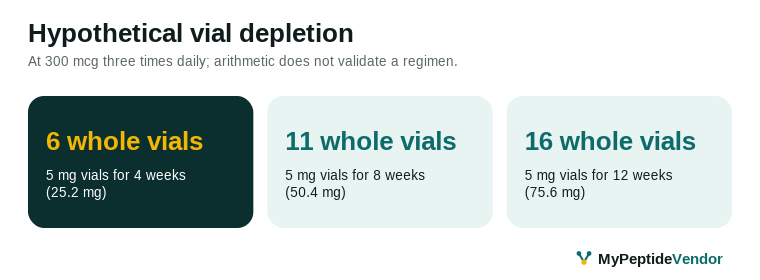
To show how quickly a vial could be depleted (not to recommend a regimen) consider a hypothetical 300 mcg three times daily. That equals 900 mcg, or 0.9 mg, per day. Over 4 weeks (28 days), the arithmetic is 25.2 mg total, or 6 whole 5 mg vials after rounding up.
At the same hypothetical rate, 8 weeks (56 days) uses 50.4 mg, or 11 whole vials; 12 weeks (84 days) uses 75.6 mg, or 16 whole vials. If each vial were mixed with 2.5 mL, those rounded quantities would require 15 mL, 27.5 mL, and 40 mL of diluent, respectively. They would also involve 84, 168, or 252 administrations. These totals exclude waste and do not validate the dose, frequency, or cycle.
Use this chart
Free to reuse with a link back:
Protocol overview and cycle notes

GHRP-6 is a synthetic growth hormone-releasing peptide. A review describes its cloned receptor as having no sequence homology with other known G-protein-coupled receptors, while the natural ligand had not been identified and the mechanism remained unsettled 2. A separate review describes an important hypothalamic contribution to its GH-releasing action 6.
Partial desensitization has been reported, with a greater effect during continuous infusion and a smaller effect during intermittent administration 2. The extent of response loss with prolonged daily use has not been quantified here. No evidence-based 4-, 8-, or 12-week cycle, or required off-period, is established.
Body composition changes should not be inferred from a GH response alone. In people with obesity, GHRP-6 produces a greater GH response than GHRH alone, but the response remains below that seen in lean subjects. GHRH plus GHRP-6 is the strongest stimulus described in obesity, yet its response is still lower than in lean subjects 8. These are hormone-response findings, not proof of weight loss or muscle gain.
Evidence for growth hormone secretagogues in men with hypogonadism or metabolic syndrome is limited, and the clinical effects remain unclear 3. A reliable dose adjustment based on body weight or body-mass index has not been established. Whether appetite changes with body composition is also not established.
Stacking GHRP-6 with CJC-1295 or ipamorelin is not a validated treatment plan. Diagnostic literature reports synergy between GHRH and GHRP-6 in some patients, but that synergy is absent after pituitary stalk transection 6. This does not establish that CJC-1295 or ipamorelin combinations are safe or effective; diagnostic GHRH testing is not interchangeable with those products.
Route matters. Intravenous GHRP-6 has been studied as a diagnostic stimulus under clinical testing conditions, not as a home-use protocol 4. Oral absorption rarely exceeded 1% in studies of hexarelin and other smaller peptides; that finding should not be presented as a measured absorption rate for GHRP-6 itself 9. An oral product's advertised activity does not show that it matches an injectable route.
Storage and handling
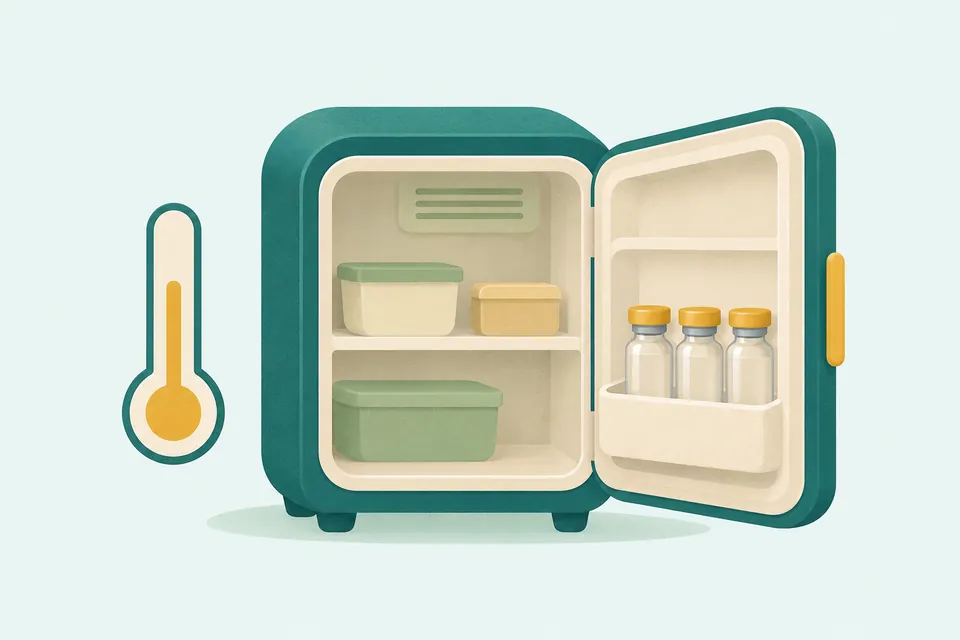
Use the storage conditions and discard date given by the dispensing pharmacy for that specific preparation. The pharmacy's product-specific refrigeration and discard directions govern storage for a given GHRP-6 vial, because no single stability standard applies to every vial.
Keep the vial closed and protected from contamination. Do not use it if the seal is damaged or the solution has unexpected particles or a changed appearance. Storage cannot make an unverified product sterile, and a beyond-use date depends on the actual preparation and pharmacy instructions.
Injection and tracking tips
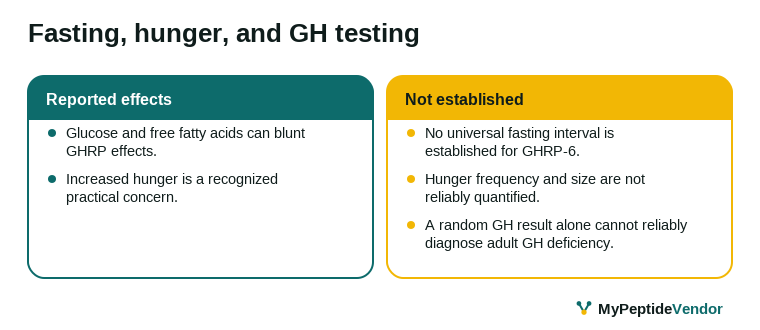
No universal fasting interval for GHRP-6 is established. Glucose and free fatty acids can blunt GHRP effects, but the review literature does not set a specific number of hours to avoid food before or after a GHRP-6 dose 28. Do not use an online meal timer as a substitute for a clinician's directions.
Increased hunger is a recognized practical concern, but its frequency and size are not reliably quantified. This may matter for someone managing weight, diabetes, or eating patterns; hunger alone does not show that a dose is working safely.
If a clinician is overseeing an investigational product, bring a record of the product, concentration, timing, meals, and symptoms to appointments. A random GH result alone cannot reliably diagnose adult GH deficiency; provocative testing is used, and the insulin tolerance test is considered the gold-standard stimulation test despite limitations 5.
Use this chart
Free to reuse with a link back:
Safety and side effects
Reliable side-effect frequencies for GHRP-6 are not established 23. Appetite increase is a recognized effect, but no dependable frequency is established. Reliable rates and quantified changes are not established here. Percentages presented without sound clinical evidence should not be treated as confirmed risk estimates.
Do not attribute findings from GHRP-6-related azapeptides to GHRP-6 itself. Cardioprotective and anti-atherosclerotic effects were reported for azapeptide analogs that modulate CD36 in laboratory and animal models, not as proof that GHRP-6 protects the heart 7.
GHRP-6 has been evaluated as an intravenous diagnostic test. In children, average GH responses were lower in those with deficiency, but individual responses overlapped considerably 4. In patients with pituitary stalk transection, responses to GHRP-6 and GHRH plus GHRP-6 were nearly blocked 46. Those results help explain why this testing depends on intact hypothalamic-pituitary signaling; they do not establish a treatment dose.
For adults, non-stimulated serum or urine GH measurements cannot reliably predict deficiency. The insulin tolerance test is considered the gold standard among GH stimulation tests, although it has limitations and may not suit every patient 5. FDA's category 2 policy concerns potential significant safety risks for bulk substances placed in that category; it does not by itself establish GHRP-6's approval status or the safety of a particular product 1.
Diagnostic approaches answer different questions: GHRP-6 was studied in short-statured children and adults with diagnosed deficiency; the insulin tolerance test is used in adult GH-deficiency assessment; and combined GHRH plus GHRP-6 testing was examined in hypothalamic-pituitary disorders 456.
| Approach | Clinical context | Key finding |
|---|---|---|
| IV GHRP-6 | Short-statured children and adults with GH deficiency | Group responses differed, but individual responses overlapped |
| Insulin tolerance test | Adult GH-deficiency assessment | Considered the gold-standard stimulation test |
| GHRH plus GHRP-6 | Hypothalamic-pituitary disorders | Response was nearly absent after stalk transection |
Frequently asked questions
What is a typical GHRP-6 dose for a 5 mg vial?
There is no validated human dose for this vial size. Five milligrams describes the amount in the vial, not a dose for a person.
How many syringe units is 200 mcg from a 5 mg vial?
It depends on the final concentration: 200 mcg corresponds to 10 U at 2 mg/mL or 8 U at 2.5 mg/mL. Confirm the concentration with a pharmacist, because the conversion does not establish that the amount is safe.
Does GHRP-6 increase appetite?
Increased appetite is associated with GHRP-6, but a reliable frequency or degree of change has not been established. The effect should not be treated as a dependable way to manage body weight.
Can GHRP-6 be combined with CJC-1295 or ipamorelin?
The diagnostic literature describes GH-release synergy between GHRH and GHRP-6 in some settings, but not after pituitary stalk transection 6. That does not demonstrate safety or benefit for combinations with CJC-1295 or ipamorelin.
Can oral GHRP-6 replace an injection?
No equivalent oral regimen is established. Oral absorption of hexarelin and other smaller peptides rarely exceeded 1% of the administered dose 9.
Is GHRP-6 used to diagnose growth hormone deficiency?
It has been studied as an intravenous diagnostic stimulus, but responses overlapped between children with and without GH deficiency 4. Adult diagnosis requires specialist testing because unstimulated GH measurements cannot reliably predict deficiency 5.
References
- FDA: Certain bulk drug substances for use in compounding that may present significant safety risks
- Ghigo et al. Growth hormone-releasing peptides. Eur J Endocrinol. 1997.
- Sinha et al. Beyond the androgen receptor: the role of growth hormone secretagogues in the modern management of body composition in hypogonadal males. Transl Androl Urol. 2020.
- Pombo et al. Growth hormone releasing hexapeptide-6 (GHRP-6) test in the diagnosis of GH-deficiency. J Pediatr Endocrinol Metab. 1996.
- Abs et al. Update on the diagnosis of GH deficiency in adults. Eur J Endocrinol. 2003.
- Casanueva et al. Role of the new growth hormone-releasing secretagogues in the diagnosis of some hypothalamopituitary pathologies. Metabolism. 1996.
- Proulx et al. Synthesis and Biomedical Potential of Azapeptide Modulators of the Cluster of Differentiation 36 Receptor (CD36). Biomedicines. 2020.
- Scacchi et al. Growth hormone in obesity. Int J Obes Relat Metab Disord. 1999.
- Deghenghi et al. The development of 'impervious peptides' as growth hormone secretagogues. Acta Paediatr Suppl. 1997.
Written by the MyPeptideVendor editorial team from the FDA label, peer-reviewed studies and ClinicalTrials.gov records listed above, fact-checked line by line and reviewed 2026-11-12.
Cite this page
MyPeptideVendor Editorial Team. ghrp 6 dosage 5mg: Protocol & Safety. MyPeptideVendor. Updated November 12, 2026. https://mypeptidevendor.com/protocols/ghrp-6-dosing-5mg/MyPeptideVendor Editorial Team. (2026, November 12). ghrp 6 dosage 5mg: Protocol & Safety. MyPeptideVendor. https://mypeptidevendor.com/protocols/ghrp-6-dosing-5mg/Related protocols
CJC-1295 DAC 2 mg
Research UseA 2 mg vial is not an approved human dose; this guide covers the evidence gap, vial math, and safety questions to review with a clinician.
View protocolCJC-1295 DAC 5 mg
Research UseNo approved human dose exists for CJC-1295 DAC; this guide explains 5 mg vial math, research limits, monitoring, and safety questions.
View protocolCJC-1295 No DAC 5 mg
Not approvedNo approved human dose exists for CJC-1295 No DAC; this guide explains 5 mg vial math, evidence limits, and safety questions to raise with a clinician.
View protocol