5 Amino 1mq Dosage 50mg: Vial Protocol
No approved human dose exists; this guide separates 50 mg vial math from dosing advice and explains evidence, handling, and safety limits.
Quickstart highlights for 5 amino 1mq dosage 50mg
There is no established human dose for a 5-Amino-1MQ 50 mg vial. The 50 mg amount describes the vial’s total contents, not a dose shown to be safe or effective in people.
5-Amino-1MQ is a small molecule studied as an NNMT inhibitor, not a peptide. FDA’s cited guidance concerns unapproved GLP-1 drugs and does not establish 5-Amino-1MQ’s approval status, dose, or safety 1.
- What it is: 5-Amino-1MQ is a small-molecule inhibitor of nicotinamide N-methyltransferase (NNMT). It is not a peptide; its name and online marketing often place it beside peptide products.
- Dose: A vial marked 50 mg is a package amount, not a recommended injection. No human starting dose, titration step, maintenance dose, or cycle endpoint is established.
- Route: Oral capsules and injectable vials are discussed in informal use, but the routes are not interchangeable. No human study establishes an oral-to-injection conversion.
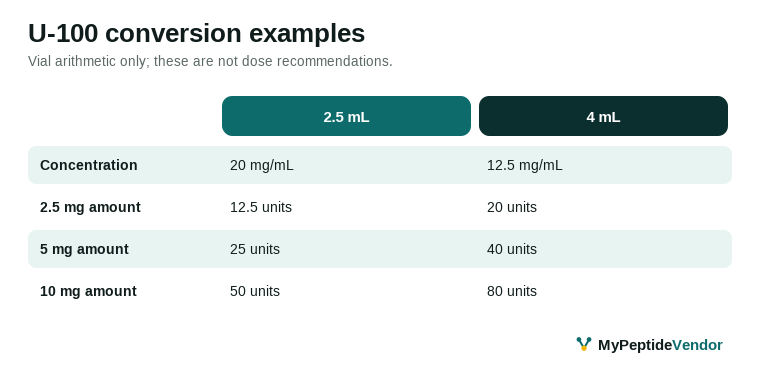
- Vial math: For a 50 mg vial, 2.5 mL of liquid gives 20 mg/mL; 4 mL gives 12.5 mg/mL. Those are concentration calculations, not instructions to prepare or inject a product.
- Evidence: No approved human dose exists.
- Regulatory context: FDA’s cited unapproved-drug page is about GLP-1 drugs such as semaglutide and tirzepatide, not 5-Amino-1MQ 1. Do not use that page as proof of this compound’s status.
Key takeaways
- A 50 mg vial contains 50 mg total; no approved human dose or titration schedule is established.
- Adding 2.5 mL gives 20 mg/mL; adding 4 mL gives 12.5 mg/mL, but neither volume is correct for every product.
- U-100 syringe units depend on the final concentration: a 2.5 mg math example is 12.5 units at 20 mg/mL and 20 units at 12.5 mg/mL.
- The 50–150 mg/day oral range sometimes repeated online is community-reported, not a human trial dose or a validated conversion from an injectable vial.
- No human side-effect frequency, verified human half-life, or evidence-based cycle length is established.
Dosing schedule and U-100 conversion math
No human titration schedule is established for 5-Amino-1MQ. If a medicine has an FDA-approved label, titration should follow that label; 5-Amino-1MQ has no approved human dosing label to follow. FDA’s cited GLP-1 notice does not set a 5-Amino-1MQ dose 1.
| Week | Dose (mg) | Dose (mcg) | U-100 units | Human schedule status |
|---|---|---|---|---|
| Week 1 | Not established | Not established | Not applicable | No human starting dose is established. |
| Week 2 | Not established | Not established | Not applicable | No evidence-based increase or maintenance dose is established. |
| Week 3 | Not established | Not established | Not applicable | No human titration step is established. |
| Week 4 | Not established | Not established | Not applicable | No evidence-based cycle endpoint or break schedule is established. |
The comparison below is vial arithmetic only. U-100 means 100 units per mL. The listed units are not dose recommendations.
| 50 mg vial mixed with | Concentration | Math example amount | U-100 units | Meaning |
|---|---|---|---|---|
| 2.5 mL | 20 mg/mL | 2.5 mg (2,500 mcg) | 12.5 units | Conversion example only |
| 4 mL | 12.5 mg/mL | 2.5 mg (2,500 mcg) | 20 units | Conversion example only |
| 2.5 mL | 20 mg/mL | 5 mg (5,000 mcg) | 25 units | Conversion example only |
| 4 mL | 12.5 mg/mL | 5 mg (5,000 mcg) | 40 units | Conversion example only |
| 2.5 mL | 20 mg/mL | 10 mg (10,000 mcg) | 50 units | Conversion example only |
| 4 mL | 12.5 mg/mL | 10 mg (10,000 mcg) | 80 units | Conversion example only |
The same 2.5 mg amount takes a larger syringe draw at the lower concentration. Neither dilution can be called correct for an unidentified formulation: the manufacturer or dispensing pharmacy must specify the diluent, amount, concentration, route, and use-by period. A matching syringe calculation cannot establish sterility, stability, or suitability for injection.
Use this chart
Free to reuse with a link back:
Syringe Unit Conversion Table
Units to draw on a U-100 insulin syringe (100 units = 1 mL) from a 50 mg vial. Find your dose, then read the column for the water you added. Every number is calculated, not estimated.
| Dose | 2.5 mL water 20 mg/mL · 1 unit = 200 mcg | 4 mL water 12.5 mg/mL · 1 unit = 125 mcg | 5 mL water 10 mg/mL · 1 unit = 100 mcg |
|---|---|---|---|
| 50 mcg | 0.25 · 1000 doses | 0.4 · 1000 doses | 0.5 · 1000 doses |
| 100 mcg | 0.5 · 500 doses | 0.8 · 500 doses | 1 · 500 doses |
| 200 mcg | 1 · 250 doses | 1.6 · 250 doses | 2 · 250 doses |
| 250 mcg | 1.25 · 200 doses | 2 · 200 doses | 2.5 · 200 doses |
| 300 mcg | 1.5 · 166 doses | 2.4 · 166 doses | 3 · 166 doses |
| 500 mcg | 2.5 · 100 doses | 4 · 100 doses | 5 · 100 doses |
| 750 mcg | 3.75 · 66 doses | 6 · 66 doses | 7.5 · 66 doses |
| 1 mg | 5 · 50 doses | 8 · 50 doses | 10 · 50 doses |
| 1.5 mg | 7.5 · 33 doses | 12 · 33 doses | 15 · 33 doses |
| 1.7 mg | 8.5 · 29 doses | 13.6 · 29 doses | 17 · 29 doses |
| 2 mg | 10 · 25 doses | 16 · 25 doses | 20 · 25 doses |
| 2.4 mg | 12 · 20 doses | 19.2 · 20 doses | 24 · 20 doses |
| 2.5 mg | 12.5 · 20 doses | 20 · 20 doses | 25 · 20 doses |
| 3 mg | 15 · 16 doses | 24 · 16 doses | 30 · 16 doses |
| 4 mg | 20 · 12 doses | 32 · 12 doses | 40 · 12 doses |
| 5 mg | 25 · 10 doses | 40 · 10 doses | 50 · 10 doses |
| 7.5 mg | 37.5 · 6 doses | 60 · 6 doses | 75 · 6 doses |
| 10 mg | 50 · 5 doses | 80 · 5 doses | 100 · 5 doses |
| 12.5 mg | 62.5 · 4 doses | 100 · 4 doses | over 100 |
| 15 mg | 75 · 3 doses | over 100 | over 100 |
5-Amino-1MQ 50 mg Vial Dosage Calculator
Shows the exact insulin-syringe units to draw. Pre-loaded with the 50 mg vial; change any value to match yours.
Total volume of your syringe?
How much mg is in the vial?
How much bacteriostatic water are you adding?
Dose per injection?
Educational tool only. Concentration = vial ÷ water; units = dose ÷ concentration × 100 (U-100 syringe). Confirm every dose with your prescriber. Different vial or peptide? Use the peptide calculator.
MYPEPTIDEVENDORAffiliate link · we may earn a commission.
Reconstitution steps
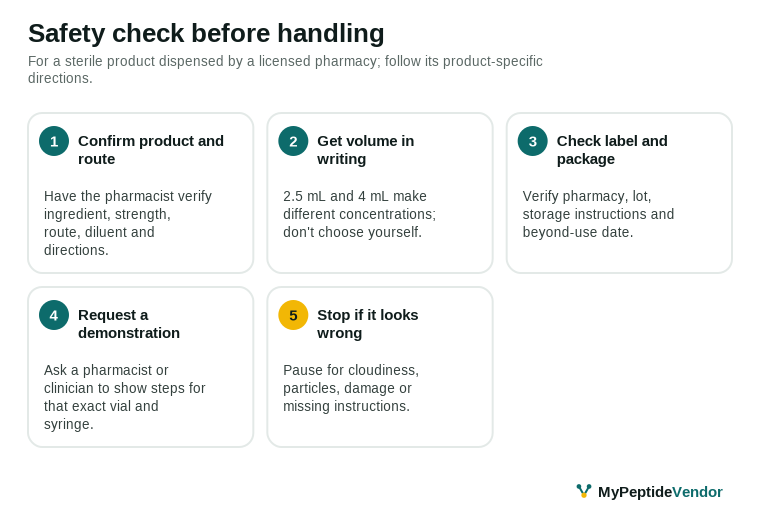
Do not mix a 50 mg vial using generic internet directions. The right diluent, amount, and post-mixing period depend on the exact product and its validated instructions. If a licensed pharmacy has dispensed a sterile product, use this safety check before handling it:
- Confirm the product and route. Ask the dispensing pharmacist to verify the ingredient, vial strength, intended route, diluent, final concentration, and written preparation directions.
- Get the volume in writing. Adding 2.5 mL and adding 4 mL produce different concentrations. Do not select a volume for convenience or copy directions from a different seller’s vial.
- Check the label and package. Verify the pharmacy name and address, lot number, storage instructions, and beyond-use date. Do not use a product labeled “for research purposes” or “not for human consumption” as a medicine 1.
- Request a demonstration. If a clinician prescribed the product, ask the pharmacist or clinician to show the preparation and measurement steps for that exact vial and syringe.
- Stop if it looks wrong. Cloudiness, discoloration, particles, a damaged seal, or missing instructions call for a pause and a call to the pharmacy. Do not shake, filter, or add more liquid to try to fix it.
FDA states that unapproved versions of the GLP-1 drugs addressed on its page do not undergo FDA review for safety, effectiveness, and quality before marketing 1. That statement applies to the products discussed on that page; it does not evaluate a particular 5-Amino-1MQ formulation.
Use this chart
Free to reuse with a link back:
Supplies needed for one full 50 mg vial
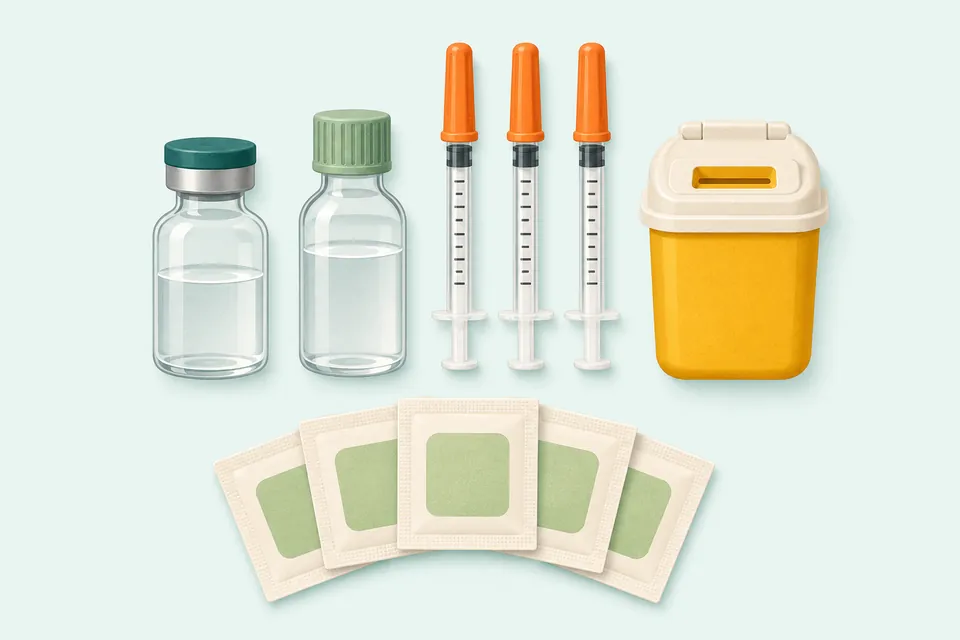
No human dose or treatment schedule is established, so a safe number of injections from one vial cannot be calculated. The quantities below are handling considerations only for a sterile injectable product prescribed by a clinician with product-specific directions.
- Vial: One 50 mg vial is the package size discussed here. It does not define a treatment course.
- U-100 insulin syringes: One new sterile syringe per prescribed administration. The total needed depends on the written schedule; the syringe scale does not confirm the liquid’s concentration.
- Bacteriostatic water: Use only the diluent and volume specified by the dispensing pharmacy. Do not assume this diluent is suitable for every formulation.
- Alcohol swabs: Keep enough for the pharmacy-directed vial-access and skin-preparation steps. A fresh swab is used for each required cleaning step.
- Sharps container: Have one approved sharps container available if a clinician has prescribed injections, and ask a pharmacist about local disposal.
FDA recommends a doctor’s prescription and filling at a state-licensed pharmacy in its guidance on compounded GLP-1 drugs 1. That recommendation does not establish that 5-Amino-1MQ is appropriate or legally eligible for compounding.
Protocol overview and cycle notes

NNMT is an enzyme involved in processing nicotinamide, a form of vitamin B3. NAD+ is a molecule used in many cell reactions, including those involved in cellular energy. Researchers study whether inhibiting NNMT changes this pathway; a proposed mechanism does not prove weight loss or improved glucose control in people.
Research discussions describe cell-culture and mouse work on 5-Amino-1MQ. Cell and animal findings can test a biological idea, but they do not establish a safe human dose, show how well a human body absorbs a product, or prove a clinical benefit. No human trial dose or clinical outcome is established.
That range is community-reported, not a human trial regimen or an FDA-approved dose. It is not equivalent to any subcutaneous amount: no human study establishes a conversion between a capsule and an injected vial.
A dependable human half-life has not been established. A reliable human half-life for 5-Amino-1MQ has not been established, so the 3.8–6.9 hour figure circulating online should not be used to justify a once-daily or twice-daily dosing schedule. Frequency remains unknown.
No evidence-based cycle length, break period, or restart schedule is established. A pause cannot be assumed to clear the compound or reduce risk; those questions have not been studied in people.
FDA’s Category 2 page describes bulk drug substances identified as potentially presenting significant safety risks for compounding 2. 5-Amino-1MQ's current Category 2 status is not established by the cited FDA page 2; check FDA's live Category 2 listing directly. Category placement and FDA approval are separate questions.
FDA says compounded drugs should be used only when an approved drug cannot meet a patient’s medical need, and its GLP-1 guidance recommends a prescription and a state-licensed pharmacy 1. That notice does not determine whether 5-Amino-1MQ can be legally or safely compounded. A prescription or a seller’s dosing chart cannot establish a human dose or verify the quality of a vial.
Storage and handling
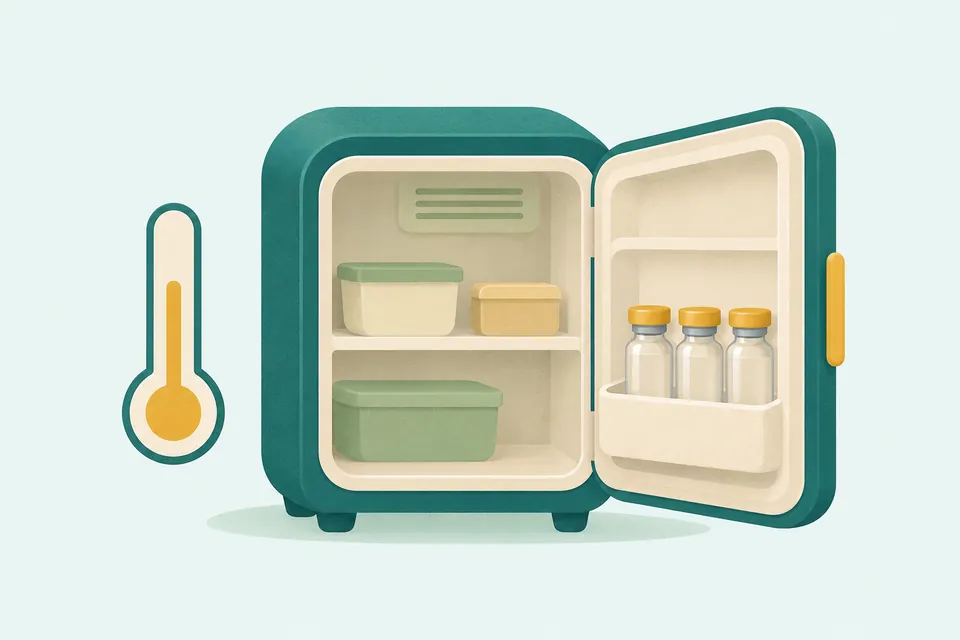
A verified storage temperature and post-mixing use-by period have not been established here for a 5-Amino-1MQ vial. Do not assume an unmixed vial should be frozen or that a mixed vial should be refrigerated; storage depends on the exact formulation and its validated directions.
For a pharmacy-dispensed sterile product, follow the label and ask the pharmacist what to do after a temperature excursion. FDA’s GLP-1 guidance generally recommends using multidose sterile vials within 28 days after first use because contamination risk rises, and discarding them by then even if medicine remains 1. That is general guidance in a GLP-1 notice, not a validated 5-Amino-1MQ use-by date 1.
Use a new sterile needle and syringe for each administration. FDA specifically warns against reusing needles or syringes in the multidose-vial discussion on its GLP-1 page 1. If a shipment arrives warm, damaged, leaking, or without clear storage instructions, contact the dispensing pharmacy before use.
Cloudiness, visible particles, unexpected color, a broken seal, or missing directions are reasons to stop and ask the pharmacy. Do not shake or filter a cloudy solution, and do not assume a printed date proves that a product was stored correctly.
Injection and tracking tips
No injection technique can make an unverified vial safe. If a licensed clinician prescribes a sterile product, ask the pharmacist or clinician to demonstrate preparation and administration using the exact label and syringe type you received.
Give the clinician a complete list of prescription medicines, over-the-counter products, and supplements before discussing investigational use. Interactions with metformin, stimulants, or NAD+ precursors have not been established; do not assume combining them is safe or that spacing doses prevents an interaction.
A clinician may discuss glucose, insulin, liver enzymes, or NAD+-related metabolites as possible monitoring topics. No validated 5-Amino-1MQ test panel, target range, or testing interval is established, and a normal lab result cannot prove the compound is safe.
Keep a dated record of the product name, lot number, dispensing pharmacy, written instructions, symptoms, and medication changes. FDA encourages reporting medication problems through MedWatch in its GLP-1 safety material 1; a report does not by itself prove that 5-Amino-1MQ caused an event.
Safety and side effects
No human side-effect frequency for 5-Amino-1MQ is established. A reliable percentage for headache, stomach upset, injection-site pain, or any other effect cannot be given without human safety data. Online reports are not measured incidence rates.
Avoid using a product labeled for research or not for human consumption as a medicine. Do not self-inject when the source, sterility, concentration, route, or use-by date is unclear. Safety has not been established during pregnancy or breastfeeding, with major medical conditions, or alongside prescription drugs; discuss those circumstances with a clinician rather than experimenting.
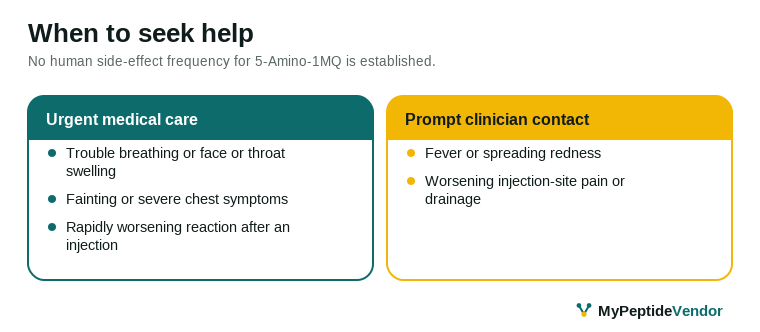
Seek urgent medical care for trouble breathing, swelling of the face or throat, fainting, severe chest symptoms, or a rapidly worsening reaction after an injection. Contact a clinician promptly for fever, spreading redness, worsening injection-site pain, or drainage, which can signal infection or another serious local problem.
FDA states that unapproved versions of the GLP-1 drugs discussed on its page do not undergo its review for safety, effectiveness, and quality before marketing 1. That page does not provide a 5-Amino-1MQ risk rate or a compound-specific safety assessment.
Use this chart
Free to reuse with a link back:
Sourcing and product checks
Ask who made and dispensed the vial, and whether a licensed pharmacist can answer product questions. Request a certificate of analysis (COA) tied to the lot number. A COA may report identity or purity, but it does not by itself prove sterility, suitability for human use, or an appropriate dose.
- Confirm that a licensed clinician evaluated you and issued a prescription if the seller describes the product as prescribed.
- Verify the pharmacy’s license with the relevant state board of pharmacy.
- Check for intact packaging, readable directions, a lot number, and a pharmacy name and address that can be verified.
- Be wary of claims that a compounded or research product is “the same as” an FDA-approved medicine. FDA lists that claim, missing medical screening, damaged packaging, and no available licensed doctor among warning signs for telehealth GLP-1 products 1.
- Do not treat a low price, website badge, or dosing chart as proof of product quality.
FDA’s Category 2 page concerns nominated bulk drug substances that may present significant safety risks 2. Whether a substance appears on that list does not establish that a particular vial is safe to inject or approved for medical use.
Frequently asked questions
What is the correct 5-Amino-1MQ dose for a 50 mg vial?
No human dose is established for the vial. The 50 mg figure is the total amount in the container, while syringe-unit examples are only concentration math and not a dose recommendation.
Is 5-Amino-1MQ taken by mouth or injected?
Both routes are discussed in informal use, but they are not interchangeable. No human evidence establishes that a capsule amount gives the same exposure as an injection.
Does 5-Amino-1MQ have a known half-life?
A reliable human half-life has not been established. A specific number of hours repeated online should not be used to choose dosing frequency.
Should a 50 mg vial be mixed with 2.5 mL or 4 mL?
Those volumes produce different concentrations: 20 mg/mL and 12.5 mg/mL. Neither is universally correct; the pharmacy must provide directions for the exact formulation.
Is 5-Amino-1MQ on the FDA Category 2 list?
The cited FDA Category 2 page 2 does not establish 5-Amino-1MQ’s status on the current list; check FDA’s live listing. Category 2 concerns potential compounding safety risks and does not itself establish FDA approval 2.
How long can I use a vial after mixing it?
No 5-Amino-1MQ-specific post-mixing period is established here. FDA’s 28-day guidance concerns multidose sterile vials in its GLP-1 notice and is not a validated use-by date for this compound 1.
What tests or medicines should I discuss with my clinician?
Bring a complete medication and supplement list, including products that affect glucose or NAD+ pathways. A clinician may discuss glucose, insulin, liver enzymes, or NAD+-related tests, but no testing interval or target has been validated for this compound.
Can a certificate of analysis prove that a vial is safe?
A lot-specific COA can show results for the tests it includes, but its value depends on the laboratory and methods. It does not by itself establish sterility, an appropriate human dose, or FDA approval.
References
- FDA: Concerns with unapproved GLP-1 drugs used for weight loss
- FDA: Certain bulk drug substances for use in compounding that may present significant safety risks
Written by the MyPeptideVendor editorial team from the FDA label, peer-reviewed studies and ClinicalTrials.gov records listed above, fact-checked line by line and reviewed 2026-11-12.
Cite this page
MyPeptideVendor Editorial Team. 5 amino 1mq dosage 50mg: Vial Protocol. MyPeptideVendor. Updated November 12, 2026. https://mypeptidevendor.com/protocols/5-amino-1mq-dosing-50mg/MyPeptideVendor Editorial Team. (2026, November 12). 5 amino 1mq dosage 50mg: Vial Protocol. MyPeptideVendor. https://mypeptidevendor.com/protocols/5-amino-1mq-dosing-50mg/Related protocols
AICAR 50 mg
Research UseAICAR has no approved human dose or validated injection schedule; a 50 mg vial does not establish a safe dose, dilution, or cycle.
View protocolAOD-9604 10 mg
Not approvedAOD-9604 is not FDA-approved, and no validated human subcutaneous dose, titration schedule, or cycle is established.
View protocolCagrilintide 10 mg
Not approvedCagrilintide is not FDA-approved; a 10 mg vial is not a dose, and trial schedules do not establish a safe home-use protocol.
View protocol