PEG-MGF: Evidence, Safety & FDA Status
PEGylated IGF-1 analogue
Brand names: No FDA-approved PEG-MGF brand is identified.

PEG-MGF is a pegylated mechano growth factor named among IGF-1 analogues in a review of performance-enhancing peptides that affect the growth hormone–IGF-1 axis 2. It has no established human muscle-building benefit, and there is no regulatory approval for physique or performance use 2.
A ClinicalTrials.gov search returned 14 hits for “PEG-MGF,” but the listed studies include unrelated interventions such as semaglutide and pegylated somatropin 3. A search-result count is not proof that PEG-MGF itself has been tested in people.
Key takeaways
- The ClinicalTrials.gov search returned 14 hits, but none of the described records is a PEG-MGF trial 3.
- No human dose, treatment duration, muscle outcome, or human half-life is established for PEG-MGF 23.
- Reported risks across GH–IGF-1 pathway compounds include dysglycemia, fluid retention, muscle or joint pain, and injection-site reactions; trial percentages are unavailable 2.
- FDA Category 2 is a compounding safety-risk category, not drug approval; the current PEG-MGF bulks-list status cannot be determined from the FDA entry provided 1.
- No evidence supports naming PEG-MGF, IGF-1 LR3, or a GH secretagogue the strongest muscle-building peptide 2.
PEG-MGF at a glance
- Class
- PEGylated mechano growth factor; listed among IGF-1 analogues.
- Mechanism
- IGF-1-related activity is proposed, but PEG-MGF-specific receptor binding and Pax7+ satellite-cell activation are not established.
- FDA Status
- No approval for physique or performance use; current 503A/503B bulks-list status cannot be determined from the FDA entry provided.
- Brand names
- No FDA-approved PEG-MGF brand is identified.
- Administration
- No FDA-approved product or route is identified.
- Typical Dose
- No label or human-trial dose is established.
- Half-life
- A human half-life is not established.
- Primary Uses
- Performance and physique use is unapproved; human muscle effects are unestablished.
What is it?

PEG-MGF means PEGylated mechano growth factor. It is listed as an IGF-1 analogue in a narrative review of peptides used to modulate the growth hormone–IGF-1 axis 2. “PEGylated” means polyethylene glycol has been attached to a molecule. That modification can change how a peptide behaves in the body, but no human duration of action is established for PEG-MGF 2.
The name connects it to mechano growth factor, but the review does not describe a proven PEG-MGF treatment for muscle growth, injury repair, gut health, or joint symptoms 2. Those benefits should not be treated as established uses. In particular, no human outcome shows how much muscle a person might gain from it 23.
What makes it different
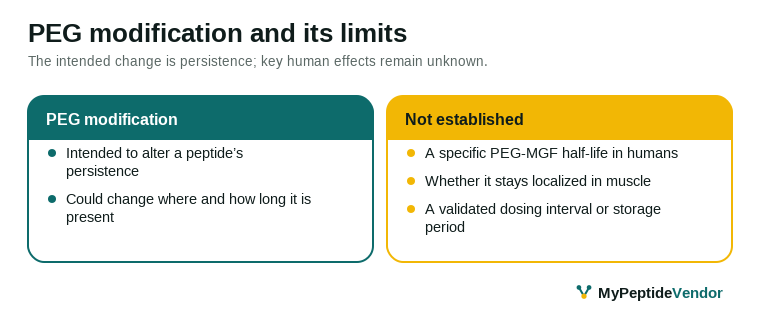
The defining feature is the PEG modification. It is intended to alter a peptide’s persistence, but a specific PEG-MGF half-life (such as a claim that it lasts several days) has not been established in humans 2. A longer-lasting form is not automatically more effective or safer. No validated dosing interval, storage temperature, or post-reconstitution use period is established for PEG-MGF 2.
There is also a pharmacology question: if a growth signal is meant to act locally, attaching PEG could change where and for how long the molecule is present. The clinical review does not answer whether PEG-MGF stays localized in muscle or instead produces wider exposure 2. Claims that it acts only in muscle and avoids systemic IGF-1 effects are not established; the review describes endocrine and metabolic concerns across this compound class 2.
Storage and reconstitution require a product-specific, reliable instruction sheet. No approved PEG-MGF label provides those directions 2. A vendor’s handling advice cannot establish that a vial is sterile, correctly dosed, or suitable for injection.
Use this chart
Free to reuse with a link back:
How does it work?
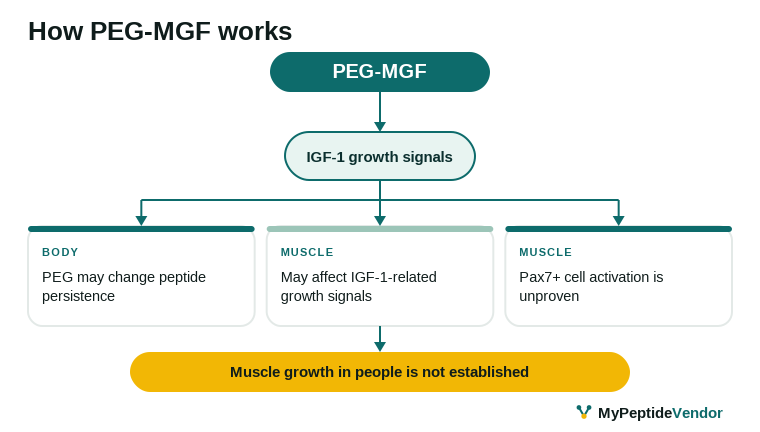
In plain words, the proposed idea is that PEG-MGF may affect growth signaling related to IGF-1. The review identifies PEG-MGF as an IGF-1 analogue, but does not establish that PEG-MGF binds the IGF-1 receptor or activates muscle satellite cells marked by Pax7 2. A plausible pathway is not proof that the peptide produces a useful result in people.
Satellite cells are involved in muscle maintenance and repair, but the clinical review does not show that PEG-MGF activates Pax7+ cells in humans 2. It also does not establish a muscle-only effect. The reported concerns across GH–IGF-1 pathway compounds include dysglycemia and elevations in prolactin or cortisol, which argue against assuming that related compounds have no wider effects 2.
PEGylation is intended to change how a peptide persists, but whether that change makes sense for a locally acting signal is unresolved for PEG-MGF 2. Without human pharmacokinetic data, the practical duration of exposure and its link to any benefit or harm remain unknown.
Use this chart
Free to reuse with a link back:
What the clinical evidence actually shows

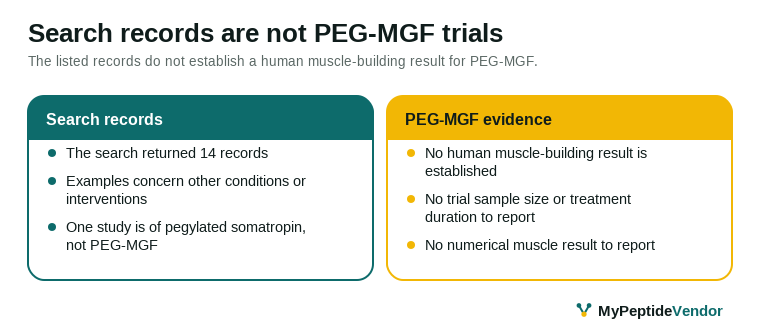
No human PEG-MGF muscle-building result is established in the ClinicalTrials.gov search information 3. The search returned 14 records, but the listed examples concern other conditions or interventions; the search total is not a count of PEG-MGF trials 3. The available information gives no PEG-MGF trial sample size, treatment duration, or numerical muscle result to report.
For example, NCT02375620 studies pegylated somatropin for children with short stature, not PEG-MGF 3. NCT04777396 and NCT04777409 are the EVOKE and EVOKE Plus semaglutide studies in people with early Alzheimer’s disease 3. Other listed records include studies of trontinemab and lipoprotein(a), again not PEG-MGF 3. These records provide no evidence that PEG-MGF builds muscle.
To check a ClinicalTrials.gov result, read the intervention and condition in each record rather than relying on the search phrase. “PEG” can match a different pegylated medicine, as in the somatropin study NCT02375620 3. A shared word in a search result does not mean that the study tested PEG-MGF.
The review describes uncertainty around performance and body-composition benefits for unregulated GH–IGF-1 compounds 2. For PEG-MGF, the human questions remain unanswered: whether it increases muscle, improves recovery, what dose could produce an effect, and how long exposure lasts 23. None of the PEG-MGF trial records listed on ClinicalTrials.gov reports a sample size, treatment duration, or numerical efficacy estimate 3, and the review does not provide these figures 2.
Use this chart
Free to reuse with a link back:
Typical dosing

Label dose: none. 2 notes that PEG-MGF has no FDA approval for physique or performance indications. Trial dose: none is established in the ClinicalTrials.gov search information, because the described records do not test PEG-MGF 3. The review describes uncertain online self-administration practices and concerns about product composition and dose in unregulated supply chains 2.
Online microgram schedules are not clinical dosing guidance. Without human dose-finding studies, an established duration of action, and a known product concentration, a safe dose or interval cannot be calculated 2. There is also no validated PEG-MGF reconstitution recipe or storage window in the cited clinical review 2.
Side effects: what to actually expect
The ClinicalTrials.gov entries 3 report no adverse-event percentages, and 2 reports no PEG-MGF-specific side-effect rates. So there is no reliable figure for the share of users who might develop swelling, blood-sugar changes, or an injection-site reaction. The review reports prolactin and cortisol elevations, dysglycemia, fluid retention, muscle or joint pain, and injection-site reactions across GH–IGF-1 pathway compounds 2. Those are class-related reports, not PEG-MGF-specific rates.
After exposure, tell a clinician what product was used, when it was used, and what else was taken. New swelling, substantial muscle or joint pain, or symptoms that may reflect abnormal blood sugar warrant medical assessment. The review highlights endocrine and metabolic concerns but does not provide a PEG-MGF-specific monitoring schedule 2.
Product uncertainty adds risk: the review notes uncertainty about composition and dose in unregulated supply chains 2. A certificate of analysis may report identity or purity, but it does not by itself establish clinical safety, effectiveness, sterility for injection, or dose accuracy in every vial. A clinician reviewing possible exposure can decide whether blood-glucose and hormone assessment fits the person’s symptoms and history 2.
Regulatory & access status in the US (as of 2026)
FDA Category 2 is an interim compounding category for bulk drug substances that may present significant safety risks under the 503A or 503B policies 1. It is not drug approval and does not show that a substance works. PEG-MGF's current 503A or 503B bulks-list status cannot be determined from the available listing 1.
The review states that no regulatory approval exists for physique- or performance-related use of these peptides 2. No FDA-approved PEG-MGF drug product is identified 2. A “research use” label does not turn a vial into an approved medicine, and a change to a compounding category alone would not establish approval or a human-use indication 12.
The cited regulatory information does not establish whether a particular purchase or use is legal, and it does not state PEG-MGF’s current WADA status 12. Athletes subject to testing should check current WADA and league rules directly. Before discussing a vial with a clinician, gather any available certificate of analysis and product details; identity, purity, sterility, and dose accuracy are separate questions, and paperwork cannot replace human safety and efficacy data.
How it compares to its closest alternative
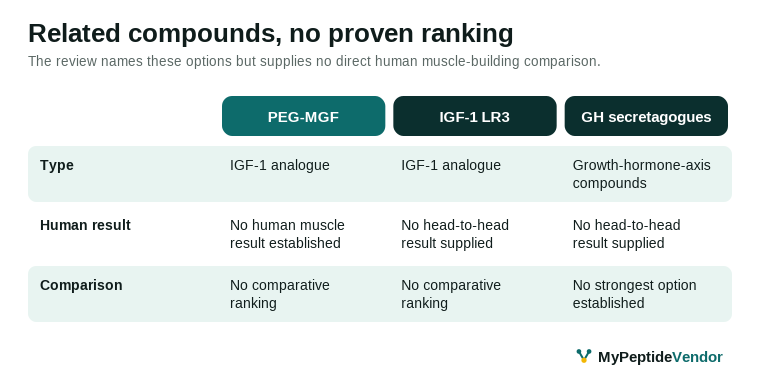
IGF-1 LR3 is a close comparison because the review names it alongside PEG-MGF as an IGF-1 analogue 2. GH secretagogues are another useful comparison: the review lists them as compounds that act on the growth-hormone axis, rather than as the same type of IGF-1 analogue 2. No head-to-head human muscle-building result ranks these options 2.
The table separates a human result from a proposed mechanism or an unproven comparison. The review names PEG-MGF, IGF-1 LR3, and GH secretagogues, while the trial search provides no PEG-MGF efficacy result 23.
| Claim or option | Evidence type | What can be concluded | Evidence grade |
|---|---|---|---|
| PEG-MGF builds muscle in people | No human efficacy result identified | Human muscle gain and an effective dose are not established | Insufficient human evidence |
| PEG-MGF activates Pax7+ satellite cells | Not established for PEG-MGF in the review | A proposed pathway is not a measured human outcome | |
| IGF-1 LR3 | Named as an IGF-1 analogue | No head-to-head result against PEG-MGF is supplied | No comparative ranking |
| GH secretagogues | Named as growth-hormone-axis compounds | Different pathway approach; no evidence establishes a strongest option | No comparative ranking |
There is no defensible strongest-peptide ranking from these data. PEG-MGF has no established human muscle outcome, and the review does not provide a direct comparison with IGF-1 LR3 or a GH secretagogue 23.
Use this chart
Free to reuse with a link back:
Ranked in our guides
Frequently asked questions
What does PEG MGF peptide do?
It is grouped with IGF-1 analogues in a review of peptides used to modulate the GH–IGF-1 axis 2. That classification does not establish a particular result in a person.
Does PEG MGF actually work?
There is no PEG-MGF human efficacy result in the trial-search information 3. The 14 search hits include other interventions, so their existence does not show that PEG-MGF works 3.
References
- FDA: Certain bulk drug substances for use in compounding that may present significant safety risks
- Dominikowski et al. The emerging landscape of performance-enhancing peptides modulating GH-IGF1 axis: bridging the gap between clinical evidence and patient self-administration. Front Endocrinol (Lausanne). 2026.
- ClinicalTrials.gov: 14 registered studies (search: PEG-MGF)
Written by the MyPeptideVendor editorial team from the FDA label, peer-reviewed studies and ClinicalTrials.gov records listed above, fact-checked line by line and reviewed 2026-11-12.
Cite this page
MyPeptideVendor Editorial Team. peg mgf: Evidence, Safety & FDA Status. MyPeptideVendor. Updated November 12, 2026. https://mypeptidevendor.com/peptides/peg-mgf/MyPeptideVendor Editorial Team. (2026, November 12). peg mgf: Evidence, Safety & FDA Status. MyPeptideVendor. https://mypeptidevendor.com/peptides/peg-mgf/Related peptides
CJC-1295
Not approvedCJC-1295 raises GH and IGF-1 in a short human trial, but benefits, long-term safety, and a standard dose remain unproven.
Learn moreFollistatin-315
Research UseFollistatin-315 binds activin and is proposed to affect myostatin, but injectable peptide benefits, doses, and risks are not established in controlled human trials.
Learn moreGonadorelin
Not approvedGonadorelin signals the pituitary to release LH and FSH; US Factrel is 50 mcg/mL and labeled for animals, not people. [1]
Learn more