B7-33: Evidence, Dosing & US Status
Single-chain relaxin mimetic
Brand names: No established prescription brand name in the cited research

B7-33 is a single-chain peptide modeled on the B-chain of human relaxin-2; it acts as an agonist at relaxin family peptide receptor 1 (RXFP1) 45. Researchers study it for effects on heart injury, blood vessels, and fibrosis.
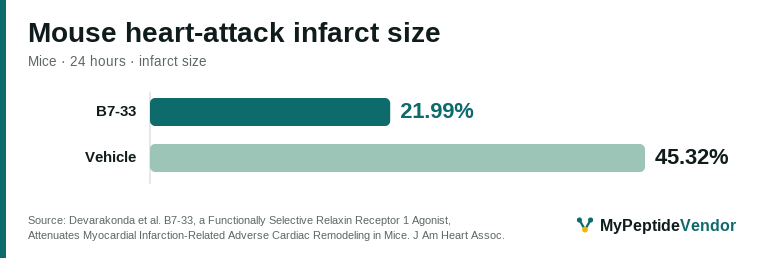
Evidence comes from cells, animals, and experimental delivery systems, not human treatment trials 2346789. In a mouse heart-attack model, infarct size was 21.99% with B7-33 versus 45.32% with vehicle 4.
Key takeaways
- B7-33 is a single-chain H2 relaxin B-chain mimetic that acts at RXFP1 45.
- After 30 minutes of coronary artery ligation in mice, infarct size was 21.99% with B7-33 versus 45.32% with vehicle 4.
- In a mouse cardiomyopathy model, B7-33 at 0.25 mg/kg/day reduced heart fibrosis similarly to relaxin at 0.5 mg/kg/day 6.
- B7-33-releasing PLGA-coated samples reduced fibrotic capsule thickness by 49.2% over 6 weeks in mice 7.
- The cited research reports no human trial results or established human dose 2346789.
B7-33 at a glance
- Class
- Single-chain relaxin mimetic; RXFP1 agonist
- Mechanism
- Promotes ERK1/2 phosphorylation; described as not activating cAMP
- FDA Status
- Research-use-only product labeling is not FDA approval; FDA's Category 2 list does not name B7-33
- Brand names
- No established prescription brand name in the cited research
- Administration
- Experimental injection, oral nanoparticle delivery, and implant-coating approaches; no established human route
- Typical Dose
- No human dose established; animal protocols include a single 13.3 μg/kg rat dose and 0.25 mg/kg/day in mice
- Half-life
- Human half-life and clearance have not been established
- Primary Uses
- Preclinical research on fibrosis, vascular function, cardiac injury, and delivery systems
What is it?

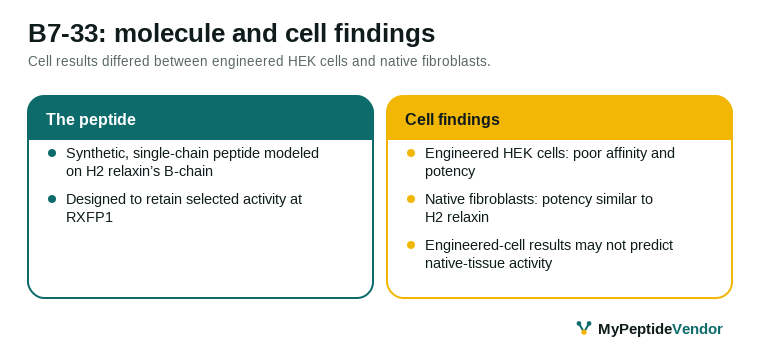
B7-33 is a synthetic, single-chain peptide modeled on the B-chain of human relaxin-2, also called H2 relaxin. Native H2 relaxin has two chains; B7-33 was designed as a simpler peptide that retains selected activity at RXFP1, the receptor for H2 relaxin 459.
B7-33 is not a growth hormone peptide. Its stated target is RXFP1, and its research concerns fibrosis, blood-vessel responses, and cardiac injury rather than growth hormone signaling 456.
Researchers developed B7-33 in 2016 as a single-chain derivative of H2 relaxin 9. It showed poor affinity and potency in HEK cells engineered to overexpress RXFP1, yet potency similar to H2 relaxin in fibroblasts that naturally express the receptor 9. That difference is a reminder that results in engineered cells may not predict activity in native tissue.
These identify the molecule; they do not establish purity, sterility, or suitability for human use.
Use this chart
Free to reuse with a link back:
What makes it different
B7-33 is described as a functionally selective RXFP1 agonist: it favors some signals from the receptor more than others. B7-33 is reported to phosphorylate ERK1/2 4. This signaling distinction comes from experimental work; it does not prove that B7-33 avoids unwanted effects in people.
Native H2 relaxin is a two-chain hormone with three disulfide bonds, while B7-33 is a single-chain design 59. H2 relaxin has been described as difficult to produce and unstable in human serum, which helped motivate work on simpler derivatives 9. A simpler structure does not show that B7-33 lasts longer in the body or is safer.
Another research direction puts B7-33 into engineered nanovesicles for a cholangiocarcinoma model. The vesicles also bind pro-angiogenic signals; the combined treatment produced 67.7% ± 17.6% tumor-growth inhibition in mouse xenografts, so that result cannot be assigned to B7-33 alone 3.
These identifiers distinguish the listed chemical from other peptides; they do not establish a medical-grade formulation.
How does it work
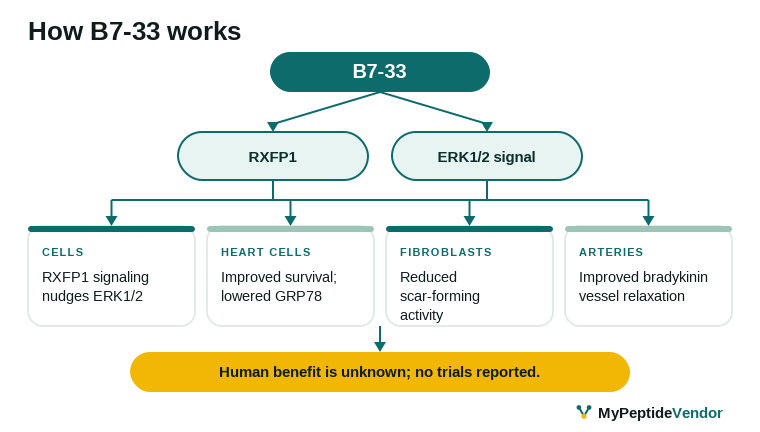
In plain terms, B7-33 binds RXFP1 and nudges cells toward an ERK1/2 signal. In technical terms, it promotes phosphorylation of extracellular signal-regulated kinases 1 and 2, steps that pass signals inside a cell 4.
In heart-cell experiments, B7-33 improved cell survival after simulated loss and restoration of oxygen, a laboratory model of ischemia-reperfusion. It also reduced GRP78, a marker of stress inside the cell, in cardiomyocyte experiments 4. These findings do not show that B7-33 prevents a heart attack in people.
In fibrosis studies, the goal is to reduce excessive scar-forming activity by influencing fibroblasts, the cells that build connective tissue. B7-33 showed anti-fibrotic activity in native fibroblasts that express RXFP1, despite its poor performance in RXFP1-overexpressing HEK cells 9.
Vessel effects were selective in rats: B7-33 improved bradykinin-mediated relaxation in mesenteric arteries, but had no overall effect on relaxation in small renal arteries or the aorta 2. That result does not support calling it a general-purpose vasodilator.
Human pharmacokinetics remain unknown. No cited study establishes a human half-life, clearance rate, or route-specific exposure for injection versus nanoparticle-based oral delivery 248.
Use this chart
Free to reuse with a link back:
What the clinical evidence actually shows: and what we don't know yet

No human B7-33 trial results are reported in the cited research. The evidence comes from cell experiments, animal disease models, and delivery-platform research; it does not show treatment benefit in patients 2346789.
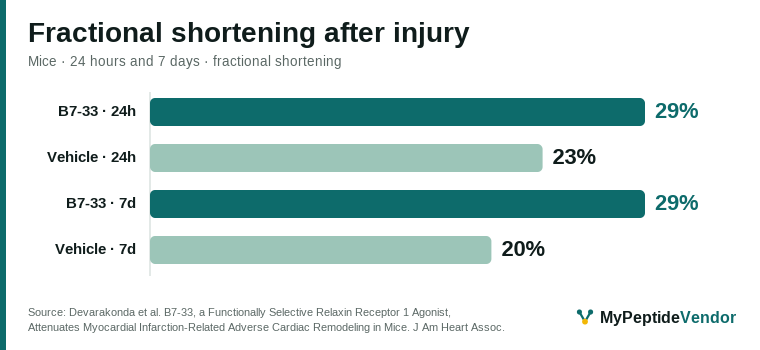
Heart attack model: Devarakonda and colleagues studied adult male CD1 mice after ligating the left anterior descending coronary artery for 30 minutes. At 24 hours, infarct size was 21.99% with B7-33 versus 45.32% with vehicle (P=0.02). Fractional shortening, a measure of how well the heart contracts, was 29% versus 23% at 24 hours and 29% versus 20% at 7 days 4. The Devarakonda study does not report group sizes; its findings come from mice 4.
Blood-vessel function: Marshall and colleagues gave male Wistar rats one tail-vein dose of B7-33 at 13.3 μg/kg or serelaxin at 26.6 μg/kg. Three hours later, both treatments improved bradykinin-mediated relaxation in mesenteric arteries; neither changed relaxation overall in small renal arteries or the aorta 2. In a separate ex vivo mouse-artery experiment, B7-33 and serelaxin at 15 or 30 nM prevented dysfunction induced by placental trophoblast-conditioned media. This was a laboratory vessel model, not a trial in pregnant patients 2.
Cardiomyopathy and fibrosis: Alam and colleagues studied male 129sv mice with isoprenaline-induced cardiomyopathy. Treatment ran from days 7 through 14 after injury: B7-33 was 0.25 mg/kg/day, relaxin was 0.5 mg/kg/day, and perindopril was 1 mg/kg/day 6. B7-33 and relaxin similarly reduced left-ventricular fibrosis and improved measured inflammation and cardiomyocyte hypertrophy. Perindopril reduced inflammation and vascular rarefaction but did not reduce fibrosis or hypertrophy in that model 6.
Implant coating: Welch and colleagues tested polypropylene samples coated with biodegradable PLGA that released B7-33. Subcutaneous implantation of B7-33-releasing PLGA-coated samples in mice reduced capsule thickness by 49.2% over 6 weeks 7. This supports research into device materials, not the safety or effectiveness of injecting B7-33.
Oral nanoparticle delivery: Somanader-Livera and colleagues compared oral SPION-B7-33 at 25 ng/day by gavage every 72 hours, from days 14–42 after injury, with perindopril at 60 ng/day in a mouse cardiomyopathy model 8. B7-33 was attached to biodegradable superparamagnetic iron oxide nanoparticles; it was not plain peptide swallowed as a capsule. The nanoparticle-linked treatment showed greater anti-fibrotic efficacy than perindopril in that model 8.
Cancer-model nanovesicles: Zhang and colleagues tested B7-33-bearing nanovesicles in subcutaneous cholangiocarcinoma xenografts. The dual-purpose vesicles reduced stromal fibrosis and angiogenesis, with tumor-growth inhibition of 67.7% ± 17.6% versus PBS (P<0.001) 3. Because the carrier also binds pro-angiogenic signals, the result does not show that B7-33 alone inhibits cancer.
How to judge the evidence: Cell experiments show receptor and cell responses; rodent models test effects in induced disease; coating and nanoparticle studies test delivery systems. None replaces a human trial 2346789. The published work does not establish a human treatment duration, clinical outcome, or adverse-event rate.
Key unanswered questions include human dose, half-life, clearance, route-specific exposure, long-term safety, and whether animal results translate to patients 2346789. The cited research does not link B7-33 to growth hormone release 45.
A claim that cAMP signaling by relaxin causes tumors, or that B7-33 avoids such a risk, is not established by the cited studies 345. The tumor-model result involved a combination nanovesicle system, not a test of that signaling claim 3.
| Study | Model | Dose, route, and duration | Main reported result |
|---|---|---|---|
| Marshall et al. | Rat arteries; ex vivo mouse arteries | Rats: 13.3 μg/kg B7-33 or 26.6 μg/kg serelaxin, tail vein; assessed 3 hours later. Ex vivo: 15 or 30 nM. | Improved mesenteric relaxation; no overall renal-artery or aortic effect. Prevented induced dysfunction ex vivo. |
| Zhang et al. | Cholangiocarcinoma xenograft mice | B7-33 carried in engineered nanovesicles; treatment duration not reported. | 67.7% ± 17.6% tumor-growth inhibition versus PBS. |
| Devarakonda et al. | Male CD1 mice after coronary artery ligation | Thirty-minute ligation; outcomes at 24 hours and 7 days. B7-33 dose not stated. | Infarct size 21.99% versus 45.32%; fractional shortening 29% versus 23% at 24 hours. |
| Praveen et al. | Review of relaxin receptor agonist research | Review article; no treatment dose or trial duration. | Summarizes development of single-B-chain agonists, including B7-33. |
| Alam et al. | Male 129sv mice with induced cardiomyopathy | B7-33 0.25 mg/kg/day; relaxin 0.5 mg/kg/day; perindopril 1 mg/kg/day, subcutaneous, days 7–14 after injury. | B7-33 and relaxin reduced fibrosis; perindopril did not reduce fibrosis in this model. |
| Welch et al. | Subcutaneous implant model in mice | B7-33 released from a PLGA coating; 6 weeks. | Fibrotic capsule thickness reduced by 49.2%. |
| Somanader-Livera et al. | Mouse cardiomyopathy model with nanoparticle delivery | Oral SPION-B7-33 25 ng per dose by gavage every 72 hours; perindopril 60 ng/day; days 14–42 after injury. | Nanoparticle-linked B7-33 showed greater anti-fibrotic efficacy than perindopril. |
| Handley et al. | RXFP1-overexpressing HEK cells and native fibroblasts | Cell assays; no human dose or treatment schedule. | Poor affinity and potency in engineered HEK cells, but potency similar to H2 relaxin in native fibroblasts. |
Use this chart
Free to reuse with a link back:
Use this chart
Free to reuse with a link back:
Typical dosing

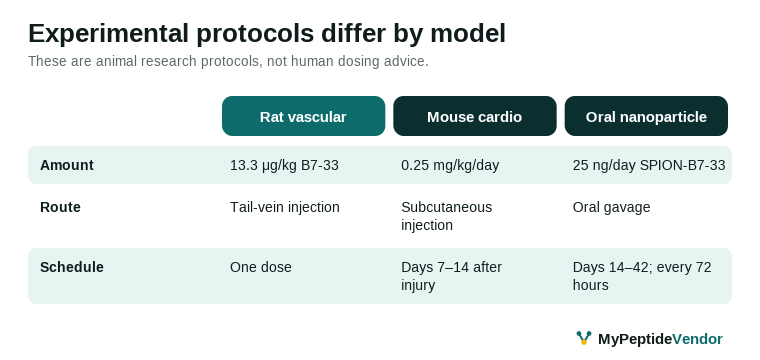
Human dosing: No human dose range is established in the cited research 2346789. The amounts below are experimental protocols in animals or cells, not dosing advice for people.
- Rat vascular experiment: one tail-vein dose of 13.3 μg/kg B7-33; the serelaxin comparator was 26.6 μg/kg 2.
- Mouse cardiomyopathy experiment: 0.25 mg/kg/day by subcutaneous injection from days 7–14 after injury 6.
- Mouse oral nanoparticle experiment: SPION-B7-33 at 25 ng/day by oral gavage every 72 hours from days 14–42 after injury 8. The peptide was attached to nanoparticles, not administered as an ordinary oral peptide 8.
- Cell experiments: B7-33 at 50 or 100 nM was tested in cardiomyocytes exposed to simulated ischemia-reperfusion 4.
These protocols differ by species, disease model, formulation, and route 2468. A dose tested in a rat or mouse cannot establish a safe or effective human dose.
Use this chart
Free to reuse with a link back:
Side effects: what to actually expect
No human adverse-event percentage is established for B7-33 in the cited research 2346789. These preclinical studies cannot tell a person which side effects to expect or how often they occur.
In the isoprenaline-induced mouse cardiomyopathy experiment, body weight and systolic blood pressure were measured weekly, and the model showed no change in those measures at day 14 after injury 6. That observation is not a human safety assessment and does not rule out other harms.
The studies do not establish safe long-term exposure, a complete interaction profile, or risks by route 2346789. Product identity, purity, sterility, and formulation can also affect risk when a peptide is used outside a controlled research setting.
The practical answer is that the human safety profile is unknown, not that side effects are absent. The cited research gives no human percentage for nausea, blood-pressure changes, allergic reactions, or other adverse events.
Regulatory & access status in the US (as of 2026)
The cited studies establish no FDA-approved human-use indication or prescription dose 2346789.
The FDA describes Category 2 as a category for bulk drug substances that may present significant safety risks under interim compounding policies 1. The FDA category 2 list in 1 does not name B7-33, so it cannot be taken as evidence of its compounding status.
Laboratory supply, eligibility for compounding, and FDA approval are separate questions. The animal and cell studies do not establish legal access for patients 1246. A clinician or pharmacy would need to verify current federal and state requirements before considering any compounded product.
Those supplier notices do not establish that B7-33 is a federally scheduled controlled substance in the United States; an EU listing is not US drug approval.
These are product-storage specifications, not evidence of a validated human-use formulation or clinical stability.
How it compares to its closest alternative
Serelaxin, the recombinant form of human H2 relaxin, is the closest comparator in B7-33 research 269. BPC-157 and growth hormone are not close molecular alternatives; the cited B7-33 studies do not compare them with B7-33 23456789.
The table compares the molecular descriptions and evidence levels relevant to these compounds 24569.
| Compound | Structure or class | Target or signaling | Evidence level here |
|---|---|---|---|
| B7-33 | Single-chain mimetic derived from the H2 relaxin B-chain. | RXFP1 agonist; ERK1/2 phosphorylation, without cAMP activation as described. | Cell, animal, and delivery-platform studies; no human trial results. |
| Serelaxin (H2 relaxin) | Recombinant form of the two-chain human relaxin-2 hormone. | RXFP1; used as a vascular and anti-fibrotic comparator. | Animal and ex vivo comparisons in the cited studies. |
| BPC-157 | A separate peptide, not a relaxin B-chain mimetic. | Not characterized as an RXFP1 comparator in the cited B7-33 studies. | Not compared with B7-33 in these studies. |
| Growth hormone | A protein hormone, not a relaxin-family peptide. | No growth-hormone target or pathway is assigned to B7-33 in these studies. | Not a comparator in the cited B7-33 research. |
In the rat vascular experiment, B7-33 at 13.3 μg/kg and serelaxin at 26.6 μg/kg each improved mesenteric relaxation; neither changed relaxation overall in the renal artery or aorta 2. One animal comparison does not prove equal effectiveness, safety, or dosing in people.
Frequently asked questions
What is B7-33 peptide used for?
B7-33 is used in laboratory research on RXFP1 signaling, fibrosis, blood-vessel function, and heart injury. Animal studies also test it in implant coatings and nanoparticle delivery systems, but they do not establish a human treatment use 234678.
What are the big 3 peptides?
There is no standard medical list called “the big 3 peptides”; the phrase depends on context, such as bodybuilding, research, or a particular clinic. B7-33 is a relaxin-derived research peptide, not part of a formally defined three-peptide medical group 45.
References
- FDA: Certain bulk drug substances for use in compounding that may present significant safety risks
- Marshall et al. B7-33 replicates the vasoprotective functions of human relaxin-2 (serelaxin). Eur J Pharmacol. 2017.
- Zhang et al. Dual-functional nanovesicles simultaneously inhibit stromal fibrosis and angiogenesis to suppress cholangiocarcinoma progression. J Nanobiotechnology. 2025.
- Devarakonda et al. B7-33, a Functionally Selective Relaxin Receptor 1 Agonist, Attenuates Myocardial Infarction-Related Adverse Cardiac Remodeling in Mice. J Am Heart Assoc. 2020.
- Praveen et al. Single chain peptide agonists of relaxin receptors. Mol Cell Endocrinol. 2019.
- Alam et al. The single-chain relaxin mimetic, B7-33, maintains the cardioprotective effects of relaxin and more rapidly reduces left ventricular fibrosis compared to perindopril in an experimental model of cardiomyopathy. Biomed Pharmacother. 2023.
- Welch et al. Coatings Releasing the Relaxin Peptide Analogue B7-33 Reduce Fibrotic Encapsulation. ACS Appl Mater Interfaces. 2019.
- Somanader-Livera et al. Immune cell uptake of glycinated nanoparticles conjugated to anti-fibrotic peptides enables their prolonged activity and oral administration. J Biomed Sci. 2025.
- Handley et al. Further Developments towards a Minimal Potent Derivative of Human Relaxin-2. Int J Mol Sci. 2023.
Written by the MyPeptideVendor editorial team from the FDA label, peer-reviewed studies and ClinicalTrials.gov records listed above, fact-checked line by line and reviewed 2026-11-12.
Cite this page
MyPeptideVendor Editorial Team. b7 33: Evidence, Dosing & US Status. MyPeptideVendor. Updated November 12, 2026. https://mypeptidevendor.com/peptides/b7-33/MyPeptideVendor Editorial Team. (2026, November 12). b7 33: Evidence, Dosing & US Status. MyPeptideVendor. https://mypeptidevendor.com/peptides/b7-33/Related peptides
BPC-157 + TB-500 Blend
Research UseA blend of BPC-157 and TB-500 has no established human dose or proven benefit for injury healing; key safety and stability questions remain unanswered.
Learn moreKPV
Research UseKPV is an experimental α-MSH tripeptide with laboratory and animal findings, no established human dose, and no proven human treatment benefit.
Learn morePE-22-28
Research UsePE 22-28 is a spadin-derived research peptide with cell and mouse findings, but no established human benefit, dose, or safety profile.
Learn more