Klow Peptide Blend: Evidence, Safety & Status
Peptide blend
Brand names: KLOW Blend; formulas may differ by seller.

The klow peptide blend is a four-peptide mixture: GHK-Cu, BPC-157, TB-500, and KPV. Vendor-listed formulas for multi-peptide vials vary, so the actual composition must be confirmed on the lot label, because a product name alone does not establish a fixed formula.
The blend’s effects, appropriate human dose, and safety have not been established by clinical results presented here. The ingredient research discussed below concerns proposed mechanisms and laboratory or animal models, not proof that KLOW treats a condition in people.
Key takeaways
- A commonly listed 80 mg KLOW vial contains 50 mg GHK-Cu plus 10 mg each of BPC-157, TB-500, and KPV.
- The four ingredients are studied for different questions, including collagen-related activity, tissue repair, cell movement, and inflammatory signaling.
- A human KLOW trial name, participant count, duration, and numeric outcome are not established here; no reliable effect timeline or side-effect percentage can be given.
- FDA Category 2 concerns certain bulk substances proposed for compounding; it is not an approval category, and KLOW’s status is not established by that list 1.
- An HPLC purity result does not by itself verify identity, peptide amount, sterility, endotoxin levels, or safety for human use.
KLOW Blend at a glance
- Class
- Four-peptide blend
- Mechanism
- Proposed ingredient-level actions involving tissue repair, collagen-related signaling, cell movement, and inflammatory signaling; combined action is unknown.
- FDA Status
- KLOW status is not established by FDA's Category 2 list.
- Brand names
- KLOW Blend; formulas may differ by seller.
- Administration
- No human route is established for the blend.
- Typical Dose
- No human dose is established.
- Half-life
- Not established for the blend.
- Primary Uses
- Laboratory investigation of peptide activity; no human medical use is established.
What is it?

KLOW is a blend name, not the name of a single peptide. One commonly listed 80 mg formulation contains GHK-Cu 50 mg, BPC-157 10 mg, TB-500 10 mg, and KPV 10 mg. The vial’s label and lot paperwork matter because the name alone does not confirm those amounts or prove that every supplier uses the same recipe.
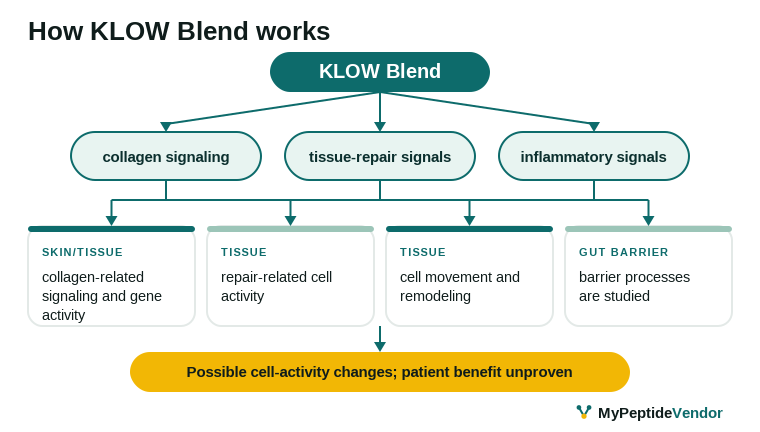
GHK-Cu is a copper-binding peptide studied in skin and tissue research, including collagen-related activity. BPC-157 is studied in tissue-repair research. TB-500 is associated with research into cell movement and tissue remodeling. KPV is studied in relation to inflammatory signaling and gut-barrier processes. These are research topics, not established benefits in patients.
The “blend” part matters. A result from one ingredient cannot establish what the four-part mixture does. Mixing could affect stability, solubility, activity, or impurity patterns; those properties have not been established for KLOW as a combination.
A research-use-only notice means the seller is not presenting the material as an approved medicine. It does not make a product sterile, confirm its contents, or establish that it is safe to inject or otherwise use in a person.
What makes it different
KPV is the ingredient that distinguishes KLOW from the commonly described GLOW formula. In that comparison, GLOW contains GHK-Cu, BPC-157, and TB-500; KLOW adds KPV, often listed at 10 mg in an 80 mg vial. The comparison describes product formulas, not evidence that one blend works better.
KPV adds a research question about inflammatory signaling to the questions raised by the other ingredients. Laboratory work on pathways such as NF-κB, cytokines, or intestinal-barrier function does not show that KLOW reduces inflammation, improves digestion, or changes a health outcome in people.
Fixed blends can also make experiments harder to interpret. If a test result changes after exposure to all four ingredients, that result alone cannot identify which ingredient caused it or whether the combination behaved differently from the ingredients used separately.
No evidence-based timeline can be given for when KLOW might produce an effect. A claim that results should appear after a particular number of days or weeks is not a clinical result for this blend.
How does it work?
In plain words, researchers study the four ingredients as possible signals that may affect different cell activities: structural support, tissue repair, cell movement, and inflammation. The proposed actions are not proof that the blend coordinates healing in a human body.
GHK-Cu: Researchers study this copper-binding peptide in skin and tissue biology, including collagen-related signaling and gene activity. A laboratory change in a marker does not establish stronger skin, faster wound closure, or another patient benefit. Claims about large percentages of human genes changing are gene-expression findings, not clinical outcomes.
BPC-157: Research questions include tissue-repair signaling and related cell activity. Results from cells or animals do not establish a safe human dose, a useful route, or treatment of an injury in people.
TB-500: Research associated with thymosin-related peptides examines cell movement and tissue remodeling. Evidence about a related peptide or protein cannot automatically establish the behavior of every product sold as TB-500, much less its behavior in KLOW.
KPV: This short peptide is studied for inflammatory signaling and intestinal-barrier processes. Findings involving a pathway or cell model do not establish that KPV or the full blend improves symptoms in people.
There is no confirmed combined mechanism for KLOW. Whether the ingredients alter one another’s activity, stability, solubility, or impurities after mixing remains unknown.
Use this chart
Free to reuse with a link back:
What the clinical evidence actually shows

A named human KLOW trial, its participant count, treatment duration, and numerical results are not established here. That means there is no KLOW result to report for pain, wound healing, skin changes, inflammation, or comparison with placebo or usual care. Ingredient-level findings cannot fill in those missing trial details.
For GHK-Cu, BPC-157, TB-500, and KPV, the proposed roles discussed in this profile come from research questions about tissue, cells, and signaling. Those findings should be kept separate from human clinical outcomes. An animal result is not a human trial, and a cell response is not proof of a treatment effect.
There is no trial-based number for how much KLOW might change a health outcome, how often a benefit occurs, or how long a benefit lasts. There is also no established KLOW treatment duration or evidence-based time to effect.
Important unanswered questions include whether the four ingredients work additively, whether one changes another’s activity, and whether the combined vial has different stability or impurity characteristics than each ingredient alone. Human dose, route, repeated-use risk, and long-term safety are also not established.
Evidence-strength check: cell and animal findings can suggest what to test next; a human trial would need to report its name, number of participants, duration, and measured outcomes. No such KLOW trial details are established here. Supplier descriptions and marketing claims are not clinical endpoints.
Typical dosing

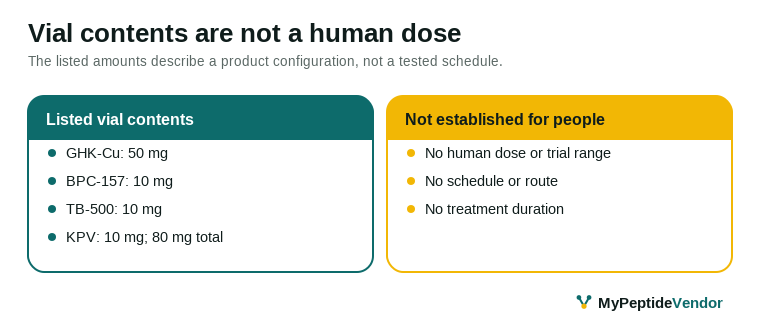
No human dose or trial range is established for KLOW. The amount in a vial is product content, not an instruction for use in a person. No schedule, route, or treatment duration can be recommended from the evidence described here.
A commonly listed vial contains 50 mg GHK-Cu and 10 mg each of BPC-157, TB-500, and KPV, totaling 80 mg. Those amounts describe a product configuration, not a tested dose. Confirm each ingredient and its stated amount against the specific vial label and lot paperwork.
Laboratory concentrations depend on the experiment and cannot be converted directly into a human dose. A research-use label or a vendor’s reconstitution directions do not make a human-use protocol medically established.
Use this chart
Free to reuse with a link back:
Side effects: what to actually expect
No percentage-based side-effect rate can be given for KLOW. A human safety study of the combination, with a defined number of participants and a reported observation period, is not established here. There is no reliable KLOW rate for headache, nausea, allergic reactions, injection-site effects, or other events.
No reported rate is not the same as no risk. Possible risk depends on the material, amount, route, contamination, sterility, and the person exposed. A high HPLC purity result does not establish sterility, endotoxin control, or safety for administration.
Safety information about one ingredient would not settle the safety of the four-peptide blend. Combined-product stability and impurity questions remain open, and a certificate of analysis cannot substitute for human safety data.
If exposure is followed by trouble breathing, facial swelling, fainting, or another urgent symptom, seek emergency care. For a non-urgent concern, contact a clinician and keep the vial and lot information available.
Regulatory & access status in the US
FDA Category 2 is an interim category for certain bulk drug substances nominated for use in compounding that FDA identifies as potentially presenting significant safety risks. The category list includes substances such as cesium, chloral hydrate, diethylstilbestrol, domperidone, and edetate disodium 1. Category 2 is an interim policy category for nominated bulk drug substances 1.
Category 2 status of KLOW or its four ingredients is not established by FDA's category list 1. That statement is narrower than saying that an ingredient is absent from every FDA record or that a product is approved. The list does not establish KLOW’s approval, safety, or effectiveness.
A supplier’s access to a vial does not establish that it is an approved medicine or suitable for human use. FDA’s compounding category addresses potential safety risks for nominated bulk substances; it does not validate a KLOW product’s identity, purity, dose, clinical benefit, or suitability for administration 1.
These are handling directions, not proof of a validated stability period or a human-use method. Published stability duration for a reconstituted KLOW blend is not established here, so do not assume a usable shelf life from the storage temperature alone.
Purity claims also need lot-level scrutiny. Purity claims, such as those labeled as HPLC-tested or "high purity," are not interchangeable; compare each claim against the lot's stated specification and ask for the actual lot result and acceptance criteria. A useful certificate of analysis should match the vial’s lot number and identify the test method and result. Look for mass spectrometry (MS) identity for each peptide, HPLC purity, net peptide content, and separate endotoxin and sterility results. A chromatogram alone does not prove all of these.
- Identity: Check whether MS supports the identity of each named peptide, not only the blend label.
- Purity: Compare the reported HPLC result with the stated specification; “high purity” without both is hard to assess.
- Content: Confirm whether the COA reports the amount of each ingredient, rather than only a purity percentage.
- Contamination controls: Look for separate endotoxin and sterility tests, with methods and acceptance criteria.
- Traceability: Match the lot number on the vial and report; a missing match or generic certificate does not verify that vial.
Even a lot-matched COA cannot show that KLOW works in people or that it is safe as a medicine. A purity result alone does not prove sterility, and no reconstituted-vial stability period is established here.
Research-grade KLOW Blend is available from American Peptides (KLOW ELITE Bundle, from $283.50); code MYPEPTIDEVENDOR takes 15% off. Sold for laboratory research only, not for human use. Affiliate link
How it compares with its closest alternative
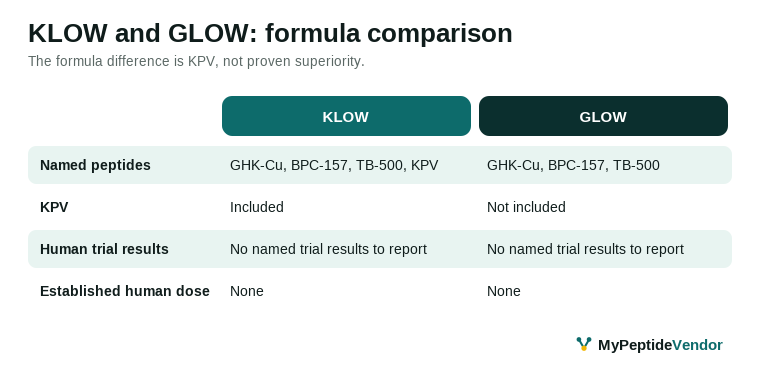
The table compares those product descriptions and research themes, not clinical benefits or recommended doses.
| Feature | KLOW | GLOW |
|---|---|---|
| Named peptides | GHK-Cu, BPC-157, TB-500, and KPV | GHK-Cu, BPC-157, and TB-500 |
| Commonly listed amounts | 50 mg GHK-Cu; 10 mg each of BPC-157, TB-500, and KPV; 80 mg total | |
| Difference | Adds KPV | No KPV in the commonly described formula |
| Research themes | Repair, collagen-related activity, cell movement, and inflammatory signaling | Repair, collagen-related activity, and cell movement |
| Human clinical results established here | No named trial results to report | No named trial results to report |
| Established human dose | None | None |
The formula difference is KPV, not proven superiority. An extra ingredient adds a research question, but it does not establish a better result or a safer product.
Use this chart
Free to reuse with a link back:
Where to Buy KLOW Blend for Research
American Peptides
KLOW ELITE Bundle · from $283.50
US-made research peptides, every lot third-party tested with a lot-matched COA.
15% offMYPEPTIDEVENDOR at checkout
- ≥99% purity verified by HPLC + mass spec, endotoxin tested
- Ships tracked from Louisiana, free shipping over $300
- 15% off your first order with code MYPEPTIDEVENDOR
Certified-Pep
US-made research peptides with batch-specific lab reports (COA) and a QR code on every vial.
- Independent laboratory testing (Vanguard Laboratory)
- Made in the USA, ships in 1-2 business days
- Research use only, not for human or veterinary use
Affiliate disclosure: we may earn a commission if you order through the link above. KLOW Blend is not approved by the FDA for human use.
Frequently asked questions
What is a KLOW peptide?
KLOW is a name for a mixture of GHK-Cu, BPC-157, TB-500, and KPV, rather than one peptide. A commonly listed vial totals 80 mg, but the exact contents should be checked on the product’s lot label.
Does KLOW peptide work?
A clinical benefit for the complete blend is not established here. Research themes for individual ingredients do not prove that the combined product improves a condition in people.
How long does it take for KLOW to work?
There is no established human timeline for an effect. A promised number of days or weeks should not be treated as a measured result for the blend.
Is KLOW blend peptide safe?
Safety in people and a side-effect rate for the combination are not established here. A lot-matched COA may provide information about identity and test results, but it cannot prove that KLOW is safe for human use.
References
Written by the MyPeptideVendor editorial team from the FDA label, peer-reviewed studies and ClinicalTrials.gov records listed above, fact-checked line by line and reviewed 2026-11-12.
Cite this page
MyPeptideVendor Editorial Team. klow peptide blend: Evidence, Safety & Status. MyPeptideVendor. Updated November 12, 2026. https://mypeptidevendor.com/peptides/klow-blend/MyPeptideVendor Editorial Team. (2026, November 12). klow peptide blend: Evidence, Safety & Status. MyPeptideVendor. https://mypeptidevendor.com/peptides/klow-blend/Related peptides
B7-33
Research UseB7-33 activates RXFP1 and has preclinical heart and fibrosis findings, but no established human dose, human trial results, or known human safety profile.
Learn moreBPC-157 + TB-500 Blend
Research UseA blend of BPC-157 and TB-500 has no established human dose or proven benefit for injury healing; key safety and stability questions remain unanswered.
Learn moreKPV
Research UseKPV is an experimental α-MSH tripeptide with laboratory and animal findings, no established human dose, and no proven human treatment benefit.
Learn more