Acetyl Hexapeptide 3 Argireline: Evidence & Use
Topical cosmetic peptide
Brand names: Argireline; acetyl hexapeptide-3; acetyl hexapeptide-8; CAS 616204-22-9

Acetyl hexapeptide 3 argireline is a synthetic peptide used in topical products and studied for wrinkles around the eyes. In a randomized trial of 60 Chinese participants, twice-daily use for 4 weeks improved subjective wrinkle ratings and reduced measured skin roughness 4.
That result is a short-term finding, not proof of lasting benefit or of an effect on every facial area. Product names and ingredient labels also vary: cosmetic ingredient listings use acetyl hexapeptide-8, while Wang and colleagues call the tested peptide Argireline 4.
Key takeaways
- Wang et al. randomized 60 Chinese participants in a 3:1 active-to-placebo ratio and tested twice-daily periocular application for 4 weeks 4.
- Subjective anti-wrinkle efficacy was 48.9% with Argireline and 0% with placebo; measured roughness decreased in the active group (p<0.01) 4.
- The Wang trial 4 does not report wrinkle-severity reductions at 15 or 30 days with twice-daily use.
- Formulation guidance commonly gives a 2–10% use rate for the supplied solution, added below 40°C; this is a formulation percentage, not a proven medical dose.
- The Wang trial abstract gives no Argireline-specific adverse-event percentage, and durability after stopping has not been established 4.
Argireline (Acetyl Hexapeptide-3) at a glance
- Class
- Topical cosmetic peptide
- Mechanism
- SNAP-25-derived peptide proposed to inhibit SNARE complex formation and catecholamine release
- FDA Status
- No FDA-approved wrinkle medicine is established by the cited FDA and trial information
- Brand names
- Argireline; acetyl hexapeptide-3; acetyl hexapeptide-8; CAS 616204-22-9
- Administration
- Topical; the randomized trial used twice-daily periocular application for 4 weeks
- Typical Dose
- No medical dose established; formulation guidance for a peptide solution is 2–10%
- Half-life
- Not established for topical cosmetic use
- Primary Uses
- Cosmetic appearance of lines; the cited randomized trial studied periocular wrinkles
What is it?

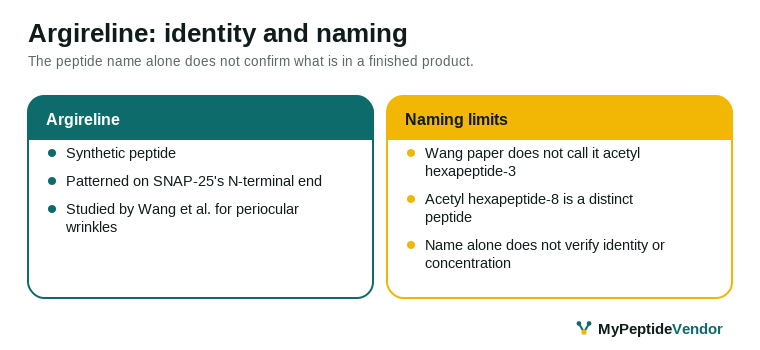
Argireline is a synthetic peptide patterned on the N-terminal end of SNAP-25, a protein involved in the machinery that nerve cells use to release chemical messengers 4. Wang et al. studied Argireline for periocular wrinkles; their paper does not call it acetyl hexapeptide-3 4.
Naming can be confusing. Acetyl hexapeptide-8 is a distinct peptide that has been studied in its own trials 5, and it should not be confused with Argireline in commercial product listings. A name on a marketing page alone does not verify the identity or concentration of what is in a finished product.
Argireline is discussed as a cosmetic ingredient, not as a peptide with an established medical dose. The human trial evaluated appearance and skin-surface roughness after topical use; it did not establish a treatment for a disease or a standard strength for all products 4.
Use this chart
Free to reuse with a link back:
What makes it different
Argireline is proposed to influence a step in chemical-messenger release, while retinol is a vitamin A derivative used in topical skin care. They are different ingredient types, and there is no head-to-head trial here to show which is stronger.
A 2024 systematic review of topical cosmeceuticals for photoaging found that peptides had the strongest evidence base among the groups it reviewed; most peptide studies reached Level Ib in its evidence hierarchy 2. This describes peptides as a broad category, not the quality of every Argireline product or the certainty of a specific result.
The direct Argireline evidence is limited to a small study of periocular wrinkles over 4 weeks 4. It does not establish the same effect on the forehead, around the mouth, or in every skin type. The trial also does not identify which participants are most likely to respond.
How does it work?
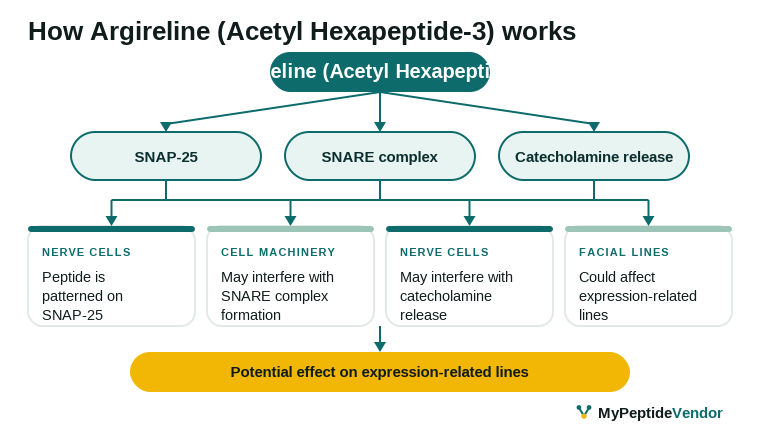
In plain terms, Argireline is intended to interfere with the cell machinery that releases chemical messengers. The idea is that changing this process could affect expression-related lines, but the wrinkle trial did not measure nerve activity or facial muscle movement 4.
More technically, Argireline is patterned on SNAP-25 and is proposed to interfere with formation of the SNARE complex and catecholamine release 4. That is a proposed mechanism, not proof that a topical product relaxes facial muscles in people as predictably as an injected treatment.
The Wang study measured wrinkle appearance and skin replicas before and after 4 weeks; it did not measure how much peptide reached nerve tissue 4. How much of a topical application penetrates to relevant tissue, and whether that changes muscle activity in people, remains unknown.
Use this chart
Free to reuse with a link back:
What the clinical evidence actually shows

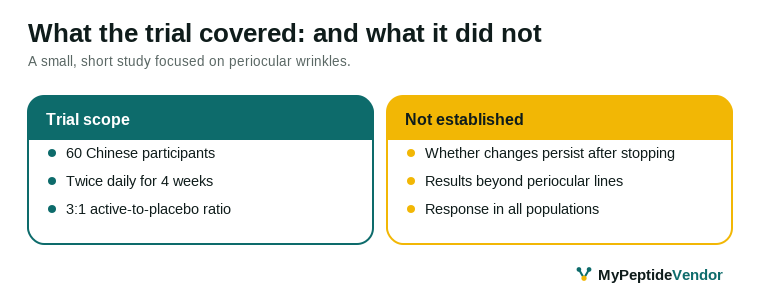
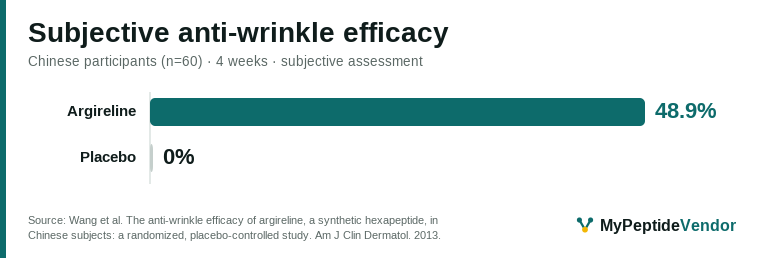
The strongest direct human evidence is the randomized, placebo-controlled trial by Wang and colleagues. It enrolled 60 Chinese participants, assigned treatment in a 3:1 active-to-placebo ratio, and applied Argireline or placebo to periocular wrinkles twice daily for 4 weeks 4. Subjective anti-wrinkle efficacy was 48.9% in the Argireline group and 0% in the placebo group 4.
The 48.9% figure is the study's overall subjective assessment of anti-wrinkle efficacy. It does not mean that wrinkles became 48.9% shallower. For the objective assessment, researchers made silicone replicas of the treated skin. Roughness measures decreased in the Argireline group (p<0.01), while no clear decrease occurred in the placebo group (p>0.05) 4.
These headline figures are not the results reported in Wang's 4-week trial, so they should not be treated as a second confirmed trial result 4.
The trial is encouraging but narrow: 60 people, one facial region, and 4 weeks of treatment 4. There are no reported washout results to show whether changes persist after stopping. Evidence is also limited for areas beyond the eyes, for different populations, and for long-term use.
Chan and colleagues' 2024 review found that peptides had the strongest evidence base among the cosmeceutical groups reviewed, with most peptide studies at Level Ib 2. That is context about the peptide category, not an Argireline-specific effect estimate. ClinicalTrials.gov lists 7 studies in its Argireline search, including cosmetic skin research and acetyl hexapeptide-8 research for blepharospasm 5. Registration or completion alone does not establish a positive result or approval.
Wang et al., Chan et al., and the ClinicalTrials.gov entries report the following study details and limits 245.
| Evidence | Population or scope | Duration or design | Reported finding | What it cannot establish |
|---|---|---|---|---|
| Wang et al., randomized, placebo-controlled trial | Chinese participants; n=60 | 4 weeks; twice daily; 3:1 active-to-placebo ratio | 48.9% subjective anti-wrinkle efficacy versus 0% with placebo; roughness decreased in the active group (p<0.01) | Durability, results beyond periocular lines, or response in all populations |
| Commercial ingredient documentation | Periocular wrinkle-severity figures | Twice daily; reported at 15 and 30 days | 17% at 15 days and 27% at 30 days | A result independently confirmed in the Wang trial |
| Chan et al., systematic review | Topical cosmeceuticals for photoaging | Review of evidence levels | Peptides had the strongest evidence base among reviewed groups; most peptide studies were Level Ib | An Argireline-specific effect size or product recommendation |
| ClinicalTrials.gov search | Cosmetic skin studies and blepharospasm studies | 7 registered studies | Includes NCT02597777 on oily skin and NCT00942851 and NCT01750346 on blepharospasm | Proof of efficacy, safety, or FDA approval |
Key unanswered questions are the effective concentration in a finished product, the size and duration of any benefit, and whether results vary by age, skin type, or facial area. The 4-week trial does not answer those questions 4.
Use this chart
Free to reuse with a link back:
Use this chart
Free to reuse with a link back:
Typical dosing

There is no established medical dose for Argireline. The Wang trial used twice-daily application for 4 weeks, but its abstract does not give the peptide concentration 4. That schedule is a trial regimen, not a proven dose for every serum.
The concentration of peptide in a finished product is unknown and does not necessarily reflect pure peptide content or a clinically established dose.
For a heat-sensitive solution, add it during cool-down, after the mixture has cooled sufficiently to avoid heat damage. Do not apply a concentrated ingredient solution directly to skin; one ingredient supplier specifically instructs users to incorporate it into a formulation. Follow the finished product's label instead of adapting laboratory or raw-material directions.
These are product-handling directions, not clinical dosing evidence. Storage specifications listed for research chemicals are laboratory guidelines, not instructions for consumer skin use.
Side effects: what to actually expect
The Wang trial abstract does not report an Argireline-specific adverse-event percentage or irritation rate 4. A numerical chance of a reaction to the peptide itself is therefore not established; lack of a reported rate does not mean reactions cannot happen.
A finished product may contain preservatives, fragrance, or other active ingredients, so redness or stinging would not identify Argireline as the cause. Stop using a product if persistent rash, swelling, burning, or eye irritation develops. Avoid getting a facial product into the eye.
A 2022 review of periocular aesthetic treatments describes complications ranging from dry-eye irritation to visual loss from vascular occlusion 3. That review covers aesthetic treatments and procedures; it does not establish these as side effects of topical Argireline. Sudden vision changes or severe eye pain after an eye-area treatment require urgent medical assessment.
Regulatory & access status in the US
No cited FDA material or clinical trial establishes Argireline as an FDA-approved medicine for wrinkles 145. A cosmetic product marketed for the appearance of lines is not the same thing as an approved drug, and a registered clinical study is not an approval.
FDA's Category 2 page concerns bulk substances nominated for use in 503A or 503B compounding 1. FDA's Category 2 page in 1 does not show whether acetyl hexapeptide is listed; check the current full list before making a compounding claim 1. This does not establish that the ingredient is approved or appropriate for compounding.
ClinicalTrials.gov lists 7 studies in its Argireline search, including trials of acetyl hexapeptide-8 for blepharospasm and cosmetic skin studies 5. The registry includes NCT00942851, listed as completed, and NCT01750346, listed as terminated; neither status by itself proves a treatment benefit 5.
Such raw material is not a finished cosmetic for direct application. Supplier notices also make no claim that Argireline has US FDA approval.
Research-grade Argireline (Acetyl Hexapeptide-3) is available from Certified-Pep. Sold for laboratory research only, not for human use. Affiliate link
How it compares with its closest alternative
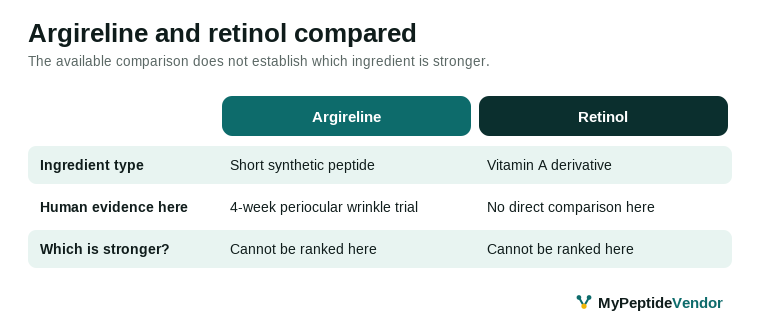
Retinol is a practical comparison because both ingredients appear in topical skin-care products aimed at visible signs of aging. Their proposed routes differ, and no head-to-head study here compares retinol with Argireline. A stronger-versus-weaker ranking is not supported.
The Argireline trial measured periocular wrinkles over 4 weeks, while the 2024 review assessed peptides among several cosmeceutical groups rather than comparing Argireline directly with retinol 24.
| Feature | Argireline | Retinol |
|---|---|---|
| Ingredient type | Short synthetic peptide | Vitamin A derivative |
| Proposed route | Interferes with SNARE complex formation and catecholamine release | Vitamin A-related effects in skin |
| Human evidence covered here | Randomized 4-week trial of periocular wrinkles | No direct comparison with Argireline |
| Which is stronger? | Cannot be ranked from the available comparison | Cannot be ranked from the available comparison |
When choosing a product, the full ingredient list and your own skin tolerance matter. A product's marketing name does not establish its peptide concentration or prove that it will match the trial formulation.
Use this chart
Free to reuse with a link back:
Where to Buy Argireline (Acetyl Hexapeptide-3) for Research
Certified-Pep
US-made research peptides with batch-specific lab reports (COA) and a QR code on every vial.
- Independent laboratory testing (Vanguard Laboratory)
- Made in the USA, ships in 1-2 business days
- Research use only, not for human or veterinary use
Affiliate disclosure: we may earn a commission if you order through the link above. Argireline (Acetyl Hexapeptide-3) is not approved by the FDA for human use.
Frequently asked questions
Is Argireline stronger than retinol?
There is no head-to-head trial to support that ranking. Argireline has a small human trial focused on lines around the eyes, while the review finding about peptides applies to the broader ingredient group 24.
What should you not mix with Argireline?
No interaction data establishes a specific ingredient that must not be combined with it. Use a finished product as directed, and do not put a concentrated raw ingredient solution directly on your skin.
Does Argireline really work for wrinkles?
A randomized study found better subjective ratings and lower measured roughness after a month of twice-daily use 4. That supports a short-term effect in the tested area, but not lasting results or benefit for every person and facial area.
What are the side effects of Argireline?
The trial abstract does not give a percentage for Argireline-related side effects 4. The rate of irritation from the peptide itself is unknown, and a reaction may come from another ingredient in the product. Serious eye complications discussed in reviews of periocular procedures are not established side effects of topical Argireline 3.
References
- FDA: Certain bulk drug substances for use in compounding that may present significant safety risks
- Chan et al. Cosmeceuticals in photoaging: A review. Skin Res Technol. 2024.
- Nagendran et al. Complications and adverse effects of periocular aesthetic treatments. Surv Ophthalmol. 2022.
- Wang et al. The anti-wrinkle efficacy of argireline, a synthetic hexapeptide, in Chinese subjects: a randomized, placebo-controlled study. Am J Clin Dermatol. 2013.
- ClinicalTrials.gov: 7 registered studies (search: Argireline (Acetyl Hexapeptide-3))
Written by the MyPeptideVendor editorial team from the FDA label, peer-reviewed studies and ClinicalTrials.gov records listed above, fact-checked line by line and reviewed 2026-11-12.
Cite this page
MyPeptideVendor Editorial Team. Acetyl Hexapeptide 3 Argireline: Evidence & Use. MyPeptideVendor. Updated November 12, 2026. https://mypeptidevendor.com/peptides/acetyl-hexapeptide-3-argireline/MyPeptideVendor Editorial Team. (2026, November 12). Acetyl Hexapeptide 3 Argireline: Evidence & Use. MyPeptideVendor. https://mypeptidevendor.com/peptides/acetyl-hexapeptide-3-argireline/Related peptides
AHK-Cu
Not approvedAHK-Cu has early lab findings related to hair follicles, but human hair benefits, safe dosing, and side-effect rates are not established.
Learn moreAHK (Tripeptide-3)
Not establishedAHK-Cu is a copper tripeptide used as a cosmetic ingredient, but human hair-growth benefit and a proven scalp dose remain unestablished.
Learn moreBronchogen
Research UseBronchogen is an experimental four-amino-acid peptide with preclinical lung findings, but no established human dose, safety profile, or treatment benefit.
Learn more