Epithalon: Evidence, Safety & FDA Status
Synthetic pineal tetrapeptide
Brand names: Epithalon, Epitalon, and Epithalone.

Epithalon is a synthetic four-amino-acid peptide studied for possible effects on aging, melatonin, and circadian rhythms 34. It is not an established treatment for any disease or aging-related condition 23.
Some reports describe biological effects, including enzyme activity and cell-marker changes, but they do not prove that people live longer, sleep better, or feel better 34[ADDF]. Human evidence is limited, and no verified human dose appears in the available clinical information 36[ADDF].
Key takeaways
- Epithalon is the synthetic sequence Ala-Glu-Asp-Gly (AEDG), modeled on the bovine pineal extract epithalamin 3.
- Telomerase is one reported enzyme effect, alongside AChE and BuChE; this does not establish longer human telomeres 3.
- A 2024 review describes changes in 4 circadian-related genes and several cell-aging markers, not proven improvements in sleep or lifespan 4.
- The only registered study is NCT07888595, an early Phase 1 study enrolling by invitation; no results are listed 6.
- Two 3-year safety trials involved epithalamin, not synthetic epithalon; they reported no severe adverse events [ADDF].
Epithalon at a glance
- Class
- Synthetic pineal tetrapeptide
- Mechanism
- Reported effects on telomerase, other enzymes, melatonin, and circadian-related markers; the full mechanism is uncertain.
- FDA Status
- The FDA bulk-substance page does not list epithalon as a category 2 substance and does not establish an approval status for an epithalon product.
- Brand names
- Epithalon, Epitalon, and Epithalone.
- Administration
- Reports describe subcutaneous use in short cycles, but a verified human route or regimen is not established [ADDF].
- Typical Dose
- No verified human dose appears in the cited clinical information[ADDF].
- Half-life
- Not established in the clinical information cited here.
- Primary Uses
- Investigated for aging-related biology and possible melatonin or circadian effects; no proven clinical use.
What is it?

Epithalon, also spelled Epitalon or Epithalone, is a synthetic tetrapeptide: a short chain of four amino acids, Ala-Glu-Asp-Gly (AEDG) 3. Researchers modeled it on the amino-acid composition of epithalamin, an extract from bovine pineal glands 3.
The two names refer to different materials. Epithalamin is a mixture of pineal polypeptides; epithalon is a defined four-amino-acid sequence 3. That distinction matters because a result with the extract cannot automatically be attributed to the synthetic peptide.
The pineal gland helps regulate melatonin, a hormone involved in daily timing of sleep and wakefulness 5. Epithalon has been studied for possible effects on this system, but it is not an established treatment for insomnia, aging, or cognitive decline 345.
What makes it different
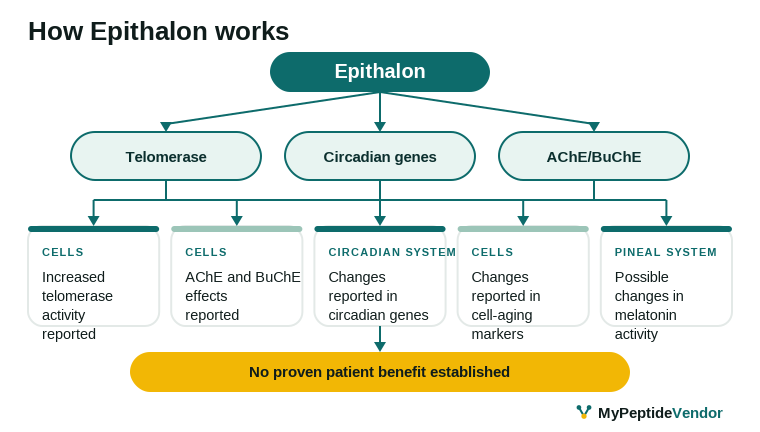
Epithalon is often discussed in relation to telomerase, an enzyme that helps maintain telomeres, the protective ends of chromosomes. But telomerase is only one of several enzyme effects reported: a 2025 review also discusses acetylcholinesterase (AChE) and butyrylcholinesterase (BuChE) 3. The authors say it remains uncertain whether these are the peptide’s only mechanisms 3.
A 2025 review surveys laboratory, animal, and computer-model research, but that breadth does not replace independently replicated human trials 3[ADDF].
The available English evidence is not enough to settle whether the main claims hold up in other laboratories.
There is also a product-quality issue. A label stating “AEDG” does not by itself verify a vial’s identity, purity, or sterility.
A 2026 orthopaedic review lists epithalon among peptides proposed for recovery-related effects, but states that clinical trials are lacking 2. This does not show that epithalon speeds recovery from an injury or operation.
How does it work?
In plain terms, researchers are testing whether epithalon can influence the body’s daily clock and how cells respond to aging-related signals. Proposed effects include changes in melatonin-related activity and enzymes that handle chemical signals 34. A biological effect does not automatically translate into a health benefit a person can feel.
Telomerase can help maintain telomeres, the chromosome ends that can shorten as cells divide. A 2025 review reports increased telomerase activity in research settings 3. The available evidence does not show that epithalon lengthens telomeres in people or slows human aging 3.
A 2024 review describes changes in the circadian-related genes Cry2, AANAT, ASMT, and CLOCK 4. It also discusses reduced levels of p16, p21, and p53, proteins associated with cell aging and cell death, and effects on TERF-1, prohibitin, SIRT1, and SIRT6, markers linked to cell function 4. These are molecular findings, not direct measures of sleep quality, energy, or lifespan.
Melatonin is a possible link between pineal biology and sleep timing 5. Those reports do not establish a reliable sleep effect in people.
It is also unknown whether synthetic epithalon reliably reproduces the melatonin effects attributed to epithalamin.
Use this chart
Free to reuse with a link back:
What the clinical evidence actually shows

Does it work? Epithalon has reported biological effects in research settings, including enzyme activity and changes in cell markers 34. But the clinical evidence summarized here does not establish a reliable benefit for lifespan, sleep, cognition, or general health in people 34[ADDF]. For a patient-facing benefit, the evidence is very limited.
The human melatonin evidence is hard to assess. A 2024 review describes increased melatonin secretion in older people and people with reduced melatonin-producing function, but its English abstract gives no participant count, dose, treatment duration, or numerical change 4. A 2012 review describes melatonin restoration with epithalamin and synthetic epithalon, but its summary also gives no human effect size or dose 5.
Mortality claims need particular care. The available summary does not give a participant count or a numerical mortality result, so it cannot establish how large any effect was or whether it applies to epithalon.
The only registered study listed under Epithalon is NCT07888595, an early Phase 1 study enrolling by invitation and assessing systemic and topical treatment with START/REST aging clocks 6. The registry listing reports no sample size, duration, dose, or results 6. An aging-clock measurement is not proof of longer life or better health.
The 2026 orthopaedic review also says clinical trials are lacking for peptide-based recovery claims 2. A change in a marker cannot show that a person thinks more clearly or recovers faster.
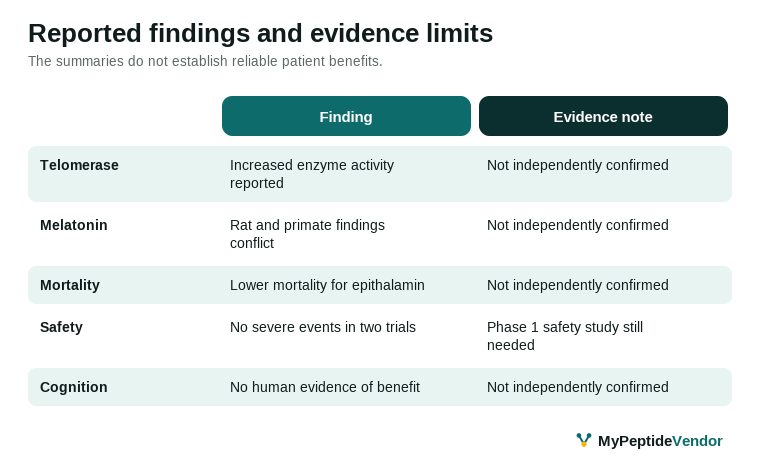
Here is the evidence in brief. The phrase “independently confirmed” refers to whether the reported finding has been replicated outside the research group associated with the work [ADDF].
| Claim | Population or model | Finding | Independently confirmed? |
|---|---|---|---|
| Telomerase | Laboratory and other research settings | Increased enzyme activity reported | No[ADDF] |
| Melatonin | Rats, older primates, and human summaries | Rat and primate findings conflict; human effect size is not given | No [ADDF] |
| Mortality | Older adults with cardiovascular disease | Lower mortality reported for epithalamin, not established for synthetic epithalon | No [ADDF] |
| Safety | Older adults receiving epithalamin | No severe adverse events in two 3-year trials; a formal Phase 1 safety study is still needed for epithalon | No [ADDF] |
| Cognition | Human cognition outcomes | No human evidence of prevention or treatment of cognitive decline | No [ADDF] |
The evidence timeline includes a 2001 primate abstract, the 2003 rat study, a 2012 review, a 2024 buccal-cell review, a 2025 overview, and the registered study NCT07888595 [ADDF]3456. None provides a confirmed onset time or a proven patient benefit.
Use this chart
Free to reuse with a link back:
Typical dosing

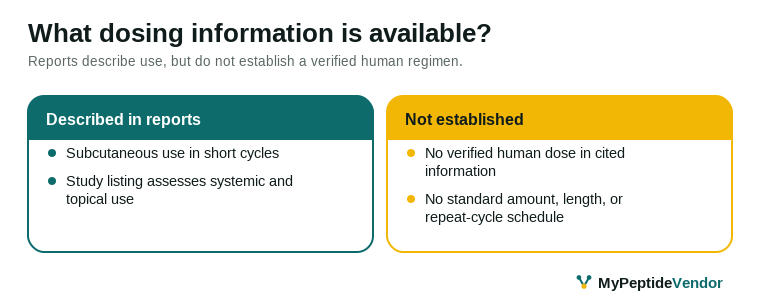
Dosing reality: No verified human dose appears in the cited clinical information 36[ADDF]. The available records do not establish a standard amount in milligrams, treatment length, or repeat-cycle schedule.
Reports describe subcutaneous administration in short cycles, but the sources do not provide a verified human dose or establish those practices as validated treatment [ADDF].
The registered study NCT07888595 assesses systemic and topical use, but its listing does not give a dose or a routine treatment plan 6. A study listing is not a general-use protocol. Do not treat an online cycle as a proven regimen; discuss any proposed use with a licensed clinician.
Use this chart
Free to reuse with a link back:
Side effects: what to actually expect
These were not safety trials of synthetic epithalon, and a formal Phase 1 safety study is still needed [ADDF].
Neither the reviews 34 nor the registry listing 6 report a rate for headache, nausea, injection-site reactions, or other common effects. There is no supported percentage to quote for those events. The NCT07888595 listing is early Phase 1 and enrolling by invitation; it does not report adverse-event results 6.
For a product intended for injection, identity, purity, and sterility are practical safety questions. Ask for lot-specific identity and purity testing and sterility testing; product testing matters because impurities may contribute to inconsistent results [ADDF]. A certificate alone cannot guarantee that a vial is safe.
The available clinical summaries do not establish which patients should avoid epithalon or identify drug interactions 345. That uncertainty means people taking medicines or managing health conditions should review the risks with a clinician rather than assume a short peptide has no interactions.
Regulatory & access status in the US (as of 2026)
That page concerns nominated bulk substances for compounding; it is not a finished-drug approval record 1.
The registered Phase 1 study NCT07888595 is research, not proof of FDA approval or a general treatment pathway 6. Most of the research discussed in the reviews is Russian-led, and the main clinical claims have limited independent replication [ADDF].
Before considering a product, ask a clinician or pharmacist to check its current legal and pharmacy status. For a synthetic peptide, request lot-specific identity and purity testing and, if the product is intended for injection, sterility testing; the amino-acid sequence on a label cannot verify the contents of a vial [ADDF].
Research-grade Epithalon is available from American Peptides (EPITHALON, from $60.00); code MYPEPTIDEVENDOR takes 15% off. Sold for laboratory research only, not for human use. Affiliate link
How it compares with its closest alternative
The closest alternative is epithalamin, the bovine pineal extract that inspired synthetic epithalon 3. The key difference is composition: epithalamin is a mixture, while epithalon is the defined AEDG sequence 3. The comparison below reflects reported composition and evidence; human findings for the extract should not be treated as findings for the synthetic peptide 3[ADDF].
| Feature | Epithalon | Epithalamin |
|---|---|---|
| Origin and composition | Synthetic four-amino-acid AEDG peptide | Mixed bovine pineal polypeptide extract |
| Research focus | Enzyme activity, including telomerase, and possible melatonin effects | Pineal, melatonin, and neuroendocrine effects |
| Human evidence described | Limited; no established dose or proven patient benefit | Human melatonin reports and mortality claims, with no independent confirmation |
| Confidence in patient benefit | Low; biological findings do not establish clinical outcomes | Low; evidence cannot be assumed to apply to the synthetic peptide |
Neither material has a proven standard treatment role. The distinction is especially important when reading mortality or melatonin claims that involve epithalamin rather than the synthetic AEDG peptide 3[ADDF].
Where to Buy Epithalon for Research
American Peptides
EPITHALON · from $60.00
US-made research peptides, every lot third-party tested with a lot-matched COA.
15% offMYPEPTIDEVENDOR at checkout
- ≥99% purity verified by HPLC + mass spec, endotoxin tested
- Ships tracked from Louisiana, free shipping over $300
- 15% off your first order with code MYPEPTIDEVENDOR
Certified-Pep
US-made research peptides with batch-specific lab reports (COA) and a QR code on every vial.
- Independent laboratory testing (Vanguard Laboratory)
- Made in the USA, ships in 1-2 business days
- Research use only, not for human or veterinary use
Affiliate disclosure: we may earn a commission if you order through the link above. Epithalon is not approved by the FDA for human use.
Frequently asked questions
What are the benefits of Epithalon?
Research has examined possible effects on telomerase, melatonin-related activity, and cell-aging markers 34. These findings do not prove better sleep, longer life, or improved health in people [ADDF].
Does epitalon actually work?
It has reported biological effects in research settings, but a meaningful clinical benefit for patients has not been established 34. The registered early Phase 1 study has no results listed 6.
References
- FDA: Certain bulk drug substances for use in compounding that may present significant safety risks
- Rahman et al. Therapeutic Peptides in Orthopaedics: Applications, Challenges, and Future Directions. J Am Acad Orthop Surg Glob Res Rev. 2026.
- Araj et al. Overview of Epitalon-Highly Bioactive Pineal Tetrapeptide with Promising Properties. Int J Mol Sci. 2025.
- Ivko et al. [Peptidergic regulation of expression of cellular aging marker proteins in buccal epithelium.]. Adv Gerontol. 2024.
- Khavinson et al. [Morphofunctional and molecular bases of pineal gland aging]. Fiziol Cheloveka. 2012.
- ClinicalTrials.gov: 1 registered studies (search: Epithalon)
Written by the MyPeptideVendor editorial team from the FDA label, peer-reviewed studies and ClinicalTrials.gov records listed above, fact-checked line by line and reviewed 2026-11-12.
Cite this page
MyPeptideVendor Editorial Team. Epithalon: Evidence, Safety & FDA Status. MyPeptideVendor. Updated November 12, 2026. https://mypeptidevendor.com/peptides/epithalon/MyPeptideVendor Editorial Team. (2026, November 12). Epithalon: Evidence, Safety & FDA Status. MyPeptideVendor. https://mypeptidevendor.com/peptides/epithalon/Related peptides
Argireline (Acetyl Hexapeptide-3)
Not approvedA small 4-week trial found wrinkle improvements, but lasting effects, ideal concentration, and Argireline-specific side-effect rates remain unknown.
Learn moreAHK-Cu
Not approvedAHK-Cu has early lab findings related to hair follicles, but human hair benefits, safe dosing, and side-effect rates are not established.
Learn moreAHK (Tripeptide-3)
Not establishedAHK-Cu is a copper tripeptide used as a cosmetic ingredient, but human hair-growth benefit and a proven scalp dose remain unestablished.
Learn more