MOTS-c: Evidence, Dose & Safety
Mitochondrial-derived peptide
Brand names: No approved MOTS-c brand is identified [USADA].

MOTS-c is a 16-amino-acid peptide encoded by the mitochondrial 12S rRNA region 2. Researchers study it for possible effects on metabolism, exercise response, and aging, but human treatment benefits have not been established 2,7,8.
There is no established MOTS-c dose or labeled route, and no long-term human safety data [ADDF, USADA].
Key takeaways
- MOTS-c has 16 amino acids; its reported sequence is MRWQEMGYIFYPRKLR [ADDF].
- The proposed Folate-AICAR-AMPK pathway is supported mainly by laboratory and animal research, not proven treatment benefit in people 6.
- The CB4211 analog was studied in a Phase 1a/1b trial with 88 participants; persistent injection-site reactions were common, but a percentage was not reported [ADDF].
- No established dose, labeled route, half-life, or treatment duration exists for MOTS-c [ADDF].
- MOTS-c is not FDA approved and is prohibited in sport at all times under WADA rules [USADA].
MOTS-c at a glance
- Class
- Mitochondrial-derived peptide
- Mechanism
- Mainly proposed to act through the Folate-AICAR-AMPK pathway.
- FDA Status
- Not approved for human use [USADA].
- Brand names
- No approved MOTS-c brand is identified [USADA].
- Administration
- No labeled or clinically established route [ADDF].
- Typical Dose
- Not established [ADDF].
- Half-life
- Not established; MOTS-c is reported not to cross the blood-brain barrier [ADDF].
- Primary Uses
- No approved use; research explores metabolic signaling, insulin sensitivity, exercise response, and aging.
What is it?

MOTS-c stands for mitochondrial open reading frame of the 12S rRNA type-c. It is a mitochondrial-derived peptide encoded by a short reading frame in the mitochondrial 12S rRNA region 2. Its reported sequence is MRWQEMGYIFYPRKLR.
Mitochondria help cells produce usable energy, but they also send signals about fuel use and cellular stress 6,8. MOTS-c is one such signal under study: it has been detected in tissues and plasma, and reviews report that circulating levels fall with age 2,8. That association does not show that replacing MOTS-c reverses aging or prevents disease.
Researchers have examined possible links to insulin sensitivity, obesity and metabolism, exercise capacity, and aging 2,7,8. The evidence is not equally strong across those topics. Most treatment findings come from cells and animals; human research mainly measures naturally occurring MOTS-c or its response to exercise 7,8.
A peptide naturally produced by the body is not the same as a vial sold for injection. A manufactured product raises separate questions about the amount delivered, route, purity, and sterility, none of which has been resolved by an approved MOTS-c product or a human dosing standard [3,ADDF].
Evidence at a glance
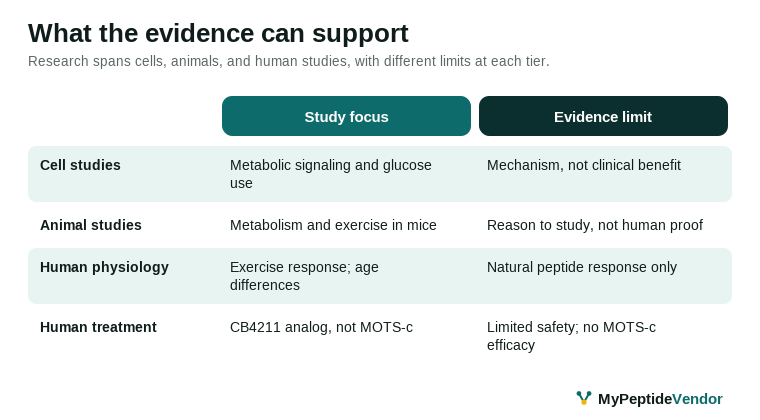
The table separates biological findings from evidence that taking MOTS-c helps people [2,6,7,8,ADDF].
| Evidence tier | What has been studied | What the evidence can support |
|---|---|---|
| Cell studies | Metabolic signaling, glucose handling, and AMPK-related pathways. | A possible mechanism; not a clinical benefit or safe dose. |
| Animal studies | Insulin sensitivity, metabolic effects, and exercise performance in mice. | A reason to study MOTS-c further; not proof of a human effect. |
| Human physiology | Exercise-related changes in natural MOTS-c levels and age-related differences. | How the body’s own peptide responds; not a test of a peptide product. |
| Human treatment evidence | A Phase 1a/1b study of the analog CB4211, not MOTS-c itself. | Limited short-term safety information for that analog; no established MOTS-c efficacy. |
Use this chart
Free to reuse with a link back:
What makes it different
MOTS-c is encoded within mitochondrial DNA rather than nuclear DNA 2,8. That origin places it among mitochondrial-derived peptides, a group researchers study as a way for mitochondria to signal to the rest of the cell 8.
Its proposed role centers on energy balance and stress adaptation rather than a proven single disease target 6,8. A natural rise after exercise shows that MOTS-c responds to a physiological stress; it does not show that an injected dose reproduces exercise or improves a person’s fitness 7.
MOTS-c is also not established as a brain-directed peptide. This leaves cognitive claims without a clear delivery basis or demonstrated human cognitive benefit.
One safety concern cuts against a simple “anti-aging” story. In senescent cells, MOTS-c stimulated secretion of IL-6, IL-1β, IL-8, IL-10, and TNF-α, worsening the senescence-associated secretory phenotype in that experimental setting 9. This does not prove that a person using MOTS-c will develop inflammation, but it shows that its effects may depend on cell state.
A review of mitochondrial stress responses lists MOTS-c among signals that may contribute to cancer progression 4. That is a theoretical concern from review-level evidence, not proof that MOTS-c causes cancer in people; it is still a reason for caution in anyone with a cancer history.
How does it work?
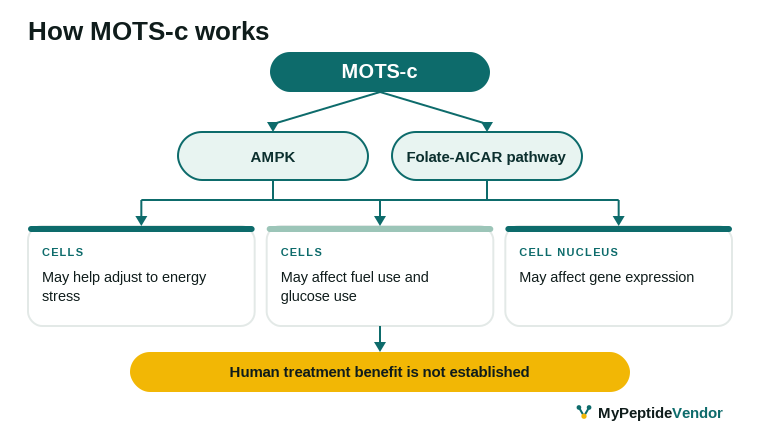
In plain terms, MOTS-c may help a cell adjust when its energy supply is under stress 6,8. Researchers connect that signal to AMPK, an enzyme that acts like an energy gauge and helps cells shift how they use fuel 6.
The more technical description is the Folate-AICAR-AMPK pathway 6. Reviews identify this pathway as a main route through which MOTS-c may influence energy metabolism, glucose use, and insulin resistance 6. That mechanism is a research model; it does not prove that taking MOTS-c improves blood sugar in people.
During metabolic stress, MOTS-c has also been reported to move into the cell nucleus and affect gene expression 2,6. This is one possible way a mitochondrial signal could influence a wider cell response. It does not establish how a manufactured peptide would distribute through human tissues after injection or oral use [2,ADDF].
Exercise provides a useful distinction between a natural signal and a treatment. Acute, high-intensity exercise can raise MOTS-c in human muscle and plasma 7. Whether training changes levels over time is less consistent and may depend on the exercise plan and participant characteristics 7. Neither result shows that taking MOTS-c improves exercise capacity.
Use this chart
Free to reuse with a link back:
What the clinical evidence actually shows

Human research has not established that MOTS-c treatment improves insulin sensitivity, produces weight loss, increases exercise capacity, or slows aging 2,7,8. Human findings mainly concern natural MOTS-c levels and responses to exercise; treatment-related benefits are largely from cells and animals 7,8.
Evidence by proposed use
- Insulin sensitivity: Cell and mouse research supports a possible role in glucose metabolism and insulin sensitivity 2,8. The human treatment effect, including any change in a glucose test, has not been established.
- Obesity and weight: Researchers study MOTS-c because of its possible role in energy metabolism and glucose handling 2,8. There is no established human treatment result for pounds lost, percentage weight change, or obesity remission.
- Exercise capacity: Acute high-intensity exercise can raise natural MOTS-c in human muscle and plasma, while treatment has improved exercise performance in mice 7. No human MOTS-c treatment result establishes an improvement in endurance, strength, or exercise time.
- Aging: Reviews report lower circulating MOTS-c with age 2,8. MOTS-c treatment improved exercise capacity and insulin sensitivity in mice 7,8, but there is no human result showing that treatment slows aging or prevents an age-related condition.
The only clinical trial information: CB4211
The study included healthy volunteers and a cohort with obesity and fatty liver disease; it evaluated the analog, not the native MOTS-c peptide [ADDF].
A numerical reaction rate, dose range, study duration, and numerical efficacy result are not available here, so no percentage or treatment effect should be inferred. The fatty liver cohort does not by itself establish liver safety because liver results are not reported [ADDF].
A short-term study of a related molecule cannot establish the safety, dose, or effectiveness of MOTS-c itself.
Registered studies
ClinicalTrials. ClinicalTrials.gov search returned nine MOTS-c-related studies; the listing shows six entries 10. The listed entries give titles and statuses, not treatment results, participant counts, or complete study designs 10.
| NCT number | Phase or status | Population or stated purpose |
|---|---|---|
| NCT07505745 | Phase 2; recruiting | MOTS-c for insulin sensitivity in adults with prediabetes and overweight or obesity. |
| NCT07678073 | Not applicable; recruiting | Compares general anesthesia with combined spinal-epidural anesthesia and measures ferroptosis, humanin, and MOTS-c in renal transplantation. |
| NCT07638696 | Not yet recruiting; phase not stated | Mitophagy and mitochondrial DNA dynamics during Ramadan dry fasting versus 16:8 time-restricted feeding. |
| NCT04013568 | Completed; phase not applicable | Exercise after breast cancer diagnosis. |
| NCT03878706 | Recruiting; phase not stated | Cardiovascular effects of a GLP-1 agonist, an SGLT2 inhibitor, and their combination. |
| NCT06500975 | Recruiting; phase not applicable | Long-term outcomes after vestibular implantation. |
The registry summary does not provide published MOTS-c treatment results, participant counts, treatment duration, or numerical outcomes for these entries 10. In particular, NCT07505745 is a recruiting Phase 2 study, not evidence that MOTS-c has already improved insulin sensitivity 10.
What remains unknown
No human dose, treatment duration, labeled route, or human half-life has been established for MOTS-c [ADDF]. Human liver safety is also unknown; a fatty liver cohort in the CB4211 study is not enough to answer that question when liver results are unreported [ADDF].
That finding does not prove that MOTS-c fails to reach every other tissue, but tissue penetration and oral absorption have not been established in clinical use.
Typical dosing

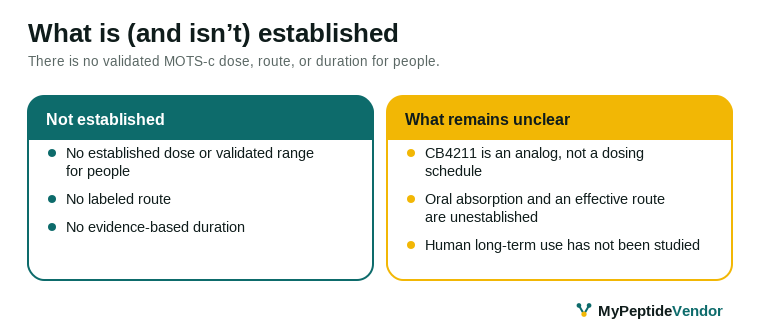
No established MOTS-c dose or labeled route exists. No clinically validated dose range is available for people, and no amount can be identified as safe for a particular person [ADDF].
The CB4211 Phase 1a/1b study involved 88 participants, but the available trial details do not give a dose range or treatment duration that can be applied to MOTS-c [ADDF]. CB4211 is an analog, so its study cannot serve as a dosing schedule for the native peptide.
Online schedules that list micrograms, milligrams, injection days, or cycling periods are not evidence-based clinical dosing guidance. Without a human dose-finding study and an approved product label, those figures do not establish a safe or effective range [ADDF,3].
Injection and oral use should not be treated as interchangeable routes. MOTS-c has no labeled route, and oral absorption or a clinically effective route has not been established [ADDF].
No evidence-based duration can be recommended. Human long-term use has not been studied, so a seller’s cycle or a schedule inferred from animal research cannot establish how long a person can use it safely [USADA,ADDF].
Use this chart
Free to reuse with a link back:
Side effects: what to actually expect
No percentage-based side-effect rate is established for MOTS-c because there is no reported completed human treatment trial of the peptide with adverse-event rates [ADDF]. There is no approved MOTS-c label with a common-side-effect percentage. The only clinical safety signal described here comes from the CB4211 analog: persistent injection-site reactions were common in its 88-person Phase 1a/1b study, but no percentage was reported [ADDF].
These reports do not establish how often the effects occur or prove that MOTS-c caused them, but they are symptoms worth reporting promptly to a clinician.
The senescent-cell finding is a biological warning, not a measured clinical side-effect rate. In that setting, MOTS-c stimulated IL-6, IL-1β, IL-8, IL-10, and TNF-α and exacerbated the senescence-associated secretory phenotype 9. It does not show that users will experience a cytokine reaction, but it argues against assuming that the peptide is uniformly anti-inflammatory or anti-aging.
Cancer risk is unresolved. A review lists MOTS-c among mitochondrial signals that may contribute to cancer progression, but it does not show that the peptide causes cancer in humans 4. Anyone with current or previous cancer should discuss this uncertainty with their oncology team before considering an unapproved product.
Liver safety is unknown. No human liver-injury rate or clear human liver-safety result is reported for MOTS-c [ADDF]. The CB4211 study included a fatty liver cohort, but its liver results are not reported; that is not evidence that MOTS-c or its analog is harmless to the liver [ADDF].
No formal contraindication list has been established [ADDF].
Safety checklist
- Ask a clinician to review the reason for use, the lack of an established dose, and the absence of long-term human safety data [ADDF,USADA].
- Review current and past cancer, pregnancy, and transplant status with a clinician because formal contraindications and safety data for these groups are not established [ADDF,4].
- Bring a full medication list, especially medicines that target AMPK, because a potential interaction has been raised [ADDF].
- Seek medical advice about palpitations, fever, insomnia, immune symptoms, or injection-site reactions rather than treating them as expected proof that the peptide is working [USADA,ADDF].
- Do not treat a seller’s stated purity as proof of identity, sterility, or dose accuracy; gray-market products may lack regulatory oversight 3.
Regulatory & access status in the US
MOTS-c is not FDA approved for human use. It has no approved product label, established dose, or labeled route [ADDF]. FDA's compounding materials identify certain nominated bulk substances as Category 2 when potential significant safety risks are under review 1.
A committee review is not the same as FDA approval, and it does not establish that a compounded MOTS-c product is safe or effective.
Products sold online may be marketed in a gray market outside the oversight applied to approved medicines 3. Purity, sterility, identity, and dose accuracy of a particular vial cannot be confirmed from a seller’s claim alone; there is no approved MOTS-c label against which to verify those details [3,ADDF].
Sports eligibility is separate from medical approval, so athletes should check the anti-doping rules that apply to their sport before using an unapproved peptide 3.
Red flags include a seller presenting “for research only” material as a human treatment, claiming that the word “compounded” proves approval, or offering purity and dose assurances without verifiable testing [3,ADDF]. FDA Category 2 review is a safety concern in the compounding context, not a certification of product quality 1.
Research-grade MOTS-c is available from American Peptides (MOTS-C, from $100.00); code MYPEPTIDEVENDOR takes 15% off. Sold for laboratory research only, not for human use. Affiliate link
How it compares to its closest alternative
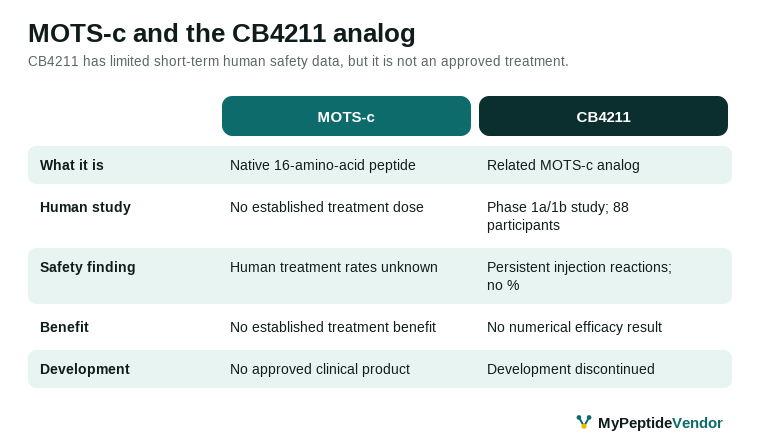
The closest peptide alternative is CB4211, a MOTS-c analog studied in the Phase 1a/1b trial; unlike native MOTS-c, it has limited short-term human safety data, but it is not an approved treatment and development was discontinued [ADDF].
| Feature | MOTS-c | CB4211 analog |
|---|---|---|
| What it is | Native 16-amino-acid mitochondrial-derived peptide. | A related MOTS-c analog studied as a development candidate. |
| Human trial information | No established human treatment result or dose. | Phase 1a/1b study with 88 participants. |
| Reported safety finding | Human treatment side-effect rates are not established. | Described as short-term safe; persistent injection-site reactions were common, without a reported percentage. |
| Evidence of benefit | No established human treatment benefit. | No numerical efficacy result is available in the trial details described here. |
| Current development | No approved clinical product. | Development discontinued after CohBar dissolved. |
CB4211’s 88-person study does not establish a safe dose, long-term safety, or efficacy for native MOTS-c [ADDF]. Neither peptide should be treated as a proven substitute for standard care.
Use this chart
Free to reuse with a link back:
Where to Buy MOTS-c for Research
American Peptides
MOTS-C · from $100.00
US-made research peptides, every lot third-party tested with a lot-matched COA.
15% offMYPEPTIDEVENDOR at checkout
- ≥99% purity verified by HPLC + mass spec, endotoxin tested
- Ships tracked from Louisiana, free shipping over $300
- 15% off your first order with code MYPEPTIDEVENDOR
Certified-Pep
US-made research peptides with batch-specific lab reports (COA) and a QR code on every vial.
- Independent laboratory testing (Vanguard Laboratory)
- Made in the USA, ships in 1-2 business days
- Research use only, not for human or veterinary use
Affiliate disclosure: we may earn a commission if you order through the link above. MOTS-c is not approved by the FDA for human use.
Ranked in our guides
Frequently asked questions
What is MOTS-c peptide used for?
MOTS-c has no approved medical use. Researchers study possible links to insulin sensitivity, metabolism, exercise response, and aging, but treatment benefits in people are not established 2,7,8.
Who should avoid taking MOTS-c?
No formal contraindication list exists because human treatment safety has not been established [ADDF]. People with a cancer history, those who are pregnant or transplant recipients, and people taking AMPK-targeting drugs should discuss the uncertainty with a clinician before considering it [4,ADDF].
Is MOTS-c hard on the liver?
Human liver effects have not been established [ADDF]. A CB4211 trial included a fatty liver cohort, but liver results are not reported, so the study cannot show whether MOTS-c is safe or harmful to the liver [ADDF].
References
- FDA: Certain bulk drug substances for use in compounding that may present significant safety risks
- Zheng et al. MOTS-c: A promising mitochondrial-derived peptide for therapeutic exploitation. Front Endocrinol (Lausanne). 2023.
- Mendias et al. Safety and Efficacy of Approved and Unapproved Peptide Therapies for Musculoskeletal Injuries and Athletic Performance. Sports Med. 2026.
- Wang et al. Role of the mitochondrial stress response in human cancer progression. Exp Biol Med (Maywood). 2020.
- Fasipe et al. Exercise and vascular function in sedentary lifestyles in humans. Pflugers Arch. 2023.
- Wan et al. Mitochondria-derived peptide MOTS-c: effects and mechanisms related to stress, metabolism and aging. J Transl Med. 2023.
- Woodhead et al. Mitochondrial-derived peptides and exercise. Biochim Biophys Acta Gen Subj. 2021.
- Merry et al. Mitochondrial-derived peptides in energy metabolism. Am J Physiol Endocrinol Metab. 2020.
- Mendelsohn et al. Mitochondrial-Derived Peptides Exacerbate Senescence. Rejuvenation Res. 2018.
- ClinicalTrials.gov: 9 registered studies (search: MOTS-c)
Written by the MyPeptideVendor editorial team from the FDA label, peer-reviewed studies and ClinicalTrials.gov records listed above, fact-checked line by line and reviewed 2026-11-12.
Cite this page
MyPeptideVendor Editorial Team. mots c: Evidence, Dose & Safety. MyPeptideVendor. Updated November 12, 2026. https://mypeptidevendor.com/peptides/mots-c/MyPeptideVendor Editorial Team. (2026, November 12). mots c: Evidence, Dose & Safety. MyPeptideVendor. https://mypeptidevendor.com/peptides/mots-c/Related peptides
Argireline (Acetyl Hexapeptide-3)
Not approvedA small 4-week trial found wrinkle improvements, but lasting effects, ideal concentration, and Argireline-specific side-effect rates remain unknown.
Learn moreAHK-Cu
Not approvedAHK-Cu has early lab findings related to hair follicles, but human hair benefits, safe dosing, and side-effect rates are not established.
Learn moreAHK (Tripeptide-3)
Not establishedAHK-Cu is a copper tripeptide used as a cosmetic ingredient, but human hair-growth benefit and a proven scalp dose remain unestablished.
Learn more