Pnc 27 Dosage 10mg: Evidence & Safety
A 10 mg PNC-27 vial is not a human dose; no approved human dose, injection schedule, or cycle has been established.
Quickstart highlights for PNC-27 10 mg
No human dose is established for a 10 mg PNC-27 vial. Published work describes laboratory and animal research, not a validated human dose, injection schedule, or cycle 235678.
Do not inject PNC-27 or use it instead of oncology care. A physician should review any proposed research use; supervision cannot make an untested dose proven safe or effective.
- Human dose: None is established. The reported research is preclinical and does not provide a validated human regimen 235678.
- Vial strength: 10 mg describes the amount in the vial, not an individual dose or evidence of safety.
- Proposed action: PNC-27 binds HDM-2 associated with cancer-cell membranes; researchers propose that the interaction helps form pores and cause cell lysis 29.
- Cell-study result: HTB-35 cervical cancer cells had a reported IC50 of 12.4 μM, while normal PCS-480 cells were not affected under that experiment’s conditions 5.
- Use caution: A cell concentration, animal experiment, vial label, or seller’s schedule cannot establish a safe human dose.
Key takeaways
- No approved human dose, titration schedule, or cycle length is established in the reported research 2567.
- PNC-27 is described as a 32-residue peptide containing a p53 amino-acid 12–26 region, a cell-penetrating leader, and a membrane-residency peptide 28.
- A cervical-cell experiment reported an IC50 of 12.4 μM in HTB-35 cells, not a human injection dose 5.
- A 10 mg vial states the quantity in the container; it does not establish how much a person should take.
- Human side-effect frequencies and a validated post-reconstitution use period have not been established 2567.
Dosing schedule and cycle length
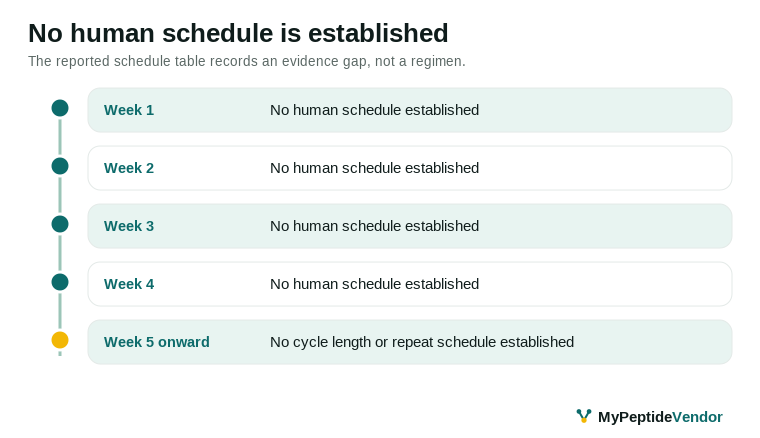
PNC-27 has no approved human dose or titration schedule in the reported studies 2567; its regulatory status is not established in these sources. For an approved medicine, dose changes should follow its FDA label or clinical-trial protocol; PNC-27 has no established human label or human titration schedule in these reports 2567. The table below records that evidence gap rather than recommending a regimen.
| Week | Dose (mg) | Dose (mcg) | U-100 units | Frequency and cycle |
|---|---|---|---|---|
| Week 1 | Not established | Not established | Not established | No human schedule established |
| Week 2 | Not established | Not established | Not established | No human schedule established |
| Week 3 | Not established | Not established | Not established | No human schedule established |
| Week 4 | Not established | Not established | Not established | No human schedule established |
| Week 5 onward | Not established | Not established | Not established | No cycle length or repeat schedule established |
Cell-culture concentrations cannot be converted into an injection dose. The 12.4 μM result in cervical cells describes exposure in a laboratory dish, not the amount, route, or frequency that would be safe for a person 5.
Online dosing schedules are not supported as human regimens by the cited studies 235678. No human pharmacokinetic profile, meaning data on how the body absorbs and clears PNC-27, is established in these reports 23567.
For arithmetic only, if a 10 mg vial were hypothetically mixed with 1 mL of liquid, the resulting concentration would be 10 mg/mL. With a U-100 syringe, that concentration corresponds to 100 mcg per unit; 250 mcg would be 2.5 units. This example is not a dose recommendation, validated diluent instruction, or confirmation that the mixture is safe to inject.
Use this chart
Free to reuse with a link back:
Syringe Unit Conversion Table
Units to draw on a U-100 insulin syringe (100 units = 1 mL) from a 10 mg vial. Find your dose, then read the column for the water you added. Every number is calculated, not estimated.
| Dose | 1 mL water 10 mg/mL · 1 unit = 100 mcg | 2 mL water 5 mg/mL · 1 unit = 50 mcg | 2.5 mL water 4 mg/mL · 1 unit = 40 mcg |
|---|---|---|---|
| 50 mcg | 0.5 · 200 doses | 1 · 200 doses | 1.25 · 200 doses |
| 100 mcg | 1 · 100 doses | 2 · 100 doses | 2.5 · 100 doses |
| 200 mcg | 2 · 50 doses | 4 · 50 doses | 5 · 50 doses |
| 250 mcg | 2.5 · 40 doses | 5 · 40 doses | 6.25 · 40 doses |
| 300 mcg | 3 · 33 doses | 6 · 33 doses | 7.5 · 33 doses |
| 500 mcg | 5 · 20 doses | 10 · 20 doses | 12.5 · 20 doses |
| 750 mcg | 7.5 · 13 doses | 15 · 13 doses | 18.75 · 13 doses |
| 1 mg | 10 · 10 doses | 20 · 10 doses | 25 · 10 doses |
| 1.5 mg | 15 · 6 doses | 30 · 6 doses | 37.5 · 6 doses |
| 1.7 mg | 17 · 5 doses | 34 · 5 doses | 42.5 · 5 doses |
| 2 mg | 20 · 5 doses | 40 · 5 doses | 50 · 5 doses |
| 2.4 mg | 24 · 4 doses | 48 · 4 doses | 60 · 4 doses |
| 2.5 mg | 25 · 4 doses | 50 · 4 doses | 62.5 · 4 doses |
| 3 mg | 30 · 3 doses | 60 · 3 doses | 75 · 3 doses |
| 4 mg | 40 · 2 doses | 80 · 2 doses | 100 · 2 doses |
| 5 mg | 50 · 2 doses | 100 · 2 doses | over 100 |
| 7.5 mg | 75 · 1 doses | over 100 | over 100 |
| 10 mg | 100 · 1 doses | over 100 | over 100 |
PNC-27 10 mg Vial Dosage Calculator
Shows the exact insulin-syringe units to draw. Pre-loaded with the 10 mg vial; change any value to match yours.
Total volume of your syringe?
How much mg is in the vial?
How much bacteriostatic water are you adding?
Dose per injection?
Educational tool only. Concentration = vial ÷ water; units = dose ÷ concentration × 100 (U-100 syringe). Confirm every dose with your prescriber. Different vial or peptide? Use the peptide calculator.
Reconstitution steps
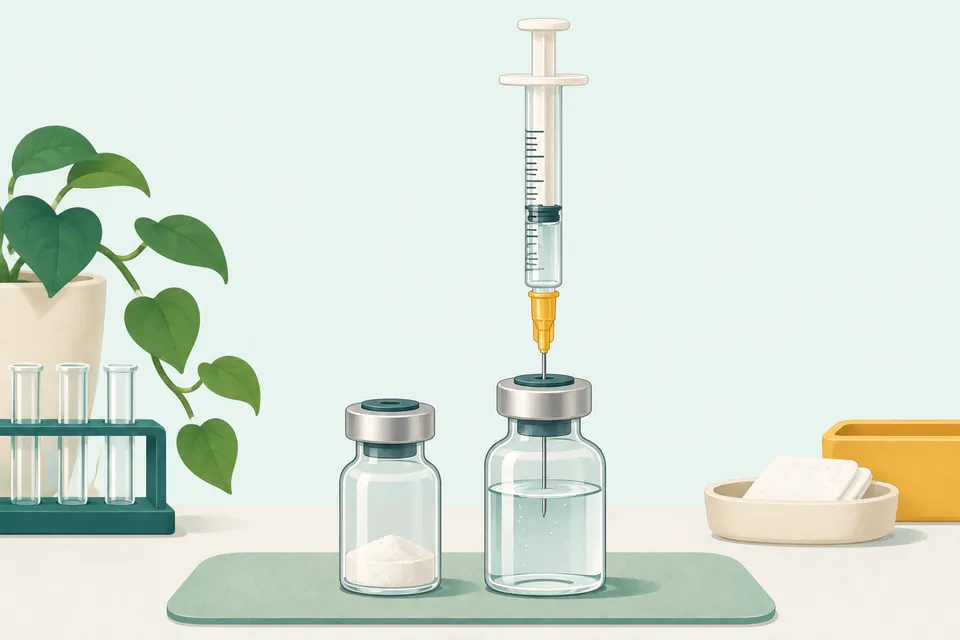
- Do not prepare the vial for personal injection. The reported human evidence does not establish an injectable formulation, route, dose, diluent, or reconstitution procedure 2567.
- Check the product identity and paperwork. A 10 mg vial label alone does not establish sterility, concentration, or clinical stability.
- For laboratory work, qualified research staff should follow the product-specific written method and their institution’s procedures. A laboratory preparation is not a treatment method.
- If you have already used the product, contact a clinician or poison-control service and provide the vial details, amount, route, time, and symptoms. Seek emergency care for severe or rapidly worsening symptoms.
No evidence-based human beyond-use period after mixing is established. Neither a 14-day nor a 28-day post-reconstitution limit can be presented as a validated clinical rule from the reported research 2567.
Supplies needed for a full vial
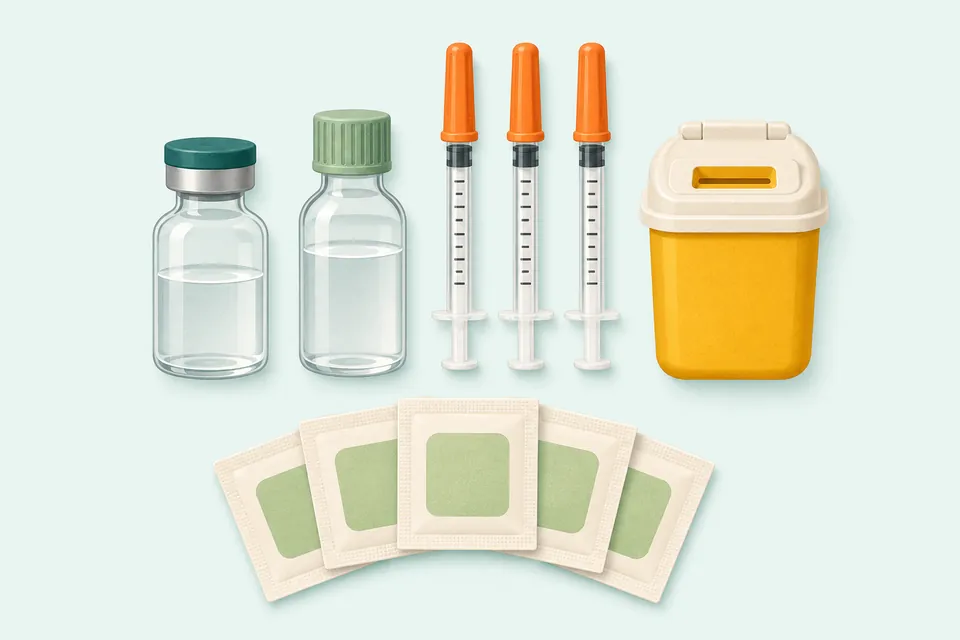
For personal injection, no supply list is recommended. No validated human preparation or injection protocol exists for a 10 mg vial, so naming injection equipment and amounts could imply a safe method where none has been established 2567.
- Full vial being discussed: 1 vial marked 10 mg.
- Validated personal-use diluent quantity: not established.
- Recommended personal injection syringes, needles, or swabs: none can be specified for an unvalidated human protocol.
The hypothetical 1 mL concentration example above is arithmetic only. It does not establish that 1 mL of any particular liquid is suitable for mixing, storage, or injection.
Protocol overview and cycle notes
PNC-27 is described as a 32-residue chimeric peptide. Its parts include p53 amino-acid residues 12–26, a cell-penetrating peptide (CPP) leader, and a membrane-residency peptide (MRP) 28. The 15-residue p53 segment is only one part of the full peptide 28.
The proposed mechanism is centered on cell membranes. PNC-27 binds HDM-2 associated with cancer-cell membranes; researchers propose that peptide–HDM-2 complexes form pores that damage the membrane and lead to cell lysis 29. In pancreatic cancer cells, laboratory work also reported mitochondrial disruption 3. These findings do not show that an injection selectively reaches tumors in a person.
Responses vary by model, and the findings do not establish that every cancer responds. Laboratory studies report effects in leukemia cell lines 68, pancreatic cancer cells 3, cervical cancer cells 5, and ovarian cancer cells 7. A PNC-27-conjugated nanoparticle study examined targeted delivery and cell effects, not a standard PNC-27 injection regimen 4.
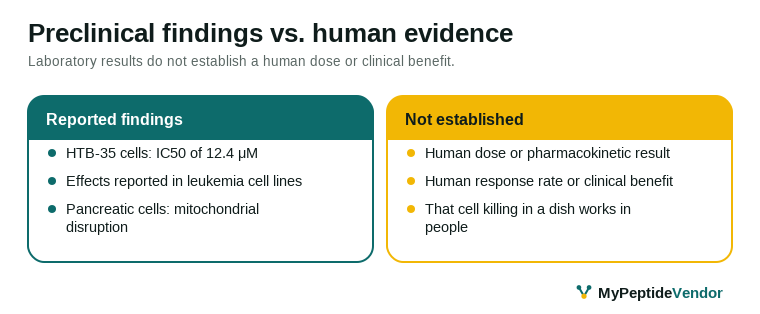
The cervical-cell study reported an IC50 of 12.4 μM in HTB-35 cells and no observed effect on normal PCS-480 cells under its experimental conditions 5. An IC50 is the concentration that reduced the measured cell response by half; it is not a treatment dose for a person 5.
The evidence levels below separate cell findings from animal work and human treatment evidence. The cited reports describe preclinical studies; they do not establish a human dose, human safety rate, or clinical benefit 23456789.
| Research question | Reported finding | Evidence level |
|---|---|---|
| Human dose or drug levels | No human dose or human pharmacokinetic result is established in these reports. | No human dosing evidence |
| Cervical cancer | HTB-35 cells had an IC50 of 12.4 μM; normal PCS-480 cells were not affected in the reported experiment. | In vitro |
| Leukemia | Studies reported effects in leukemia cell lines, including a K562 experiment with nearly 100% cell killing under its conditions. | In vitro |
| Pancreatic cancer | Researchers reported HDM-2-related effects and mitochondrial disruption in MIA-PaCa-2 cells. | In vitro |
| Ovarian cancer | Researchers reported cell effects and tested combined treatment in an ID8 mouse model. | In vitro and mouse |
| Clinical benefit | These results do not establish a human response rate or clinical benefit. | Not established |
Cell killing in a dish is not proof that a treatment works in a person. Selected cell lines and controlled exposure conditions cannot establish human absorption, distribution, breakdown, or toxicity 235678.
No cycle length, time off treatment, or repeat-cycle plan has been established for people 2567. Do not delay, stop, or replace standard cancer treatment because of laboratory or animal findings 357.
Use this chart
Free to reuse with a link back:
Storage and handling

A validated clinical storage temperature and post-reconstitution use period are not established in the reported human evidence 2567. Do not assume refrigeration, freezing, or a particular number of days makes a vial suitable for injection.
The cervical-cell study found that membrane-bound HDM-2 could still be detected in alcoholic preservative solutions; that finding concerns HDM-2 detection, not PNC-27 stability in alcohol or a validated mixing liquid 5. Bacteriostatic water should not be assumed to preserve PNC-27 activity or make a preparation safe for injection.
For laboratory use, follow the specific product’s written handling instructions and institutional procedures. If the vial’s identity or storage history is uncertain, do not use it as a personal medicine.
Injection and tracking tips
No human injection route, site, or frequency is established in the reported studies 2567. Do not use a subcutaneous or intramuscular schedule copied from a seller or online forum as cancer-treatment guidance.
If you are discussing an experimental product with an oncologist, bring the container and its written product information. Ask whether a properly authorized clinical trial is available for your diagnosis and whether participation could affect your current treatment.
No PNC-27-specific liver-test or tumor-marker monitoring schedule is established in these studies 23567. Your oncologist can decide whether liver tests or a cancer-specific marker is appropriate for your condition and existing care; a normal result would not prove that PNC-27 is safe.
If exposure has occurred, write down the product name, vial strength, route, time, and any symptoms, then share those details with a clinician. Do not use another dose while waiting for medical advice.
Safety and side effects
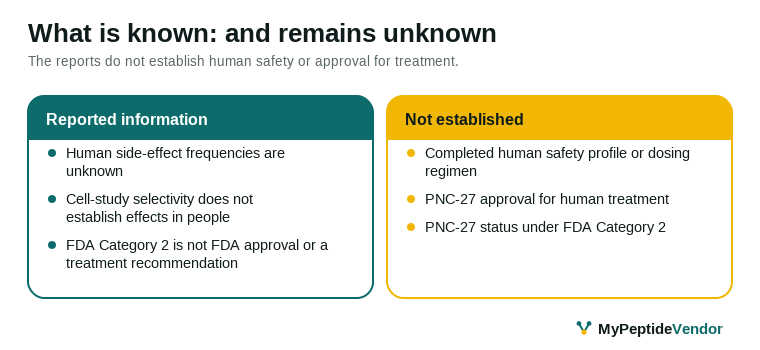
Human side-effect frequencies are unknown. No completed human safety profile or dosing regimen has been established, so reliable percentages for injection-site reactions, liver injury, allergic reactions, or other effects cannot be given 23567.
PNC-27 is being studied for membrane effects and cell injury. Selectivity in selected cell experiments does not establish that treatment in a person would affect only cancer cells or spare normal tissue throughout the body 2569.
Regulatory status needs careful checking. FDA Category 2 is an interim policy category for bulk substances that may present significant safety risks in compounding 1; PNC-27's status under this category is not established 1. Category 2 is not FDA approval or a treatment recommendation 1.
The research reports do not establish that PNC-27 is approved for human treatment or that a particular vial can legally be used for that purpose 2567. Check current federal and state requirements with a licensed clinician and pharmacist before considering any experimental product. Physician oversight cannot turn an unsupported dose into a proven treatment.
Use this chart
Free to reuse with a link back:
References
- 1 FDA. “Certain Bulk Drug Substances for Use in Compounding that May Present Significant Safety Risks.” Category 2 overview.
- 2 Sarafraz-Yazdi et al. “PNC-27, a Chimeric p53-Penetratin Peptide Binds to HDM-2 in a p53 Peptide-like Structure, Induces Selective Membrane-Pore Formation and Leads to Cancer Cell Lysis.” Biomedicines, 2022.
- 3 Krzesaj et al. “Anti-Cancer Peptide PNC-27 Kills Cancer Cells by Unique Interactions with Plasma Membrane-Bound hdm-2 and with Mitochondrial Membranes Causing Mitochondrial Disruption.” Annals of Clinical & Laboratory Science, 2024.
- 4 Rahmani et al. “Conjugated PNC-27 peptide/PEI-superparamagnetic iron oxide nanoparticles (SPIONs) as a double targeting agent for early cancer diagnosis: In vitro study.” Iranian Journal of Basic Medical Sciences, 2022.
- 5 Krzesaj et al. “HDM-2-Targeting Peptide PNC-27 Kills Cervical Cancer Cells but not Normal Cervical Cells.” Annals of Clinical & Laboratory Science, 2025.
- 6 Thadi et al. “Targeting Membrane HDM-2 by PNC-27 Induces Necrosis in Leukemia Cells But Not in Normal Hematopoietic Cells.” Anticancer Research, 2020.
- 7 Alagkiozidis et al. “Synergy between Paclitaxel and Anti-Cancer Peptide PNC-27 in the Treatment of Ovarian Cancer.” Annals of Clinical & Laboratory Science, 2017.
- 8 Davitt et al. “The anti-cancer peptide, PNC-27, induces tumor cell necrosis of a poorly differentiated non-solid tissue human leukemia cell line…” Annals of Clinical & Laboratory Science, 2014.
- 9 Sarafraz-Yazdi et al. “Anticancer peptide PNC-27 adopts an HDM-2-binding conformation and kills cancer cells by binding to HDM-2 in their membranes.” Proceedings of the National Academy of Sciences, 2010.
Frequently asked questions
What is the PNC-27 dosage for a 10 mg vial?
No human dose has been established for a 10 mg vial. The published research does not validate a human amount or injection plan 2567.
How often should PNC-27 be injected?
No evidence-based human injection frequency or cycle length is established. An online schedule is not a clinical-trial protocol or a substitute for an oncologist’s advice 2567.
How much bacteriostatic water should I use to reconstitute PNC-27?
No human reconstitution method or diluent volume has been established in the reported research 2567. Concentration arithmetic alone cannot establish that a preparation is safe or stable for injection.
Has PNC-27 been tested in people?
The reports describe cell experiments and animal research, not an established human dose or human safety profile 235678. Ask an oncologist about properly authorized clinical trials.
What side effects does PNC-27 cause?
Human side-effect rates have not been established, so reliable frequency estimates are unavailable 23567. Laboratory membrane effects do not show what whole-body effects an injection might cause 29.
References
- FDA: Certain bulk drug substances for use in compounding that may present significant safety risks
- Sarafraz-Yazdi et al. PNC-27, a Chimeric p53-Penetratin Peptide Binds to HDM-2 in a p53 Peptide-like Structure, Induces Selective Membrane-Pore Formation and Leads to Cancer Cell Lysis. Biomedicines. 2022.
- Krzesaj et al. Anti-Cancer Peptide PNC-27 Kills Cancer Cells by Unique Interactions with Plasma Membrane-Bound hdm-2 and with Mitochondrial Membranes Causing Mitochondrial Disruption. Ann Clin Lab Sci. 2024.
- Rahmani et al. Conjugated PNC-27 peptide/PEI-superparamagnetic iron oxide nanoparticles (SPIONs) as a double targeting agent for early cancer diagnosis: In vitro study. Iran J Basic Med Sci. 2022.
- Krzesaj et al. HDM-2-Targeting Peptide PNC-27 Kills Cervical Cancer Cells but not Normal Cervical Cells. Ann Clin Lab Sci. 2025.
- Thadi et al. Targeting Membrane HDM-2 by PNC-27 Induces Necrosis in Leukemia Cells But Not in Normal Hematopoietic Cells. Anticancer Res. 2020.
- Alagkiozidis et al. Synergy between Paclitaxel and Anti-Cancer Peptide PNC-27 in the Treatment of Ovarian Cancer. Ann Clin Lab Sci. 2017.
- Davitt et al. The anti-cancer peptide, PNC-27, induces tumor cell necrosis of a poorly differentiated non-solid tissue human leukemia cell line that depends on expression of HDM-2 in the plasma membrane of these cells. Ann Clin Lab Sci. 2014.
- Sarafraz-Yazdi et al. Anticancer peptide PNC-27 adopts an HDM-2-binding conformation and kills cancer cells by binding to HDM-2 in their membranes. Proc Natl Acad Sci U S A. 2010.
Written by the MyPeptideVendor editorial team from the FDA label, peer-reviewed studies and ClinicalTrials.gov records listed above, fact-checked line by line and reviewed 2026-11-12.
Cite this page
MyPeptideVendor Editorial Team. pnc 27 dosage 10mg: Evidence & Safety. MyPeptideVendor. Updated November 12, 2026. https://mypeptidevendor.com/protocols/pnc-27-dosing-10mg/MyPeptideVendor Editorial Team. (2026, November 12). pnc 27 dosage 10mg: Evidence & Safety. MyPeptideVendor. https://mypeptidevendor.com/protocols/pnc-27-dosing-10mg/