ARA-290 Peptide: Evidence, Dosing & US Status
Erythropoietin-derived peptide
Brand names: ARA-290; cibinetide; pHBSP

ARA-290 is a synthetic 11-amino-acid peptide derived from erythropoietin (EPO), also called cibinetide. It has been studied mainly for small-fiber neuropathy linked to sarcoidosis and type 2 diabetes 3689.
In a placebo-controlled pilot, 22 people with sarcoidosis received treatment or placebo for 4 weeks 6. The results offer an early signal, not proof that ARA-290 reverses nerve damage or is safe with long-term use.
Key takeaways
- ARA-290 is designed to activate the innate repair receptor without triggering EPO’s red-blood-cell production pathway 3.
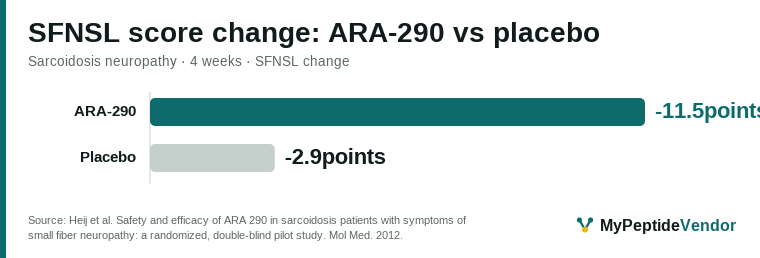
- In a 22-person sarcoidosis pilot, the neuropathy symptom score fell 11.5 points with ARA-290 versus 2.9 points with placebo after 4 weeks 6.
- Trial schedules included 2 mg IV three times weekly or 4 mg under the skin daily for 28 days; neither is an approved dose 68.
- Heij and Brines reported no safety concerns 68, treatment lasted no more than 28 days 689, and specific side-effect percentages were not reported 689.
- ARA-290 is investigational, and its inclusion in FDA Category 2 cannot be confirmed from the FDA excerpt 15.
ARA-290 at a glance
- Class
- Synthetic EPO-derived 11-amino-acid peptide; also called cibinetide
- Mechanism
- Designed to activate the innate repair receptor, formed by EPOR and CD131 β-common receptor, without activating the red-cell production receptor
- FDA Status
- Not FDA-approved; investigational, with no approved dose
- Brand names
- ARA-290; cibinetide; pHBSP
- Administration
- IV or subcutaneous in clinical trials
- Typical Dose
- Research schedules included 2 mg IV three times weekly or 4 mg subcutaneous daily; not recommendations
- Half-life
- About 2 minutes in plasma
- Primary Uses
- Studied for sarcoidosis-related small-fiber neuropathy and type 2 diabetic neuropathy
What is it?

ARA-290 is a lab-made peptide built from an 11-amino-acid segment modeled on erythropoietin (EPO), the hormone best known for signaling the bone marrow to make red blood cells. Its other names include cibinetide and pyroglutamate helix B surface peptide (pHBSP) 53. It is a separate molecule from full-length EPO, not simply a smaller dose of the hormone.
Researchers designed ARA-290 to engage tissue-protection signaling rather than the receptor pathway that promotes red-cell production 3. That design explains why it has been investigated for nerve symptoms and tissue protection. It does not establish that the peptide repairs tissue in every disease or patient.
Human research has focused on small-fiber neuropathy in sarcoidosis and type 2 diabetes 689. Small nerve fibers carry pain and temperature signals and help control some automatic functions, such as sweating.
ARA-290 is unapproved by the FDA 5; no FDA-approved dose exists for it 5. The studies below are early clinical research, not evidence that a clinician can prescribe it as an established neuropathy treatment.
What makes it different
The proposed difference is which receptor ARA-290 activates. EPO can activate the receptor involved in red-cell production, while ARA-290 was engineered to favor a separate tissue-protection receptor complex 3. The aim is to study protective signaling without deliberately stimulating erythropoiesis, the process of making red blood cells.
This matters because EPO-related rises in hematocrit, platelet activation, and selectin expression are linked with thrombosis risk 3. ARA-290’s design avoids intentionally driving that red-cell response, but this is not proof that it has no clotting risk or that it is safe for long-term use. The ARA-290 trials were small and short 689.
ARA-290 also has a plasma half-life of about 2 minutes 3. Yet researchers used daily or several-times-weekly dosing and measured effects after repeated treatment 689. One proposed explanation is that a brief receptor signal starts cellular responses that last after the peptide has cleared. That is a biological explanation, not a proven reason to assume that any dose will have lasting clinical effects.
Results in one kind of neuropathy cannot automatically be applied to another. The sarcoidosis and diabetes studies do not establish benefit for traumatic nerve injury 7. A 2026 review found that direct human evidence for ARA-290 in traumatic inferior alveolar nerve injury remains inadequate 7.
How does it work?
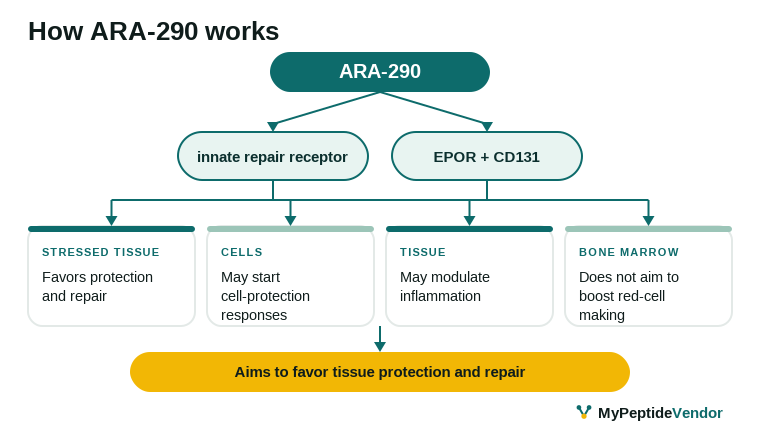
In plain terms, ARA-290 is meant to signal stressed tissue to favor protection and repair, rather than signal the bone marrow to make more red blood cells. The target is the innate repair receptor (IRR), made from the erythropoietin receptor (EPOR) and the beta-common receptor (βcR, also called CD131) 3.
That receptor pair differs from the EPOR homodimer involved in red-cell production 3. Researchers propose that activating the IRR can start cell-protection and inflammation-modulating responses. Those proposed effects help explain why small-fiber nerve symptoms have been studied, but receptor activity alone does not prove that damaged human nerves will regrow.
In clinical trials, researchers looked at patient-reported symptoms and physical function; some also measured corneal nerve-fiber density as an indicator of small nerve fibers 689. A better symptom score can matter to a patient, but it is not the same as full nerve recovery. A change in nerve density is also not, by itself, proof of lasting reversal.
The short time ARA-290 remains in plasma (about 2 minutes) does not tell us the right injection interval 3. The trials used different schedules, and none directly compared daily injections with dosing three times weekly 689. The best frequency, duration, and need for repeat treatment remain unknown.
Use this chart
Free to reuse with a link back:
What the clinical evidence actually shows

The human evidence is early. A 2014 review describes two Phase II trials, not a Phase III program 2. The main clinical reports concern sarcoidosis-associated small-fiber neuropathy and type 2 diabetes 689.
Where the cited reports do not give a participant count or effect size, a precise average treatment effect cannot be stated 89.
| Study | Participants | Route, dose, and duration | Reported result | What limits the finding |
|---|---|---|---|---|
| Heij et al., sarcoidosis small-fiber neuropathy | 22 total: 12 received ARA-290; 10 received placebo | 2 mg IV three times weekly for 4 weeks | Small Fiber Neuropathy Screening List (SFNSL) change: −11.5 ± 3.04 with ARA-290 versus −2.9 ± 3.34 with placebo; p < 0.05. Some SF-36 pain and physical-function measures also improved. | Exploratory pilot with small groups. Brief Pain Inventory and fatigue scores improved similarly in both groups. |
| Brines et al., type 2 diabetes | Participant count not reported | 4 mg subcutaneous daily for 28 days, followed by 28 days without treatment | Authors reported improved HbA1c and lipid profiles during the 56-day observation period, better PainDetect scores, and increased corneal nerve-fiber density in a subgroup with lower baseline density. | Numerical sizes of these changes are not reported; follow-up after dosing was 1 month. |
| Dahan et al., sarcoidosis-associated small nerve-fiber loss | Participant count not reported | Daily subcutaneous treatment for 28 days; dose not stated | Authors reported improved neuropathic symptoms, increased corneal nerve-fiber density, changes in temperature sensitivity, and increased distance on the 6-minute walk test. | The participant count, dose, and numerical size of the changes are not reported. |
The Heij study gives the clearest placebo comparison. After 4 weeks, the SFNSL score improved by 11.5 points in the ARA-290 group versus 2.9 points in the placebo group 6. The difference favors treatment, but a 22-person pilot cannot settle how reliable the result is in a broader group of patients.
In the diabetes study, 4 mg was injected under the skin each day for 28 days, followed by a 28-day observation period without treatment 8. The report describes changes in HbA1c, blood fats, PainDetect scores, and corneal nerve-fiber density, but does not provide numerical effect sizes. Without those figures, it is hard to judge how large or clinically meaningful the average changes were.
Dahan and colleagues reported better neuropathy symptoms, corneal nerve-fiber density, temperature sensitivity, and 6-minute walk distance after 28 days of daily subcutaneous treatment 9. The walking test adds a functional measure beyond a pain questionnaire. The dose, participant count, and size of the walking-distance change are not stated, so that result cannot be weighed precisely.
These studies do not show that ARA-290 reverses neuropathy. Symptom and nerve-density measures changed over about 4 weeks, but long-term nerve recovery was not established 689. There is also inadequate direct human evidence for traumatic nerve injury, so results in sarcoidosis or diabetes should not be presented as evidence for that condition 7.
Fatigue claims need particular restraint. A systematic review found that the evidence for treating sarcoidosis-related fatigue was limited; most of the included studies had high risk of bias, while the others were small and short 4. In the Heij trial, fatigue improved similarly in the ARA-290 and placebo groups 6.
ClinicalTrials.gov lists four ARA-290 studies with different statuses; a registered study is not proof of benefit or availability 10.
| Trial identifier | Condition or focus | Phase and listed status |
|---|---|---|
| NCT06626971 | Diabetic macular oedema | Phase 2; terminated |
| NCT02039687 | Corneal nerve-fiber density and neuropathic symptoms in sarcoidosis | Phase 2; completed |
| NCT01933529 | Prediabetes and type 2 diabetes | Phase 2; status unknown |
| NCT02070783 | Cognitive and neural effects | Phase 1/2; completed |
Trial registration status does not answer whether treatment works. One listed study was terminated, and the status of another is unknown 10. Long-term reversal of neuropathy and the durability of any symptom or nerve-density change remain unproven 689.
Use this chart
Free to reuse with a link back:
Typical dosing

There is no FDA-approved ARA-290 dose 5. The amounts below are research schedules from small clinical studies, not instructions for self-treatment.
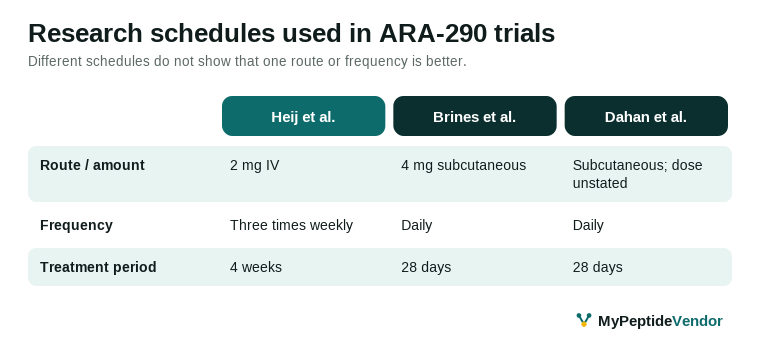
Clinical trials used different routes and schedules, and they were not head-to-head dose comparisons 689. Trial protocols: Heij 2 mg IV three times weekly for 4 weeks 6; Brines 4 mg SC daily for 28 days 8; Dahan dose not stated 9.
| Study | Route and amount | Frequency | Duration |
|---|---|---|---|
| Heij et al. | 2 mg IV | Three times weekly | 4 weeks |
| Brines et al. | 4 mg subcutaneous | Daily | 28 days; then 28 days of follow-up without treatment |
| Dahan et al. | Subcutaneous; dose not stated | Daily | 28 days |
The different schedules do not show that one route or frequency is better 689. A plasma half-life of about 2 minutes is not a method for calculating an appropriate dose or interval 3. No established maintenance schedule, repeat-course plan, or dose for routine care has been shown.
Use this chart
Free to reuse with a link back:
Side effects: what to actually expect
The Heij trial reported no safety concerns from clinical or laboratory assessments, and the Brines study identified no potential safety issues 68. These are reassuring observations from small studies, not proof that the treatment is free of harm.
Event-by-event side-effect percentages are not reported in these trials 689. There is therefore no reliable percentage to quote for headache, nausea, injection-site reactions, or other specific effects. “No safety concerns” does not mean that no participant had any symptom, and it does not rule out uncommon harms.
Reported treatment periods lasted up to 28 days; the diabetes study followed participants for an additional 28 days after dosing ended 689. Safety beyond these short periods has not been established. Small trials also cannot reliably identify rare adverse events.
ARA-290 was designed not to trigger the red-cell production response associated with EPO 3. That design distinction does not prove that ARA-290 has no thrombosis risk or is safe for every person.
Regulatory & access status in the US (as of 2026)
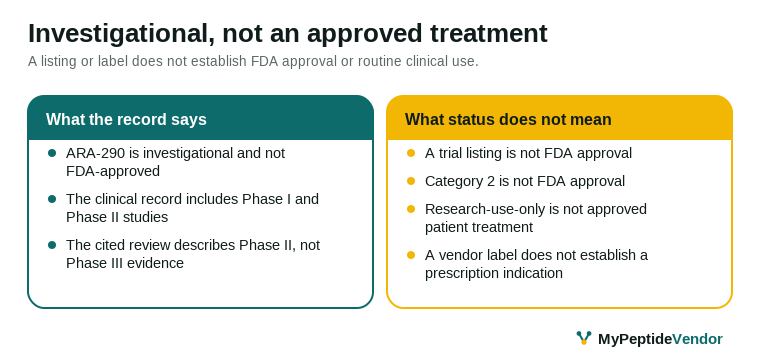
As of 2026, ARA-290 remains investigational and is not FDA-approved for any indication 5. The clinical record includes Phase I and Phase II studies; the cited review describes Phase II trials, not Phase III evidence 210. A trial listing or publication is not FDA approval.
FDA describes Category 2 as a category for certain nominated bulk drug substances that may present significant safety risks 1. A Category 2 designation is not FDA approval or routine permission to compound a drug.
Products marked “research use only” are not an approved patient treatment. A vendor label does not create a prescription indication, establish product quality for injection, or provide a medically validated dose. ARA-290 is not FDA-approved for any indication 5.
For someone with neuropathy, the practical point is that the evidence does not establish ARA-290 as standard clinical care. The registered studies have mixed statuses, including a terminated study and one with unknown status 10.
Use this chart
Free to reuse with a link back:
Research-grade ARA-290 is available from American Peptides (ARA-290, from $82.00); code MYPEPTIDEVENDOR takes 15% off. Sold for laboratory research only, not for human use. Affiliate link
How it compares with its closest alternative
EPO is the closest comparison because ARA-290 was modeled on its structure. EPO can activate the receptor homodimer involved in red-cell production, while ARA-290 was designed to activate the EPOR-plus-CD131 innate repair receptor 3. The comparison below describes the intended biology and the limited neuropathy evidence; it does not show that ARA-290 is a proven or safer replacement for EPO 3689.
| Feature | ARA-290 (cibinetide) | Erythropoietin (EPO) |
|---|---|---|
| Structure | Synthetic 11-amino-acid peptide modeled from EPO | Full-length hormone |
| Proposed receptor action | Designed to activate EPOR plus CD131, the innate repair receptor | Activates the EPOR homodimer involved in red-cell production |
| Red-cell effect | Designed not to stimulate erythropoiesis | Stimulates red-cell production and can raise hematocrit |
| Risk highlighted in the literature | Long-term and rare-event safety are not established by small, short trials | Hematocrit rises, platelet activation, and selectin expression are linked to thrombosis risk |
| Human neuropathy evidence | Small, short studies in sarcoidosis and type 2 diabetes | Not established as a neuropathy treatment by the trials discussed above |
The intended distinction is that ARA-290 targets tissue-protection signaling without deliberately activating EPO’s red-cell pathway 3. Whether it provides durable clinical benefit without important harm remains unanswered by the short trials available 689.
Where to Buy ARA-290 for Research
American Peptides
ARA-290 · from $82.00
US-made research peptides, every lot third-party tested with a lot-matched COA.
15% offMYPEPTIDEVENDOR at checkout
- ≥99% purity verified by HPLC + mass spec, endotoxin tested
- Ships tracked from Louisiana, free shipping over $300
- 15% off your first order with code MYPEPTIDEVENDOR
Certified-Pep
US-made research peptides with batch-specific lab reports (COA) and a QR code on every vial.
- Independent laboratory testing (Vanguard Laboratory)
- Made in the USA, ships in 1-2 business days
- Research use only, not for human or veterinary use
Affiliate disclosure: we may earn a commission if you order through the link above. ARA-290 is not approved by the FDA for human use.
Frequently asked questions
How often should you take ARA-290?
There is no approved schedule for taking ARA-290. Research used 2 mg IV three times weekly for 4 weeks or 4 mg under the skin daily for 28 days 68. These were study protocols, not personal dosing instructions.
What are the big 3 peptides?
There is no single medical or regulatory list called “the big 3 peptides.” The phrase varies by context, and popularity does not show that a peptide is approved, effective, or safe. ARA-290 itself remains investigational 5.
References
- FDA: Certain bulk drug substances for use in compounding that may present significant safety risks
- van Velzen et al. ARA 290 for treatment of small fiber neuropathy in sarcoidosis. Expert Opin Investig Drugs. 2014.
- Collino et al. Flipping the molecular switch for innate protection and repair of tissues: Long-lasting effects of a non-erythropoietic small peptide engineered from erythropoietin. Pharmacol Ther. 2015.
- Atkins et al. Managing fatigue in sarcoidosis - A systematic review of the evidence. Chron Respir Dis. 2017.
- Luansritisakul et al. Peptides in Regenerative Medicine: A Comprehensive Review of Clinical Applications in Tissue Repair and Chronic Pain Management. Curr Pain Headache Rep. 2026.
- Heij et al. Safety and efficacy of ARA 290 in sarcoidosis patients with symptoms of small fiber neuropathy: a randomized, double-blind pilot study. Mol Med. 2012.
- Froum et al. Regenerative peptides for inferior alveolar nerve injury: a narrative review. Front Dent Med. 2026.
- Brines et al. ARA 290, a nonerythropoietic peptide engineered from erythropoietin, improves metabolic control and neuropathic symptoms in patients with type 2 diabetes. Mol Med. 2015.
- Dahan et al. ARA 290 improves symptoms in patients with sarcoidosis-associated small nerve fiber loss and increases corneal nerve fiber density. Mol Med. 2013.
- ClinicalTrials.gov: 4 registered studies (search: ARA-290)
Written by the MyPeptideVendor editorial team from the FDA label, peer-reviewed studies and ClinicalTrials.gov records listed above, fact-checked line by line and reviewed 2026-11-12.
Cite this page
MyPeptideVendor Editorial Team. ARA 290 Peptide: Evidence, Dosing & US Status. MyPeptideVendor. Updated November 12, 2026. https://mypeptidevendor.com/peptides/ara-290/MyPeptideVendor Editorial Team. (2026, November 12). ARA 290 Peptide: Evidence, Dosing & US Status. MyPeptideVendor. https://mypeptidevendor.com/peptides/ara-290/Related peptides
Thymogen
Not establishedThymogen is a Russian-origin Glu-Trp dipeptide studied in small clinical reports; its benefits, safe dose, and US regulatory status remain uncertain.
Learn moreThymosin Alpha-1
Not establishedThymosin alpha 1 is an immune-modulating peptide studied for hepatitis, sepsis, cancer support, and vaccine response; evidence and US status vary.
Learn moreVIP
Research UseVIP is a 28-amino-acid signaling peptide studied in laboratory and animal research; a 6 mg vial is not an established human dose.
Learn more