Dsip Dosage 10mg: Protocol & Safety
DSIP has no approved human dose; this 10 mg vial guide separates unverified community subcutaneous figures from small, older human IV studies.
Quickstart Highlights for DSIP Dosage 10mg
DSIP dosage 10mg has no FDA-approved schedule or established human dose. A 10 mg vial mixed with 3 mL of bacteriostatic water gives about 3.33 mg/mL; at that concentration, 1 U-100 unit (0.01 mL) contains about 33.3 mcg.
DSIP is a nine-amino-acid peptide first isolated from rabbit cerebral venous blood in 1977 3.
- Vial: One 10 mg vial contains 10,000 mcg of peptide before handling loss.
- 3 mL dilution example: Adding 3 mL of bacteriostatic water to 10 mg gives about 3.33 mg/mL. One U-100 unit is 0.01 mL, or about 33.3 mcg at that concentration.
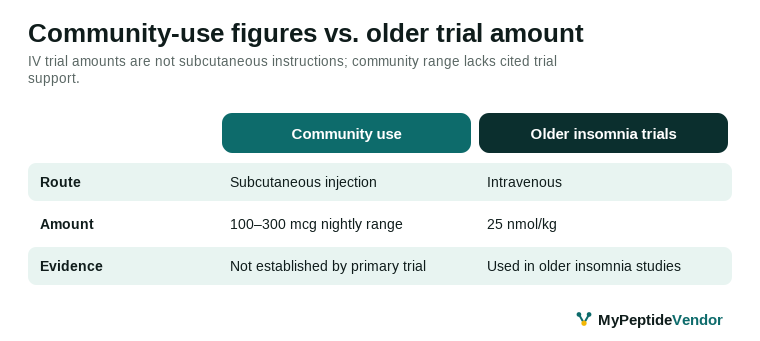
- Community-use range: 100–300 mcg by subcutaneous injection is commonly discussed as a nightly range. No cited primary human trial establishes this dose, route, timing, or weekly increase.
- Human trial comparison: Older insomnia studies used 25 nmol/kg 2, administered intravenously 8. At an approximate molecular weight of 849 g/mol, that is about 1.06 mg for a 50 kg adult, 1.49 mg for a 70 kg adult, and 1.91 mg for a 90 kg adult 28. Those are trial-scale calculations, not subcutaneous instructions.
- Regulatory point: DSIP is not FDA-approved for insomnia or another indication. FDA Category 2 is a compounding-risk category, but the cited FDA page does not list DSIP 1.
- Evidence limit: There is no approved human dose. Reviews describe the DSIP–sleep link and its normal physiological role as unresolved 34.
The 3 mL example is a concentration calculation, not a recommendation to prepare or inject an unapproved product. The weekly table below uses a 2.5 mL dilution, which gives a separate concentration of 4 mg/mL; do not use its unit values with the 3 mL dilution.
Use this chart
Free to reuse with a link back:
Key takeaways
- A 10 mg vial mixed with 3 mL of bacteriostatic water gives about 3.33 mg/mL; 1 U-100 unit then contains about 33.3 mcg.
- The 100–300 mcg subcutaneous schedule is an unverified community-use figure, not an approved or trial-validated dose.
- Older human insomnia studies used 25 nmol/kg intravenously; for a 70 kg adult, that is about 1.49 mg using an approximate molecular weight of 849 g/mol 28.
- DSIP is not FDA-approved; the FDA Category 2 page describes compounding-risk categories but does not list DSIP in the cited material 1.
- Small, older studies leave the mechanism, subcutaneous absorption, long-term safety, and normal sleep role unresolved 34678.
DSIP Dosing Schedule: Weekly Reference Table
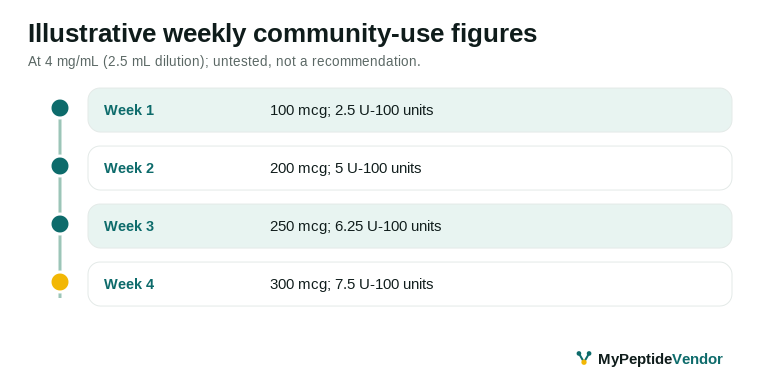
No FDA label or approved human titration schedule exists for DSIP. When a molecule is approved, dosing should follow its FDA label and, where relevant, the clinical evidence supporting that label. DSIP is not approved, so the schedule below is an illustrative community-use titration only; its 100–300 mcg figures have no cited primary source, and the weekly increases have not been tested in a cited trial.
The unit column uses a 10 mg vial mixed with 2.5 mL of water, giving 4 mg/mL. The 100, 200, 250, and 300 mcg amounts correspond to 2.5, 5, 6.25, and 7.5 U-100 units at that concentration.
| Week | Daily amount (mg) | Daily amount (mcg) | U-100 units | Context |
|---|---|---|---|---|
| Week 1 | 0.10 mg | 100 mcg | 2.5 units | Unverified community-use figure |
| Week 2 | 0.20 mg | 200 mcg | 5 units | Unverified community-use figure |
| Week 3 | 0.25 mg | 250 mcg | 6.25 units | Unverified community-use figure |
| Week 4 | 0.30 mg | 300 mcg | 7.5 units |
This table is not a recommendation to increase a dose each week. There is no established target, proven stopping point, or known safe duration for repeated subcutaneous use. A clinician should review the proposed product and plan before any injection.
In a 1981 study, 6 middle-aged people with chronic insomnia received 25 nmol/kg intravenously. Sleep benefit appeared in the second hour after injection and was reported for up to 6 hours 8. A 1983 report described slow intravenous injection as essential, sleep induction after about 1 hour, and effects lasting up to 20 hours 7. Neither timing result validates a bedtime schedule for subcutaneous use.
A 1984 summary reported that repeated morning injections improved night sleep, while two doses daily did not show the same result 2. This does not support morning self-dosing or twice-daily use; it also does not establish a modern outpatient regimen.
The trial amount of 25 nmol/kg is not interchangeable with a 100–300 mcg subcutaneous amount. The cited human reports do not test subcutaneous absorption, so they cannot show whether the routes produce comparable exposure or how to convert between them 278.
Use this chart
Free to reuse with a link back:
Syringe Unit Conversion Table
Units to draw on a U-100 insulin syringe (100 units = 1 mL) from a 10 mg vial. Find your dose, then read the column for the water you added. Every number is calculated, not estimated.
| Dose | 1 mL water 10 mg/mL · 1 unit = 100 mcg | 2 mL water 5 mg/mL · 1 unit = 50 mcg | 2.5 mL water 4 mg/mL · 1 unit = 40 mcg |
|---|---|---|---|
| 50 mcg | 0.5 · 200 doses | 1 · 200 doses | 1.25 · 200 doses |
| 100 mcg | 1 · 100 doses | 2 · 100 doses | 2.5 · 100 doses |
| 200 mcg | 2 · 50 doses | 4 · 50 doses | 5 · 50 doses |
| 250 mcg | 2.5 · 40 doses | 5 · 40 doses | 6.25 · 40 doses |
| 300 mcg | 3 · 33 doses | 6 · 33 doses | 7.5 · 33 doses |
| 500 mcg | 5 · 20 doses | 10 · 20 doses | 12.5 · 20 doses |
| 750 mcg | 7.5 · 13 doses | 15 · 13 doses | 18.75 · 13 doses |
| 1 mg | 10 · 10 doses | 20 · 10 doses | 25 · 10 doses |
| 1.5 mg | 15 · 6 doses | 30 · 6 doses | 37.5 · 6 doses |
| 1.7 mg | 17 · 5 doses | 34 · 5 doses | 42.5 · 5 doses |
| 2 mg | 20 · 5 doses | 40 · 5 doses | 50 · 5 doses |
| 2.4 mg | 24 · 4 doses | 48 · 4 doses | 60 · 4 doses |
| 2.5 mg | 25 · 4 doses | 50 · 4 doses | 62.5 · 4 doses |
| 3 mg | 30 · 3 doses | 60 · 3 doses | 75 · 3 doses |
| 4 mg | 40 · 2 doses | 80 · 2 doses | 100 · 2 doses |
| 5 mg | 50 · 2 doses | 100 · 2 doses | over 100 |
| 7.5 mg | 75 · 1 doses | over 100 | over 100 |
| 10 mg | 100 · 1 doses | over 100 | over 100 |
DSIP 10 mg Vial Dosage Calculator
Shows the exact insulin-syringe units to draw. Pre-loaded with the 10 mg vial; change any value to match yours.
Total volume of your syringe?
How much mg is in the vial?
How much bacteriostatic water are you adding?
Dose per injection?
Educational tool only. Concentration = vial ÷ water; units = dose ÷ concentration × 100 (U-100 syringe). Confirm every dose with your prescriber. Different vial or peptide? Use the peptide calculator.
MYPEPTIDEVENDORAffiliate link · we may earn a commission.
Reconstitution Steps for a 10 mg DSIP Vial
The 3 mL example gives about 3.33 mg/mL, while the dosing table uses a 2.5 mL dilution at 4 mg/mL. Always follow the written directions for a pharmacy-dispensed product; sterility, concentration, and stability cannot be assumed for every vial.
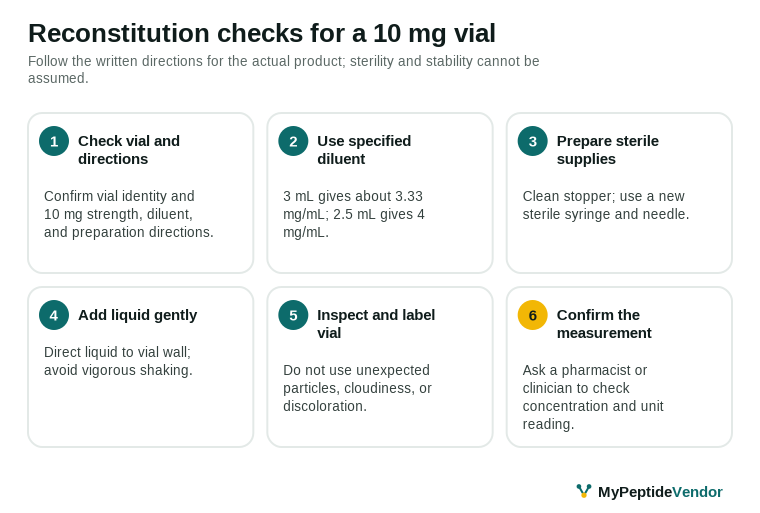
- Check the vial and its directions. Confirm the vial identity and 10 mg strength, the specified diluent, and the preparation directions. Do not use a vial with a damaged seal, unclear labeling, or uncertain sterility.
- Use the specified diluent and volume. For the concentration example, adding 3 mL of bacteriostatic water to 10 mg gives about 3.33 mg/mL. The schedule uses a separate 2.5 mL dilution at 4 mg/mL. Never transfer syringe-unit readings between those concentrations.
- Prepare with sterile supplies. Clean the vial stopper with an alcohol swab and use a new sterile syringe and needle. Keep the needle from touching hands, counters, or other nonsterile surfaces.
- Add the liquid gently. Direct the liquid toward the inside wall of the vial rather than forcefully onto the powder. Avoid vigorous shaking and follow the pharmacy’s mixing directions if they differ.
- Inspect and label the vial. Do not use a solution with unexpected particles, cloudiness, or discoloration. Record the product, amount of diluent, resulting concentration, preparation date, and the storage and discard instructions.
- Have the measurement checked. Ask a pharmacist or clinician to confirm the concentration, syringe type, and unit reading before relying on it. A U-100 syringe has 100 units per mL, but the amount of peptide in each unit changes with concentration.
These steps cannot confirm that a research-use product is sterile, correctly manufactured, or safe for injection. A vial sold for research is not the same as a pharmacy-dispensed sterile medicine.
Use this chart
Free to reuse with a link back:
Supplies Needed for One Full Vial
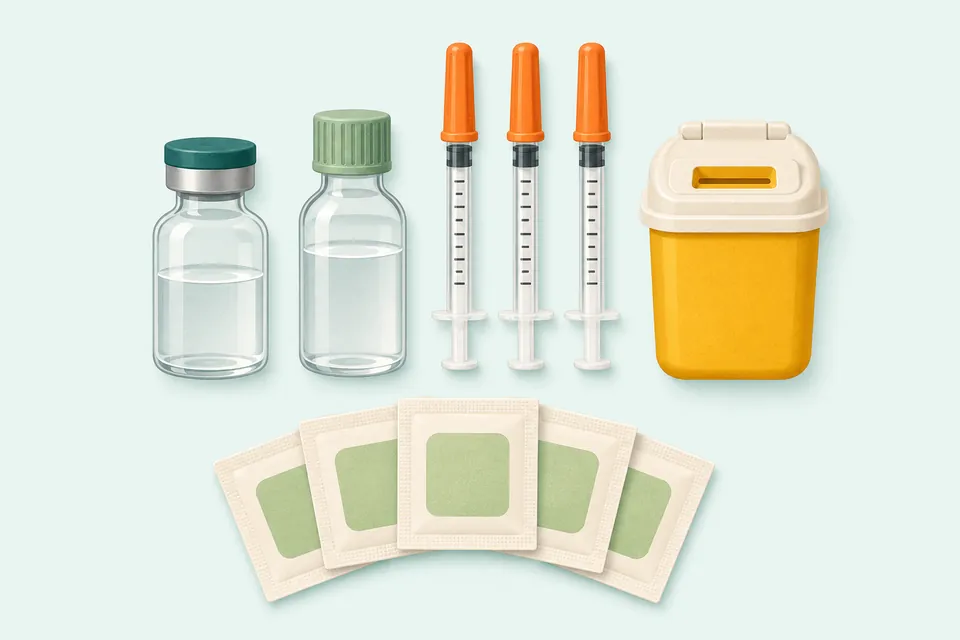
For the 4-week example in the dosing table, once-daily use would require 28 single-use U-100 syringes and 56 alcohol swabs: one swab for the vial stopper and one for the skin at each of 28 administrations. The quantities below cover one 10 mg vial and the 2.5 mL dilution used in that table.
- DSIP vial: 1 vial labeled 10 mg. The vial contains 10,000 mcg total before handling loss or liquid that cannot be withdrawn.
- Bacteriostatic water: 2.5 mL for the 4 mg/mL concentration used in the table. The separate 3 mL example uses 3 mL and gives about 3.33 mg/mL. Use only the diluent and volume specified for the actual product.
- U-100 syringes: 7 sterile, single-use syringes per week, or 28 for 4 weeks of once-daily administrations. Choose a syringe with markings that let a clinician-directed amount be measured clearly; never reuse or share syringes.
- Alcohol swabs: 14 per week, or 56 for 4 weeks, using 2 swabs per administration.
- Sharps container: 1 puncture-resistant container for used needles and syringes. Keep it upright and follow local disposal rules.
At 100 mcg per use, 10 mg equals 100 theoretical doses; at 300 mcg per use, it equals about 33 theoretical doses. These are arithmetic estimates, not safe-use periods. They do not account for contamination, dead space, product loss, or a pharmacy’s discard date.
Protocol Overview and Cycle Notes

DSIP means delta sleep-inducing peptide. It is a nonapeptide, meaning a peptide made of 9 amino acids, first isolated from rabbit cerebral venous blood in 1977 3. Researchers initially proposed it as a sleep-promoting factor, but its natural role has not been established 34.
The human sleep findings come from small studies published in the early 1980s, not a large modern treatment program 2678. The reports describe intravenous injections or, in some summaries, do not clearly specify the route. The 1981 and 1983 reports explicitly describe intravenous administration 78. None of these cited trials tested repeated subcutaneous dosing.
In the 1981 study, 6 middle-aged people with chronic insomnia received 25 nmol/kg intravenously. The report described longer sleep, better sleep quality, and fewer interruptions, with sleep benefit lasting up to 6 hours 8. Slight arousal was noted in the first hour, while sleep benefit began in hour 2 8. A group of 6 cannot establish how often either effect occurs in a broader population.
The 1983 paper described 5 human studies using single and repeated intravenous injections under double-blind conditions. It reported that slow injection was essential, sleep onset had a latency of about 1 hour, and effects lasted up to 20 hours 7. Four consecutive injections were reported to normalize disturbed sleep in the study context 7. That finding does not validate a 4-day subcutaneous cycle.
A 1984 summary reported improvement after single injections of 25 nmol/kg and described a buildup in sleep-structure effects after 4 administrations 2. It also reported that repeated morning injections improved night sleep, while 2 daily doses did not show the same effect 2. Those findings do not establish a safe dose or timing plan for use outside the studied setting.
In an open study, 7 people with severe insomnia received a series of 10 injections. Sleep was reported as normalized in 6 of 7, with follow-up periods of 3–7 months 6. Because the study was open and included only 7 participants, it cannot establish efficacy or estimate uncommon harms. The authors raised a long-standing drug-addiction habit as a possible concern, but did not explain or quantify that concern 6.
For a dose comparison, 25 nmol/kg is about 1.06 mg for a 50 kg adult, 1.49 mg for a 70 kg adult, and 1.91 mg for a 90 kg adult, using an approximate molecular weight of 849 g/mol 28. These figures convert the reported trial amount; they are not doses for subcutaneous use. No cited human study tests whether subcutaneous DSIP is absorbed comparably to intravenous DSIP.
The conversion also helps show why unit labels matter: the 90 kg calculation is about 1.91 mg (1910 mcg), using 25 nmol/kg and an approximate molecular weight of 849 g/mol 28. The subcutaneous community figures of 100–300 mcg are therefore not a direct conversion of the intravenous trial dose, and no human study in the cited literature establishes how the two routes compare 28.
The following table summarizes the human insomnia reports with the routes, doses, outcomes, and follow-up they describe. The papers do not provide modern randomized-trial evidence or a validated subcutaneous protocol 2678.
| Report | Participants and route | Dose or schedule | Reported result | Follow-up |
|---|---|---|---|---|
| Schneider-Helmert, 1981 | 6 middle-aged chronic insomniacs; IV | 25 nmol/kg | Sleep benefit began in hour 2 and lasted up to 6 hours | Not stated in the report summary |
| Schneider-Helmert, 1983 | Five human studies; IV | Single and repeated injections; dose not stated in the summary | Slow injection was essential; onset latency about 1 hour; effects up to 20 hours | Not stated in the report summary |
| Schneider-Helmert, 1984 | Different investigations; route details vary in the summary | 25 nmol/kg for single injections; repeated schedules also discussed | Improvement after single injections; reported buildup after 4 administrations | Not stated in the report summary |
| Kaeser, 1984 | 7 people with severe insomnia; injection route not stated in the summary | Series of 10 injections | Sleep normalized in 6 of 7 | 3–7 months |
The IV timing reports do not fit a simple “inject 30–60 minutes before bed” rule. In the 1981 report, the first hour showed slight arousal and the sleep benefit began in hour 2; in the 1983 report, slow injection was essential and effects were described for up to 20 hours 78. Neither result establishes timing for a subcutaneous dose.
Reviews give reasons to be cautious about interpreting sleep claims. A 2006 review called the DSIP–sleep link extremely poorly documented, noted that some sleep-promoting findings involved DSIP analogues rather than DSIP itself, and reported that no DSIP gene, protein, or related receptor had been isolated 3. A 2003 review listed DSIP among 4 proposed sleep factors but said its physiological role in sleep had not been determined 4.
Evidence for other proposed uses is also limited. An older review discussed research into pain and withdrawal but described DSIP’s physiological functions and possible mechanism as unresolved 5. A review of anticonvulsant findings discussed animal audiogenic seizure models, not proof of seizure prevention or treatment in people 9. These findings do not establish an approved human indication or dose.
Cycle note: No cited evidence sets a validated cycle length, washout interval, or dose-escalation schedule for subcutaneous DSIP. The community-style weekly table is not derived from the intravenous trials, and the trial reports do not resolve tolerance or dependence with multiweek use 2678.
Storage and Handling
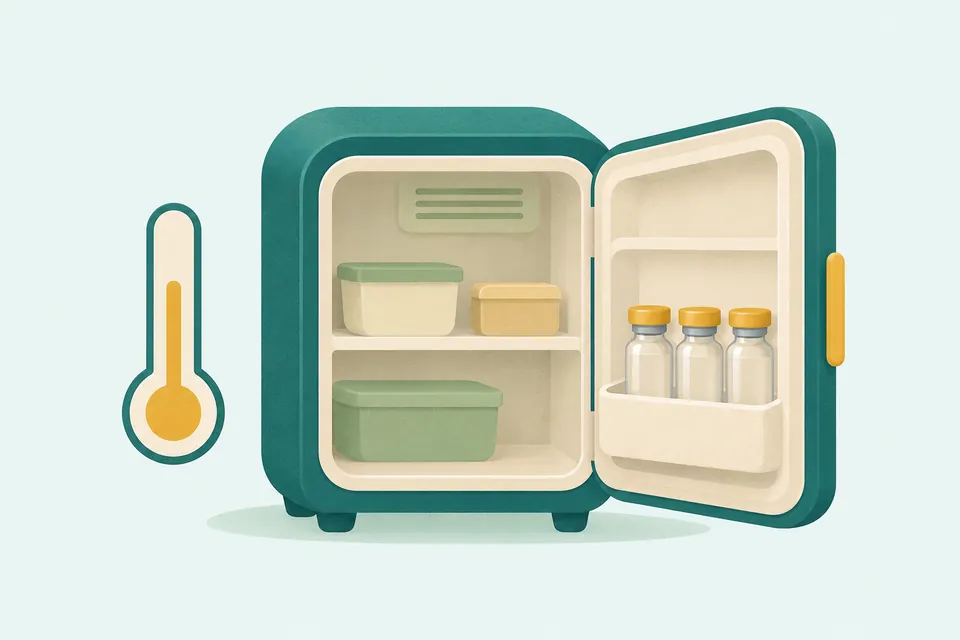
Lyophilized (freeze-dried) peptide powders are commonly kept in a freezer, but the cited human studies do not establish a storage life or stability specification for every DSIP vial. Follow the actual product’s written directions rather than assuming a research-use vial has a verified shelf life.
After reconstitution, refrigeration at 2–8°C and protection from light are common peptide-handling practices, not a DSIP-specific stability guarantee. The cited studies do not establish how many days a reconstituted vial remains suitable, so follow the dispensing pharmacy’s directions and discard date.
Keep the vial closed and avoid unnecessary temperature changes. Do not use it if the seal is damaged, the solution has an unexpected appearance, or sterility is uncertain. Never share needles, syringes, or vials.
Injection and Tracking Tips
Because DSIP is not an approved medicine and the cited human studies do not test subcutaneous dosing, a clinician should review the product, route, and proposed plan before any injection. Ask a pharmacist to confirm the vial concentration and syringe markings; a unit value only makes sense for the concentration used to calculate it.
If a clinician is supervising a proposed use, record the date, time, product concentration, clinician-directed amount, sleep onset, awakenings, total sleep time, and next-day alertness. A 7-day diary can describe patterns, but it cannot prove that DSIP caused a change.
Before considering any product, ask the clinician whether its source and sterility are verified, what concentration and discard date apply, whether the proposed route is appropriate, and what symptoms call for stopping. Pregnancy, breastfeeding, kidney or liver impairment, and drug-interaction risks are not adequately characterized in the cited DSIP reports.
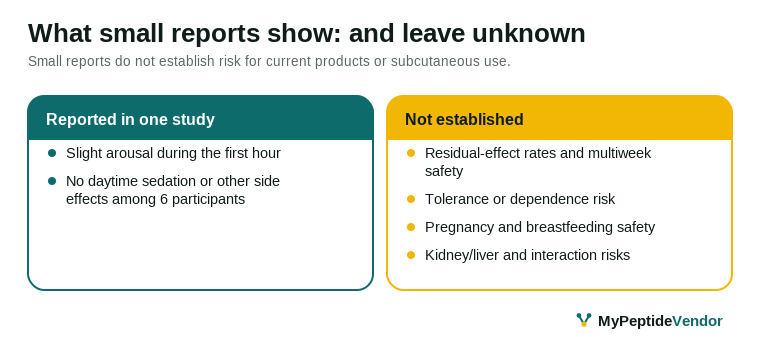
Do not drive or operate machinery if you feel unusually sleepy, dizzy, or less alert. The 1981 report found no daytime sedation in its 6-person study, but that result cannot establish that residual impairment never occurs 8.
Safety, Side Effects, and FDA Status
DSIP is not FDA-approved for insomnia or any other human indication. FDA Category 2 describes nominated bulk substances that the agency identifies as potentially presenting significant safety risks in compounding; the cited FDA page does not list DSIP 1. The page therefore does not establish that DSIP itself is Category 2 or that a particular DSIP product is safe to compound.
Published human safety details are sparse. In the 1981 study, investigators reported slight arousal during the first hour and no daytime sedation or other side effects among 6 participants 8. That is 0 reported cases in a very small study, not a dependable estimate of risk for current products or subcutaneous use. A 1983 paper described compatibility as good, but it gives no usable event rate 7.
The first-hour arousal in one small study does not prove that DSIP causes no morning grogginess. Residual-effect rates, multiweek safety, and the risk of tolerance or dependence have not been established by the cited reports 678. The addiction-history caution in the 7-person study is unexplained, so its meaning and size cannot be determined 6.
Pregnancy, breastfeeding, kidney disease, liver disease, and interactions with sedatives or other medicines are not adequately addressed in these reports. People in those groups should not infer safety from small insomnia studies. A clinician can review medical history, current medicines, product quality, and better-studied options before any decision.
Stop and seek urgent care for trouble breathing, swelling of the face or throat, fainting, severe confusion, or a rapidly worsening reaction. Contact a clinician promptly for a new rash, persistent injection-site redness or swelling, marked agitation, or a major change in daytime function. These are general injection and allergy warning signs; DSIP-specific frequencies are not established.
This page is an educational reference, not medical advice or a prescription. Do not use a research-use vial as a substitute for prescribed sleep treatment; speak with a licensed clinician before any proposed peptide use.
Use this chart
Free to reuse with a link back:
Frequently asked questions
How many U-100 units equal 100 mcg of DSIP?
It depends on the final concentration. With a 10 mg vial mixed with 2.5 mL of water, 100 mcg corresponds to 2.5 U-100 units. With a 3 mL dilution, the amount per unit is different, so do not reuse the 2.5 mL measurement.
Does a 10 mg vial require a higher DSIP dose than a 5 mg vial?
No. Vial strength tells you the total amount in the vial, not the amount appropriate for one person. DSIP has no approved human dose, and the amount in a measured volume also depends on how much liquid was added.
Is the 100–300 mcg DSIP schedule based on a clinical sleep trial?
No cited human trial tested that subcutaneous range or its weekly increases. Older human sleep reports describe injection studies, including a 25 nmol/kg protocol 28, but they do not validate the community-use schedule.
Is DSIP FDA-approved for insomnia?
No. DSIP is not FDA-approved for insomnia. FDA Category 2 concerns nominated bulk substances with potential compounding risks, and the cited FDA page does not list DSIP 1.
Why do reports about DSIP and sleep conflict?
The evidence includes small studies with different injection timing and outcomes, while later reviews question whether DSIP has a defined physiological role in sleep 34. For example, one 1981 report described slight arousal in the first hour and sleep benefit beginning in the second hour 8.
References
- FDA: Certain bulk drug substances for use in compounding that may present significant safety risks
- Schneider-Helmert et al. DSIP in insomnia. Eur Neurol. 1984.
- Kovalzon et al. Delta sleep-inducing peptide (DSIP): a still unresolved riddle. J Neurochem. 2006.
- Obal et al. Biochemical regulation of non-rapid-eye-movement sleep. Front Biosci. 2003.
- Graf et al. Delta-sleep-inducing peptide (DSIP): an update. Peptides. 1986.
- Kaeser et al. A clinical trial with DSIP. Eur Neurol. 1984.
- Schneider-Helmert et al. Effects of DSIP in man. Multifunctional psychophysiological properties besides induction of natural sleep. Neuropsychobiology. 1983.
- Schneider-Helmert et al. The influence of synthetic DSIP (delta-sleep-inducing-peptide) on disturbed human sleep. Experientia. 1981.
- Stanojlović et al. [Endogenous anticonvulsants: neuropeptide Y and delta sleep inducing peptide]. Med Pregl. 2008.
Written by the MyPeptideVendor editorial team from the FDA label, peer-reviewed studies and ClinicalTrials.gov records listed above, fact-checked line by line and reviewed 2026-11-12.
Cite this page
MyPeptideVendor Editorial Team. dsip dosage 10mg: Protocol & Safety. MyPeptideVendor. Updated November 12, 2026. https://mypeptidevendor.com/protocols/dsip-dosing-10mg/MyPeptideVendor Editorial Team. (2026, November 12). dsip dosage 10mg: Protocol & Safety. MyPeptideVendor. https://mypeptidevendor.com/protocols/dsip-dosing-10mg/