Melanostatin DM: Evidence, Dosing & US Status
Alpha-MSH antagonist peptide
Brand names: Melanostatin DM; Hexapeptide-2 is the listed INCI name.

Supplier listings describe it as research material, and one product warning says it is not for human or veterinary use 12.
Key takeaways
- The reported pA2 is 7 in U. ornatus melanocytes; this is an assay result, not a dose for people 1.
- The reported peptide sequence has six residues, and suppliers list different forms and nearly identical molecular weights 12.
- No human trial size, duration, clinical result, or adverse-event percentage is reported in the cited material 12.
- Cayman lists 1 mg for $39 and 10 mg for $254, while BOC lists 5 mg for $319 12.
- Supplier instructions specify storage at -20°C, with room-temperature shipping listed for Cayman within the continental US 12.
Melanostatin DM at a glance
- Class
- Alpha-MSH antagonist hexapeptide
- Mechanism
- Blocks alpha-MSH-related skin darkening in a U. ornatus melanocyte assay.
- FDA Status
- Research-use product; FDA compounding status is not confirmed.
- Brand names
- Melanostatin DM; Hexapeptide-2 is the listed INCI name.
- Administration
- No human route is established; supplier products are for research use.
- Typical Dose
- No human dose or trial range is reported.
- Half-life
- Not established in humans.
- Primary Uses
- Research on alpha-MSH signaling and cosmetic ingredient development.
What is it?

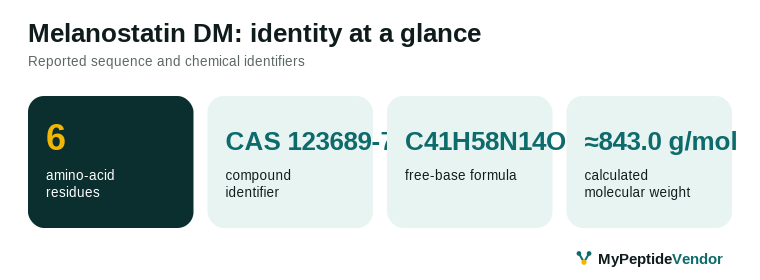
Melanostatin DM is an alpha-melanocyte-stimulating hormone (alpha-MSH) antagonist peptide. Its reported sequence is His-D-Arg-Ala-Trp-D-Phe-Lys-NH2, which contains six amino-acid residues. The sequence is also written in shorthand as HrAWfK-NH2 1.
The compound is identified as CAS 123689-72-5, with a free-base formula of C41H58N14O6 and a calculated molecular weight (MW) of approximately 843.0 g/mol. These reported weights are nearly the same despite the different salt descriptions, so do not assume that a milligram of one form equals a milligram of active peptide in another form.
INCI is a cosmetic ingredient naming system; the name alone does not establish that a particular product or concentration is safe, effective, or permitted. Suppliers also attach research-use restrictions, including a warning against human or veterinary use 12.
For a research purchase, ask for the batch certificate of analysis (CoA). Confirm the sequence and identity test, the stated purity and how it was measured, peptide content, and whether the counterion is acetate, trifluoroacetate (TFA), or another form. This matters because purity percentage and salt mass affect how much peptide is present in a weighed sample.
Use this chart
Free to reuse with a link back:
What makes it different
Its proposed action is to oppose a pigment-related signal, rather than activate that signal. In the reported assay, Melanostatin DM had a pA2 of 7 in U. ornatus melanocytes. In plain terms, pA2 describes antagonist strength in a particular experimental system; it is not a skin-lightening percentage, a topical concentration, or a human dose.
The assay context is specific: the peptide inhibited skin darkening induced by alpha-MSH and by [Nle4,D-Phe7]-alpha-MSH in white-background-adapted U. ornatus 1. That result does not establish how much peptide reaches pigment-producing cells in human skin, whether a finished cream works, or whether results would be the same across skin tones.
The cosmetic ingredient listing and the experimental peptide listing serve different purposes. Hexapeptide-2 appears as an INCI name in a cosmetic ingredient directory, while the research suppliers describe specific laboratory products with purity and handling details 123. The directory does not provide a recommended use level or establish US or EU authorization 3.
How does it work
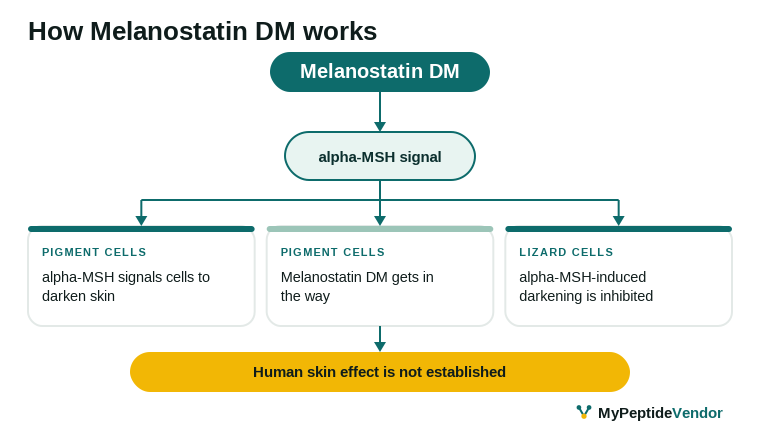
In plain words, alpha-MSH can signal pigment cells to darken skin, and Melanostatin DM is reported to get in the way of that signal 1. The reported result is inhibition of alpha-MSH-induced darkening in the stated lizard model, not a measured change in human skin 1.
In pharmacology terms, this is antagonist activity: a molecule reduces the effect of an activating signal at its target. The pA2 value of 7 describes the antagonist’s activity in the U. ornatus melanocyte assay; it cannot be converted directly into a cream percentage or a treatment schedule 1.
Human skin penetration, effective concentration, duration of action, and effects on conditions such as melasma have not been established in the cited evidence. A proposed mechanism is a reason to study a peptide, not proof that it treats pigmentation in people.
Use this chart
Free to reuse with a link back:
What the clinical evidence actually shows

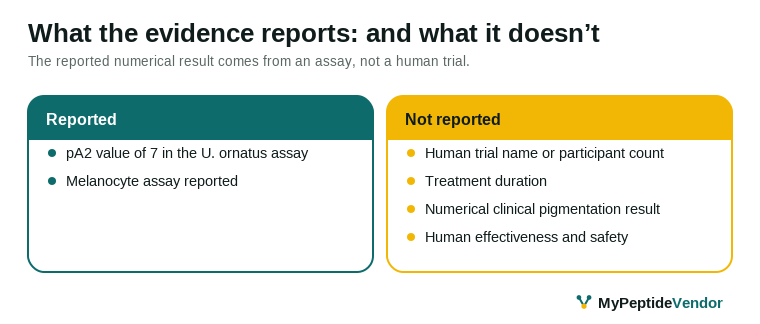
The product description reports the melanocyte assay and its pA2 value, but does not give a human trial name, participant count, treatment duration, or numerical clinical pigmentation result 1.
No cited source reports a clinical trial of Melanostatin DM in people 1234. Therefore there is no human sample size, number of treatment weeks, percentage change in pigmentation, or response rate to report. The pA2 value of 7 is the numerical result available here, and it belongs to the U. ornatus assay rather than a clinical study 1.
Human effectiveness and safety remain unknown. The cited material does not establish absorption through human skin, an effective cosmetic concentration, long-term exposure outcomes, or rates of irritation and allergy. It also does not show whether a product containing the INCI ingredient Hexapeptide-2 produces a visible result 13.
Use this chart
Free to reuse with a link back:
Typical dosing

No human dose, route, or schedule is reported in the product information or the cited study summary 12. The supplier pack sizes (1, 5, and 10 mg from Cayman and 5 mg from BOC) are research quantities, not patient doses 12.
No verified clinical topical concentration or injection range can be given. The available supplier details do not provide a human dosing label, and the reported pA2 value of 7 is not a dosing instruction 1. Do not treat unsourced percentages or online titration schedules as tested regimens.
For laboratory work, use the lot-specific documentation and the approved protocol for the study. Check the CoA for peptide content and salt form before calculating experimental amounts; the supplier listings describe acetate and free-base forms with slightly different identity records 12.
Side effects: what to actually expect
No human trial or human-use label supplies side-effect rates for Melanostatin DM 12. There are no supported percentages for redness, burning, allergy, or other reactions, and no human exposure duration can be used to estimate long-term risk.
That lack of reported rates does not show that the peptide is safe. Human skin reactions, absorption beyond the application site, and effects with repeated exposure have not been established. The supplier warning that the material is not for human or veterinary use is a research-use restriction, not a human safety assessment 12.
Purity figures also do not equal a safety result. Purity specifications alone do not establish sterility, suitability for skin application, or safety in people.
Regulatory & access status in the US (as of 2026)
Melanostatin DM is not shown among the visible substances on the FDA category 2 bulk-substance page 1. That page concerns substances nominated under sections 503A or 503B and identified as potentially presenting significant safety risks; it is not an approval list for cosmetic ingredients 4.
Its absence from the visible category 2 entries does not establish that Melanostatin DM is approved, legally compoundable, or authorized for human use. Its 503A and 503B status is unverified and should be checked with FDA and qualified regulatory counsel before any compounding decision. The INCI listing does not set a use concentration or determine US cosmetic legality 3.
For buyers, the practical checks are to confirm the product’s exact identity and salt form, request a batch CoA, ask for peptide content and counterion data, and verify the intended-use restrictions before purchase.
How it compares to its closest alternative
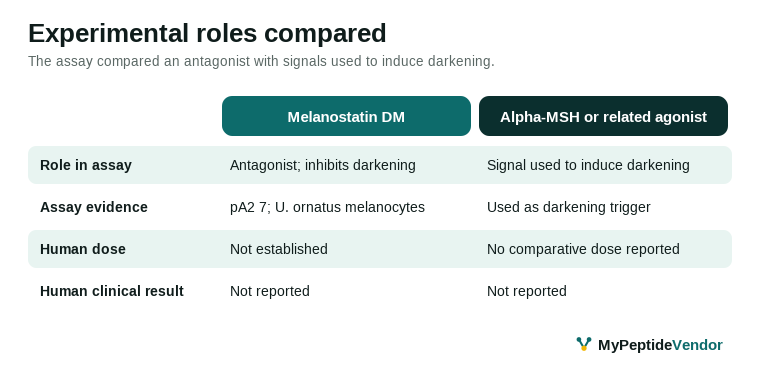
The closest comparison is alpha-MSH itself and the related agonist [Nle4,D-Phe7]-alpha-MSH, because the reported experiment tested whether Melanostatin DM blocked darkening induced by those signals 1. This is a comparison of experimental roles, not of proven human treatments.
| Feature | Melanostatin DM | Alpha-MSH or [Nle4,D-Phe7]-alpha-MSH |
|---|---|---|
| Role in the reported assay | Antagonist; reported to inhibit induced darkening | Stimulating signals used to induce darkening |
| Assay evidence | pA2 = 7 in U. ornatus melanocytes | Used as the darkening trigger in the assay |
| Human dose | Not established | No comparative human dose is reported |
| Human clinical result | Not reported | Not reported in the cited product description |
The assay description supports the role comparison, but it does not establish clinical superiority, a usable dose, or safety for either option in people 1.
Supplier pack sizes and listed prices differ: Cayman lists 1 mg for $39, 5 mg for $156, and 10 mg for $254; BOC lists 5 mg for $319 12. The calculated listed prices are about $39/mg, $31.20/mg, $25.40/mg, and $63.80/mg, respectively. These calculations compare catalog prices only; they do not compare peptide content, salt composition, testing, or suitability.
Milestone Pharmtech appears as a supplier of Hexapeptide-2 in the ingredient directory, but the listing shown provides no price or purity specification 3.
Use this chart
Free to reuse with a link back:
Frequently asked questions
Is Melanostatin DM legal to use in cosmetics in the United States?
The available ingredient listing identifies Hexapeptide-2 but gives no cosmetic use level or US legal conclusion 3. A buyer should not treat the INCI entry as proof that a particular formula or concentration is permitted; confirm the finished product’s regulatory status before use.
How potent is Melanostatin DM?
The reported pA2 is 7 in U. ornatus melanocytes 1. It describes activity in that assay, not the amount needed in a human product or the size of a pigmentation change.
How should Melanostatin DM be stored?
The supplier listings specify storage at -20°C 12. There is no stated stability period for a reconstituted solution at room temperature or 4°C 1.
Why do supplier records show different salt forms and identity keys?
Cayman lists an acetate product with InChIKey FKTKAAPPLRZUAU, while BOC lists a free-base product with InChIKey CGVQCSBCAOKPQQ 12. Ask for the lot-specific CoA and confirm the counterion and peptide content; the nearly identical listed molecular weights do not provide a validated weighing conversion.
References
Written by the MyPeptideVendor editorial team from the FDA label, peer-reviewed studies and ClinicalTrials.gov records listed above, fact-checked line by line and reviewed 2026-11-12.
Cite this page
MyPeptideVendor Editorial Team. Melanostatin DM: Evidence, Dosing & US Status. MyPeptideVendor. Updated November 12, 2026. https://mypeptidevendor.com/peptides/melanostatin-dm/MyPeptideVendor Editorial Team. (2026, November 12). Melanostatin DM: Evidence, Dosing & US Status. MyPeptideVendor. https://mypeptidevendor.com/peptides/melanostatin-dm/Related peptides
Melanotan 1 (MT-1)
Not approvedMT-1 is a synthetic α-MSH analog studied with UV exposure; three small phase 1 trials found increased tanning, but did not establish long-term safety.
Learn morePT-141
FDA-ApprovedPT 141 is bremelanotide, a brain-acting peptide approved as Vyleesi for acquired, generalized HSDD in premenopausal women.
Learn moreMelanotan 2 (MT-2)
Not approvedMelanotan 2 can stimulate pigment, but it has no FDA-approved use, established tanning dose or proven human fat-loss benefit.
Learn more