Eloralintide: Trials, Dosing & FDA Status
Selective amylin receptor agonist
Eloralintide (LY3841136) is an investigational peptide being developed by Eli Lilly for weight management. In a 48-week Phase 2 trial, the 9 mg group lost 20% of body weight on the efficacy estimand 3.
That result is from a clinical trial, not a promise or an approved treatment dose. As of 2026, eloralintide's Phase 3 studies are listed as recruiting or not yet recruiting 11, following a Phase 2 trial 3.
Key takeaways
- In a 48-week Phase 2 trial of 263 adults, the 9 mg group lost 20.1% of body weight on the efficacy estimand 3.
- Eloralintide activated AMY1R 12 times more potently than the calcitonin receptor in human-cell tests 4.
- Phase 2 tested weekly doses from 1 mg to 9 mg and two escalation arms; these are study regimens, not instructions for use 3.
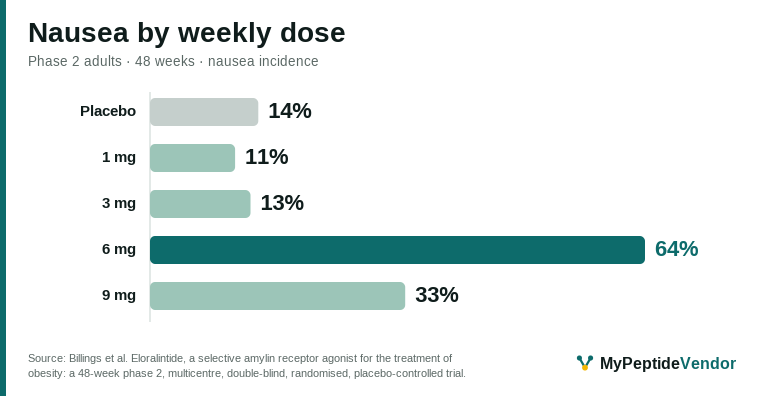
- Nausea affected 64% of the 6 mg group 3.
- The six listed Phase 3 studies include obesity, type 2 diabetes, sleep apnea, knee osteoarthritis, and add-on treatment for persistent obesity 11.
Eloralintide at a glance
- Class
- Selective amylin receptor agonist
- Mechanism
- Preferential activation of AMY1R
- FDA Status
- Not FDA-approved
- Brand names
- None; LY3841136 is a development code
- Administration
- Once-weekly subcutaneous injection in trials
- Typical Dose
- 1–9 mg weekly in Phase 2; investigational, not a recommendation
- Primary Uses
- Being studied for obesity and related conditions
What is it?

Eloralintide, also known by its development code LY3841136, is a long-acting peptide drug being studied for obesity. It acts on the amylin system, which helps regulate appetite and meal size. Its main published obesity study enrolled 263 adults and ran for 48 weeks 3.
It is not insulin or a GLP-1 receptor agonist. Published human research includes a single-dose Phase 1 study, a 12-week Phase 1 study, and the 48-week Phase 2 study; Phase 3 studies are now registered 34711.
What makes it different
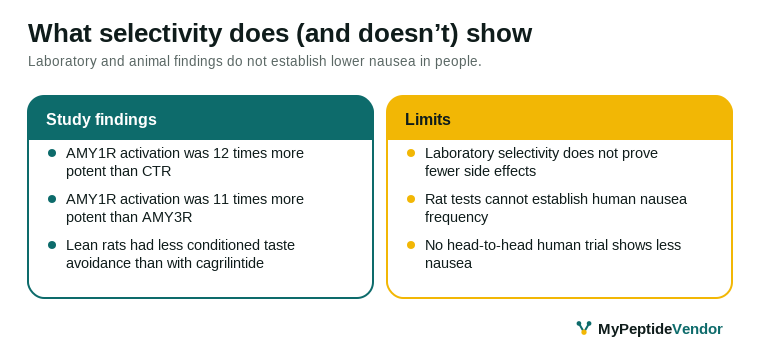
Eloralintide was designed to favor one amylin receptor, AMY1R, over related receptors. In human-cell tests, it activated AMY1R 12 times more potently than the calcitonin receptor (CTR) and 11 times more potently than AMY3R 4.
That selectivity is a laboratory result, not proof that people have fewer side effects. In lean rats, eloralintide caused less conditioned taste avoidance than cagrilintide, but an animal test cannot establish how often people feel nausea 4. No head-to-head human trial has shown that eloralintide causes less nausea than cagrilintide 910.
In a 12-week Phase 1 study, eloralintide exposure rose in proportion to dose: the dose-normalized ratios for total exposure and peak concentration were 1.1 and 1.0 7. Those results support dose-proportional exposure in that study, but do not show which dose is best for patients.
Use this chart
Free to reuse with a link back:
How does it work?
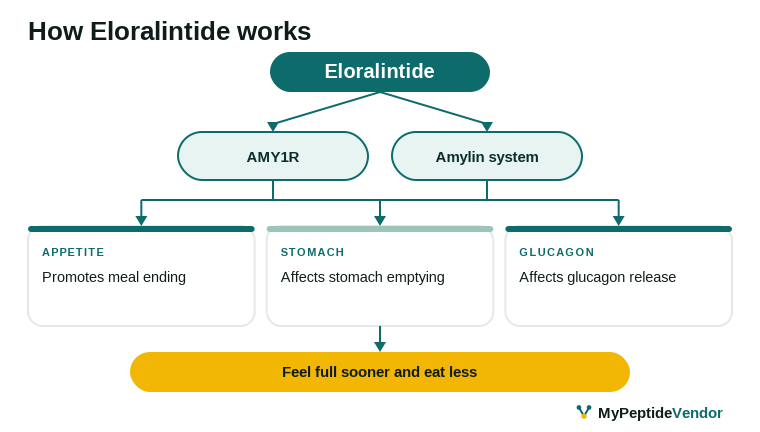
In plain terms, eloralintide is intended to help a person feel full sooner and eat less. It imitates some actions of amylin, a hormone released by the pancreas alongside insulin after meals. Amylin signaling can promote meal termination and affect stomach emptying and glucagon release 56.
AMY1R is one receptor involved in amylin signaling. Eloralintide’s preference for AMY1R was measured in laboratory cells; it does not directly predict a person’s weight change or nausea risk 4. Reviews note that calcitonin-receptor activity, drug exposure, and brain signaling may affect whether reduced eating feels like ordinary fullness or an unpleasant reaction 9.
In obese rats, eloralintide reduced food intake and body weight, with weight loss mainly from fat mass 4. Human body-composition results have not been reported, so the balance of fat and lean-tissue loss in people remains unknown.
Use this chart
Free to reuse with a link back:
What the clinical evidence actually shows

The main study was a randomized, double-blind, placebo-controlled Phase 2 trial at 46 US research centers. It enrolled adults ages 18–75 with obesity, or overweight plus a weight-related condition, and excluded people with type 2 diabetes. Participants received a weekly injection for 48 weeks 3.
An estimand is the trial’s rule for calculating an outcome when events such as stopping treatment occur. The efficacy estimand estimates weight change under the trial’s efficacy conditions; a treatment-policy estimand counts outcomes regardless of treatment changes or stopping. At 9 mg, mean weight change was −20% on the efficacy estimand (95% CI −22.7 to −17.5) 3. For a patient, the treatment-policy result is often closer to the practical question of what happened to everyone assigned treatment, while neither result predicts an individual outcome.
The Phase 2 efficacy results and adverse-event-led discontinuation rates are shown below. A 20% reduction is about 45 pounds for someone starting at 225 pounds; it is an arithmetic example, not a personal forecast 3.
| Study arm | Participants | Mean weight change at 48 weeks | Stopped due to adverse events |
|---|---|---|---|
| Placebo | 53 | −0.4% | 7.7% |
| 1 mg weekly | 28 | −9% | 11.1% |
| 3 mg weekly | 24 | −12% | 0% |
| 6 mg weekly | 28 | −18% | 21.4% |
| 9 mg weekly | 54 | −20.1% | 7.4% |
| 6–9 mg escalation | 24 | −20% | 8.3% |
| 3–9 mg escalation | 52 | −16% | 11.5% |
The 3–9 mg and 6–9 mg arms tested stepping up toward a higher dose rather than starting at the final dose. Comparing those arms with fixed doses let researchers examine whether escalation changed weight loss or tolerability; the reported trial details do not give the step sizes, timing, or a specific rationale for each schedule 3. The reason the 6 mg group had higher adverse-event discontinuation than the 9 mg group is not established; the groups were small, with 28 and 54 participants 3.
Earlier studies add short-term safety and activity information. In a single-dose Phase 1 study, 48 healthy adults received 0.04–12 mg; nine participants reported 16 adverse events, most of them mild. After a single 4 mg or 12 mg dose, mean weight change at week 4 was −2.5% or −4.4%, compared with +0.6% on placebo 4.
A separate 12-week Phase 1 study enrolled 100 adults with overweight or obesity. Weight reduction across eloralintide dose groups ranged from 2.6% to 11.3% at week 12 7. Its short duration does not show whether those changes persist over longer treatment.
ClinicalTrials.gov lists six Phase 3 eloralintide studies 11. Their listed focus and status are below 11.
| ClinicalTrials.gov number | Study focus | Status |
|---|---|---|
| NCT07353931 | Knee osteoarthritis with overweight or obesity | Recruiting |
| NCT07392190 | Persistent obesity while treated with a weekly incretin | Recruiting |
| NCT07881458 | EloraTZP in obesity or overweight with type 2 diabetes | Recruiting |
| NCT07369011 | Obstructive sleep apnea with overweight or obesity | Recruiting |
| NCT07282600 | Obesity or overweight with type 2 diabetes | Recruiting |
| NCT07900633 | Obesity or overweight, type 2 diabetes, and increased cardiovascular risk | Not yet recruiting |
Important unknowns remain: whether weight loss lasts beyond the trial period, how much human lean mass changes, and how eloralintide performs in people with type 2 diabetes. NCT07392190 is a recruiting study of eloralintide in persistent obesity treated with a weekly incretin 11.
Use this chart
Free to reuse with a link back:
Typical dosing

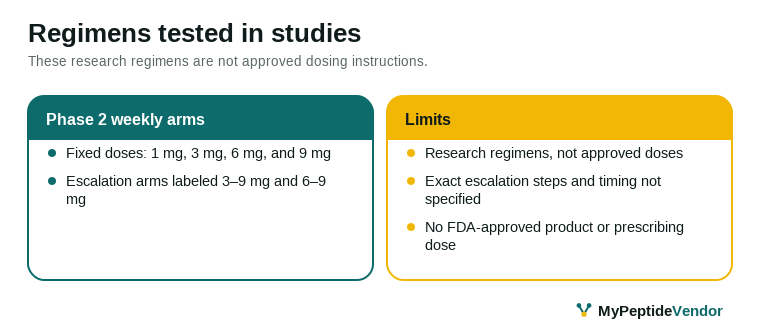
The Phase 2 trial tested 1 mg, 3 mg, 6 mg, and 9 mg once weekly, plus escalation arms labeled 3–9 mg and 6–9 mg 3. These were research regimens, not approved doses or instructions for self-treatment.
The escalation arms began below their target dose and stepped upward. The reported trial details do not specify the exact step sizes or timing 3. A separate single-dose Phase 1 study tested 0.04–12 mg in healthy participants; those were single doses, not a weekly schedule 4.
There is no FDA-approved eloralintide product or prescribing dose. FDA advises patients with questions about medicines to speak with a doctor and, when relevant, contact the compounder or telehealth platform that supplied the medicine 1.
Use this chart
Free to reuse with a link back:
Side effects: what to actually expect
Nausea and fatigue were common in some groups in the 48-week Phase 2 trial, and rates differed by dose. The trial reported these percentages 3.
| Study arm | Nausea | Fatigue |
|---|---|---|
| Placebo | 14% | 12% |
| 1 mg | 11% | 0% |
| 3 mg | 13% | 13% |
| 6 mg | 64% | 29% |
| 9 mg | 33% | 43% |
| 6–9 mg escalation | 54% | 46% |
| 3–9 mg escalation | 25% | 21% |
In the 12-week Phase 1 study, decreased appetite affected 19% of eloralintide participants, headache 12%, fatigue 11%, diarrhea 10%, nausea 8%, and vomiting 4%. Most events were mild; one serious event in a 6 mg group was judged unrelated to eloralintide 7.
In the single-dose study, nine participants reported 16 adverse events, 15 of which were mild. Two participants reported four gastrointestinal events, including one moderate vomiting event 4. These early studies cannot establish the frequency of rare or delayed harms.
AMY1R selectivity may affect tolerability, but it has not been shown to reduce nausea in people compared with cagrilintide in a head-to-head trial 4910.
Regulatory & access status in the US
As of 2026, eloralintide is investigational and is not FDA-approved. The registered Phase 3 studies remain recruiting or not yet recruiting, and there is no FDA-approved US prescription product for eloralintide 311.
FDA says unapproved drugs have not undergone its review for safety, effectiveness, and quality; its warning about unapproved GLP-1 products does not specifically evaluate eloralintide 1. FDA also warns consumers about weight-loss products falsely labeled for research use or not for human consumption, including products containing other investigational drugs 1.
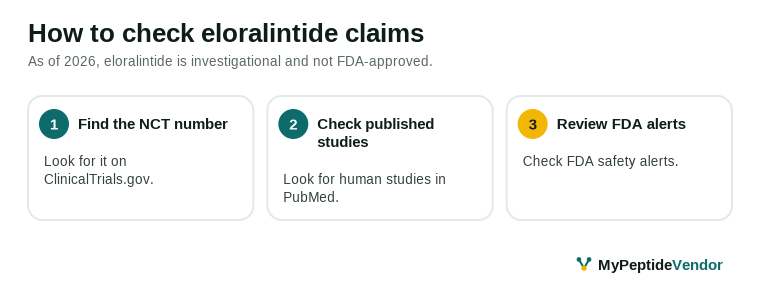
To check eloralintide claims, look for the NCT number on ClinicalTrials.gov and published human studies in PubMed, and review FDA safety alerts 134711. FDA’s review warning means an unapproved product has not passed the agency’s review for safety, effectiveness, and quality 1.
Use this chart
Free to reuse with a link back:
Research-grade Eloralintide is available from Certified-Pep. Sold for laboratory research only, not for human use. Affiliate link
How it compares to its closest alternative
Cagrilintide is the closest comparison by drug class because it also acts on amylin-related receptors; retatrutide uses a different, multi-receptor approach. The weight-loss figures below come from separate clinical studies, not head-to-head trials, so differences in participants, duration, and analysis prevent a fair direct ranking 3810.
| Drug | Receptor approach | Reported weight-loss result | What the comparison means |
|---|---|---|---|
| Eloralintide | Selective AMY1R amylin agonist | −20.1% at 48 weeks with 9 mg in Phase 2 | Investigational; no head-to-head comparison |
| Cagrilintide | Amylin and calcitonin receptor activity | CagriSema, the cagrilintide–semaglutide combination, reported up to 22.7% at 68 weeks | The combination result is not cagrilintide-alone efficacy |
| Retatrutide | GLP-1, GIP, and glucagon receptor agonist | A review reports 20–24% weight reductions across clinical studies | Different drug targets and trials; not directly comparable |
Eloralintide’s proposed distinction is receptor selectivity, not proven greater weight loss or better tolerability. A direct trial would be needed to establish whether it outperforms cagrilintide or retatrutide 3910.
Where to Get Eloralintide Legally
Through your own doctor
Ask your doctor whether this treatment is appropriate and which licensed pharmacy can supply it.
Certified-Pep
US-made research peptides with batch-specific lab reports (COA) and a QR code on every vial.
- Independent laboratory testing (Vanguard Laboratory)
- Made in the USA, ships in 1-2 business days
- Research use only, not for human or veterinary use
HumeCare
Online GLP-1 weight-loss program with a licensed US provider.
- Short online assessment reviewed by a licensed provider
- If prescribed, medication ships to your door
- Ongoing support to adjust your plan
Affiliate disclosure: we may earn a commission if you sign up through the link above. It never changes what we write.
Frequently asked questions
What is Eli Lilly’s new weight-loss drug?
Eloralintide (LY3841136) is one investigational weight-management drug developed by Eli Lilly. The 48-week Phase 2 trial tested it for obesity, and it is not FDA-approved 311.
What is retatrutide?
Retatrutide is an investigational drug that activates GLP-1, GIP, and glucagon receptors. That differs from eloralintide’s amylin-receptor approach 8.
Does cagrilintide really work?
Clinical research has reported weight loss with CagriSema, a combination of cagrilintide and semaglutide; a review reports up to 22.7% at 68 weeks. That result does not establish the effect of cagrilintide alone 10.
What is the brand name for liraglutide injection?
Saxenda is the liraglutide injection brand used for chronic weight management. Victoza is another liraglutide injection brand, used for type 2 diabetes.
References
- FDA: Concerns with unapproved GLP-1 drugs used for weight loss
- FDA: Certain bulk drug substances for use in compounding that may present significant safety risks
- Billings et al. Eloralintide, a selective amylin receptor agonist for the treatment of obesity: a 48-week phase 2, multicentre, double-blind, randomised, placebo-controlled trial. Lancet. 2025.
- Briere et al. Eloralintide (LY3841136), a novel amylin receptor agonist for the treatment of obesity: From discovery to clinical proof of concept. Mol Metab. 2025.
- Bailey et al. Long-acting amylin-related peptides as therapies for obesity and type 2 diabetes. Peptides. 2026.
- Alhazmi et al. Amylin Analogs: The Next Major Class of Weight Loss Therapy: A Review of Experimental Data and Early-Phase Clinical Trials. Diabetes Obes Metab. 2026.
- Bhattachar et al. Eloralintide, a selective, long-acting amylin receptor agonist for treatment of obesity: Phase 1 proof of concept. Diabetes Obes Metab. 2026.
- Lempesis et al. Obesity pharmacotherapy reimagined: The era of multi-receptor agonists and next-generation metabolic modulators, perspectives and controversies. Metabol Open. 2026.
- Fischer et al. Beyond GLP-1: Amylin-based pharmacotherapy and the search for better-tolerated weight-loss drugs. Pharmacol Res. 2026.
- Panou et al. New Amylin-Based Agonists for the Treatment of Obesity and Type 2 Diabetes Mellitus. Diabetes Ther. 2026.
- ClinicalTrials.gov: 21 registered studies (search: Eloralintide)
Written by the MyPeptideVendor editorial team from the FDA label, peer-reviewed studies and ClinicalTrials.gov records listed above, fact-checked line by line and reviewed 2026-11-12.
Cite this page
MyPeptideVendor Editorial Team. Eloralintide: Trials, Dosing & FDA Status. MyPeptideVendor. Updated November 12, 2026. https://mypeptidevendor.com/peptides/eloralintide/MyPeptideVendor Editorial Team. (2026, November 12). Eloralintide: Trials, Dosing & FDA Status. MyPeptideVendor. https://mypeptidevendor.com/peptides/eloralintide/Related peptides
5-Amino-1MQ
Not approved5-Amino-1MQ is a small molecule, not a peptide; its human benefits, dose, side effects, and long-term safety are not established.
Learn moreAdipotide (FTPP)
Not approvedAdipotide is an experimental fat-vessel-targeting peptide with animal findings, kidney concerns, and no established human dose or benefit.
Learn moreAOD-9604
Not approvedAOD-9604 was studied for obesity, but available evidence does not establish meaningful weight loss, a standard dose, or FDA approval.
Learn more