CagriSema: Weight Loss, Dosing & FDA Status
GLP-1/amylin combination
Brand names: CagriSema is the study name; it has no FDA-approved US brand name.
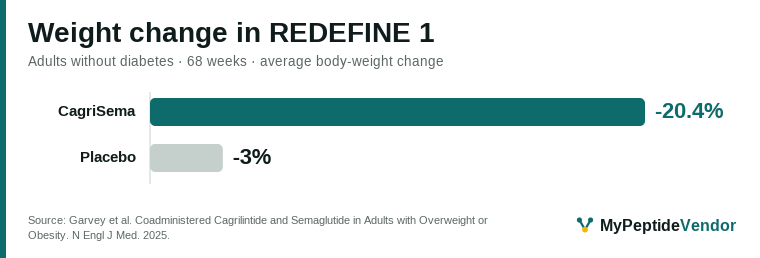
CagriSema is an investigational once-weekly combination of semaglutide, a GLP-1 receptor agonist, and cagrilintide, an amylin analog. In the 68-week REDEFINE 1 trial, average weight change was -20.4% with CagriSema and -3.0% with placebo. 3
Phase 3 trials studied 2.4 mg of each ingredient once weekly, but that was a trial regimen, not an approved prescription dose. CagriSema is investigational, and no US availability date is confirmed. 3711
Key takeaways
- REDEFINE 1 randomized 3,417 adults without diabetes; at 68 weeks, average weight change was -20.4% with CagriSema and -3.0% with placebo. 3
- REDEFINE 2 studied 1,206 adults with type 2 diabetes; average weight change at 68 weeks was -13.7% with CagriSema and -3.4% with placebo. 7
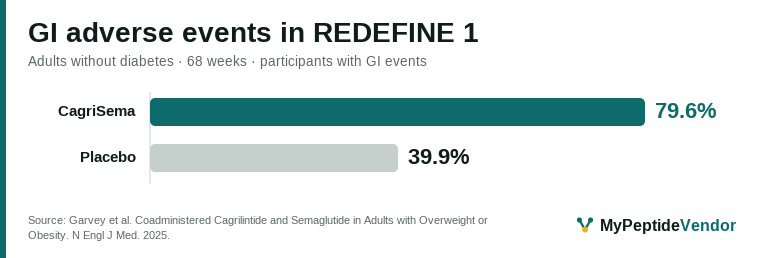
- Gastrointestinal adverse events affected 79.6% of CagriSema participants in REDEFINE 1 and 72.5% in REDEFINE 2. 37
- The phase 3 regimen was 2.4 mg of semaglutide plus 2.4 mg of cagrilintide once weekly; it is not an approved dose. 37
- CagriSema remains investigational, with no confirmed US approval or launch date. 11
CagriSema at a glance
- Class
- GLP-1 receptor agonist plus amylin analog
- Mechanism
- Semaglutide activates GLP-1 receptors; cagrilintide adds amylin-related appetite and fullness signaling.
- FDA Status
- Investigational; not FDA-approved
- Brand names
- CagriSema is the study name; it has no FDA-approved US brand name.
- Administration
- Once-weekly injection under the skin in trials
- Typical Dose
- Trials studied 2.4 mg semaglutide plus 2.4 mg cagrilintide once weekly; not an approved dose
- Half-life
- A combination-product half-life is not established in the supplied trial reports.
- Primary Uses
- Under study for weight management in adults with overweight or obesity, including adults with type 2 diabetes.
What is it?

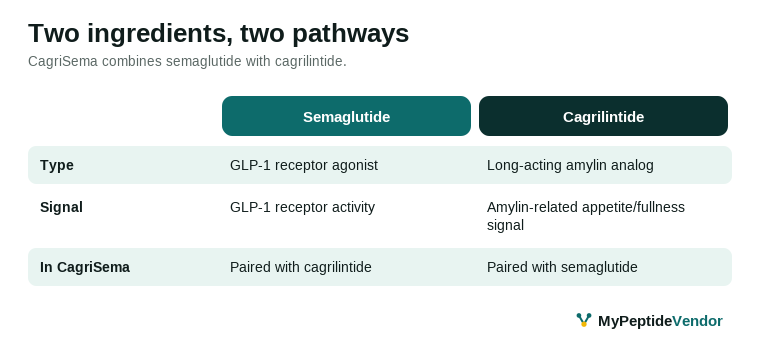
CagriSema combines semaglutide and cagrilintide in a once-weekly injection. Semaglutide is a GLP-1 receptor agonist; cagrilintide is a long-acting amylin analog. The phase 3 regimen used 2.4 mg of each ingredient once weekly. 37
Is CagriSema a GLP-1? It contains semaglutide, which acts on the GLP-1 receptor, but the combination is not semaglutide alone. Cagrilintide adds an amylin-related pathway involved in appetite and fullness. 310
Researchers studied CagriSema in adults with obesity, or overweight plus a weight-related complication, and in adults with type 2 diabetes. REDEFINE 1 enrolled adults without diabetes; REDEFINE 2 enrolled adults with type 2 diabetes. 37
Use this chart
Free to reuse with a link back:
What makes it different
Ozempic contains semaglutide alone. CagriSema pairs semaglutide with cagrilintide, so it combines GLP-1 receptor activity with an amylin-related signal rather than relying on semaglutide alone. That difference in ingredients does not prove that every person will lose more weight or have fewer side effects. 310
The combination is intended to bring together two appetite-related signals. In REDEFINE 1, researchers compared CagriSema with semaglutide alone, cagrilintide alone, and placebo over 68 weeks; the published abstract reports the combination's comparison with placebo, not a full numerical head-to-head result for each active arm. 3
There is no FDA-approved CagriSema label, indication, or US dosing schedule. The 2.4 mg semaglutide amount used in CagriSema trials is a research regimen, not an Ozempic dose recommendation; Ozempic is a separate semaglutide-only product. 311
How does it work?
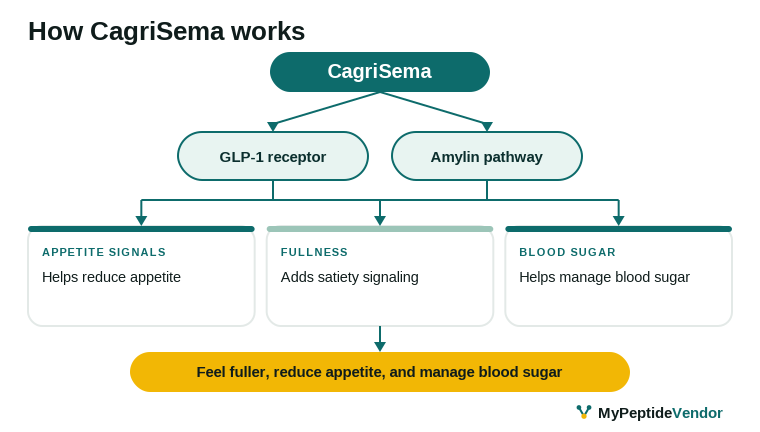
In plain terms, CagriSema aims to help people feel full, reduce appetite, and manage blood sugar. Semaglutide activates the GLP-1 receptor. Cagrilintide is an amylin analog, and amylin-based treatments can add satiety signaling. 310
The two ingredients act through different hormone pathways, but the trial results do not establish how much each ingredient contributes to weight change. REDEFINE 1 and REDEFINE 2 tested the combination against placebo, with lifestyle support offered to both groups. 37
In REDEFINE 2, 73.5% of participants taking CagriSema had an HbA1c of 6.5% or lower at week 68, compared with 15.9% taking placebo. HbA1c is a blood test that reflects average blood sugar over the prior few months. 7
Use this chart
Free to reuse with a link back:
What the clinical evidence actually shows

REDEFINE 1 was a phase 3a trial lasting 68 weeks. It randomized 3,417 adults without diabetes who had obesity, or overweight plus at least one weight-related complication, in a 21:3:3:7 ratio to CagriSema, semaglutide, cagrilintide, or placebo. All groups also received lifestyle intervention. 3
Using the treatment-policy estimate, average body weight changed by -20.4% with CagriSema and -3.0% with placebo at week 68. For a person starting at 225 pounds, a 20.4% decrease is about 46 pounds. The -20.4% figure is the treatment-policy result; the REDEFINE 1 abstract reports that estimand, not an efficacy-estimand result. 3
Treatment-policy results include outcomes regardless of whether participants stayed fully on treatment. An efficacy estimand instead estimates the effect if participants followed the treatment as intended. The REDEFINE 1 and REDEFINE 2 abstracts report treatment-policy estimates for weight loss with CagriSema 37. 37
REDEFINE 2 was a 68-week phase 3a trial in adults with type 2 diabetes, a body-mass index of at least 27, and HbA1c from 7% to 10%. Of 1,206 participants, 904 received CagriSema and 302 received placebo. Average weight change was -13.7% with CagriSema and -3.4% with placebo. 7
The weight-loss percentages differed between the two REDEFINE trials, but they studied different populations. REDEFINE 1 excluded people with diabetes; REDEFINE 2 enrolled people with type 2 diabetes. The trials were not a direct comparison of those populations, so the difference is not a personal prediction. 37
A 2026 network meta-analysis estimated one-year weight change versus lifestyle modification at -14.8% for CagriSema and -14.9% for tirzepatide. Those estimates are nearly the same, but they come from indirect comparisons across different trials, not one randomized head-to-head study. 9
ClinicalTrials.gov lists two phase 3 trials comparing CagriSema with tirzepatide in adults with type 2 diabetes, NCT06221969 and NCT06534411. Both are listed as completed, but the registry information does not provide their results; a direct answer on which works better is therefore not available from those entries. 11
Long-term weight maintenance, rare harms after years of use, and cardiovascular outcomes for CagriSema are not established by the 68-week trials. A trial lasting 68 weeks can show results during that period, but it cannot settle those longer-term questions. 37
Use this chart
Free to reuse with a link back:
Use this chart
Free to reuse with a link back:
Typical dosing

REDEFINE 1 and REDEFINE 2 studied 2.4 mg of semaglutide plus 2.4 mg of cagrilintide once weekly by injection under the skin. Those are research doses, not an approved dose for routine use. 37
No FDA-approved starting dose, titration path, missed-dose instruction, or switching schedule exists for CagriSema. The 2.4 mg trial dose is not an approved dose and should not be used for self-dosing. 3711
Whether a person can switch from semaglutide to CagriSema without worsening tolerability is still under study. ClinicalTrials.gov lists NCT07817251 as a recruiting phase 3 study of switching from semaglutide to CagriSema in adults with type 2 diabetes. 11
Side effects: what to actually expect
Stomach and bowel symptoms were common during the 68-week REDEFINE trials. In REDEFINE 1, gastrointestinal adverse events affected 79.6% of people receiving CagriSema and 39.9% receiving placebo. In REDEFINE 2, the rates were 72.5% and 34.4%, respectively; most events were described as transient and mild or moderate. 37
Reported gastrointestinal events included nausea, vomiting, diarrhea, constipation, and abdominal pain. The trials report aggregate gastrointestinal adverse event rates, not per-symptom percentages. 37
A meta-analysis found that gastrointestinal adverse events and vomiting were significantly more frequent with CagriSema than with semaglutide alone. It also found less vomiting with cagrilintide alone than with semaglutide or liraglutide. 8
These percentages describe groups in trials, not the chance that a specific person will have a particular symptom. The 68-week trials also cannot settle the risk of rare events or safety after several years of treatment. 37
Regulatory & access status in the US (as of 2026)
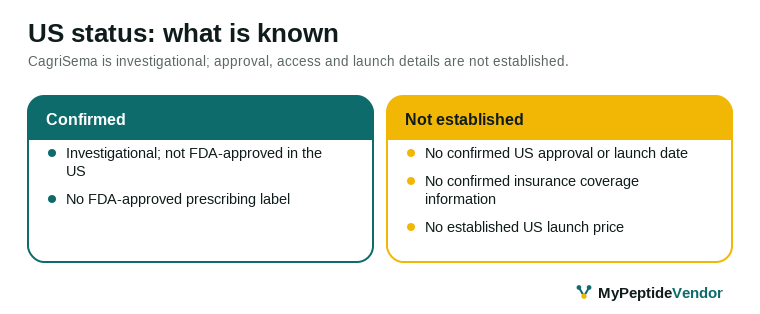
CagriSema is investigational and is not FDA-approved in the United States. ClinicalTrials.gov lists ongoing development studies, but the listed trials do not establish an FDA submission date, decision date, or US launch date. 11
FDA states that cagrilintide cannot be used in compounding under federal law and is not an ingredient in an FDA-approved drug. FDA also warns that unapproved drug versions have not undergone its review for safety, effectiveness, and quality before marketing. 1
There is no confirmed US approval window or insurance coverage information for CagriSema. A drug that has not been approved does not have an FDA-approved prescribing label or an established US launch price.
ClinicalTrials.gov lists 32 CagriSema studies, including recruiting pediatric studies NCT07282613 and NCT07253285 and a blood-pressure study, NCT07919405, listed as not yet recruiting. Those entries do not establish safety or effectiveness in children, and the blood-pressure study has no results listed. 11
FDA warns consumers about fraudulent and unapproved GLP-1 products and advises obtaining prescription medicines through a licensed clinician and state-licensed pharmacy. FDA warns that products falsely labeled 'for research purposes' or 'not for human consumption' are of unknown quality and may be harmful 1.
Use this chart
Free to reuse with a link back:
Research-grade CagriSema is available from Certified-Pep. Sold for laboratory research only, not for human use. Affiliate link
How it compares to its closest alternatives
The 68-week figures below are treatment-policy results from REDEFINE 1 for CagriSema and placebo. One-year estimates are from a network meta-analysis comparing treatments indirectly with lifestyle modification; they are not direct rankings from one trial. 39
| Treatment | What it contains | Weight result | US status |
|---|---|---|---|
| CagriSema | Semaglutide plus cagrilintide | -20.4% at week 68 in REDEFINE 1; -14.8% estimated at one year | Investigational; not FDA-approved |
| Semaglutide 2.4 mg | GLP-1 receptor agonist alone | -9.8% estimated at one year | Semaglutide is FDA-approved under specific product labels |
| Tirzepatide | Dual GIP/GLP-1 receptor agonist | -14.9% estimated at one year | FDA-approved under specific product labels |
| Placebo plus lifestyle support | No active study drug | -3.0% at week 68 in REDEFINE 1 | Not a drug treatment |
Semaglutide activates the GLP-1 receptor; tirzepatide activates GIP and GLP-1 receptors; CagriSema combines semaglutide with an amylin analog. The available one-year estimates put CagriSema and tirzepatide close together, but the completed head-to-head trial results are needed for a direct comparison. 591011
Where to Get CagriSema Legally
Through your own doctor
Ask your doctor whether this treatment is appropriate and which licensed pharmacy can supply it.
Certified-Pep
US-made research peptides with batch-specific lab reports (COA) and a QR code on every vial.
- Independent laboratory testing (Vanguard Laboratory)
- Made in the USA, ships in 1-2 business days
- Research use only, not for human or veterinary use
HumeCare
Online GLP-1 weight-loss program with a licensed US provider.
- Short online assessment reviewed by a licensed provider
- If prescribed, medication ships to your door
- Ongoing support to adjust your plan
Affiliate disclosure: we may earn a commission if you sign up through the link above. It never changes what we write.
Frequently asked questions
How is CagriSema different from Ozempic?
Ozempic contains semaglutide alone; CagriSema adds the amylin analog cagrilintide. CagriSema remains investigational, while semaglutide is approved under specific product labels. 3511
Is CagriSema better than tirzepatide?
That has not been established by reported head-to-head results. A network analysis estimated one-year weight change of -14.8% for CagriSema and -14.9% for tirzepatide, but those are indirect comparisons across trials. 911
When will CagriSema be available in the USA?
There is no confirmed US availability date because CagriSema remains investigational. Trial listings show development activity, not an FDA submission or decision timetable. 11
References
- FDA: Concerns with unapproved GLP-1 drugs used for weight loss
- FDA: Certain bulk drug substances for use in compounding that may present significant safety risks
- Garvey et al. Coadministered Cagrilintide and Semaglutide in Adults with Overweight or Obesity. N Engl J Med. 2025.
- Yao et al. Comparative effectiveness of GLP-1 receptor agonists on glycaemic control, body weight, and lipid profile for type 2 diabetes: systematic review and network meta-analysis. BMJ. 2024.
- Melson et al. What is the pipeline for future medications for obesity? Int J Obes (Lond). 2025.
- Kokkorakis et al. Emerging pharmacotherapies for obesity: A systematic review. Pharmacol Rev. 2025.
- Davies et al. Cagrilintide-Semaglutide in Adults with Overweight or Obesity and Type 2 Diabetes. N Engl J Med. 2025.
- Dutta et al. Efficacy and Safety of Cagrilintide Alone and in Combination with Semaglutide (Cagrisema) as Anti-Obesity Medications: A Systematic Review and Meta-Analysis. Indian J Endocrinol Metab. 2024.
- Nong et al. Comparative effects of drugs for adults with overweight or obesity: systematic review and network meta-analysis. BMJ. 2026.
- Son et al. Novel GLP-1-based Medications for Type 2 Diabetes and Obesity. Endocr Rev. 2026.
- ClinicalTrials.gov: 32 registered studies (search: CagriSema)
Written by the MyPeptideVendor editorial team from the FDA label, peer-reviewed studies and ClinicalTrials.gov records listed above, fact-checked line by line and reviewed 2026-11-12.
Cite this page
MyPeptideVendor Editorial Team. CagriSema: Weight Loss, Dosing & FDA Status. MyPeptideVendor. Updated November 12, 2026. https://mypeptidevendor.com/peptides/cagrisema/MyPeptideVendor Editorial Team. (2026, November 12). CagriSema: Weight Loss, Dosing & FDA Status. MyPeptideVendor. https://mypeptidevendor.com/peptides/cagrisema/Related peptides
5-Amino-1MQ
Not approved5-Amino-1MQ is a small molecule, not a peptide; its human benefits, dose, side effects, and long-term safety are not established.
Learn moreAdipotide (FTPP)
Not approvedAdipotide is an experimental fat-vessel-targeting peptide with animal findings, kidney concerns, and no established human dose or benefit.
Learn moreAOD-9604
Not approvedAOD-9604 was studied for obesity, but available evidence does not establish meaningful weight loss, a standard dose, or FDA approval.
Learn more