Tesamorelin Dosage 10mg: Vial Protocol
A 10 mg vial is not an FDA-labeled tesamorelin product; see trial dosing, conversion math, handling limits, and safety guidance for supervised care.
Quickstart Highlights for Tesamorelin 10 mg
No FDA-labeled dose or mixing instruction exists for a 10 mg tesamorelin vial. The FDA-labeled products are EGRIFTA SV at 2 mg per vial and EGRIFTA WR at 11.6 mg per vial; their doses and preparation instructions differ, and the products are not substitutable 1.
The EGRIFTA WR dose is 1.28 mg once daily for its labeled use, while the Phase 3 trials used 2 mg once daily with a different formulation 17. Neither dose establishes a prescription for a 10 mg vial. The conversion below is arithmetic for one example mixture, not a treatment recommendation.
- Check the exact product. A 10 mg vial is not the labeled 2 mg EGRIFTA SV vial or 11.6 mg EGRIFTA WR vial. Their dosing, mixing, and storage directions differ 1.
- There is no FDA dose for a 10 mg vial. The EGRIFTA WR dose is 1.28 mg once daily for its specific indication; the Phase 3 trials studied 2 mg once daily using another formulation 17.
- Example conversion only: If a pharmacy directs mixing 10 mg with 2.5 mL, the concentration is 4 mg/mL. On a U-100 syringe, 1 mg is 25 units and 2 mg is 50 units. Confirm the exact concentration and prescribed dose with the dispensing pharmacy.
- Do not borrow another product’s mixing directions. The EGRIFTA WR direction to add 1.3 mL of supplied diluent applies to that 11.6 mg product only 1.
- Ask for the beyond-use date. EGRIFTA WR is discarded 7 days after mixing, but that product-specific limit is not established for a 10 mg vial 1.
- Use is a supervised medical decision. The labeled indication is not general weight loss, bodybuilding, sports performance, or orthopedic injury treatment 13.
Key takeaways
- A 10 mg vial matches neither labeled product: EGRIFTA SV is 2 mg per vial and EGRIFTA WR is 11.6 mg per vial 1.
- The Phase 3 trials used a fixed 2 mg daily amount during the 26-week main phase 17.
- For the example mix of 10 mg in 2.5 mL, 2 mg equals 2,000 mcg and 50 U-100 units; this is conversion math, not a recommended dose.
- EGRIFTA WR is indicated for excess abdominal fat in adults with HIV-associated lipodystrophy, not general weight-loss management 1.
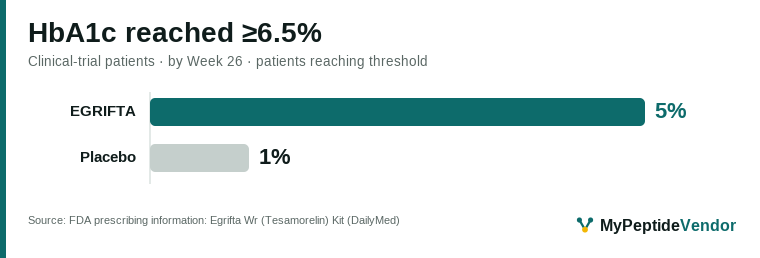
- The label calls for glucose and IGF-1 monitoring; HbA1c reached at least 6.5% by Week 26 in 5% of treated patients and 1% of placebo patients 1.
Dosing Schedule for a 10 mg Vial

The schedule below follows the fixed daily amount tested in Phase 3 studies, not a 10 mg product label. The main trial phase lasted 26 weeks, and some participants continued treatment during a further 26-week extension 17. The syringe units shown are only for the example of 10 mg mixed with 2.5 mL.
For that example mixture, the conversion table gives 2 mg as 2,000 mcg and 50 U-100 units. The clinical trials used a different formulation, so this conversion does not make a 10 mg vial equivalent to the trial or an FDA-labeled product 17.
| Period | Daily amount | U-100 units for example mix | Evidence context |
|---|---|---|---|
| Weeks 1–26 | 2 mg / 2,000 mcg | 50 units | Fixed daily amount in the Phase 3 main phase |
| Weeks 27–52 | 2 mg / 2,000 mcg for participants assigned to continue | 50 units | Extension phase; some participants were reassigned to placebo |
Do not read the table as a personal treatment plan. The 2 mg research amount came from studies of adults with HIV-associated lipodystrophy, not from a study of a 10 mg vial 17. No approved human dose is established for that vial strength.
The EGRIFTA WR label specifies 1.28 mg once daily, but that direction applies only to the 11.6 mg EGRIFTA WR formulation 1. EGRIFTA SV has a separate 2 mg vial formulation and separate prescribing information; WR and SV are not substitutable 1. Do not transfer either product’s dose to a 10 mg vial by assumption.
The labeled tesamorelin strengths are 2 mg per vial for EGRIFTA SV and 11.6 mg per vial for EGRIFTA WR 1. No FDA-labeled tesamorelin 5 mg product exists; the labeled strengths are 2 mg (EGRIFTA SV) and 11.6 mg (EGRIFTA WR) 1. A 10 mg vial matches neither labeled product.
Common vial sizes can be confusing because they do not all refer to FDA-labeled products. A 2 mg vial is the labeled EGRIFTA SV strength, an 11.6 mg vial is the labeled EGRIFTA WR strength, and a 10 mg vial is not either labeled product 1. This page does not give unit conversions for the other strengths because the conversion example is specific to a 10 mg vial and a stated mixing volume.
Conversion figures do not show that a 10 mg vial is sterile, accurately compounded, or stable after mixing. A vial containing 10 mg has five 2 mg amounts by arithmetic, but that does not establish that the mixed vial may be used for five days. The pharmacy’s instructions and beyond-use date control.
Product and evidence comparison
The labeled products have different vial strengths and instructions; a 10 mg vial has no FDA product directions. The WR mixing and storage details below apply only to WR 1.
| Product | Vial strength | Indication and dose context | Mixing and storage context |
|---|---|---|---|
| EGRIFTA SV | 2 mg | Separate labeled formulation; consult its own prescribing information | Not interchangeable with WR; its preparation directions are separate |
| EGRIFTA WR | 11.6 mg | 1.28 mg once daily for the labeled indication | Mix one vial with 1.3 mL supplied diluent; after mixing, room temperature and discard after 7 days |
| Compounded or other 10 mg vial | 10 mg | No FDA-labeled dose for this vial strength | Use only pharmacy-specific directions; no universal mixing or storage limit is established |
Syringe Unit Conversion Table
Units to draw on a U-100 insulin syringe (100 units = 1 mL) from a 10 mg vial. Find your dose, then read the column for the water you added. Every number is calculated, not estimated.
| Dose | 1 mL water 10 mg/mL · 1 unit = 100 mcg | 2 mL water 5 mg/mL · 1 unit = 50 mcg | 2.5 mL water 4 mg/mL · 1 unit = 40 mcg |
|---|---|---|---|
| 50 mcg | 0.5 · 200 doses | 1 · 200 doses | 1.25 · 200 doses |
| 100 mcg | 1 · 100 doses | 2 · 100 doses | 2.5 · 100 doses |
| 200 mcg | 2 · 50 doses | 4 · 50 doses | 5 · 50 doses |
| 250 mcg | 2.5 · 40 doses | 5 · 40 doses | 6.25 · 40 doses |
| 300 mcg | 3 · 33 doses | 6 · 33 doses | 7.5 · 33 doses |
| 500 mcg | 5 · 20 doses | 10 · 20 doses | 12.5 · 20 doses |
| 750 mcg | 7.5 · 13 doses | 15 · 13 doses | 18.75 · 13 doses |
| 1 mg | 10 · 10 doses | 20 · 10 doses | 25 · 10 doses |
| 1.5 mg | 15 · 6 doses | 30 · 6 doses | 37.5 · 6 doses |
| 1.7 mg | 17 · 5 doses | 34 · 5 doses | 42.5 · 5 doses |
| 2 mg | 20 · 5 doses | 40 · 5 doses | 50 · 5 doses |
| 2.4 mg | 24 · 4 doses | 48 · 4 doses | 60 · 4 doses |
| 2.5 mg | 25 · 4 doses | 50 · 4 doses | 62.5 · 4 doses |
| 3 mg | 30 · 3 doses | 60 · 3 doses | 75 · 3 doses |
| 4 mg | 40 · 2 doses | 80 · 2 doses | 100 · 2 doses |
| 5 mg | 50 · 2 doses | 100 · 2 doses | over 100 |
| 7.5 mg | 75 · 1 doses | over 100 | over 100 |
| 10 mg | 100 · 1 doses | over 100 | over 100 |
Tesamorelin 10 mg Vial Dosage Calculator
Shows the exact insulin-syringe units to draw. Pre-loaded with the 10 mg vial; change any value to match yours.
Total volume of your syringe?
How much mg is in the vial?
How much bacteriostatic water are you adding?
Dose per injection?
Educational tool only. Concentration = vial ÷ water; units = dose ÷ concentration × 100 (U-100 syringe). Confirm every dose with your prescriber. Different vial or peptide? Use the peptide calculator.
MYPEPTIDEVENDORAffiliate link · we may earn a commission.
What the Evidence Shows
Use this chart
Free to reuse with a link back:
Use this chart
Free to reuse with a link back:
Reconstitution Steps for a 10 mg Vial
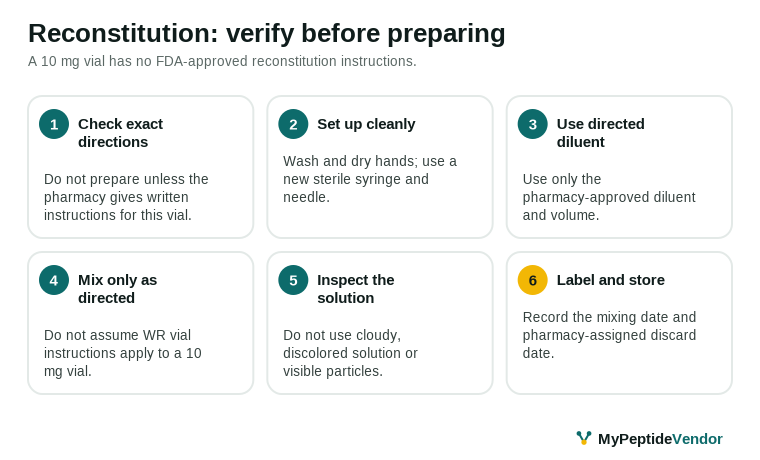
A 10 mg vial has no FDA-approved reconstitution instructions. Do not prepare or inject it unless the dispensing pharmacy has supplied written directions for that exact vial, including the diluent, volume, storage temperature, and discard date. EGRIFTA WR’s 1.3 mL instruction applies to its 11.6 mg vial only 1.
- Confirm the vial and directions. Check the pharmacy label for the product name, strength, prescribed dose, route, approved diluent, mixing volume, storage directions, and beyond-use date. Call the pharmacist if any item is missing or unclear.
- Set up a clean work area. Wash and dry your hands. Gather a new sterile syringe and needle for mixing, the pharmacy-approved diluent, and alcohol swabs. Never reuse a syringe or needle.
- Use only the directed water and volume. If the pharmacy specifically directs bacteriostatic water and a 2.5 mL volume, adding 2.5 mL to 10 mg gives 4 mg/mL, or 4,000 mcg/mL. This is a concentration example, not a validated recipe for every 10 mg product.
- Clean the vial stopper. Wipe it with an alcohol swab and allow it to dry before entering it with sterile equipment.
- Add the liquid gently. If the pharmacy directs reconstitution, introduce the liquid slowly and follow its instructions for where to direct the stream. Do not improvise if the product insert or pharmacy directions specify a different method.
- Mix only as directed. The EGRIFTA WR label says to swirl its vial and not shake it 1. That direction does not establish a validated method for a separate 10 mg vial; follow the instructions for the exact preparation.
- Inspect before use. Do not use a solution that is cloudy, discolored, or has visible particles. EGRIFTA WR is described as clear and colorless 1; ask the dispensing pharmacist what appearance is expected for a different vial.
- Label and store it. Write down the mixing date and the pharmacy’s discard date. Do not apply the EGRIFTA WR 7-day limit to a 10 mg vial unless the pharmacist confirms that limit for that exact preparation 1.
Worked conversion: For 10 mg mixed with 2.5 mL, 1 mg is 1,000 mcg and 25 U-100 units; 2 mg is 2,000 mcg and 50 units. A U-100 syringe has 100 units per 1 mL. These figures describe volume only; they do not select a dose or confirm product quality.
Use bacteriostatic water only when the pharmacy specifically directs it. EGRIFTA WR uses the diluent supplied with that product, but its instruction does not validate the same diluent or volume for every 10 mg vial 1. The exact diluent, mixing method, and beyond-use date must come from the pharmacy that dispensed the vial.
Use this chart
Free to reuse with a link back:
Supplies Needed for One Full 10 mg Vial
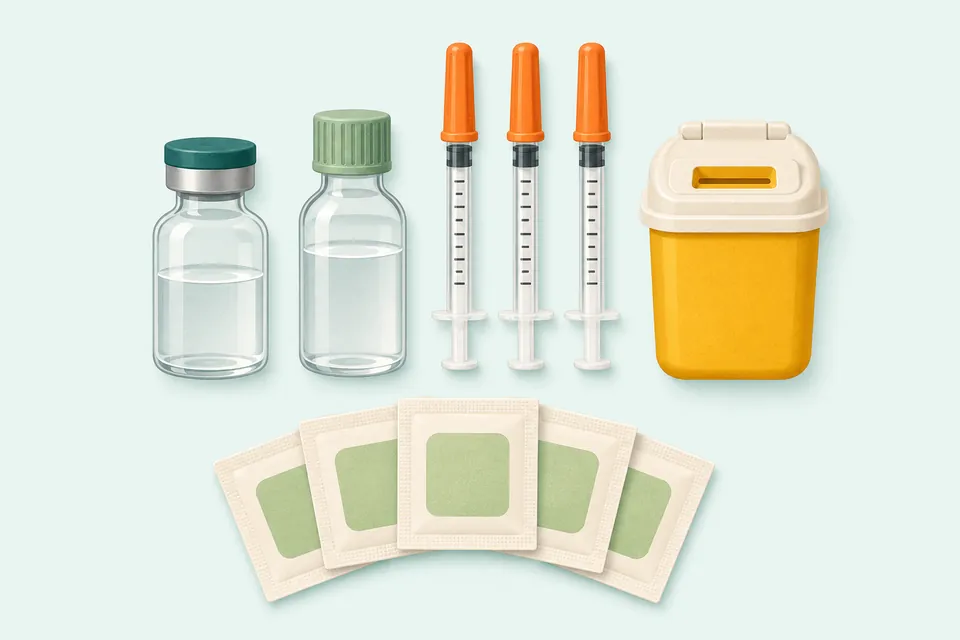
This is a practical supply checklist, not a recommendation to use a 10 mg vial. Quantities below illustrate the example of five 2 mg amount-equivalents; the pharmacy must confirm whether repeated vial access and the preparation’s beyond-use date permit any particular use schedule.
- One 10 mg vial dispensed with a prescription and product-specific instructions.
- One container of pharmacy-approved diluent. For the example 2.5 mL preparation, at least 2.5 mL is needed; use that amount only if the dispensing pharmacy directs it.
- One sterile mixing syringe and needle with enough capacity for the directed volume. Use a separate injection syringe if the pharmacy directs a separate device.
- Five new U-100 insulin syringes for five example injections at the 2 mg trial-reference amount. This is an arithmetic supply estimate, not permission to use a mixed vial for five days.
- Ten alcohol swabs for the example five injections: one for the vial stopper and one for the skin at each injection. Follow pharmacy instructions on vial access and skin preparation.
- One sharps container for used syringes and needles. Do not share injection equipment.
- One appropriate storage location that meets the exact product label or pharmacy directions for temperature and light protection.
The amount of diluent does not determine how long a mixed vial remains safe to use. Stability depends on the specific preparation and its assigned beyond-use date, which is not established for every 10 mg vial.
Protocol Overview and Cycle Notes
Tesamorelin is a growth hormone-releasing factor analog. It stimulates the pituitary gland to release growth hormone and can raise insulin-like growth factor 1 (IGF-1) 1. The FDA label says EGRIFTA WR is weight neutral and is not indicated for weight-loss management 1. A reduction in visceral fat in the approved population is not the same as general weight loss.
The labeled use is reduction of excess abdominal fat in adults with HIV-associated lipodystrophy 1. Abdominal fat alone does not establish that a person meets this indication. Tesamorelin is not labeled for bodybuilding, athletic performance, ordinary weight reduction, or orthopedic injury treatment 13. A review reports no supporting orthopedic evidence for tesamorelin 3.
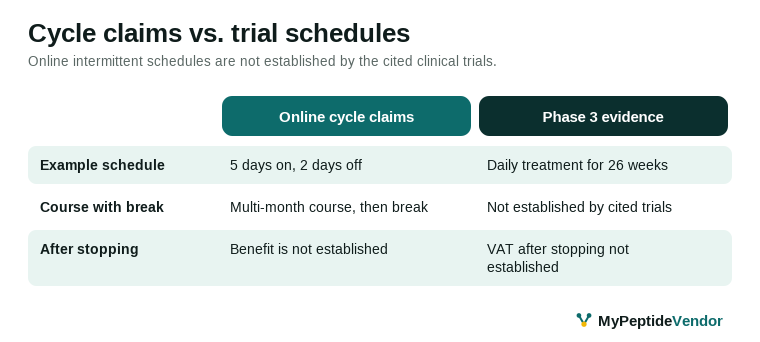
Schedules described online as 5 days on and 2 days off, or as a multi-month course followed by a break, are not established by the cited clinical trials. The Phase 3 trials evaluated daily treatment for 26 weeks, with extension data through 52 weeks 17. Whether intermittent cycling preserves benefit or what happens to visceral fat after stopping has not been established.
Two Phase 3 studies in adults with HIV-associated lipodystrophy found significant reductions in visceral adipose tissue (VAT) after 26 weeks 17. Mean VAT fell by 18% in one study and 14% in the other; treatment-related changes in body weight were small 1. The treatment differences in waist circumference compared with placebo were about 2 cm and 1 cm in the two studies 1. These results do not establish an effect for a 10 mg vial.
During the 26-week extension phases, participants who continued treatment maintained VAT improvements. A review reported no adverse impact on blood glucose or lipid measures during those extensions 7. Long-term cardiovascular safety remains unestablished, and the FDA label advises weighing the risks and benefits of continuing when VAT has not decreased 1.
A 1-year randomized, placebo-controlled trial in people with HIV-associated nonalcoholic fatty liver disease (NAFLD) found reduced liver fat and prevention of fibrosis progression 8. Whether that liver benefit applies to adults without HIV has not been established. ClinicalTrials.gov lists 24 tesamorelin studies, including recruiting Phase 2 fatty-liver studies and a terminated Phase 4 body-composition study 9. A registry listing does not establish benefit, completion, or FDA approval.
Tesamorelin is not listed in 2; legal compounding status of a 10 mg vial must be confirmed with the pharmacy. A similar ingredient name does not prove that a vial has the same strength, quality, dose delivery, or stability as a labeled product.
Evidence for sports and orthopedic use is limited. A review reports no supporting orthopedic evidence for tesamorelin 3. Reviews also describe scarce human safety data and potential for serious harm with unapproved peptides 4. Use for muscle gain, injury recovery, or sports performance has not been established by the cited clinical evidence.
Evidence timeline
The following findings come from studies in specific populations and at specific durations. They do not validate a 10 mg vial 178.
| Study period | Population and treatment | Reported result |
|---|---|---|
| 26 weeks | Phase 3 studies in adults with HIV-associated lipodystrophy | Significant VAT and waist-circumference reductions |
| Weeks 27–52 | Extension phases among participants assigned to continued treatment or placebo | VAT improvements were maintained on treatment; the review reported no adverse impact on glucose or lipid measures |
| 1 year | Randomized, placebo-controlled trial in HIV-associated NAFLD | Reduced liver fat and prevented fibrosis progression |
What the different dose figures mean
The labeled EGRIFTA WR dose is 1.28 mg once daily for the 11.6 mg formulation 1. The Phase 3 trials used 2 mg once daily with a different formulation 17. The 10 mg vial example is a conversion exercise only; no approved human dose for a 10 mg vial exists.
Use this chart
Free to reuse with a link back:
Storage and Handling
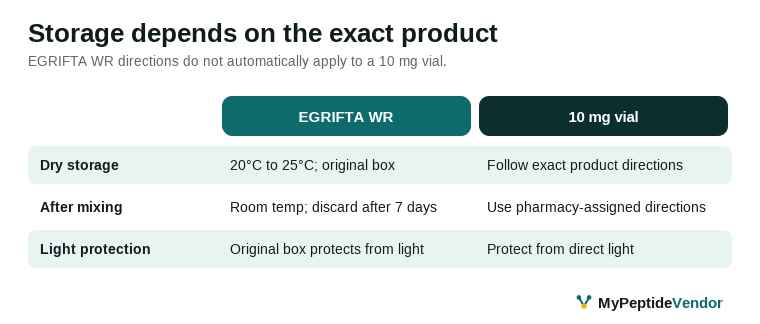
Storage requirements depend on the exact product. Store dry EGRIFTA WR in its original box to protect it from light at 20°C to 25°C (68°F to 77°F); permitted excursions are 15°C to 30°C (59°F to 86°F) 1. These directions apply to EGRIFTA WR, not automatically to a 10 mg vial.
After mixing, EGRIFTA WR is stored at room temperature, is not frozen, and is discarded 7 days after mixing 1. That is not a universal tesamorelin storage limit. A 10 mg product may have a different pharmacy-assigned storage requirement and beyond-use date; do not assume it must be refrigerated or that WR directions apply.
Keep the vial protected from direct light and away from excess heat, children, and pets. If it was stored outside the range on its label, ask the dispensing pharmacist before use. Do not use a solution that is cloudy, colored, or contains visible particles; the WR label warns against those changes 1.
Never share a vial, needle, or syringe between people. The FDA label warns that syringe or needle sharing can transmit infection 1. Place used equipment in a sharps container rather than leaving it loose on a counter or in household trash.
Use this chart
Free to reuse with a link back:
Injection and Tracking Tips

The EGRIFTA WR label specifies once-daily subcutaneous injection into the abdomen, with rotation among different abdominal areas 1. It says not to inject into the navel, scar tissue, or bruises 1. Use those directions for a 10 mg vial only if the prescription and pharmacy confirm the route and technique for that exact preparation.
- Wash and dry your hands. Check the vial name, strength, appearance, storage instructions, and discard date.
- Clean the chosen abdominal skin area with an alcohol swab and let it dry.
- Draw only the amount prescribed for the exact product. For the example mixture of 10 mg in 2.5 mL, 1 mg converts to 25 units and 2 mg converts to 50 units; neither amount is a recommendation to inject.
- Inject under the skin in the abdomen, avoiding the navel, scars, and bruises. Choose a different abdominal area for the next injection 1.
- Put the used syringe directly into a sharps container. Do not share or reuse it.
Keep a log of the date, prescribed dose, syringe mark, injection area, and any reaction. Bring the record to follow-up visits so the clinician can review response with glucose and IGF-1 results. The FDA label calls for glucose evaluation before treatment and monitoring during treatment, as well as IGF-1 monitoring 1.
If you miss a dose, do not double the next dose or take an extra injection. Contact the prescriber or pharmacist for instructions for your exact product. The FDA label information for WR does not establish a missed-dose rule for a 10 mg vial 1.
Follow the prescription for timing. The WR label specifies once-daily administration but does not establish a required bedtime, fasting period, or meal interval 1. Do not add a meal restriction or timing rule based on an online cycling claim.
Safety and Side Effects
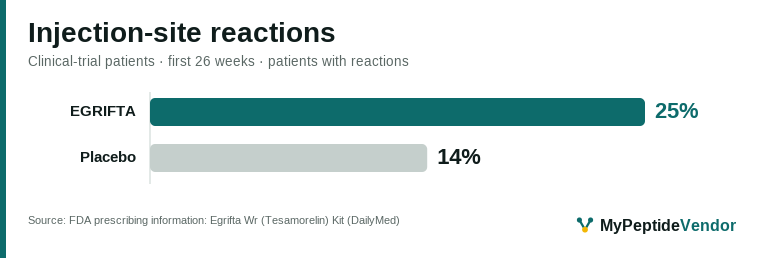
Injection-site reactions occurred in 25% of EGRIFTA-treated patients and 14% of placebo patients during the first 26 weeks of clinical trials 1. Reported reactions included redness, itching, pain, irritation, and bruising 1. Rotating abdominal sites can reduce local reactions; contact the prescriber if a reaction persists or worsens 1.
Common reported reactions occurring in more than 5% of treated patients included joint pain, injection-site redness, injection-site itching, pain in an extremity, peripheral edema, and muscle pain 1. Fluid retention may cause swelling, joint discomfort, or carpal tunnel symptoms such as tingling or numbness 1. Contact the prescriber about new swelling, persistent pain, or new hand numbness.
Hypersensitivity reactions occurred in 4% of treated patients in clinical trials. Reported reactions included itching, redness, flushing, hives, and rash 1. Stop treatment and seek prompt medical attention if an allergic reaction is suspected. Breathing trouble or swelling of the face or throat requires emergency care.
Glucose intolerance or diabetes can develop during treatment. By Week 26, HbA1c reached at least 6.5% in 5% of EGRIFTA-treated patients and 1% of placebo patients; the label reports a hazard odds ratio of 3.3 1. The label calls for glucose assessment before treatment and periodic monitoring during treatment 1. People with diabetes may need changes to diabetes care, and the label advises monitoring for development or worsening of retinopathy 1.
Tesamorelin can raise IGF-1. After 26 weeks, 47% of patients had IGF-1 above 2 standard deviation scores (SDS), and 36% were above 3 SDS 1. The label says to monitor IGF-1 and consider discontinuing for persistent elevations, such as above 3 SDS, particularly if the treatment response is not strong 1. The effects of prolonged IGF-1 elevation are unknown 1.
Active malignancy is a contraindication, and the label says to discontinue treatment if there is evidence of recurrent malignancy 1. A history of cancer needs careful review before treatment. Long-term cardiovascular safety has not been established; if VAT does not decrease, the prescriber should weigh the risks and benefits of continuing 1.
The EGRIFTA WR label contraindicates use during pregnancy, with active malignancy, with known hypersensitivity to tesamorelin or its excipients, or with disruption of the hypothalamic-pituitary axis, including disruption related to pituitary surgery, tumor, or head trauma 1. If pregnancy occurs, the label says to discontinue treatment 1. A clinician should review the HIV-associated lipodystrophy diagnosis, glucose status, cancer history, pituitary conditions, and cardiovascular risk before treatment.
The label advises considering discontinuation during acute critical illness, including serious illness after major surgery, multiple trauma, or acute respiratory failure 1. Do not start, stop, or restart treatment around a serious illness without speaking with the treating clinician.
Tesamorelin is a prescription medicine, and the labeled use is for adults with HIV-associated lipodystrophy 1. This page does not provide a personal prescription or establish that a 10 mg vial is suitable for injection. Have the prescriber and pharmacist confirm the product, dose, route, diluent, storage conditions, and discard date before use.
Frequently asked questions
What is the correct tesamorelin dosage for a 10 mg vial?
There is no FDA-labeled dose for a 10 mg vial. EGRIFTA WR is labeled at 1.28 mg once daily for its specific indication, while Phase 3 trials studied 2 mg daily with a different formulation 17. Ask the prescriber for instructions tied to the exact dispensed product.
How many U-100 units is 1 mg of tesamorelin?
For the example of 10 mg mixed with 2.5 mL, 1 mg converts to 25 U-100 units. Confirm both the concentration and prescribed amount with the pharmacy before drawing a dose.
How many U-100 units is 2 mg from a 10 mg vial?
For the example of 10 mg in 2.5 mL, 2 mg converts to 50 units. The Phase 3 trials studied 2 mg daily, but that does not establish a dose for a 10 mg vial 17.
Can I use EGRIFTA WR mixing directions for a 10 mg vial?
No. The WR directions apply to its 11.6 mg vial and specify 1.3 mL of supplied diluent; the FDA states that WR and SV are not substitutable 1. Get written preparation directions for the exact 10 mg product from the dispensing pharmacy.
Does tesamorelin cause weight loss?
EGRIFTA WR is not indicated for weight-loss management, and its label describes the effect on body weight as weight neutral 1. The trials found reduced visceral fat in adults with HIV-associated lipodystrophy, which is not an approval for general weight loss 1.
What should I do if I miss a dose?
Do not take two doses together or add an extra injection. Call the prescriber or pharmacist for product-specific advice because the labeled WR instructions do not establish a missed-dose rule for a 10 mg vial 1.
Should a mixed 10 mg vial be refrigerated?
There is no single storage rule for every 10 mg preparation. EGRIFTA WR is kept at room temperature after mixing and discarded after 7 days, but those directions do not automatically apply to a 10 mg vial 1. Follow the pharmacy label.
Who should not use tesamorelin?
The EGRIFTA WR label contraindicates use during pregnancy, with active malignancy, with known hypersensitivity, or with disruption of the hypothalamic-pituitary axis 1. A clinician should also confirm the labeled HIV-associated lipodystrophy indication and review relevant medical history.
References
- FDA prescribing information: Egrifta Wr (Tesamorelin) Kit (DailyMed)
- FDA: Certain bulk drug substances for use in compounding that may present significant safety risks
- Mayfield et al. Injectable Peptide Therapy: A Primer for Orthopaedic and Sports Medicine Physicians. Am J Sports Med. 2026.
- Mendias et al. Safety and Efficacy of Approved and Unapproved Peptide Therapies for Musculoskeletal Injuries and Athletic Performance. Sports Med. 2026.
- Rahman et al. Therapeutic Peptides in Orthopaedics: Applications, Challenges, and Future Directions. J Am Acad Orthop Surg Glob Res Rev. 2026.
- Renke et al. Therapeutic Peptides in Aesthetic, Metabolic and Endocrine Conditions: Effects, Safety, Clinical Applications, and Future Perspectives. Int J Mol Sci. 2026.
- Spooner et al. Tesamorelin: a growth hormone-releasing factor analogue for HIV-associated lipodystrophy. Ann Pharmacother. 2012.
- Fourman et al. Effects of tesamorelin on hepatic transcriptomic signatures in HIV-associated NAFLD. JCI Insight. 2020.
- ClinicalTrials.gov: 24 registered studies (search: Tesamorelin)
Written by the MyPeptideVendor editorial team from the FDA label, peer-reviewed studies and ClinicalTrials.gov records listed above, fact-checked line by line and reviewed 2026-11-12.
Cite this page
MyPeptideVendor Editorial Team. tesamorelin dosage 10mg: Vial Protocol. MyPeptideVendor. Updated November 12, 2026. https://mypeptidevendor.com/protocols/tesamorelin-dosing-10mg/MyPeptideVendor Editorial Team. (2026, November 12). tesamorelin dosage 10mg: Vial Protocol. MyPeptideVendor. https://mypeptidevendor.com/protocols/tesamorelin-dosing-10mg/Related protocols
CJC-1295 DAC 2 mg
Research UseA 2 mg vial is not an approved human dose; this guide covers the evidence gap, vial math, and safety questions to review with a clinician.
View protocolCJC-1295 DAC 5 mg
Research UseNo approved human dose exists for CJC-1295 DAC; this guide explains 5 mg vial math, research limits, monitoring, and safety questions.
View protocolCJC-1295 No DAC 5 mg
Not approvedNo approved human dose exists for CJC-1295 No DAC; this guide explains 5 mg vial math, evidence limits, and safety questions to raise with a clinician.
View protocol