Tesamorelin Dosage 20mg: Protocol & Safety
Tesamorelin is prescription-only for HIV-associated lipodystrophy, but a 20 mg vial is not an FDA-labeled Egrifta product.
Quickstart highlights for tesamorelin dosage 20mg
Tesamorelin dosage 20mg has no FDA-approved 20 mg-vial regimen. The clinical reference is 2 mg (2,000 mcg) once daily, studied for 26 weeks in Phase 3 trials using the EGRIFTA 1 mg/vial formulation 1.
Tesamorelin is a growth hormone-releasing hormone analog (GHRH analog) injected under the skin of the abdomen once daily for excess abdominal fat in adults with HIV-associated lipodystrophy 1. Before using a 20 mg vial, get written directions for that exact product from the prescriber and dispensing pharmacy.
- Approved use: Tesamorelin is a prescription medicine indicated to reduce excess abdominal fat in adults with HIV-associated lipodystrophy. It is not indicated for weight-loss management 1.
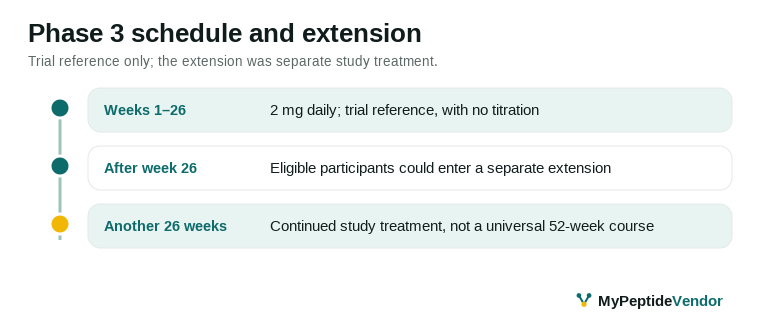
- Trial reference: Phase 3 studies used 2 mg once daily for 26 weeks. Their extension phases studied another 26 weeks; neither design establishes a titration or routine off-cycle 1,7.
- Product difference: Egrifta WR contains 11.6 mg per vial and has a labeled daily dose of 1.28 mg. Egrifta SV is a separate 2 mg-vial formulation; the FDA label states WR and SV are not interchangeable 1.
- Unit example only: If a pharmacy specifically directs that a 20 mg vial be mixed with 1 mL, the concentration is 20 mg/mL and 2 mg equals 10.0 U-100 units. This is a conversion, not an approved preparation direction.
- Mixing and storage: No FDA-labeled Egrifta instructions establish how to mix or store a 20 mg vial. Obtain the exact diluent, volume, storage conditions, and discard date from the dispensing pharmacy 1.
- Monitoring: Ask the prescriber about IGF-1 and glucose testing, plus a consistent way to assess waist or visceral-fat response 1.
Key takeaways
- Phase 3 trials used 2 mg (2,000 mcg) once daily for 26 weeks, with no dose-escalation schedule 1,7.
- At the hypothetical concentration of 20 mg/mL, 2 mg corresponds to 10.0 U-100 units; that calculation does not approve a 20 mg vial preparation.
- Egrifta WR is an 11.6 mg vial with a labeled 1.28 mg daily dose; Egrifta SV is a separate 2 mg-vial formulation with separate directions 1.
- The Egrifta label does not establish mixing instructions or mixed-solution stability for a 20 mg vial 1.
- Treatment can raise IGF-1 and worsen glucose control, so discuss both measurements with the prescriber 1.
Dosing schedule: 2 mg trial reference, not 20 mg-vial titration
The schedule below follows the steady 2 mg daily dose used in the Phase 3 trials, which were conducted with the EGRIFTA 1 mg/vial formulation 1. The 10.0-unit amount assumes a pharmacy-confirmed 1 mL volume in a 20 mg vial, or 20 mg/mL. Confirm the concentration on your own product before measuring; a different concentration changes the syringe amount.
The dose and study duration below reflect the Phase 3 regimen and the FDA label's clinical-study information 1,7.
| Week | Dose per day | U-100 units | Schedule note |
|---|---|---|---|
| 1 | 2 mg / 2,000 mcg | 10.0 units | Trial reference; no titration |
| 2 | 2 mg / 2,000 mcg | 10.0 units | Trial reference; no titration |
| 3 | 2 mg / 2,000 mcg | 10.0 units | Trial reference; no titration |
| 4 | 2 mg / 2,000 mcg | 10.0 units | Trial reference; no titration |
| 5 | 2 mg / 2,000 mcg | 10.0 units | Trial reference; no titration |
| 6 | 2 mg / 2,000 mcg | 10.0 units | Trial reference; no titration |
| 7 | 2 mg / 2,000 mcg | 10.0 units | Trial reference; no titration |
| 8 | 2 mg / 2,000 mcg | 10.0 units | Trial reference; no titration |
| 9 | 2 mg / 2,000 mcg | 10.0 units | Trial reference; no titration |
| 10 | 2 mg / 2,000 mcg | 10.0 units | Trial reference; no titration |
| 11 | 2 mg / 2,000 mcg | 10.0 units | Trial reference; no titration |
| 12 | 2 mg / 2,000 mcg | 10.0 units | Trial reference; no titration |
| 13 | 2 mg / 2,000 mcg | 10.0 units | Trial reference; no titration |
| 14 | 2 mg / 2,000 mcg | 10.0 units | Trial reference; no titration |
| 15 | 2 mg / 2,000 mcg | 10.0 units | Trial reference; no titration |
| 16 | 2 mg / 2,000 mcg | 10.0 units | Trial reference; no titration |
| 17 | 2 mg / 2,000 mcg | 10.0 units | Trial reference; no titration |
| 18 | 2 mg / 2,000 mcg | 10.0 units | Trial reference; no titration |
| 19 | 2 mg / 2,000 mcg | 10.0 units | Trial reference; no titration |
| 20 | 2 mg / 2,000 mcg | 10.0 units | Trial reference; no titration |
| 21 | 2 mg / 2,000 mcg | 10.0 units | Trial reference; no titration |
| 22 | 2 mg / 2,000 mcg | 10.0 units | Trial reference; no titration |
| 23 | 2 mg / 2,000 mcg | 10.0 units | Trial reference; no titration |
| 24 | 2 mg / 2,000 mcg | 10.0 units | Trial reference; no titration |
| 25 | 2 mg / 2,000 mcg | 10.0 units | Trial reference; no titration |
| 26 | 2 mg / 2,000 mcg | 10.0 units | End of main trial phase |
Eligible participants in the studies could enter a separate extension phase after the first 26 weeks; that was continued study treatment, not evidence that everyone should use a 52-week course 1,7. Egrifta WR instead has a 1.28 mg daily dose from its 11.6 mg vial, and its label directs readers to separate Egrifta SV prescribing information for the 2 mg-vial formulation 1. Do not transfer either branded product's mixing instructions to a 20 mg vial.
Use this chart
Free to reuse with a link back:
Syringe Unit Conversion Table
Units to draw on a U-100 insulin syringe (100 units = 1 mL) from a 20 mg vial. Find your dose, then read the column for the water you added. Every number is calculated, not estimated.
| Dose | 1 mL water 20 mg/mL · 1 unit = 200 mcg | 2 mL water 10 mg/mL · 1 unit = 100 mcg | 2.5 mL water 8 mg/mL · 1 unit = 80 mcg |
|---|---|---|---|
| 50 mcg | 0.25 · 400 doses | 0.5 · 400 doses | 0.62 · 400 doses |
| 100 mcg | 0.5 · 200 doses | 1 · 200 doses | 1.25 · 200 doses |
| 200 mcg | 1 · 100 doses | 2 · 100 doses | 2.5 · 100 doses |
| 250 mcg | 1.25 · 80 doses | 2.5 · 80 doses | 3.12 · 80 doses |
| 300 mcg | 1.5 · 66 doses | 3 · 66 doses | 3.75 · 66 doses |
| 500 mcg | 2.5 · 40 doses | 5 · 40 doses | 6.25 · 40 doses |
| 750 mcg | 3.75 · 26 doses | 7.5 · 26 doses | 9.38 · 26 doses |
| 1 mg | 5 · 20 doses | 10 · 20 doses | 12.5 · 20 doses |
| 1.5 mg | 7.5 · 13 doses | 15 · 13 doses | 18.75 · 13 doses |
| 1.7 mg | 8.5 · 11 doses | 17 · 11 doses | 21.25 · 11 doses |
| 2 mg | 10 · 10 doses | 20 · 10 doses | 25 · 10 doses |
| 2.4 mg | 12 · 8 doses | 24 · 8 doses | 30 · 8 doses |
| 2.5 mg | 12.5 · 8 doses | 25 · 8 doses | 31.25 · 8 doses |
| 3 mg | 15 · 6 doses | 30 · 6 doses | 37.5 · 6 doses |
| 4 mg | 20 · 5 doses | 40 · 5 doses | 50 · 5 doses |
| 5 mg | 25 · 4 doses | 50 · 4 doses | 62.5 · 4 doses |
| 7.5 mg | 37.5 · 2 doses | 75 · 2 doses | 93.75 · 2 doses |
| 10 mg | 50 · 2 doses | 100 · 2 doses | over 100 |
| 12.5 mg | 62.5 · 1 doses | over 100 | over 100 |
| 15 mg | 75 · 1 doses | over 100 | over 100 |
Tesamorelin 20 mg Vial Dosage Calculator
Shows the exact insulin-syringe units to draw. Pre-loaded with the 20 mg vial; change any value to match yours.
Total volume of your syringe?
How much mg is in the vial?
How much bacteriostatic water are you adding?
Dose per injection?
Educational tool only. Concentration = vial ÷ water; units = dose ÷ concentration × 100 (U-100 syringe). Confirm every dose with your prescriber. Different vial or peptide? Use the peptide calculator.
MYPEPTIDEVENDORAffiliate link · we may earn a commission.
What the Evidence Shows
Use this chart
Free to reuse with a link back:
Use this chart
Free to reuse with a link back:
Reconstitution steps for a pharmacy-dispensed vial
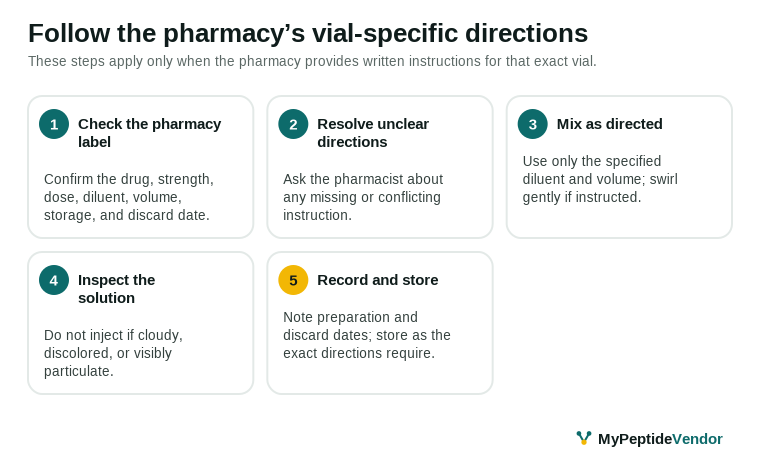
A 20 mg vial has no reconstitution directions established by the Egrifta label 1. The steps below apply only if the dispensing pharmacy gives written instructions for that exact vial, including the diluent, mixing volume, storage, and discard date.
- Read the pharmacy label before opening the vial. Confirm the drug name, strength, prescribed dose, diluent, mixing volume, storage conditions, and discard date. Ask the pharmacist to resolve any missing or conflicting direction.
- Use bacteriostatic water only if the pharmacy specifies it for that product, and use only the volume stated in its instructions. The 1 mL example used for the unit conversion is not a universal mixing direction.
- With clean technique, add the instructed diluent slowly as directed. If the pharmacy's directions call for swirling, move the vial gently in a circle until the powder dissolves; do not shake it.
- Inspect the solution according to the product instructions. Do not inject it if it is cloudy, discolored, contains visible particles, or was prepared under uncertain conditions.
- Write down the preparation date and the pharmacy's discard date. Store at 2–8 °C only if those exact product directions require refrigeration; do not infer a stability period from another tesamorelin product.
The Egrifta WR label gives different, formulation-specific instructions: its 11.6 mg vial is mixed with 1.3 mL of supplied bacteriostatic water, swirled rather than shaken, stored at room temperature after mixing, and discarded 7 days after mixing 1. Those instructions do not establish a method or stability period for a 20 mg vial.
Use this chart
Free to reuse with a link back:
Supplies needed for one full 20 mg vial
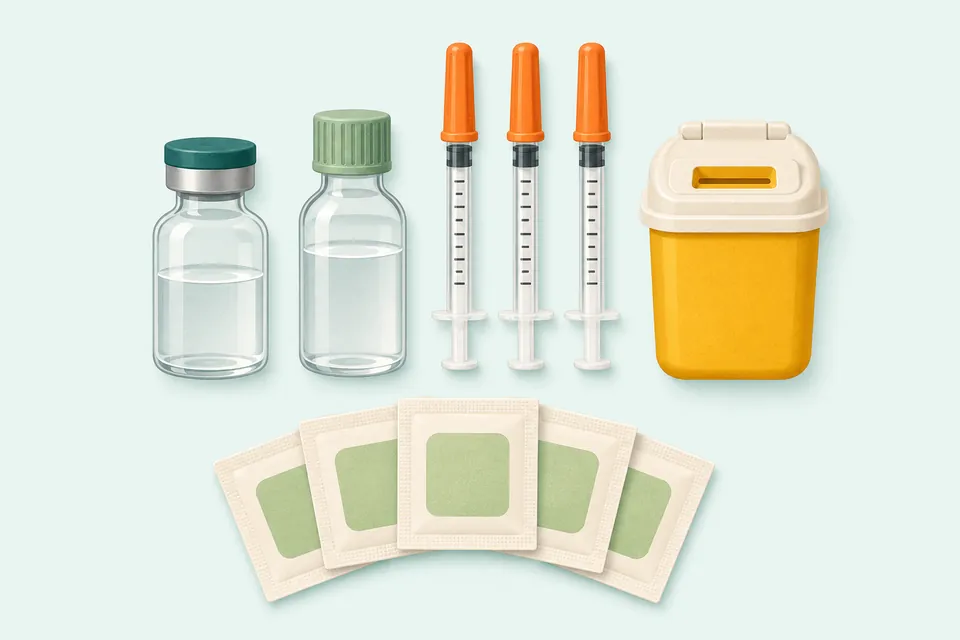
The quantities below are planning arithmetic for one 20 mg vial at the 2 mg trial reference, assuming the pharmacy confirms 20 mg/mL and the full labeled contents can be withdrawn. At that hypothetical concentration, 2 mg is 10.0 U-100 units, and the vial contains ten 2 mg amounts. This is not a pharmacy-approved preparation plan.
- Medication: 1 pharmacy-dispensed vial labeled 20 mg, with a valid prescription and complete product-specific directions.
- Diluent: 1 mL bacteriostatic water only if the pharmacy confirms that volume for the vial.
- Injection syringes: 10 sterile, single-use syringes for ten planned injections at the 2 mg arithmetic reference. Use the syringe type and size specified by the prescriber or pharmacist.
- Alcohol swabs: 20 as a planning amount, one for the vial stopper and one for the skin per planned injection. Follow the product's actual cleaning instructions.
- Sharps container: 1 puncture-resistant container with enough room for the used syringes and needles.
- Written directions: Keep the prescription label and pharmacy instructions with the medication so the concentration, storage conditions, and discard date are easy to check.
Nominal vial contents do not guarantee that every milligram can be withdrawn. Vial design, preparation, syringe dead space, and the pharmacy's beyond-use date can affect usable quantity. Do not decide treatment duration from vial arithmetic alone.
Protocol overview and cycle notes

Tesamorelin stimulates the pituitary gland to release growth hormone, which can raise insulin-like growth factor 1 (IGF-1) 1. The approved indication is specific: reducing excess abdominal fat in adults with HIV-associated lipodystrophy. The label says tesamorelin is not indicated for weight-loss management and does not establish improved adherence to HIV medicines 1.
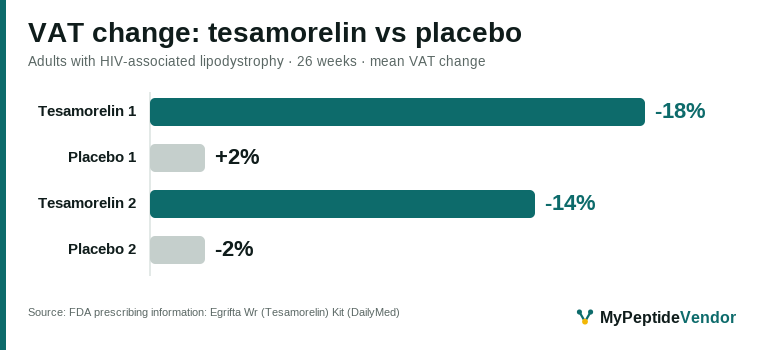
In the two Phase 3 studies, adults with HIV-associated lipodystrophy and excess abdominal fat received 2 mg daily or placebo for 26 weeks 1. Mean visceral adipose tissue (VAT) changed by −18% and −14% in the tesamorelin groups, compared with +2% and −2% in the placebo groups. Mean waist circumference changed by −3 cm and −2 cm with tesamorelin, versus −1 cm in each placebo group 1. These group averages are not a forecast for an individual.
The extension phases studied another 26 weeks. A review reports that the trials' extensions confirmed maintenance of VAT improvement among participants continuing treatment, without adverse effects on blood glucose or lipid parameters in those extension data 7.
A 1-year randomized study in people with HIV-associated nonalcoholic fatty liver disease (NAFLD) found that tesamorelin reduced liver fat and prevented fibrosis progression 8. A paired liver-biopsy analysis found changes in gene-expression pathways involving oxidative phosphorylation, inflammation, tissue repair, and cell division 8. These results concern a specific research population; NAFLD is not an approved indication.
The approved indication does not support using tesamorelin as a general bodybuilding or weight-loss drug. The FDA label says it is not indicated for weight-loss management, and the Phase 3 studies did not show a meaningful treatment difference in body weight 1. A review describes evidence for off-label uses as limited 7.
The FDA label distinguishes Egrifta WR and Egrifta SV by vial strength, dose, preparation, and storage; it says the two formulations are not interchangeable 1. The comparison below summarizes the known product and trial distinctions without applying branded instructions to a 20 mg vial.
| Product or evidence | Vial or dose | Meaning |
|---|---|---|
| Egrifta WR | 11.6 mg vial; 1.28 mg once daily | FDA-labeled formulation and dose |
| Egrifta SV | 2 mg vial | Separate formulation with its own instructions; not interchangeable with WR |
| Phase 3 reference | 2 mg once daily for 26 weeks | Trial regimen for HIV-associated lipodystrophy |
| 20 mg vial | 20 mg stated vial content | Not a vial strength identified in the Egrifta label; get product-specific pharmacy directions |
The WR label specifies 1.3 mL of diluent and a 7-day discard period for its own 11.6 mg vial; it does not provide SV's reconstitution directions in the WR prescribing information 1. Do not use WR preparation or storage instructions as a substitute for SV or 20 mg-vial directions.
ClinicalTrials.gov lists tesamorelin studies beyond the approved indication, including nerve injury, cognition, exercise and physical function in HIV, and fatty liver disease 9. A study registration shows that a question is being studied; it does not prove benefit or establish a dose for that condition 9.
The six listed registrations below include recruiting, completed, and terminated studies; one entry is explicitly described as a “Mock Study” 9. Their statuses do not change the approved indication.
| Study | Status and phase | Condition or question |
|---|---|---|
| NCT03150511 | Recruiting; Phase 2 | Functional outcomes after peripheral nerve injury |
| NCT06554717 | Recruiting; Phase 2 | Tesamorelin with exercise for physical function in HIV |
| NCT03226821 | Terminated; Phase 4 | Body composition and adipose tissue in HIV |
| NCT07481734 | Recruiting; Phase 2 | “Mock Study” for liver-fat reduction in adults with fatty liver disease |
| NCT02572323 | Completed; Phase 2 | Cognition in aging people with HIV |
| NCT03375788 | Completed; Phase 2 | NAFLD and related cardiovascular risk |
FDA information describes a category for bulk drug substances that may present significant safety risks, but the available listing does not establish whether a particular 20 mg tesamorelin vial is FDA-approved, properly made, or suitable for an individual 2. Ask the dispensing pharmacy whether the product is compounded and request its quality, preparation, and beyond-use information.
Storage and handling
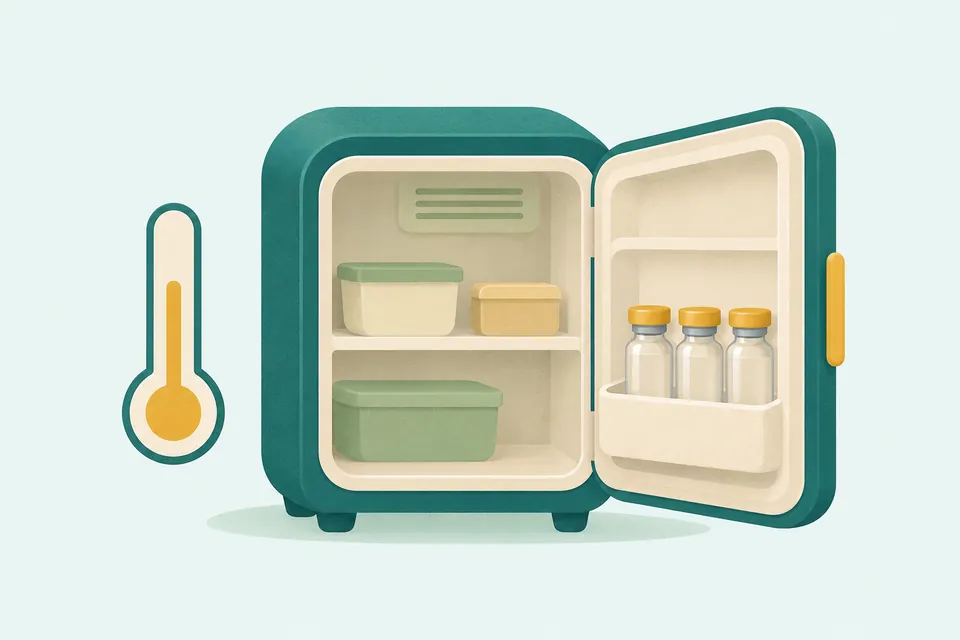
Do not assume that a 20 mg vial can be stored like Egrifta WR or Egrifta SV. For its own 11.6 mg vial, the Egrifta WR label directs room-temperature storage of the dry vial and mixed solution, and says to discard the mixed solution 7 days after preparation 1. That does not validate the stability of a 20 mg preparation.
For a pharmacy-dispensed 20 mg vial, follow the exact product label for temperature, light protection, and beyond-use date. Refrigerate at 2–8 °C only when that product's written pharmacy instructions say to do so. A universal 28-day use period has not been established for a 20 mg vial.
Keep the vial away from children and do not use it past the product's discard date. Never share a syringe or needle; sharing can transmit infection 1.
Injection and tracking tips
The approved treatment is injected under the skin of the abdomen once daily, with sites rotated among different abdominal areas 1. Avoid scar tissue, bruises, and the navel, as the Egrifta instructions direct 1. Ask a clinician or pharmacist to demonstrate the technique before injecting at home.
Use a new sterile syringe and needle for each injection. Clean the skin and vial stopper as directed, let the alcohol dry, and place the used device directly into a sharps container. Follow local sharps-disposal rules rather than putting a loose needle into household trash.
Record the date, prescribed dose, injection site, missed dose, and any redness, pain, or swelling. If your clinician recommends waist tracking, measure at the same location and under similar conditions each time so that changes are easier to compare.
Before treatment, ask the prescriber to review cancer and pituitary history, baseline IGF-1, fasting glucose or HbA1c, diabetes medicines, and existing swelling or carpal tunnel symptoms 1. Discuss periodic IGF-1 and glucose checks during treatment; the label requires monitoring but does not set one testing calendar for every patient 1. Waist or VAT response can help the clinician judge whether continued treatment has a clear benefit 1.
Safety and side effects
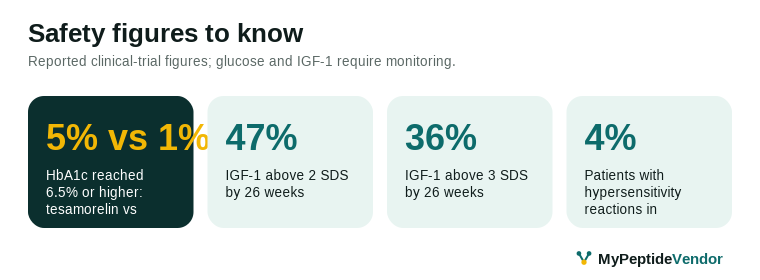
Injection-site reactions were reported in 25% of tesamorelin-treated patients versus 14% of placebo patients in the first 26 weeks (Section 5.6), while Table 1 reports 17% versus 6% for injection-site reaction terms 1. Other Table 1 rates were 13% versus 11% for arthralgia, 6% versus 5% for pain in an extremity, 6% versus 2% for myalgia, and 6% versus 2% for peripheral edema 1. The label also describes redness, itching, pain, irritation, and bruising at injection sites 1.
Fluid retention can cause swelling, joint discomfort, or carpal tunnel symptoms 1. Contact the prescriber about new or worsening swelling, persistent joint pain, or hand numbness or tingling. Hypersensitivity reactions occurred in 4% of patients in clinical trials; seek prompt medical care for a suspected reaction and urgent care for breathing trouble or swelling of the face or throat 1.
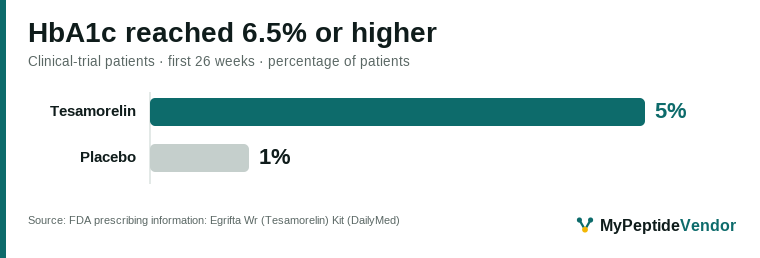
Glucose control can worsen. During the first 26 weeks, HbA1c reached 6.5% or higher in 5% of tesamorelin-treated patients and 1% of placebo patients; the label reported a higher risk of diabetes with tesamorelin 1. Tell the prescriber about increased thirst, frequent urination, or unexpectedly high glucose readings, and do not change diabetes medicine without clinical guidance.
IGF-1 can rise during treatment. By 26 weeks, 47% of patients had IGF-1 above 2 standard deviation scores (SDS), and 36% were above 3 SDS; the label advises monitoring and says the clinician may consider stopping treatment for persistent elevation 1. The long-term effects of sustained high IGF-1 are not known 1.
Do not use tesamorelin with active malignancy or disruption of the hypothalamic-pituitary axis, including hypophysectomy, hypopituitarism, pituitary tumor or surgery, head irradiation, or head trauma 1. A prior malignancy must be inactive and treatment complete before therapy is considered; a history of cancer needs careful risk review, and treatment should stop if cancer recurs 1.
Tell the clinician about diabetes, retinopathy, edema, carpal tunnel syndrome, major surgery, serious breathing illness, or prior trauma. The label warns about glucose intolerance and recommends regular retinopathy monitoring for patients with diabetes who are receiving tesamorelin 1. These cautions call for clinical review; they are not all listed as formal contraindications.
Pregnancy is a contraindication; stop treatment and contact the prescriber if pregnancy occurs 1. Safety and effectiveness have not been established in children, and tesamorelin is not indicated for pediatric patients 1. Human milk data are unavailable; the label advises against breastfeeding while receiving Egrifta WR, and HIV-infected mothers should not breastfeed to prevent HIV transmission 1.
Tell the prescriber and pharmacist about every medicine. Tesamorelin may alter clearance of some drugs metabolized by cytochrome P450 enzymes, including corticosteroids, sex steroids, anticonvulsants, and cyclosporine, so monitoring may be needed 1. People taking glucocorticoid replacement for adrenal insufficiency may need a clinician-directed adjustment after starting treatment 1.
If you miss a dose, check the directions for your exact product or call the prescriber or pharmacist. Do not guess at a replacement dose or take an extra dose without product-specific clinical advice.
Use this chart
Free to reuse with a link back:
Frequently asked questions
Is there an FDA-approved 20 mg tesamorelin vial?
The Egrifta label identifies WR as an 11.6 mg vial and refers to separate SV directions for its 2 mg-vial formulation; it does not identify a 20 mg presentation 1. Ask the dispensing pharmacy whether your vial is compounded and request its written preparation and storage directions.
How many U-100 units equal 2 mg from a 20 mg vial?
Only if the pharmacy confirms a 1 mL mixing volume, the resulting concentration is 20 mg/mL and 2 mg corresponds to 10.0 U-100 units. A different concentration changes the syringe measurement, so do not use this example without confirming your product directions.
Does tesamorelin have a titration schedule?
The Phase 3 studies used a steady 2 mg daily dose for 26 weeks, not a step-up schedule 1,7. Your prescribed product and dose must come from the clinician and dispensing pharmacy.
How do you reconstitute a 20 mg tesamorelin vial?
The Egrifta label does not give a reconstitution method for a 20 mg vial 1. Use bacteriostatic water, a particular volume, or swirling rather than shaking only when the pharmacy's written directions for that exact vial specify them; confirm the storage and discard date as well.
How long does mixed tesamorelin last?
The Egrifta WR label says to discard its reconstituted solution 7 days after mixing, but that instruction applies to the 11.6 mg WR formulation 1. It does not establish stability for a 20 mg vial; follow the pharmacy's beyond-use date.
Is tesamorelin for weight loss or bodybuilding?
The approved indication is reducing excess abdominal fat in adults with HIV-associated lipodystrophy, not weight-loss management 1. The label does not support general bodybuilding use 1, and evidence for off-label uses is limited 7.
What should I do if I miss a dose?
Check the directions for the exact product or ask the prescriber or pharmacist. Do not take an extra dose unless a clinician gives you product-specific instructions.
References
- FDA prescribing information: Egrifta Wr (Tesamorelin) Kit (DailyMed)
- FDA: Certain bulk drug substances for use in compounding that may present significant safety risks
- Mayfield et al. Injectable Peptide Therapy: A Primer for Orthopaedic and Sports Medicine Physicians. Am J Sports Med. 2026.
- Rahman et al. Therapeutic Peptides in Orthopaedics: Applications, Challenges, and Future Directions. J Am Acad Orthop Surg Glob Res Rev. 2026.
- Mendias et al. Safety and Efficacy of Approved and Unapproved Peptide Therapies for Musculoskeletal Injuries and Athletic Performance. Sports Med. 2026.
- Renke et al. Therapeutic Peptides in Aesthetic, Metabolic and Endocrine Conditions: Effects, Safety, Clinical Applications, and Future Perspectives. Int J Mol Sci. 2026.
- Spooner et al. Tesamorelin: a growth hormone-releasing factor analogue for HIV-associated lipodystrophy. Ann Pharmacother. 2012.
- Fourman et al. Effects of tesamorelin on hepatic transcriptomic signatures in HIV-associated NAFLD. JCI Insight. 2020.
- ClinicalTrials.gov: 24 registered studies (search: Tesamorelin)
Written by the MyPeptideVendor editorial team from the FDA label, peer-reviewed studies and ClinicalTrials.gov records listed above, fact-checked line by line and reviewed 2026-11-12.
Cite this page
MyPeptideVendor Editorial Team. Tesamorelin Dosage 20mg: Protocol & Safety. MyPeptideVendor. Updated November 12, 2026. https://mypeptidevendor.com/protocols/tesamorelin-dosing-20mg/MyPeptideVendor Editorial Team. (2026, November 12). Tesamorelin Dosage 20mg: Protocol & Safety. MyPeptideVendor. https://mypeptidevendor.com/protocols/tesamorelin-dosing-20mg/Related protocols
CJC-1295 DAC 2 mg
Research UseA 2 mg vial is not an approved human dose; this guide covers the evidence gap, vial math, and safety questions to review with a clinician.
View protocolCJC-1295 DAC 5 mg
Research UseNo approved human dose exists for CJC-1295 DAC; this guide explains 5 mg vial math, research limits, monitoring, and safety questions.
View protocolCJC-1295 No DAC 5 mg
Not approvedNo approved human dose exists for CJC-1295 No DAC; this guide explains 5 mg vial math, evidence limits, and safety questions to raise with a clinician.
View protocol