HCG for Men: Evidence, Dosing & Safety
Gonadotropin hormone
Brand names: Pregnyl, Novarel
hCG for men is a prescription hormone injection that signals the testes to make testosterone. Clinicians may use it for selected forms of hypogonadism and fertility treatment.
A testosterone level around 300 ng/dL or lower, together with symptoms such as low sex drive, can suggest testosterone deficiency. One result alone does not diagnose the cause or tell you which treatment is right.
Key takeaways
- hCG acts like luteinizing hormone and stimulates the testes to make testosterone.
- A 2024 review included 103 studies and 5,328 patients with hypogonadotropic hypogonadism 3.
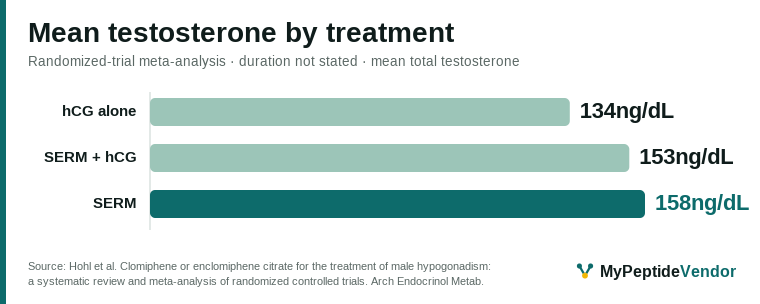
- A 2025 meta-analysis reported mean testosterone of 134 ng/dL with hCG alone, compared with 158 ng/dL with SERMs 2.
- Do not exceed your prescribed dose or use an injectable product from a seller that cannot identify its licensed pharmacy.
HCG at a glance
- Class
- Gonadotropin hormone
- Mechanism
- Mimics luteinizing hormone, stimulating Leydig cells in the testes to make testosterone.
- FDA Status
- FDA-approved prescription products exist for specific uses; some male uses may be off-label. Compounded products are not FDA-approved products.
- Brand names
- Pregnyl, Novarel
- Administration
- Injection; self-injection may be taught by a clinician.
- Typical Dose
- Varies by diagnosis. A small study used 1,500–2,000 IU intramuscularly three times weekly for 8 weeks.
- Half-life
- Varies by product and formulation.
- Primary Uses
- Selected forms of hypogonadism and fertility-related treatment.
What is it?

Human chorionic gonadotropin (hCG) is a hormone given by injection. In men, it can prompt the testes to make testosterone rather than supply testosterone directly. Clinicians may consider it for certain forms of hypogonadism, especially when the pituitary signal to the testes is low, or when fertility is a treatment goal.
Testosterone deficiency is assessed using symptoms and blood tests together. A level around 300 ng/dL is a commonly used threshold, not a diagnosis by itself. Low sex drive, fewer morning erections, and reduced energy can be relevant symptoms. Repeat testing and evaluation of the cause help guide care.
hCG may be considered instead of testosterone replacement therapy (TRT), or in selected cases alongside it. Raising blood testosterone, supporting sperm production, and maintaining testicular activity are related goals, but they are not interchangeable outcomes.
What makes it different
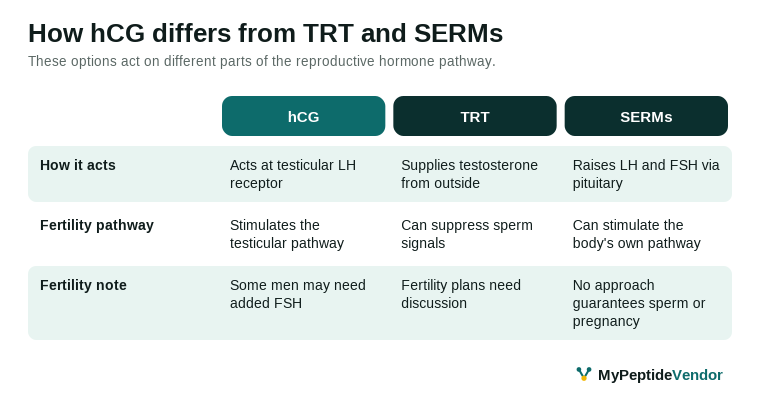
TRT supplies testosterone from outside the body. hCG instead tells the testes to make testosterone. That difference can matter when fertility is a priority: external testosterone can suppress the signals needed for sperm production, while hCG stimulates the testicular pathway.
hCG also differs from selective estrogen receptor modulators (SERMs), such as clomiphene. SERMs act through the brain and pituitary to increase the body’s luteinizing hormone (LH) and follicle-stimulating hormone (FSH) signals. hCG acts more directly at the testicular LH receptor.
Neither approach guarantees a particular sperm count or pregnancy. The cause of low testosterone and the testes’ response matter. Some men with fertility goals may need FSH in addition to hCG.
Use this chart
Free to reuse with a link back:
How does it work?
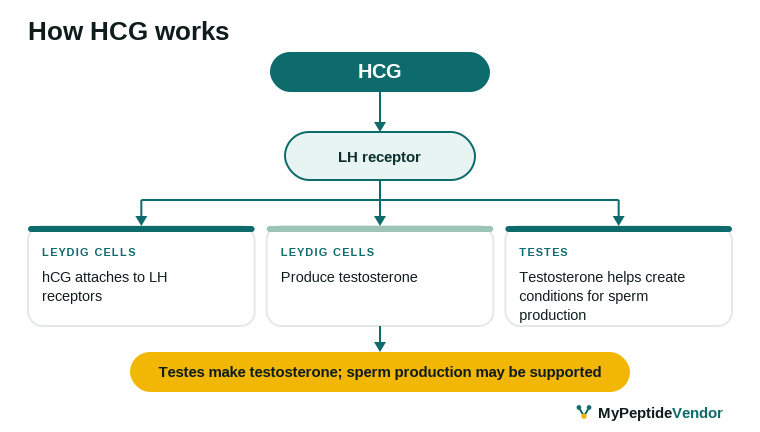
In plain terms, hCG imitates LH, the signal that tells the testes to make testosterone. It attaches to receptors on Leydig cells, which then produce testosterone.
Testosterone inside the testes helps create conditions for sperm production. FSH also supports that process, so hCG alone may not be enough for every man trying to restore sperm production. A clinician may add FSH or another gonadotropin when fertility treatment requires it.
The testes have to respond to the signal. If the testes themselves are damaged, hCG may not produce the expected testosterone or sperm response. This is one reason the cause of low testosterone should be assessed before treatment.
Use this chart
Free to reuse with a link back:
What the clinical evidence actually shows

The 2024 systematic review and meta-analysis by Alexander and colleagues included 103 studies and 5,328 patients with hypogonadotropic hypogonadism. hCG was used in 90.3% of the studies, and the median reported treatment or follow-up was 18 months. More than 98% of analyses reported an increase in testicular volume, penile size, or testosterone 3. These findings may mainly apply to people with deficient gonadotropin signaling, and it is likely that they would not extend to men with normal gonadal function.
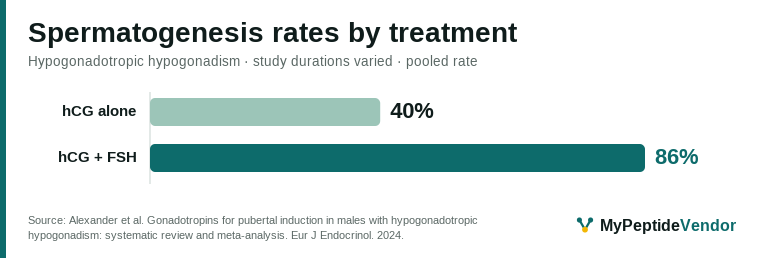
In pooled analyses of those studies, spermatogenesis rates were 40% (95% CI 25%–56%) with hCG alone and 86% (95% CI 82%–91%) with hCG plus FSH 3. These are pooled study estimates, not a promise that a particular patient will produce sperm. The studies differed in treatment, dose, duration, and outcome measures.
The measurements show that testosterone continued to rise after the 8-week course ended. Mean testicular volume also increased 1. This was a small study in young patients with a specific diagnosis, not evidence of enlargement in adult men with normal gonadal function.
Hohl and colleagues’ 2025 meta-analysis of randomized trials reported mean total testosterone of 158 ng/dL with SERMs, 153 ng/dL with a SERM plus hCG, and 134 ng/dL with hCG alone. The SERM and combination groups had higher values than hCG alone in those comparisons 2. Those pooled levels do not establish which option best improves an individual man’s symptoms or fertility.
Important questions remain open. The evidence here does not establish how hCG compares with TRT in head-to-head terms for sperm count, fertility, or testosterone. It also does not establish whether hCG changes penis or testicle size in adult men with normal gonadal function, how long treatment is safe for an individual, or what happens after stopping. Whether tapering is needed has not been established.
Use this chart
Free to reuse with a link back:
Use this chart
Free to reuse with a link back:
Typical dosing

There is no single dose for every male use. Dose and duration depend on the diagnosis, fertility goals, test results, and product. The 2024 review found substantial variation in gonadotropin treatment choices and schedules 3.
Trial regimen, not a general prescription: That regimen should not be copied for another diagnosis or used without a prescriber.
Use only the dose and schedule prescribed for you. A clinician or pharmacist should show you how to prepare and inject the medicine and confirm the correct syringe and measurement. Never take extra doses, change the schedule, or follow an online or bodybuilding regimen without your prescriber.
Before starting, discuss fertility plans, prostate-specific antigen (PSA) history, and any heart disease, congestive heart failure, kidney disease, asthma, or migraine history. Ask which labs are appropriate, such as testosterone, LH, estradiol, hematocrit, and PSA. The monitoring schedule depends on your health and treatment plan; the best timing has not been established for every patient.
Side effects: what to actually expect
Possible effects include headache, irritability, restlessness, fatigue, depressed mood, breast tenderness or enlargement, and pain or redness at the injection site. Reliable percentages for these effects in men have not been established. The small Kim study reported no remarkable adverse effects, but 20 patients cannot rule out less common problems.
Tell your prescriber about a new or worsening symptom instead of changing the dose yourself. Get urgent medical help for trouble breathing, a severe allergic reaction, chest pain, or sudden limb swelling or pain.
Discuss heart disease, congestive heart failure, kidney disease, asthma, and migraine before treatment. A history of prostate cancer or a rising PSA also calls for a clinician’s review, as safety in those situations has not been established.
Regulatory & access status in the US
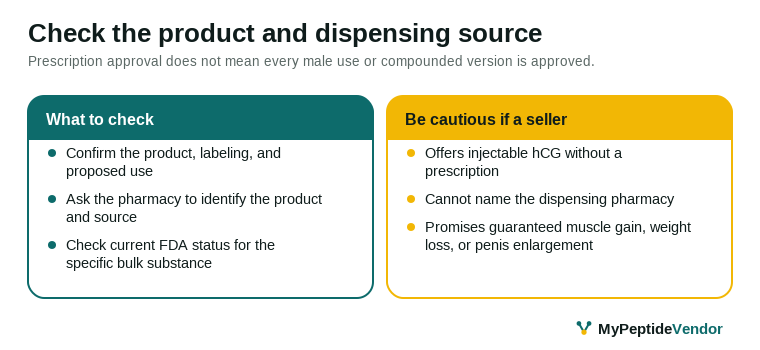
Prescription hCG products have FDA-approved uses, but not every use in men is necessarily an approved indication. A clinician or pharmacist can confirm the product, its labeling, and whether the proposed use is on-label. Approval of a prescription product does not mean that every compounded version has FDA approval.
FDA places certain bulk drug substances nominated for compounding in Category 2 when they may present significant safety risks 1. That is a category for substances identified on the FDA list, not a blanket finding about every compounded hormone. Ask the dispensing pharmacy to identify the product and its source, and check whether the specific bulk substance is affected by FDA’s current compounding status.
Use a licensed clinician and a pharmacy that can identify what it dispenses. Be cautious if a seller offers injectable hCG without a prescription, cannot name the dispensing pharmacy, or promises guaranteed muscle gain, weight loss, or penis enlargement.
Use this chart
Free to reuse with a link back:
If you and a clinician decide it fits, one option is Elevated Health TRT: online testosterone therapy program with a licensed US provider (US only). Affiliate link
How it compares with its closest alternatives
The options below differ in how they raise testosterone and how they relate to fertility. The 2025 SERM meta-analysis and 2024 gonadotropin review provide context, but do not identify one best treatment for every man 23.
| Option | Testosterone | Fertility and testicular size | Trade-offs and evidence |
|---|---|---|---|
| hCG | Signals the testes to produce it. | May support testicular activity and sperm production; FSH may also be needed. | Requires injections and testes that respond. Evidence includes a broad but varied review in hypogonadotropic hypogonadism. |
| TRT | Supplies testosterone directly. | Does not promote testicular growth or sperm production in hypogonadotropic hypogonadism. | May suit testosterone replacement goals, but fertility plans need discussion. The cited reviews do not provide a direct head-to-head comparison with hCG. |
| SERMs, such as clomiphene | Increase pituitary LH and FSH signaling. | Can stimulate the body’s own reproductive hormone pathway. | A 2025 meta-analysis reported testosterone levels of 158 ng/dL with SERMs versus 134 ng/dL with hCG alone (p < 0.002). |
If fertility is a priority, ask whether hCG alone or a gonadotropin combination fits the cause of the problem. If symptom relief is the main goal, compare options using repeat tests, symptoms, and a clear fertility plan.
Frequently asked questions
These answers summarize what is known for common treatment goals; they do not replace an assessment of the cause of low testosterone.
Where to Get HCG Legally
Through your own doctor
The FDA-approved product needs a prescription. Your doctor decides whether it fits your health history and insurance may cover part of the cost.
Elevated Health TRT
Online testosterone therapy program with a licensed US provider.
- At-home lab testing and online provider review
- Treatment plan only if your levels and history fit
- Ongoing monitoring of your levels
Brightmeds TRT
Male testosterone therapy with a licensed US provider.
- Lab testing and online provider review
- Treatment only if your levels fit
- Ongoing monitoring
Affiliate disclosure: we may earn a commission if you sign up through the link above. It never changes what we write.
Frequently asked questions
What does hCG do to a man's body?
It acts like LH and signals the testes to make testosterone. When pituitary signaling is deficient, it may also support testicular development and sperm production, but response varies 3.
Can hCG increase size?
It may increase testicular volume and penile size in people with hypogonadotropic hypogonadism; a 2024 review found increases in more than 98% of analyses 3. Whether it increases either in adult men with normal gonadal function has not been established.
Can I just take hCG instead of TRT?
A clinician may consider hCG, particularly when preserving fertility matters. It is not a direct substitute for every TRT plan: hCG relies on responsive testes, while TRT supplies testosterone. The cause of low testosterone and your fertility plans should guide that decision.
How long can a man take hCG for?
There is no established maximum duration that applies to every man. The 2024 review reported a median treatment or follow-up of 18 months, but study schedules varied 3. Safety over many years and the effects of stopping have not been established.
References
- FDA: Certain bulk drug substances for use in compounding that may present significant safety risks
- Hohl et al. Clomiphene or enclomiphene citrate for the treatment of male hypogonadism: a systematic review and meta-analysis of randomized controlled trials. Arch Endocrinol Metab. 2025.
- Alexander et al. Gonadotropins for pubertal induction in males with hypogonadotropic hypogonadism: systematic review and meta-analysis. Eur J Endocrinol. 2024.
- Bobdiwala et al. Diagnostic protocols for the management of pregnancy of unknown location: a systematic review and meta-analysis. BJOG. 2019.
- Tyler et al. Interventions to optimize embryo transfer in women undergoing assisted conception: a comprehensive systematic review and meta-analyses. Hum Reprod Update. 2022.
- Solangon et al. Methotrexate vs expectant management for treatment of tubal ectopic pregnancy: An individual participant data meta-analysis. Acta Obstet Gynecol Scand. 2023.
- Beebeejaun et al. Triggering oocyte maturation in in vitro fertilization treatment in healthy responders: a systematic review and network meta-analysis. Fertil Steril. 2025.
- Ghobara et al. Cycle regimens for endometrial preparation prior to frozen embryo transfer. Cochrane Database Syst Rev. 2025.
- Long et al. Interventions for non-tubal ectopic pregnancy. Cochrane Database Syst Rev. 2020.
- ClinicalTrials.gov: 2564 registered studies (search: HCG)
Written by the MyPeptideVendor editorial team from the FDA label, peer-reviewed studies and ClinicalTrials.gov records listed above, fact-checked line by line and reviewed 2026-11-12.
Cite this page
MyPeptideVendor Editorial Team. hcg for men: Evidence, Dosing & Safety. MyPeptideVendor. Updated November 12, 2026. https://mypeptidevendor.com/peptides/hcg/MyPeptideVendor Editorial Team. (2026, November 12). hcg for men: Evidence, Dosing & Safety. MyPeptideVendor. https://mypeptidevendor.com/peptides/hcg/Related peptides
CJC-1295
Not approvedCJC-1295 raises GH and IGF-1 in a short human trial, but benefits, long-term safety, and a standard dose remain unproven.
Learn moreFollistatin-315
Research UseFollistatin-315 binds activin and is proposed to affect myostatin, but injectable peptide benefits, doses, and risks are not established in controlled human trials.
Learn moreGonadorelin
Not approvedGonadorelin signals the pituitary to release LH and FSH; US Factrel is 50 mcg/mL and labeled for animals, not people. [1]
Learn more