Mgf Dosage 5mg: Evidence & Safety
A 5 mg vial is a stated quantity of material, not a human dose; no MGF or PEG-MGF dose is established in the cited literature.
Quickstart Highlights for MGF Dosage 5mg
No human mgf dosage 5mg protocol is established. A 5 mg vial states the amount of material in the container; it does not establish an amount, schedule, route, or cycle for a person.
MGF is discussed in muscle research as an IGF-1 splice variant linked to satellite-cell biology 58. PEG-MGF has no established human dose in the cited literature, and a ClinicalTrials.gov search for MGF lists six entries out of 645 registered studies 10.
- Human dose: No MGF or PEG-MGF dose is established in the cited literature 58. Do not treat vial strength as a personal dose.
- Vial amount: The 5 mg figure states the amount in the vial. It does not set a dose, frequency, injection route, or cycle.
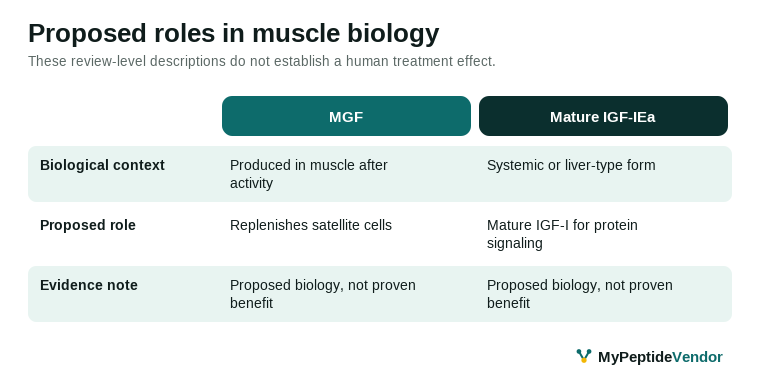
- Mechanism: MGF is proposed to replenish muscle satellite cells; mature IGF-IEa is described as supplying mature IGF-I needed for protein-synthesis signaling 5.
- Half-life: A measured PEG-MGF half-life is not established in the cited literature. Claims of a duration such as hours or days should not be presented as measured pharmacokinetics.
- Human evidence: The ClinicalTrials.gov MGF search lists six entries, none a PEG-MGF trial, out of 645 registered studies 10.
Goldspink described MGF's potential for abuse and noted bodybuilder interest 8. That observation is a caution, not evidence that MGF improves muscle or is safe to use.
Key takeaways
- A 5 mg vial describes the stated vial quantity, not a validated human dose.
- No MGF or PEG-MGF dose or titration schedule is established in the cited literature 58.
- MGF is proposed to replenish muscle satellite cells, while mature IGF-IEa supplies mature IGF-I involved in protein-synthesis signaling 5.
- A measured PEG-MGF half-life and human side-effect frequencies are not established in the cited literature.
- Goldspink described MGF's potential for abuse and reported bodybuilder interest 8.
MGF Dosing Schedule: No Human Schedule Established

No titration schedule is established in the cited literature for MGF or PEG-MGF 58. These reviews discuss muscle biology, not a validated human dose; the ClinicalTrials.gov entries in 10 do not state an MGF or PEG-MGF dosing schedule. No amount is assigned below, and no U-100 units are provided as a human instruction.
| Week | Dose in mg | Dose in mcg | U-100 units | Schedule status |
|---|---|---|---|---|
| Week 1 | Not established | Not established | Not assigned | No human schedule |
| Week 2 | Not established | Not established | Not assigned | No human schedule |
| Week 3 | Not established | Not established | Not assigned | No human schedule |
| Week 4 | Not established | Not established | Not assigned | No human schedule |
| Later weeks | Not established | Not established | Not assigned | No cycle or titration established |
Neither 5 nor 8 establishes a human MGF dose, so a dose cannot be selected by body weight, training status, age, or a vial's stated amount. An arithmetic conversion from milligrams to syringe volume would not supply the missing clinical evidence.
Syringe Unit Conversion Table
Units to draw on a U-100 insulin syringe (100 units = 1 mL) from a 5 mg vial. Find your dose, then read the column for the water you added. Every number is calculated, not estimated.
| Dose | 1 mL water 5 mg/mL · 1 unit = 50 mcg | 2 mL water 2.5 mg/mL · 1 unit = 25 mcg | 2.5 mL water 2 mg/mL · 1 unit = 20 mcg |
|---|---|---|---|
| 50 mcg | 1 · 100 doses | 2 · 100 doses | 2.5 · 100 doses |
| 100 mcg | 2 · 50 doses | 4 · 50 doses | 5 · 50 doses |
| 200 mcg | 4 · 25 doses | 8 · 25 doses | 10 · 25 doses |
| 250 mcg | 5 · 20 doses | 10 · 20 doses | 12.5 · 20 doses |
| 300 mcg | 6 · 16 doses | 12 · 16 doses | 15 · 16 doses |
| 500 mcg | 10 · 10 doses | 20 · 10 doses | 25 · 10 doses |
| 750 mcg | 15 · 6 doses | 30 · 6 doses | 37.5 · 6 doses |
| 1 mg | 20 · 5 doses | 40 · 5 doses | 50 · 5 doses |
| 1.5 mg | 30 · 3 doses | 60 · 3 doses | 75 · 3 doses |
| 1.7 mg | 34 · 2 doses | 68 · 2 doses | 85 · 2 doses |
| 2 mg | 40 · 2 doses | 80 · 2 doses | 100 · 2 doses |
| 2.4 mg | 48 · 2 doses | 96 · 2 doses | over 100 |
| 2.5 mg | 50 · 2 doses | 100 · 2 doses | over 100 |
| 3 mg | 60 · 1 doses | over 100 | over 100 |
| 4 mg | 80 · 1 doses | over 100 | over 100 |
| 5 mg | 100 · 1 doses | over 100 | over 100 |
MGF 5 mg Vial Dosage Calculator
Shows the exact insulin-syringe units to draw. Pre-loaded with the 5 mg vial; change any value to match yours.
Total volume of your syringe?
How much mg is in the vial?
How much bacteriostatic water are you adding?
Dose per injection?
Educational tool only. Concentration = vial ÷ water; units = dose ÷ concentration × 100 (U-100 syringe). Confirm every dose with your prescriber. Different vial or peptide? Use the peptide calculator.
Reconstitution Steps for Research-Lab Work
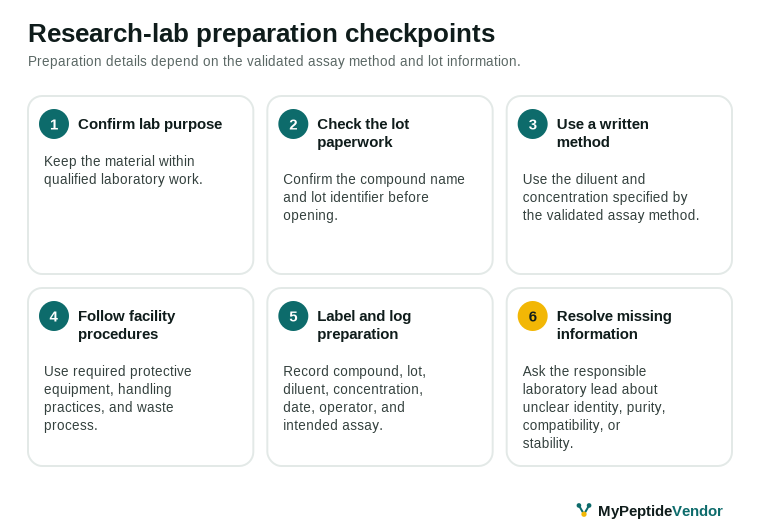
- Confirm the purpose. Keep the material within qualified laboratory work. Reconstituting a research compound does not establish that it is suitable for human use.
- Review the lot record. Confirm the compound name and lot identifier against its paperwork before opening the vial. Record the planned assay and the person responsible.
- Use a written laboratory method. Select a diluent and final concentration only when the laboratory's validated assay method specifies them. There is no clinically validated mixing recipe for human use in the cited literature 58.
- Follow facility procedures. Use the laboratory's required protective equipment, handling practices, and waste process. Do not treat this page as an injection-preparation guide.
- Label every preparation. Record compound, lot, diluent, concentration, preparation date, operator, and intended assay on the container and in the lab record.
- Track aliquots. Record each aliquot's volume and storage history. The number of aliquots from a 5 mg vial depends on the validated assay concentration and planned volume; the vial amount alone does not determine it.
- Pause if key information is missing. Resolve unclear identity, purity, endotoxin status, compatibility, or stability with the responsible laboratory lead before using the material.
Reconstitution volume, concentration, and aliquot count are assay-specific. No single preparation recipe or human-use method is established in the cited literature 58.
Use this chart
Free to reuse with a link back:
Supplies Needed for One Full Vial
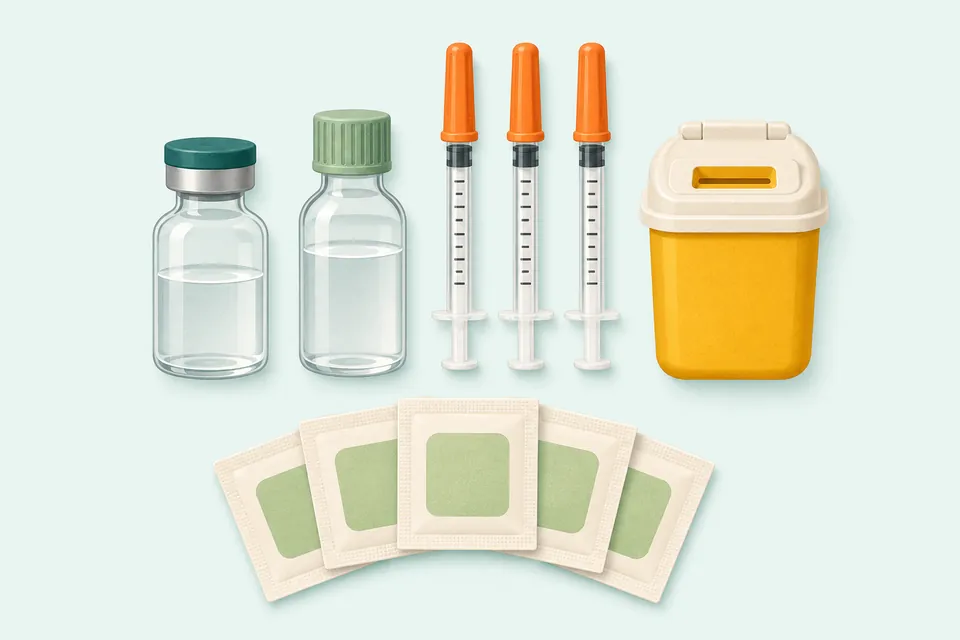
For laboratory work with one 5 mg vial, assemble the items required by the written assay method. The vial amount alone does not specify a diluent volume, aliquot size, or clinical preparation.
- One labeled MGF or PEG-MGF vial, with the lot identifier recorded.
- One lot-specific certificate of analysis, if available, plus the lot's handling information.
- The diluent and volume specified by the validated assay method; no general human-use volume is established.
- One compatible, labeled container for each aliquot required by the experiment; the required count depends on the study design.
- Laboratory gloves and any other protective equipment required by facility procedures.
- Labels and a preparation log for concentration, date, operator, storage location, and temperature or freeze-thaw events.
- The documented assay method and its controls for checking the experimental concentration.
A certificate of analysis can describe tested lot characteristics, but it does not prove clinical safety or suitability for injection. Mass-spectrometry peak processing can affect later identification and quantitation 2.
Protocol Overview and Cycle Notes
MGF is a form of IGF-1 produced through alternative splicing of the IGF-1 gene in skeletal muscle in response to physical activity 5. The review distinguishes its peptide sequence and proposed role from systemic or liver-type IGF-IEa 5.
The proposed roles differ: MGF is described as replenishing satellite cells, while mature IGF-IEa supplies mature IGF-I needed to upregulate protein synthesis 5. Satellite cells are muscle stem cells involved in repair and growth; these biological descriptions do not prove that injecting MGF increases muscle, repairs injury, or improves strength in people.
Age is part of the biological context. The review reports that the ability to produce MGF declines with age alongside circulating growth hormone (GH); it also says GH treatment combined with resistance exercise shifts IGF-1 gene expression toward MGF in older people 5. This review finding is not a recommendation to use GH or MGF, and it does not establish that either reverses age-related muscle loss.
Goldspink's later review describes MGF as activating muscle progenitor cells that provide extra nuclei for hypertrophy, repair, and maintenance, and says this potential has attracted bodybuilder interest and carries potential for abuse 8. A proposed mechanism is not a clinical outcome, and interest among athletes is not proof of benefit.
Evidence tiers: The age and GH context comes from a review of muscle ageing 5. The proposed progenitor-cell role and abuse concern are also review-level discussion 8. A human PEG-MGF dose, measured PEG-MGF half-life, and human treatment effect are not established in the cited literature. The ClinicalTrials.gov excerpt shows six search entries and no PEG-MGF trial among those entries, but does not show all 645 results 10.
Timeline: Goldspink and colleagues reviewed muscle ageing and MGF biology in 2004 5. Their review on growth factors, muscle function, and doping followed in 2008 8. These reviews support biological context and a caution about misuse; they do not provide a human dosing schedule.
Stacking: A human combination dose, interaction profile, or sequencing plan for MGF or PEG-MGF with IGF-1 LR3, GH, or another peptide is not established in the cited literature 58. Combining compounds without clinical guidance adds uncertainty and makes it harder to identify which compound caused an effect.
Common beginner mistakes: Treating vial strength as a dose, assuming an unmeasured half-life, inferring an injection route, and adding another peptide to compensate for an unknown effect all go beyond the evidence described in the reviews 58. A lot certificate can document analytical testing; it cannot establish a human dose or clinical benefit.
Use this chart
Free to reuse with a link back:
Storage and Handling

Follow the storage and stability instructions provided for the exact lot and preparation. A universal storage temperature or post-reconstitution shelf life for every MGF or PEG-MGF formulation is not established in the cited literature 58.
Keep the container identified and separate from materials that could be confused with it. Log the preparation date, storage location, and any temperature excursion or freeze-thaw event. If the lot record does not give a stability period for that preparation, do not invent one.
When reviewing a certificate of analysis, check what the test actually measured, including identity and purity information where provided. Mass-spectrometry peak processing can affect downstream identification and quantitation 2. A laboratory result does not establish sterility, suitability for injection, or a clinical effect.
Injection and Tracking Tips
No human injection route, site, timing, or technique is established in the cited literature for MGF or PEG-MGF 58. This page does not provide injection instructions or translate a research amount into U-100 syringe units. A volume conversion cannot substitute for a dose supported by human evidence.
For laboratory work, track the lot, assay, planned concentration, preparation date, operator, storage history, and any deviation from the written method. Record control conditions beside test conditions so a change in a laboratory readout is not mistaken for a treatment effect in people.
If a person has already used a research peptide, record the product name, lot, amount if known, time, route, and symptoms, then contact a healthcare professional or poison control. Trouble breathing, fainting, or rapidly worsening swelling needs urgent medical attention.
Safety, Side Effects, and Legal Status
Human side-effect frequencies for MGF or PEG-MGF are not established in the cited literature 58. A reliable percentage for injection-site soreness, swelling, or systemic effects cannot be given. Those symptoms can occur with injections generally, but they should not be described as measured MGF-specific rates.
No human data in the cited literature establish hormonal suppression or a specific tumor risk for PEG-MGF 58. These risks are uncharacterized in people, so neither a claim of safety nor a claim of a proven specific harm is justified by the evidence described here.
FDA and compounding: FDA Category 2 is an interim category for nominated bulk drug substances that may present significant safety risks 1. FDA places MGF and PEG-MGF in Category 2, which identifies bulk substances that raise significant safety risks for use in compounding 1. That limited view does not establish FDA approval, compounding eligibility, or permission to market a product for human use.
WADA and sport: No WADA classification or detection window for MGF or PEG-MGF is reported 5, 8, 10. Tested athletes should check the current WADA Prohibited List and ask their anti-doping organization before using any research peptide; a research-use label does not establish sport eligibility.
Goldspink described MGF's potential for abuse and reported bodybuilder interest 8. That warning does not establish a benefit or a safe-use plan. Performance-community interest is not clinical evidence.
A vial label or purity statement cannot establish an approved human dose, safe route, or therapeutic effect. No human dose for MGF or PEG-MGF is established in the cited literature 58; approval status is not addressed by these sources.
Frequently asked questions
What is the correct mgf dosage 5mg?
No human dose for MGF or PEG-MGF is established in the cited literature 58. The 5 mg figure states the vial quantity, not an amount a person should take or inject. Among the six ClinicalTrials.gov MGF search entries, none is a PEG-MGF trial; the search covers 645 registered studies 10.
How much bacteriostatic water should I add to a 5 mg MGF vial?
There is no clinically validated mixing recipe for human use in the cited literature 58. For laboratory work, the diluent and final concentration must come from the written assay method and lot-specific handling instructions.
What is PEG-MGF's half-life?
A measured PEG-MGF half-life is not established in the cited literature. PEGylation is a chemical modification, but that term alone does not show how long the compound remains active in a person or an animal.
Does MGF build muscle in humans?
A muscle-building effect from injected MGF or PEG-MGF in humans is not established in the cited literature 58. The reviews discuss proposed roles in satellite-cell biology and IGF-1 splicing, not a proven treatment outcome.
Can I stack PEG-MGF with IGF-1 LR3?
A human combination dose or safety plan for PEG-MGF with IGF-1 LR3 is not established in the cited literature 58. Combining compounds without clinical guidance adds uncertainty and makes it harder to identify the cause of an unwanted effect.
Is MGF FDA approved or permitted by WADA?
FDA Category 2 is an interim safety-risk category, not an approval category 1. The visible rows of the FDA table do not name MGF or PEG-MGF, but the excerpt is incomplete 1. The cited materials do not establish a current WADA classification, so athletes should check the current prohibited list and ask their anti-doping organization.
References
- FDA: Certain bulk drug substances for use in compounding that may present significant safety risks
- Matthiesen et al. LC-MS Spectra Processing. Methods Mol Biol. 2020.
- Voß et al. Roan coat color in livestock. Anim Genet. 2022.
- Mizoguchi et al. Escherichia coli minimum genome factory. Biotechnol Appl Biochem. 2007.
- Goldspink et al. Growth factors and muscle ageing. Exp Gerontol. 2004.
- Liu et al. Neuroprotective mechanisms of mangiferin in neurodegenerative diseases. Drug Dev Res. 2021.
- Di Giammarco et al. Intraoperative graft verification in coronary surgery. J Cardiovasc Med (Hagerstown). 2017.
- Goldspink et al. Growth factors, muscle function and doping. Curr Opin Pharmacol. 2008.
- Fomenko et al. Mangiferin modulation of metabolism and metabolic syndrome. Biofactors. 2016.
- ClinicalTrials.gov: 645 registered studies (search: MGF)
Written by the MyPeptideVendor editorial team from the FDA label, peer-reviewed studies and ClinicalTrials.gov records listed above, fact-checked line by line and reviewed 2026-11-12.
Cite this page
MyPeptideVendor Editorial Team. mgf dosage 5mg: Evidence & Safety. MyPeptideVendor. Updated November 12, 2026. https://mypeptidevendor.com/protocols/mgf-dosing-5mg/MyPeptideVendor Editorial Team. (2026, November 12). mgf dosage 5mg: Evidence & Safety. MyPeptideVendor. https://mypeptidevendor.com/protocols/mgf-dosing-5mg/Related protocols
CJC-1295 DAC 2 mg
Research UseA 2 mg vial is not an approved human dose; this guide covers the evidence gap, vial math, and safety questions to review with a clinician.
View protocolCJC-1295 DAC 5 mg
Research UseNo approved human dose exists for CJC-1295 DAC; this guide explains 5 mg vial math, research limits, monitoring, and safety questions.
View protocolCJC-1295 No DAC 5 mg
Not approvedNo approved human dose exists for CJC-1295 No DAC; this guide explains 5 mg vial math, evidence limits, and safety questions to raise with a clinician.
View protocol