K-Copper Peptide: Evidence, Uses & Safety
Copper-binding signaling peptide
Brand names: No FDA-approved drug brand; cosmetic brand names vary.
K copper peptide usually refers to GHK-Cu, a copper-binding peptide made from glycine, histidine, and lysine. GHK occurs naturally in human plasma, and the complex is used in some topical skin-care products.
The skin-care idea is plausible: GHK-Cu may deliver copper and influence tissue-repair signals. But human evidence is limited, and injectable GHK-Cu is not an FDA-approved drug. A cosmetic serum is not proven to erase wrinkles, tighten loose skin, or replace a prescribed treatment.
Key takeaways
- GHK-Cu is a copper complex of the tripeptide glycyl-L-histidyl-L-lysine 4.
- The ClinicalTrials.gov search for “K-Copper” returned 45 records; the listed records are unrelated to GHK-Cu 2.
- No GHK-Cu human trial with a sample size, duration, control group, and numerical skin outcome is identified in 2.
- Cosmetic labels may list the ingredient as copper tripeptide-1; that name does not disclose its concentration.
- There is no FDA-approved GHK-Cu injection dose; injectable GHK-Cu is not an FDA-approved drug.
K-Copper at a glance
- Class
- Copper-binding signaling peptide
- Mechanism
- Binds copper and may influence tissue-repair signals, including proposed collagen and elastin pathways.
- FDA Status
- No FDA-approved GHK-Cu drug product; topical products are sold as cosmetics.
- Brand names
- No FDA-approved drug brand; cosmetic brand names vary.
- Administration
- Topical serum or cream; injectable products are not FDA-approved drugs.
- Typical Dose
- No established clinical dose or effective topical percentage; follow cosmetic product directions.
- Half-life
- A clinically useful human half-life has not been established.
- Primary Uses
- Cosmetic skin care; tissue-repair effects are under study.
What is it?

GHK-Cu is a complex of GHK, a short chain of three amino acids, and a copper ion. Its full chemical name is glycyl-L-histidyl-L-lysine copper. GHK occurs naturally in human plasma 4. In skin care, the ingredient is often listed as copper tripeptide-1.
The letters “Cu” refer to copper, not to a separate peptide. The peptide binds copper, and the resulting complex is used in cosmetic serums and creams 4. A product listing “copper tripeptide-1” does not, by itself, tell you the concentration, amount of copper delivered, or whether the formula has been tested in people.
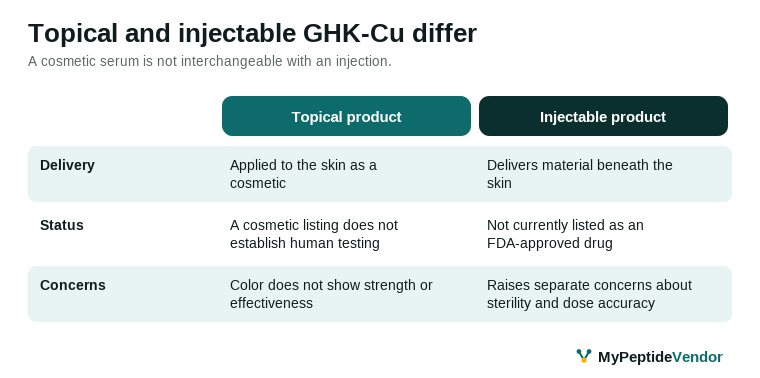
Topical and injectable products are not interchangeable. A serum is applied to the skin as a cosmetic; an injection delivers material beneath the skin and raises separate concerns about sterility, dose accuracy, and regulatory status. Injectable GHK-Cu is not currently listed as an FDA-approved drug.
A blue or blue-green tint can come from the copper-containing complex. Color is not a strength test: a darker serum does not prove that it contains more active peptide or works better. Packaging, marketing terms, and color cannot replace a disclosed concentration or human outcome data.
Use this chart
Free to reuse with a link back:
What makes it different
That two-part explanation differs from Matrixyl-type signal peptides, which are marketed mainly as messengers to skin cells.
It is also different from vitamin C. Vitamin C is an antioxidant used in topical products for concerns such as uneven tone; GHK-Cu is a peptide-copper complex. The ingredients may appear in the same general skin-care routine, but they have different chemistry and should not be treated as equivalent treatments.
Claims for GHK-Cu reach beyond skin appearance, including hair growth, wound repair, and changes in gene activity. A laboratory finding is a reason to study an ingredient, not proof that a cosmetic product treats a disease.
The central practical difference is the size of the evidence base. Retinoids have a more established clinical role for photoaging than GHK-Cu, while the strength of evidence for a peptide serum depends on the specific ingredient, formula, and human testing. No reliable head-to-head result establishes that GHK-Cu beats retinoids or Matrixyl.
How does it work?
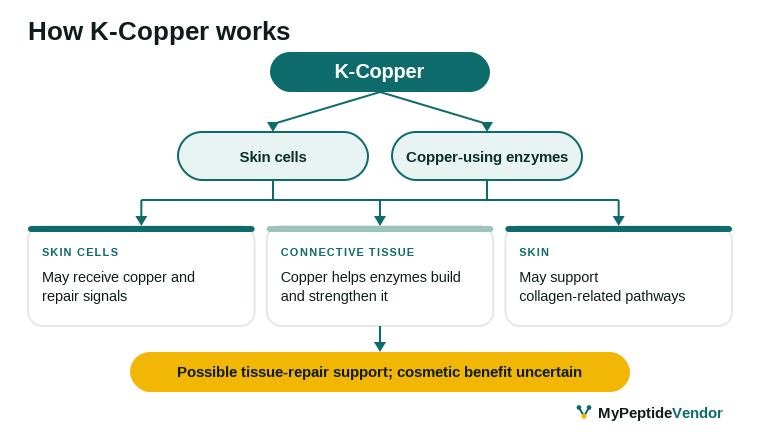
In plain words, GHK-Cu may carry copper to cells and signal them to support tissue repair. Copper helps enzymes involved in building and strengthening connective tissue.
Collagen gives skin much of its strength, elastin helps it spring back, and glycosaminoglycans help tissue retain water. The proposed effect is not an instant filler effect. It would depend on cells responding over time, and a topical product would first need to reach the relevant skin layers in a useful amount.
Researchers also discuss GHK-Cu in relation to tissue remodeling, inflammation, and antioxidant defenses 4. These are biological findings, not proof that applying a serum repairs DNA, treats pain or anxiety, prevents cancer, or changes gene activity in a clinically useful way.
Several practical links remain uncertain: how much peptide in a specific formula crosses the outer skin barrier, how much reaches living tissue, and whether that amount changes visible wrinkles or firmness. A blue tint cannot answer those questions, and a product’s concentration alone would not prove that it reaches its target.
Use this chart
Free to reuse with a link back:
What the clinical evidence actually shows

The evidence story is much stronger for biological plausibility than for a predictable cosmetic result. Laboratory and animal work supports studying collagen-related pathways and tissue repair 4, but it cannot tell a consumer how much a particular serum will change facial lines or firmness.
No named GHK-Cu human trial with sample size, duration, control group, and numerical skin outcome is identified in 2. That means there is no reliable number to quote from that search for wrinkle reduction, increased firmness, or the share of users who notice a benefit. Do not treat a before-and-after photo or a marketing claim as a controlled trial result.
A ClinicalTrials.gov search for “K-Copper” returned 45 records, of which six are displayed in 2. The records listed in the search results concern other topics, not GHK-Cu 2. “K-Copper” is not a precise GHK-Cu search term, so those records cannot prove that no GHK-Cu trial exists; a peptide-specific registry and publication search is needed to identify relevant studies.
By claim: collagen and elastin effects are proposed from laboratory work 4, but human cosmetic benefit is not quantified; wound-healing claims need condition-specific human results; and hair-growth claims lack a verified numerical outcome in the ClinicalTrials.gov results 2. No GHK-Cu human trial for a specific indication is identified in those results 2.
Because named trial details and reliable numerical results are not established, a set timeline for visible change cannot be promised. If someone chooses a topical product, judging it over a few applications is unlikely to answer whether it helped. There is no verified study duration or minimum time to measurable improvement to use as a benchmark.
Typical dosing

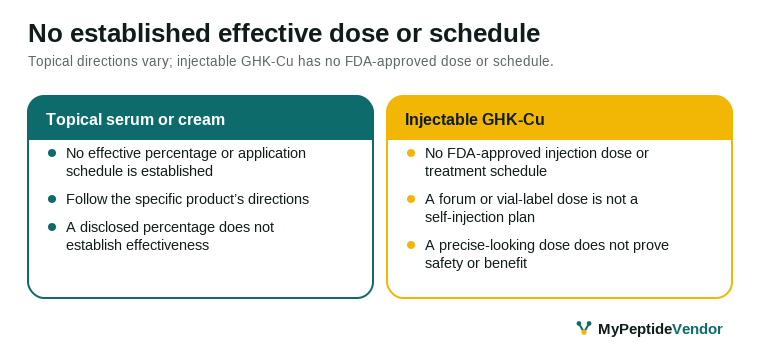
Topical serum or cream: no evidence-based percentage or application schedule has been established as effective for a cosmetic outcome. Product concentrations and directions vary, and there is no verified minimum effective percentage to compare with a label. Follow the specific product’s directions rather than copying a concentration or schedule from an online post.
Injectable GHK-Cu: there is no FDA-approved injection dose or approved treatment schedule. Do not use a dose from a forum, vial label, or “research use” listing as a self-injection plan. A dose that appears precise is not proof that it has been studied for safety or benefit.
For label reading, check for the INCI name copper tripeptide-1, directions that clearly specify topical use, and a disclosed concentration if the maker provides one. A disclosed percentage still does not establish effectiveness. Be cautious with products that promote injection, promise disease treatment, or use phrases such as “professional strength” without clear product information.
There is no established daily copper amount from a typical GHK-Cu serum that can be used to assess total exposure. A product’s ingredient list also does not say how much copper is absorbed through skin. Do not assume that adding a serum to a copper-containing supplement is either harmful or risk-free based on the label alone.
Use this chart
Free to reuse with a link back:
Side effects: what to actually expect
With a topical serum, the practical concerns are local irritation or an allergic reaction: stinging, redness, itching, dryness, or a rash. These symptoms can come from the full formula, including fragrance or other active ingredients, not only from GHK-Cu. Reliable side-effect percentages from GHK-Cu trials or product labels have not been established, so a numerical risk estimate would be misleading.
Introduce one new product at a time and try a small amount on a limited area first. If you tolerate it, follow the product directions and avoid adding several new active ingredients at once; that makes it easier to identify what caused a reaction. Stop if burning persists, redness worsens, or swelling or hives appear. Seek medical advice for a severe or lasting reaction.
There is no established evidence that copper sensitivity or Wilson disease is a formal contraindication to every topical GHK-Cu product. A person with a copper-metabolism disorder should ask a clinician before use, particularly before considering an injectable product. Pregnancy and breastfeeding safety have not been established, so ask a clinician rather than assuming a naturally occurring peptide is safe in those settings.
Injectable products add risks that a patch test cannot address, including contamination, sterility failures, and dosing errors. A cosmetic serum’s safety record cannot be used to establish the safety of injecting the same named ingredient. Do not inject a product marketed for topical use or labeled for research.
There is no verified universal rule that GHK-Cu must not be combined with retinoids, vitamin C, or exfoliating acids. Still, introducing one active at a time is a practical way to spot irritation. If a routine causes burning or persistent redness, pause the newest product and ask a dermatologist before restarting it.
Regulatory & access status in the US
Injectable GHK-Cu is not an FDA-approved drug. Cosmetic availability does not mean the FDA has approved a product to treat wrinkles, wounds, hair loss, or another medical condition.
FDA explains that Category 2 bulk substances are substances identified as potentially presenting significant safety risks in compounding. The FDA Category 2 list in 1 includes cesium, chloral hydrate, diethylstilbestrol, domperidone, and edetate disodium 1.
That distinction matters for anyone offered a compounded injection. A clinic or online seller offering a vial does not establish FDA approval, lawful compounding, or drug-quality standards. The FDA Category 2 list in 1 does not address whether injectable GHK-Cu is lawful to buy or compound. Ask the prescriber and pharmacy to explain the product’s regulatory basis, source, sterility controls, and intended use before considering it.
For a topical product, read the full ingredient list and intended-use directions. A serum sold as a cosmetic is not interchangeable with a compounded drug. Do not use an injectable product labeled “research use only” on yourself, and do not treat an online dosing protocol as an approved prescription.
Research-grade K-Copper is available from Certified-Pep. Sold for laboratory research only, not for human use. Affiliate link
How it compares to its closest alternatives
The comparison below separates ingredient type from strength of human evidence. No verified head-to-head trial establishes that GHK-Cu outperforms retinoids, vitamin C, or Matrixyl, and the response to any cosmetic product depends on its formula and the person using it 4.
| Option | Main role | Evidence and expected timing | Irritation and practical note |
|---|---|---|---|
| Topical GHK-Cu | Copper delivery and proposed tissue-repair signaling | Mostly laboratory and animal support; no dependable human onset time established | Possible local irritation; concentration and outcome data may be unclear |
| Topical retinoid | Photoaging and skin-cell turnover | More established clinical role for photoaging; changes develop gradually | Dryness, peeling, or irritation can occur; a clinician can help select an appropriate product |
| Vitamin C | Antioxidant skin care and uneven-tone concerns | Results depend on the formula; it is not a peptide or a direct substitute for GHK-Cu | Some formulas sting; product stability and tolerance matter |
| Signal peptides such as Matrixyl | Marketed to signal skin-support pathways | Evidence varies by peptide and product; no proven equivalence to GHK-Cu | Possible irritation depends on the full formula |
If your main goal is photoaging treatment, a dermatologist can discuss options with a more established clinical role, including retinoids. If you try GHK-Cu, treat it as an optional cosmetic ingredient with uncertain benefit, not as a replacement for sunscreen, wound care, or prescribed treatment.
For reactive skin, pregnancy or breastfeeding, or a known copper-metabolism condition, discuss the product with a clinician before use. For an adult who simply wants to try a cosmetic serum, choose a clearly labeled topical product, patch-test it, and stop if irritation outweighs any perceived benefit.
Where to Buy K-Copper for Research
Certified-Pep
US-made research peptides with batch-specific lab reports (COA) and a QR code on every vial.
- Independent laboratory testing (Vanguard Laboratory)
- Made in the USA, ships in 1-2 business days
- Research use only, not for human or veterinary use
Affiliate disclosure: we may earn a commission if you order through the link above. K-Copper is not approved by the FDA for human use.
Frequently asked questions
What does the GHK-Cu peptide do for you?
GHK-Cu is studied for copper binding and tissue-repair signaling, including proposed effects on connective-tissue proteins 4. That makes it a plausible cosmetic ingredient, but it does not establish a predictable change in skin appearance.
What are the negative side effects of GHK-Cu?
A topical formula can cause local irritation or an allergic reaction, and there are no reliable percentage estimates from GHK-Cu trials or labels. Injectable use raises additional concerns about product sterility and dose accuracy.
Do copper peptides actually work?
GHK-Cu has biological activity in laboratory and animal research 4, but that is not the same as proving a visible benefit from a particular serum. No verified head-to-head result shows that it beats retinoids or signal peptides such as Matrixyl.
Is GHK-Cu real or fake?
GHK-Cu is a real copper-binding peptide, and copper tripeptide-1 is a name to look for on cosmetic labels. The ingredient’s existence does not prove every product claim, and injectable GHK-Cu is not an FDA-approved drug.
References
- FDA: Certain bulk drug substances for use in compounding that may present significant safety risks
- ClinicalTrials.gov: 45 registered studies (search: K-Copper)
Written by the MyPeptideVendor editorial team from the FDA label, peer-reviewed studies and ClinicalTrials.gov records listed above, fact-checked line by line and reviewed 2026-11-12.
Cite this page
MyPeptideVendor Editorial Team. k copper peptide: Evidence, Uses & Safety. MyPeptideVendor. Updated November 12, 2026. https://mypeptidevendor.com/peptides/k-copper/MyPeptideVendor Editorial Team. (2026, November 12). k copper peptide: Evidence, Uses & Safety. MyPeptideVendor. https://mypeptidevendor.com/peptides/k-copper/Related peptides
Argireline (Acetyl Hexapeptide-3)
Not approvedA small 4-week trial found wrinkle improvements, but lasting effects, ideal concentration, and Argireline-specific side-effect rates remain unknown.
Learn moreAHK-Cu
Not approvedAHK-Cu has early lab findings related to hair follicles, but human hair benefits, safe dosing, and side-effect rates are not established.
Learn moreAHK (Tripeptide-3)
Not establishedAHK-Cu is a copper tripeptide used as a cosmetic ingredient, but human hair-growth benefit and a proven scalp dose remain unestablished.
Learn more