Tripeptide-29: Evidence, Uses & US Status
Topical cosmetic peptide
Brand names: Tripeptide-29; no established drug brand

Tripeptide-29 is a synthetic skincare peptide made from glycine, proline, and hydroxyproline, often shortened to Gly-Pro-Hyp. Its cosmetic ingredient name is Tripeptide-29 1.
It is marketed for collagen support, fine lines, plumping, firmness, uneven texture, and the look of dehydration 14. Those are cosmetic claims, not proof of a visible result in people.
Key takeaways
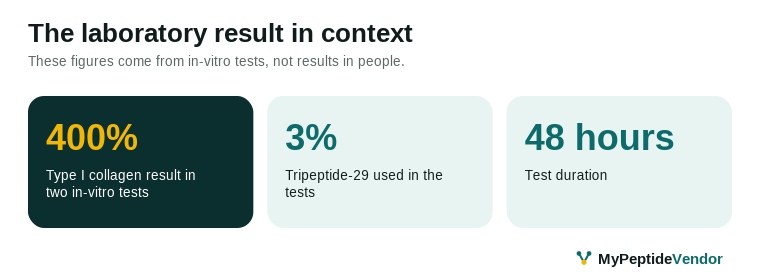
- A lab test reported 400% higher type I collagen synthesis after 48 hours with 3% Tripeptide-29; this was in vitro, not a human skin result 3.
- The typical cosmetic use level is 0.1–1%, but no human treatment dose has been established 14.
- The supplier guidance calls for water-phase addition, a compatible pH of 4.0–7.0, and temperatures no higher than about 50°C 1.
- No human clinical result establishes how much it changes wrinkles, firmness, texture, or sagging 35.
- The FDA Category 2 compounding page does not establish Tripeptide-29 approval or a specific 503A/503B status 1.
Tripeptide-29 at a glance
- Class
- Topical cosmetic tripeptide
- Mechanism
- Proposed collagen-related cell signal
- FDA Status
- Not an FDA-approved drug treatment for wrinkles or skin laxity
- Brand names
- Tripeptide-29; no established drug brand
- Administration
- Topical use in a finished cosmetic formula
- Typical Dose
- Cosmetic formulation level: 0.1–1%; no human clinical dose established
- Half-life
- Not established for topical use
- Primary Uses
- Appearance claims involving fine lines, firmness, texture, plumping, and dehydration
What is it?

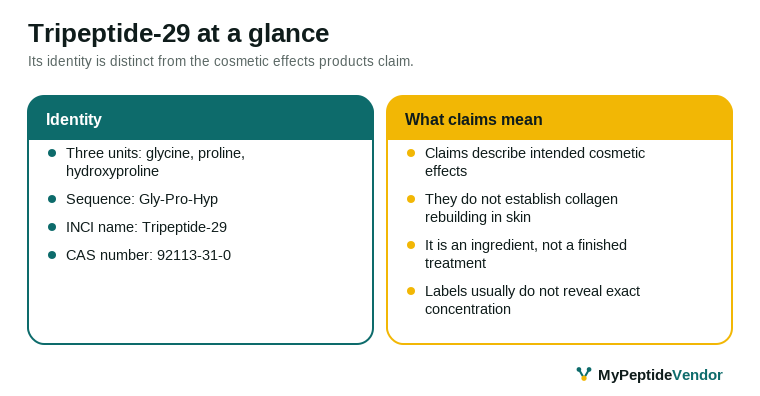
Tripeptide-29 is a synthetic peptide made from three linked units: glycine, proline, and hydroxyproline. The sequence is written Gly-Pro-Hyp. Tripeptide-29 is its INCI name, the standardized name used on cosmetic ingredient labels, and 92113-31-0 is its CAS number 13.
Skincare products use it for claims about collagen synthesis, anti-wrinkle effects, plumping, firmness, texture, and the appearance of dehydration. These describe intended cosmetic effects. They do not establish that the ingredient rebuilds collagen in a person’s skin or treats a medical condition.
It is an ingredient, not a finished treatment. A serum or cream may include many other ingredients, and its label usually does not reveal the exact Tripeptide-29 concentration. A raw solution or powder is a formulation material, not automatically a ready-to-use skincare product 1.
Use this chart
Free to reuse with a link back:
What makes it different
Gly-Pro-Hyp resembles a short sequence associated with collagen. The proposed idea is that skin may read a collagen-related fragment as a signal to make more collagen. That idea is biologically plausible, but a lab response does not show that a topical formula produces the same effect on a person’s face 3.
That result came from in-vitro tests, meaning experiments outside a living person; it is not a 400% improvement in skin, wrinkles, or firmness.
Finished-product concentration and raw-material concentration are not interchangeable. A supplier may sell a solution or powder, and the percentage of active peptide in a supplied solution may differ from the amount of raw powder added to a formula. Check the specific product’s documentation rather than assuming that the same listed percentage means the same active amount 1.
How does it work?
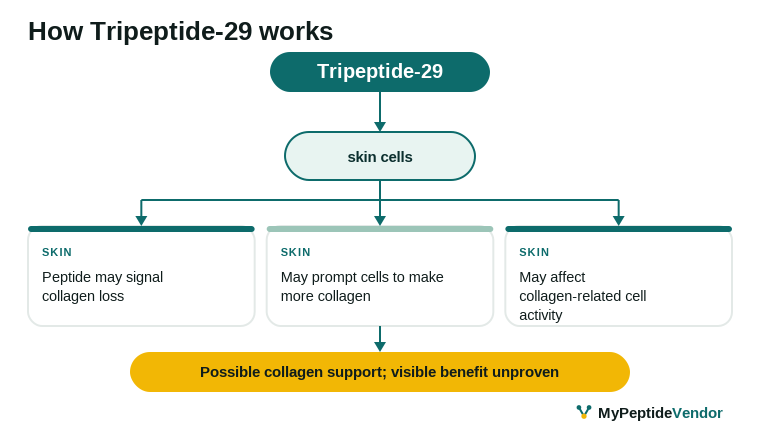
In plain words, the theory is that a small collagen-related peptide could tell skin cells that collagen has been lost and prompt them to make more. That is a proposed signal, not a proven response to a face cream in people 3.
More technically, the peptide is proposed to affect collagen-related cell activity. A test-tube result cannot show how much intact peptide gets through the outer skin, whether it reaches the relevant cells, or whether any change is large enough to see. It also cannot establish how long a person would need to use a product.
For formulation, the supplier describes Tripeptide-29 as water-soluble and recommends adding it to the water phase. That is supplier formulation guidance, not a clinical use instruction.
Use this chart
Free to reuse with a link back:
What the clinical evidence actually shows

Human clinical trial results establishing that Tripeptide-29 improves wrinkles, firmness, texture, dehydration, or sagging are not presented here, and no participant count, treatment duration, or percentage improvement in people is reported.
The 400% type I collagen result came from two in-vitro tests using 3% Tripeptide-29 for 48 hours 3. Think of this as an early laboratory signal, not a forecast of what a person might see after a month or a year. No ex-vivo results (testing on excised human or animal tissue) or human trial results are established for this peptide.
Paula’s Choice lists three references: Amino Acids (2018), pages 29–38; Journal of Cosmetic Dermatology (2016), pages 514–519; and Journal of the Society of Cosmetic Scientists of Korea (2010), pages 65–69 4. The ingredient page gives no study titles, participant numbers, treatment lengths, designs, or numerical outcomes for those references. Those details cannot be inferred from journal names and page ranges alone.
So the practical unanswered questions are substantial: whether enough peptide reaches living skin, whether it makes a visible difference, how long that would take, and whether any benefit lasts after stopping. There is also no evidence here that Tripeptide-29 specifically lifts sagging skin. Fine lines and surface texture are different concerns from deeper skin laxity.
Use this chart
Free to reuse with a link back:
Typical dosing

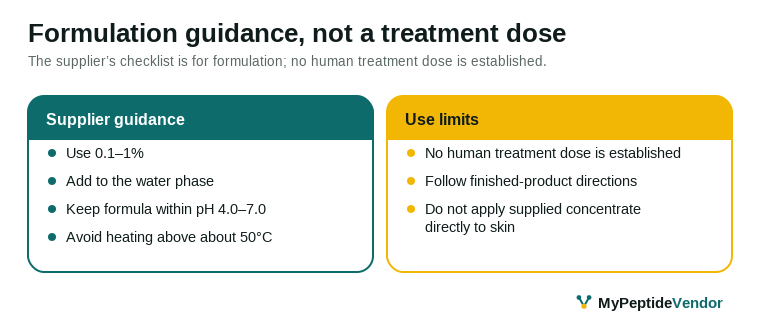
There is no human treatment dose because a clinical regimen has not been established. A formulation percentage is not a dose proven to work in a clinical trial 14.
For a finished product, follow its directions rather than trying to calculate a peptide dose from the ingredient list. Ingredient order does not give an exact concentration. For a raw ingredient, use the supplier’s specific technical information, since a powder and a diluted solution may not contain the same active concentration 1.
The supplier’s formulation checklist is: use 0.1–1%; add to the water phase; keep the formula within pH 4.0–7.0; and avoid heating above about 50°C 1. Do not apply the supplied concentrate directly to skin; it is intended for use in a formulation.
Use this chart
Free to reuse with a link back:
Side effects: what to actually expect
No Tripeptide-29 human trial or drug label provides a percentage for irritation, allergy, or other side effects. With no human trial results to report, there is no reliable reaction rate to quote 35. That does not prove that reactions cannot happen.
Redness, itching, burning, or swelling may come from the peptide, another ingredient, or the finished formula as a whole. Stop using a product if a reaction persists or worsens; get medical help for severe swelling or trouble breathing.
Do not test raw powder or concentrate directly on your face. A cosmetic ingredient is not the same as a finished product assessed for its intended use, and the supplier specifically says not to apply its concentrate directly to skin 1.
Regulatory & access status in the US
Tripeptide-29 is not an FDA-approved drug for wrinkles, collagen loss, or sagging skin. A cosmetic product marketed for appearance is not thereby an approved treatment for a disease or medical condition.
Tripeptide-29 is not listed in FDA Category 2 for 503A or 503B use, so it should not be presented as approved for compounding, injection, or other medical use 1.
Consumers can look for finished skincare through brand websites and beauty retailers, then check the ingredient label for “Tripeptide-29.” Cosmetic-ingredient suppliers sell raw materials for formulation; before buying bulk material, ask for a safety data sheet (SDS), a certificate of analysis (COA), and clear information on identity, concentration, and intended use. These checks do not make raw material suitable for direct application.
A supplier disclaimer may say that statements have not been evaluated by the FDA and that the product is not intended to diagnose, treat, cure, or prevent disease. That is a disclaimer, not evidence that a product works or a substitute for an FDA approval.
How it compares with its closest alternatives
These ingredients are not interchangeable, and there is no head-to-head human trial here showing which is best for sagging skin. The evidence and formulation details below are broad distinctions, not proof that one ingredient produces better results.
| Ingredient | Proposed role | Evidence for visible human results | Formulation note |
|---|---|---|---|
| Tripeptide-29 | Gly-Pro-Hyp sequence proposed to signal collagen-related activity | In-vitro result only; no human clinical outcome established | Supplier guidance: water phase, pH 4.0–7.0 |
| Palmitoyl Tripeptide-1 | Signal peptide used in cosmetic formulas | No direct comparison with Tripeptide-29 established | Check the specific product’s formula guidance |
| Copper Tripeptide-1 | Copper-binding peptide used in skincare | No direct comparison with Tripeptide-29 established | Do not assume it has the same compatibility needs |
| Matrixyl | Trade name used for peptide-based cosmetic ingredients | No direct comparison with Tripeptide-29 established | Check which specific Matrixyl ingredient is listed |
For visible skin laxity, no peptide can be called “best” on the evidence available here. Sun protection and a dermatologist’s assessment are more useful starting points than choosing a product by the word “peptide.”
FAQ
Can it be layered with other skincare? There is no Tripeptide-29-specific compatibility trial for combining it with retinoids, acids, vitamin C, or other peptides. Follow the finished product’s directions, and use the supplier’s pH guidance when formulating 1.
| Combination | Practical guidance |
|---|---|
| Other peptides | There is no universal ban; follow each product’s directions. |
| Retinoids | No specific Tripeptide-29 conflict is established; introduce products cautiously if your skin is sensitive. |
| AHAs, BHAs, or low-pH vitamin C | Use caution when combining in one formula. A low pH may fall outside the stated pH 4.0–7.0 compatibility range. |
| Raw concentrate | Do not apply directly to skin; it is intended for formulation. |
Frequently asked questions
What is Tripeptide-29?
It is a synthetic skincare peptide made from glycine, proline, and hydroxyproline, also called Gly-Pro-Hyp 3. It is used in cosmetics with collagen-support and smoothing claims, but a visible benefit in people has not been established 35.
What peptide is best for sagging skin?
No peptide has been established as the best choice for sagging skin, and Tripeptide-29 has not been shown to lift lax skin 35. For persistent or pronounced laxity, a dermatologist can discuss options suited to your skin and goals.
What should you not mix with peptides?
There is no universal rule against pairing peptides with retinoids, vitamin C, or other peptides. For Tripeptide-29, take particular care with low-pH acids in the same formula because the stated compatible range is pH 4.0–7.0 1.
Where can I buy tripeptides?
For everyday use, look for finished skincare at brand websites or beauty retailers and check the label for the exact peptide name. Raw Tripeptide-29 is sold by cosmetic-ingredient suppliers for formulation; request an SDS and COA, and do not apply raw material directly to skin 1.
References
Written by the MyPeptideVendor editorial team from the FDA label, peer-reviewed studies and ClinicalTrials.gov records listed above, fact-checked line by line and reviewed 2026-11-12.
Cite this page
MyPeptideVendor Editorial Team. tripeptide 29: Evidence, Uses & US Status. MyPeptideVendor. Updated November 12, 2026. https://mypeptidevendor.com/peptides/tripeptide-29/MyPeptideVendor Editorial Team. (2026, November 12). tripeptide 29: Evidence, Uses & US Status. MyPeptideVendor. https://mypeptidevendor.com/peptides/tripeptide-29/Related peptides
Argireline (Acetyl Hexapeptide-3)
Not approvedA small 4-week trial found wrinkle improvements, but lasting effects, ideal concentration, and Argireline-specific side-effect rates remain unknown.
Learn moreAHK-Cu
Not approvedAHK-Cu has early lab findings related to hair follicles, but human hair benefits, safe dosing, and side-effect rates are not established.
Learn moreAHK (Tripeptide-3)
Not establishedAHK-Cu is a copper tripeptide used as a cosmetic ingredient, but human hair-growth benefit and a proven scalp dose remain unestablished.
Learn more