Glutathione Injections: Evidence, Risks & Status
Antioxidant tripeptide
Brand names: No FDA-approved brand for these uses.
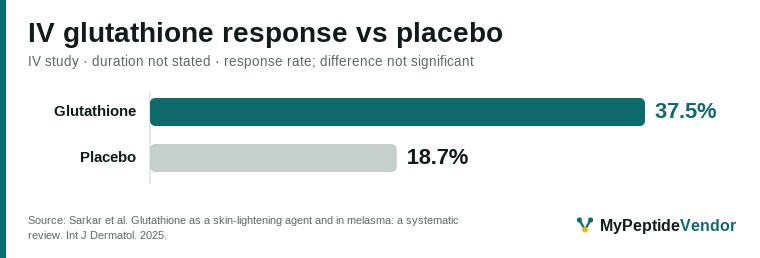
Glutathione injections are compounded IV or IM products commonly promoted for skin brightening, detox, antioxidant support, and immunity. The strongest controlled injection finding is uncertain: one placebo-controlled IV study reported a response in 37.5% of participants receiving glutathione and 18.7% receiving placebo, but the difference was not statistically significant (p=0.054) 3.
There is no established injection dose, session schedule, or reliable timeline for a skin-tone change 3. Oral and topical studies provide some evidence about those routes, but their results do not prove that injections work 349.
Key takeaways
- One placebo-controlled IV study found 37.5% responders with glutathione and 18.7% with placebo; the difference was not statistically significant (p=0.054) 3.
- In a 4-week oral trial with 60 students, 500 mg per day beat placebo at 2 of 6 skin measurement sites 4.
- In a 6-month oral trial with 54 adults, 1,000 mg per day increased some measured glutathione levels by 30–35%; levels returned to baseline after a 1-month washout in most cases 5.
- Controlled evidence has not established how quickly IV or IM glutathione changes skin tone, or how long a possible effect lasts 3.
- Compounded glutathione is not FDA-approved for skin lightening, detox, or general wellness use.
Glutathione at a glance
- Class
- Naturally occurring tripeptide antioxidant
- Mechanism
- Supports cellular antioxidant reactions; its proposed effect on skin pigment has not been shown to make injections reliably lighten skin.
- FDA Status
- Not FDA-approved for skin lightening, detox, or general wellness use; the specific bulk-substance status is not verified by the FDA page cited here.
- Brand names
- No FDA-approved brand for these uses.
- Administration
- Compounded IV or IM injection; glutathione is also used in oral supplements and topical products.
- Typical Dose
- No established injection dose. Oral skin studies used 250–500 mg per day; a body-store trial tested 250 or 1,000 mg per day.
- Half-life
- A clinically useful half-life for injected glutathione has not been established in the cited human studies.
- Primary Uses
- Marketed for skin brightening, detox, antioxidant support, and immunity; evidence does not establish these as effective injection treatments.
What is it?

Glutathione is a small tripeptide, a molecule made from three amino acids: glutamate, cysteine, and glycine. The body makes it inside cells. It helps cells manage oxidative stress, the chemical wear that can occur as the body uses oxygen and processes nutrients 5.
Glutathione also takes part in normal cell defense and immune processes. Those roles explain why it is marketed as an antioxidant and for immune support. They do not show that an injection prevents illness, boosts day-to-day energy, or removes harmful substances in a way that improves health 5.
Skin brightening is another common use. Researchers have proposed that glutathione may affect melanin, the pigment that gives skin its color, including the balance between darker eumelanin and lighter pheomelanin. This is a proposed explanation for pigment changes, not proof that injections produce a visible or lasting result 37.
“Detox” is a broad marketing term, not a defined outcome in the skin trials. The clinical studies discussed here measured skin pigmentation or glutathione levels in the body; they did not establish that injections detoxify a healthy person or treat a diagnosed disease 34579.
The skin trials and oral body-store trial discussed here do not establish glutathione injections as treatments for those conditions 34579.
What makes it different
Glutathione is a substance the body already produces, rather than a drug developed to act on one specific receptor or disease. Taking it by mouth, applying it to skin, or injecting it changes how it is delivered; a different route does not by itself mean a better clinical result 5.
Oral glutathione passes through the digestive tract. A topical product is placed on the skin. IV administration puts a product into a vein, while IM administration places it into muscle. These routes should not be treated as interchangeable: the human studies used different doses and measured different outcomes 3459.
The cited human evidence does not provide a head-to-head pharmacokinetic comparison showing how much glutathione reaches the blood or tissues after IV, IM, and oral dosing. So the common claim that injections are better absorbed, or work faster, is not established by these skin trials or the oral body-store trial 345. Even a higher or faster blood exposure, if demonstrated, would not alone prove better skin results.
Oral glutathione has measurable effects on body glutathione levels in one controlled study. That does not establish that oral products and injections have the same effects, or that raising a laboratory measure leads to a benefit a person can feel 5. Topical findings are local: they concern treated skin and cannot be used as evidence that an injection changes skin throughout the body 39.
IV and IM products also involve an injection or infusion and a compounded preparation. That creates practical questions about the exact dose, product quality, pharmacy, and administration that do not arise in the same way with a topical cream or capsule. The clinical studies reviewed do not establish a standard injection protocol 3.
How does it work?
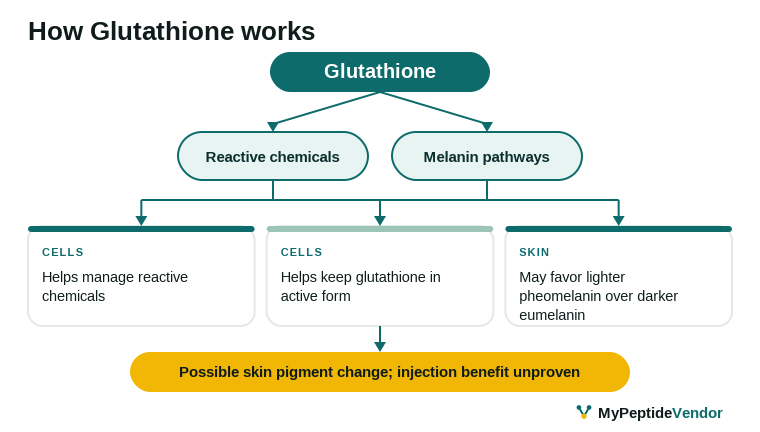
In plain terms, glutathione helps cells manage some of the reactive chemicals made during ordinary metabolism. It takes part in antioxidant reactions and helps maintain glutathione in its active, reduced form. In one oral trial, the ratio of oxidized to reduced glutathione in whole blood fell after treatment, a laboratory finding consistent with less oxidative stress; it does not show that injections prevent disease 5.
For skin pigment, researchers have proposed that glutathione may influence pigment-making pathways and favor production of lighter pheomelanin over darker eumelanin. This possible shift in melanin production is a mechanism hypothesis; it does not predict how much an individual’s skin will change or whether a change will last 37.
IV glutathione enters a vein, while IM glutathione is injected into muscle. Neither route has an established skin-lightening schedule. The 2025 review found only one placebo-controlled IV study, and its difference in response between treatment and placebo did not reach statistical significance 3.
Claims about faster or greater absorption from injections need human route-comparison data. The cited research does not provide a head-to-head pharmacokinetic study of injected versus oral glutathione, so it cannot confirm how much more reaches the bloodstream or whether any difference matters to skin or health 345.
For someone considering an injection, the key point is that entering the bloodstream is a delivery route, not proof of a useful clinical effect. The IV skin study did not show a statistically significant advantage over placebo, and the reviewed evidence does not establish a corresponding IM benefit 3.
Use this chart
Free to reuse with a link back:
What the clinical evidence actually shows

The human evidence points to possible, limited skin changes with oral or topical glutathione, but it does not establish that injections reliably lighten skin. A 2019 systematic review included four skin studies and judged the evidence inconclusive because of study quality and inconsistent findings 9.
IV glutathione: The 2025 review found one placebo-controlled IV study. Six of 16 people given glutathione responded, compared with 3 of 16 given placebo: 37.5% versus 18.7%. The difference was not statistically significant (p=0.054), meaning the study did not establish that glutathione performed better than placebo 3. The review summary does not provide enough detail to establish a dependable injection dose, treatment duration, or time to response.
Oral glutathione for skin: In the Arjinpathana trial, 60 healthy medical students received 500 mg per day in two divided doses or placebo for 4 weeks. All 60 completed the study. Melanin measurements fell at all six sites in the glutathione group, but the difference from placebo was statistically significant at only two sites: the right side of the face (p=0.021) and the sun-exposed left forearm (p=0.036). The investigators said long-term safety had not been established 4.
Oral glutathione and body levels: Richie and colleagues studied 54 nonsmoking adults in a 6-month randomized trial of 250 or 1,000 mg per day of oral glutathione versus placebo. At 1,000 mg per day, glutathione levels rose by 30–35% in red blood cells, plasma, and lymphocytes, and by 260% in cheek cells at the end of treatment. At 250 mg per day, blood levels rose by 17% and red-cell levels by 29%. In most cases, levels returned to baseline after a 1-month washout 5. These are laboratory measures, not proof of a visible skin change or a general health benefit.
The same 6-month study found that natural killer cell cytotoxicity increased more than twofold in the high-dose group compared with placebo at 3 months, in a subset of participants. That immune-cell result is not evidence that people taking glutathione have fewer infections or better everyday immune protection 5.
Topical glutathione: The 2025 review reported that topical 0.5% glutathione performed better than 0.1% glutathione and placebo. It also reported that topical 2% glutathione combined with oral glutathione performed better than either treatment alone. The review found a mix of low- and high-risk-of-bias studies, so these results need cautious interpretation 3.
Glutathione with cystine: In the Duperray trial, 124 Asian women were assigned to four equal groups for 12 weeks. One group took 500 mg of L-cystine plus 250 mg of L-glutathione each day 7. The combination improved skin tone and reduced facial dark-spot size more than placebo, cystine alone, or glutathione alone. This was an oral combination trial, so it does not show what glutathione injections do 7.
Where effects appeared: The 2019 review found that oral glutathione at 500 mg per day and topical 2% oxidized glutathione could brighten sun-exposed skin, but found no significant melanin-index reduction in sun-protected skin. It rated the overall skin evidence inconclusive because of study quality and inconsistent results 9. A result on sun-exposed skin should not be taken to mean that all skin areas will change.
What remains unknown: Controlled research has not established how quickly IV or IM glutathione changes skin tone, how long any injection-related change lasts after the final dose, or whether injections outperform oral or topical products. The return of measured glutathione levels to baseline after a 1-month oral washout cannot tell us how long an injection-related skin effect might last 35.
Oral studies measured skin outcomes over 4 to 12 weeks 47, and the separate Richie body-store trial lasted 6 months 5. These timeframes cannot predict an injection response because the routes and measured outcomes differ.
The table compares separate studies, not direct head-to-head tests. It summarizes the doses, durations, participant numbers, and findings reported for oral, topical, IV, and IM routes 34579.
| Route | Study and amount | Time and participants | Result and evidence limits |
|---|---|---|---|
| Oral | 500 mg per day | 4 weeks; 60 students | Significant versus placebo at 2 of 6 skin sites; small study. |
| Oral | 250 or 1,000 mg per day | 6 months; 54 adults | Raised measured body glutathione; not a skin-outcome trial. |
| Oral combination | 500 mg cystine plus 250 mg glutathione daily | 12 weeks; 124 women | Combination improved tone and spots more than either ingredient alone or placebo. |
| Topical | 0.5% compared with 0.1% and placebo | Duration and sample size not stated in the review summary | 0.5% performed better; study-quality concerns remain. |
| IV | Dose and duration not stated in the review summary | 16 participants in the glutathione group | 37.5% responded versus 18.7% with placebo; difference not statistically significant. |
| IM | No controlled skin-lightening dose established | No controlled IM skin trial identified in the review | Skin effect and timing remain unknown. |
For a simple timeline, oral skin outcomes were measured at 4 weeks in one trial and at 12 weeks in another; the 6-month oral study measured body glutathione rather than skin lightening. No controlled IV or IM timing is established, and oral body levels returned to baseline after a 1-month washout in most cases 457.
Use this chart
Free to reuse with a link back:
Typical dosing

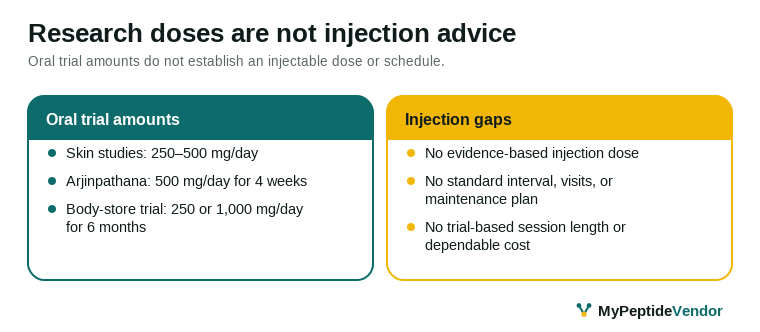
There is no established evidence-based dose for glutathione injections used for skin lightening, detox, or general wellness. The reviewed IV evidence does not establish a reliable amount, interval, number of sessions, or maintenance plan 3. Do not convert an oral research dose into an injection dose.
Oral skin studies used 250–500 mg per day; the Arjinpathana trial used 500 mg per day for 4 weeks 34. The Richie body-store trial tested oral doses of 250 or 1,000 mg per day for 6 months 5. These are oral trial amounts, not injection recommendations.
The Duperray oral combination trial used 500 mg of L-cystine plus 250 mg of reduced glutathione per day for 12 weeks. Because it tested two ingredients together, it cannot establish an effective glutathione-only dose, much less an injectable dose 7.
There is no trial-based standard for session length, how often to inject, or how many visits to book 3. A clinic may describe an IV visit or IM injection as a short appointment, but the studies cited here do not establish a medically appropriate session length or series.
The clinical evidence does not provide a dependable cost range. Clinics set their own prices and may charge differently for an IV visit, an IM injection, or an add-on; ask for the full cost before agreeing to treatment.
Do not use a clinic’s package or proposed schedule as evidence that a course is necessary. Ask what outcome is being measured, when the plan would be reassessed, and what evidence supports the proposed route and dose; no standard injection regimen has been established 3.
Use this chart
Free to reuse with a link back:
Side effects: what to actually expect
No FDA-approved glutathione injection label provides a side-effect rate for cosmetic or wellness use. The IV study and review do not give dependable percentages for specific reactions, and the available evidence is too small to rule out uncommon or serious events 3. A missing percentage is not proof that a reaction cannot occur.
In the 4-week oral Arjinpathana trial, glutathione was described as very well tolerated, but event counts and percentages were not provided 4. The 12-week oral cystine-glutathione trial described its tested regimen as safe, but that finding does not establish the safety of injections or long-term daily use 7.
The 2025 review concluded that IV glutathione was not supported for skin lightening and identified side effects as a concern 3. With only one placebo-controlled IV study in the review, the true frequency of injection-related harms is unknown. The evidence does not give a reliable percentage for allergy, breathing problems, or other specific events 3.
Who needs extra caution: The cited trials do not report safety data in pregnancy or breastfeeding 457. Avoid elective use during pregnancy or breastfeeding unless a clinician who knows the person’s circumstances specifically recommends it after discussing the uncertainty.
People with asthma, liver disease, or a history of serious reactions to injections should discuss the specific product and route with a clinician before use. The cited trials do not establish safety for these groups 347. If you have asthma, do not assume an injectable product has the same risk profile as an oral supplement; ask the prescriber to review your condition and the exact formulation.
Tell the prescriber about every medicine, vitamin, supplement, and herbal product you use. The cited studies do not test drug interactions with injected glutathione 34579. They also do not establish whether people receiving chemotherapy or taking blood thinners should use it, so the clinician managing that treatment should review the decision.
Get urgent medical help for trouble breathing, swelling of the face or throat, fainting, or a rapidly spreading rash after an injection. These can be signs of a serious reaction to an injected product, even when the cause has not been confirmed.
Long-term daily injection safety has not been established. The 6-month oral study measured glutathione in several body compartments and natural killer cell cytotoxicity in a subset; it did not establish long-term injection safety or whether zinc or liver tests should routinely be monitored 5. The study also does not answer whether long-term use affects zinc levels.
Before an injection, use this red-flag checklist: asthma or liver disease; pregnancy or breastfeeding; medicines such as chemotherapy or blood thinners; and a pharmacy or vial whose source, concentration, or storage instructions cannot be verified. Disclose all medicines and supplements to the clinician because the cited trials do not provide interaction guidance 34579.
Regulatory & access status in the US
Glutathione injections are not FDA-approved for skin lightening, melasma, detox, or general immune and antioxidant support. A compounded preparation is not the same as an FDA-approved drug: it has not been FDA-approved for those uses. Access through a compounding pharmacy does not establish that a particular use is effective or that a clinic’s dosing plan has been tested.
The FDA’s bulk-substance page describes categories used when reviewing nominated substances for compounding and identifies potential safety concerns for substances placed in Category 2 1. That page does not establish glutathione’s specific bulk-substance status. Do not infer from the general category description that glutathione is either cleared for compounding or listed as a Category 2 substance 1.
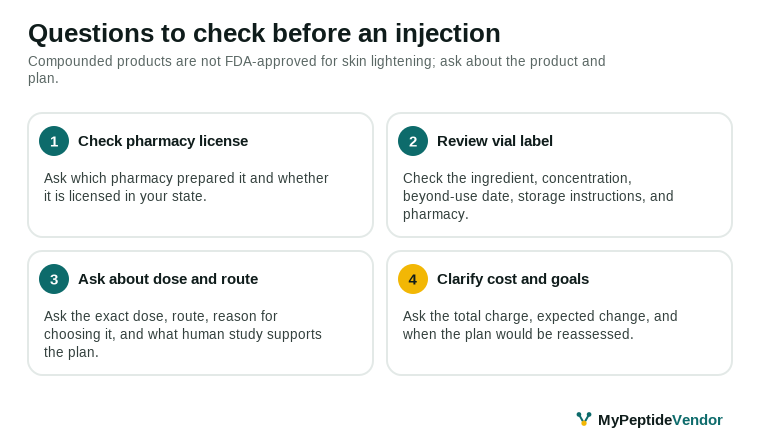
Before considering a compounded injection, ask which pharmacy prepared it, whether that pharmacy is licensed in your state, what the product contains, and how much glutathione is in each dose. Ask whether the preparation came from a state-licensed 503A pharmacy or an FDA-registered 503B outsourcing facility; those designations do not mean FDA approved the product for skin lightening 1.
Check that the vial identifies the ingredient, concentration, beyond-use date, storage instructions, and dispensing pharmacy. Ask the pharmacist how the product should be stored and who to contact about a quality concern. Do not use a vial with missing or unclear labeling, a damaged seal, or a product that does not match the pharmacy’s description.
There is no evidence-based session length, number of visits, or standard price in the clinical trials. Ask the clinic for the total charge, including the product, administration, and follow-up, and ask what result would count as a reason to continue or stop.
Claims that glutathione injections treat male infertility, Parkinson’s disease, or memory loss are not established by the skin trials or oral body-store trial discussed here 34579. The clinical evidence summarized here is not a substitute for a diagnosis or for established treatment of those conditions.
Questions to ask the provider:
- Which pharmacy prepared the product, and how can I verify its license?
- What is the exact dose per injection, the route, and the reason for choosing it?
- What human study supports this dose and schedule for my goal?
- What change should I realistically expect, and when will we reassess?
- Do my asthma, liver disease, pregnancy plans, breastfeeding, medicines, or supplements change the risk?
- What monitoring is appropriate for my health, and who should I contact if I have a reaction?
- What is the full cost, including administration and follow-up?
Use this chart
Free to reuse with a link back:
If you and a clinician decide it fits, one option is Brightmeds Glutathione: prescription glutathione injections with a licensed US provider (US only, not available in California). Affiliate link
How it compares to its closest alternative
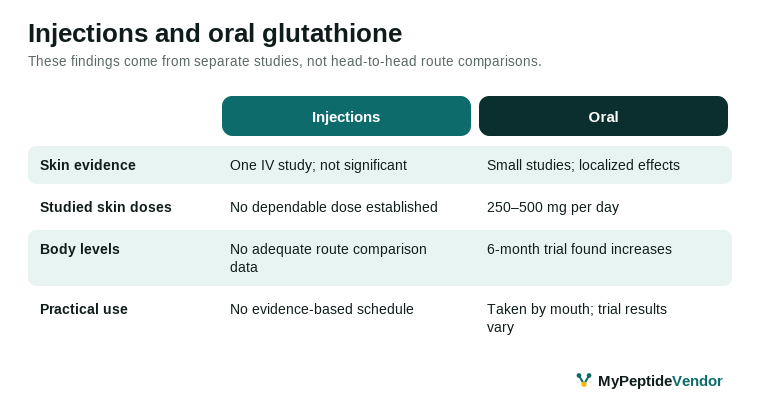
For someone considering an injection, the closest alternative is oral glutathione: it is the same molecule, but oral trials have measured skin outcomes and body glutathione levels. Neither route has strong evidence for a durable, meaningful skin benefit, and oral results do not prove that injections work 3459.
The route comparisons below reflect separate studies rather than head-to-head trials. The oral, topical, IV, and IM findings come from research with different participants, doses, durations, and outcomes 34579.
| Feature | Glutathione injections | Oral glutathione |
|---|---|---|
| Human skin evidence | One placebo-controlled IV study in the review; the response difference was not statistically significant. | Small studies reported limited or localized effects; one trial found a significant difference at 2 of 6 sites. |
| Studied skin doses | No dependable injection dose established by the reviewed evidence. | Skin studies used 250–500 mg per day. |
| Body glutathione levels | Human data adequate to compare injected and oral levels are not established here. | A 6-month trial found increases in several measured body compartments; levels returned to baseline after a 1-month washout in most cases. |
| Practical use | Requires an injection or infusion setting and a compounded product; no evidence-based session schedule is established. | Taken by mouth; trial results do not establish the quality or effect of every commercial supplement. |
| Main uncertainty | Benefit, dose, timing, and duration are unknown. | Skin effects are inconsistent and may be limited to sun-exposed areas; long-term safety for skin use is not established. |
For a localized skin concern, a topical product is another distinct route, not a substitute for medical evaluation. The 2025 review found topical 0.5% glutathione performed better than 0.1% and placebo, while the 2019 review found possible brightening mainly on sun-exposed skin. Neither result establishes a lasting benefit or makes glutathione a proven treatment for a pigment disorder 39.
Use this chart
Free to reuse with a link back:
Where to Get Glutathione Legally
Through your own doctor
Ask your doctor whether this treatment is appropriate and which licensed pharmacy can supply it.
Brightmeds Glutathione
Prescription glutathione injections with a licensed US provider.
- Online consultation with a licensed provider
- Shipped to your home if prescribed
- Ongoing provider support
American Peptides
US-made research peptides, every lot third-party tested with a lot-matched COA.
- ≥99% purity verified by HPLC + mass spec, endotoxin tested
- Ships tracked from Louisiana, free shipping over $300
- 15% off your first order with code MYPEPTIDEVENDOR
Affiliate disclosure: we may earn a commission if you sign up through the link above. It never changes what we write.
Ranked in our guides
Frequently asked questions
What is a glutathione injection good for?
Clinics commonly offer glutathione injections for complexion changes or general antioxidant and wellness goals, but controlled evidence has not established those benefits for injections. In the only placebo-controlled IV skin study, 6 of 16 participants responded, compared with 3 of 16 given placebo; the difference was not statistically significant 3.
How quickly does injectable glutathione work?
There is no reliable controlled timeline for a skin-tone effect after IV or IM glutathione 3. Oral skin studies measured outcomes at 4 and 12 weeks, but those timeframes cannot predict an injection response 47.
Who should not take glutathione injections?
People who are pregnant or breastfeeding should avoid elective use unless their clinician recommends it after reviewing the situation, because the cited trials do not establish safety for those groups 457. People with asthma, liver disease, or medicines that need careful interaction review should speak with a clinician before an injection.
What happens to your body when you start taking glutathione?
Your body already makes glutathione, so taking more does not guarantee that you will feel a noticeable change. In one oral study, measured levels rose during treatment and, in most cases, were back at baseline after a 1-month break; that finding does not tell us what happens after an injection 5.
References
- FDA: Certain bulk drug substances for use in compounding that may present significant safety risks
- Jafari et al. Curcumin on Human Health: A Comprehensive Systematic Review and Meta-Analysis of 103 Randomized Controlled Trials. Phytother Res. 2024.
- Sarkar et al. Glutathione as a skin-lightening agent and in melasma: a systematic review. Int J Dermatol. 2025.
- Arjinpathana et al. Glutathione as an oral whitening agent: a randomized, double-blind, placebo-controlled study. J Dermatolog Treat. 2012.
- Richie et al. Randomized controlled trial of oral glutathione supplementation on body stores of glutathione. Eur J Nutr. 2015.
- Lee et al. Effectiveness of N-acetylcysteine in autism spectrum disorders: A meta-analysis of randomized controlled trials. Aust N Z J Psychiatry. 2021.
- Duperray et al. The effects of the oral supplementation of L-Cystine associated with reduced L-Glutathione-GSH on human skin pigmentation: a randomized, double-blinded, benchmark- and placebo-controlled clinical trial. J Cosmet Dermatol. 2022.
- Tratenšek et al. Oxidative stress-related biomarkers as promising indicators of inflammatory bowel disease activity: A systematic review and meta-analysis. Redox Biol. 2024.
- Dilokthornsakul et al. The clinical effect of glutathione on skin color and other related skin conditions: A systematic review. J Cosmet Dermatol. 2019.
- ClinicalTrials.gov: 1178 registered studies (search: Glutathione)
Written by the MyPeptideVendor editorial team from the FDA label, peer-reviewed studies and ClinicalTrials.gov records listed above, fact-checked line by line and reviewed 2026-11-12.
Cite this page
MyPeptideVendor Editorial Team. Glutathione Injections: Evidence, Risks & Status. MyPeptideVendor. Updated November 12, 2026. https://mypeptidevendor.com/peptides/glutathione/MyPeptideVendor Editorial Team. (2026, November 12). Glutathione Injections: Evidence, Risks & Status. MyPeptideVendor. https://mypeptidevendor.com/peptides/glutathione/Related peptides
Argireline (Acetyl Hexapeptide-3)
Not approvedA small 4-week trial found wrinkle improvements, but lasting effects, ideal concentration, and Argireline-specific side-effect rates remain unknown.
Learn moreAHK-Cu
Not approvedAHK-Cu has early lab findings related to hair follicles, but human hair benefits, safe dosing, and side-effect rates are not established.
Learn moreAHK (Tripeptide-3)
Not establishedAHK-Cu is a copper tripeptide used as a cosmetic ingredient, but human hair-growth benefit and a proven scalp dose remain unestablished.
Learn more