Cartalax Peptide: Evidence, Dosing & Safety
Marketed bioregulatory peptide
Brand names: Cartalax
Cartalax peptide is marketed as a cartilage bioregulator, but no registered human Cartalax trial establishes that it relieves joint pain or regrows cartilage 2.
ClinicalTrials.gov lists NCT06852014, a recruiting study of Peptamen 1.6 in people undergoing pancreatic surgery; it does not study Cartalax 2. There is no Cartalax trial dose, treatment duration, patient result, or adverse-event rate to report from that record.
Key takeaways
- No human Cartalax trial is registered in ClinicalTrials.gov; NCT06852014 studies Peptamen 1.6, not Cartalax 2.
- No evidence-based human dose, route, or treatment schedule has been established for Cartalax.
- FDA’s Category 2 list describes nominated bulk substances that may present significant safety risks; Cartalax is not named in the provided excerpt 1.
- No trial-based Cartalax adverse-event percentages are available in the registry record 2.
- Persistent, worsening, or injury-related joint pain deserves assessment rather than a delay for an unproven peptide.
Cartalax at a glance
- Class
- Marketed bioregulatory peptide
- Mechanism
- Proposed cartilage-cell signaling effects; no human treatment mechanism is established
- FDA Status
- No FDA-approved Cartalax treatment is identified in or
- Brand names
- Cartalax
- Administration
- No clinically established route
- Typical Dose
- No evidence-based human dose
- Half-life
- Not established in humans
- Primary Uses
- Promoted for cartilage and joint support; clinical benefit has not been established
What is it?

Sellers market Cartalax as a cartilage bioregulator peptide. A bioregulator is a proposed signal that may influence how cells behave. That label describes a proposed role, not proof that a product treats joint disease. ClinicalTrials.gov does not provide a Cartalax trial record establishing its identity, origin, or medical use 2.
Cartilage is the smooth tissue covering the ends of bones in many joints. It has no direct blood supply, so nutrients reach its cells mainly by diffusion through surrounding fluid. Its resident cells, called chondrocytes, maintain a supporting framework that includes type II collagen and aggrecan. Collagen provides structure; aggrecan helps the tissue hold water and resist compression. With few cells and limited repair capacity, cartilage damage can be difficult to reverse.
Several processes can contribute to cartilage degeneration. Inflammatory signals such as IL-1β and TNF-α can favor tissue breakdown. Mechanical load, prior injury, aging, metabolic dysfunction, and oxidative stress can also shift the balance between maintaining and degrading the cartilage framework. A proposed effect on cell signaling would not, by itself, remove those drivers or restore a damaged joint.
The St. Petersburg and Khavinson origin sometimes attached to Cartalax cannot be confirmed from the clinical registry record 2. Nor does that record establish a sequence, chemical formula, or molecular weight. A product name, label, or seller’s paperwork can describe what a seller claims is in a vial; none of those details alone shows that a product works in people.
What makes it different
Cartalax is positioned as cartilage-focused rather than as a conventional pain reliever. Its specific molecular target has not been established. That distinction is a theory about how it might act; it does not demonstrate that a dose reaches joint cartilage or changes pain, movement, or imaging results in a patient.
Cartilage biology gives the idea a research rationale, but not a proven treatment effect. A change in a cell marker in a dish would not establish that someone with osteoarthritis grows new cartilage or walks more comfortably. Those outcomes require human studies with a defined product, dose, comparison group, and follow-up. No registered Cartalax study in ClinicalTrials.gov supplies those results 2.
Claims of joint repair, faster recovery, or anti-aging benefit should be treated as proposed uses, not demonstrated outcomes. The available registry record concerns a nutrition product in pancreatic surgery patients, not any of those Cartalax claims 2.
| Claim | What the clinical record establishes |
|---|---|
| Supports cartilage-cell signaling | A proposed rationale; no human treatment effect is established |
| Repairs joints or regrows cartilage | No Cartalax patient result is reported |
| Relieves osteoarthritis pain | No Cartalax pain result or effect size is reported |
| Improves recovery or slows aging | No human outcome is established |
Cell-culture and animal findings can help researchers choose questions for later studies, but no Cartalax-specific cell or animal results are reported 2. Without those details, claims about collagen production, DNA binding, or anti-inflammatory action cannot be presented as established findings.
How does it work?
In plain words, Cartalax is proposed to send a signal that changes how cartilage cells behave. The exact mechanism has not been established in people. A laboratory finding about cell signaling would still need to be linked to a meaningful result, such as less pain or better function, in a controlled human study.
Chondrocytes maintain cartilage’s supporting framework, including type II collagen and aggrecan. If an experiment finds a change in a cell or matrix marker, that can help researchers study cartilage biology. It cannot show that a person makes more healthy cartilage, feels less pain, or moves better. ClinicalTrials.gov does not report those outcomes for Cartalax 2.
Claims that Cartalax binds particular DNA regions, increases collagen production in people, or blocks inflammation should not be treated as established clinical facts. NCT06852014 studies Peptamen 1.6 in pancreatic surgery patients, not Cartalax or a cartilage mechanism 2.
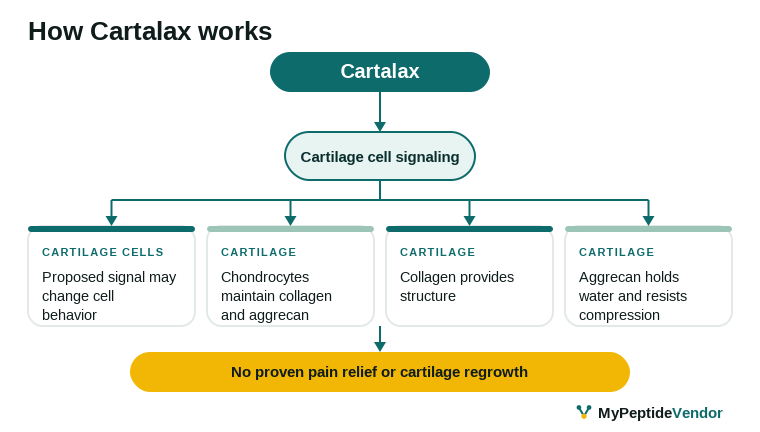
Use this chart
Free to reuse with a link back:
What the clinical evidence actually shows

NCT06852014 is a recruiting mechanistic study of Peptamen 1.6 in malnourished or at-risk patients undergoing pancreatic surgery 2. It does not test Cartalax, cartilage repair, or osteoarthritis. The registry record therefore cannot be used to estimate Cartalax’s benefit or risk.
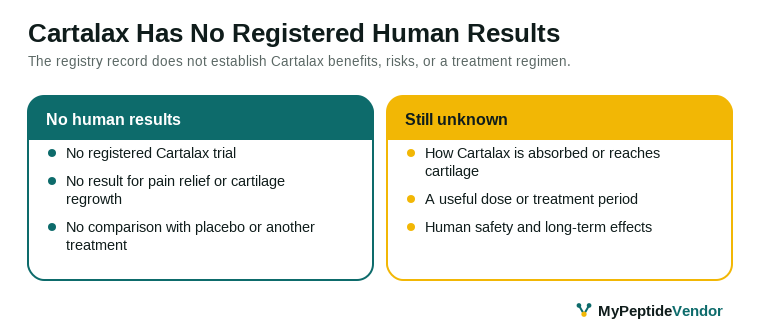
No human Cartalax trial is registered in ClinicalTrials.gov. The registry result gives no Cartalax-treated group, participant count, treatment duration, or numerical outcome 2. There is no registered result showing cartilage regrowth, pain relief, better function, or slower joint degeneration. This absence of registered human evidence does not prove that every possible biological effect is impossible.
Without human outcome data, there is no measured percentage chance of pain relief to quote and no change in cartilage thickness to report. There is also no comparison group showing whether Cartalax performs better than placebo, rehabilitation, or another treatment. The registry record does not establish a safe or effective dose, a useful treatment period, or whether any effect persists after use 2.
Key unanswered questions include how Cartalax is absorbed, whether it reaches joint cartilage by any proposed route, which dose might be active, and how repeated use affects people. Human safety, long-term effects, medicine interactions, and outcomes in people with osteoarthritis have not been established in the registered record 2.
A cell or animal result, if reported elsewhere, would not answer whether a person’s pain improves or cartilage is restored. Those are clinical outcomes that require human testing. No head-to-head human comparison in the registry record establishes Cartalax as the best peptide for joint repair 2.
Use this chart
Free to reuse with a link back:
Typical dosing

There is no clinically established Cartalax dose, route, or schedule. The registered study is not a Cartalax trial and gives no Cartalax dose range or treatment duration 2. A vial size or seller’s suggested protocol is not a clinical dosing standard.
Label range: No human label dose is established here. Trial range: No Cartalax trial dose range is registered in ClinicalTrials.gov 2. These are not zero-dose recommendations; they mean that a reliable human regimen has not been established.
Do not calculate a dose from another peptide, an animal experiment, or an online schedule. Different compounds can have different structures, routes, and effects, so an amount used for one peptide does not establish a safe or effective amount for Cartalax. A human half-life and evidence-based cycle length are also not established by the registered record 2.
If you are discussing an experimental product with a clinician, bring the exact label and product paperwork. Do not stop prescribed treatment or put off an assessment to try an unproven peptide. A clinician can help identify whether pain needs imaging, physical therapy, or evaluation for an inflammatory condition.
Side effects: what to actually expect
No Cartalax trial result in ClinicalTrials.gov provides an adverse-event percentage 2. There is no reliable trial-based rate to quote for headache, nausea, allergy, injection-site reactions, or other effects. Missing safety data are not evidence that the peptide is safe.
With an untested product, risks include an unexpected reaction and uncertainty about vial identity, dose accuracy, contamination, and sterility. A certificate of analysis (COA) can document selected batch tests. It cannot establish that a product is effective, suitable for injection, or safe for a person.
When checking a COA, look for a batch match and a clear description of the tests. Identity testing checks whether the material matches the claimed compound. A purity result reports the proportion of detected material meeting the method’s criteria; it does not prove sterility. Endotoxin testing checks for bacterial toxins, while sterility testing looks for microbial contamination. A named laboratory and stated test methods make the paperwork easier to assess, but a passing result does not replace human safety studies.
Do not let an unproven peptide delay care for a hot, swollen, suddenly impaired, or persistently painful joint. After an injury or with worsening symptoms, a clinician can decide whether examination, imaging, physical therapy, or rheumatology evaluation is appropriate. A product without established clinical benefit cannot rule out a fracture, inflammatory arthritis, or another cause of pain.
Regulatory & access status in the US
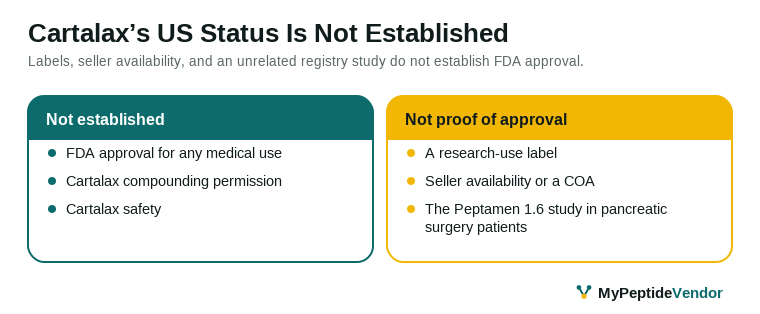
Cartalax is not identified as FDA-approved for any medical use. A research-use label does not authorize human use or show that a product is an approved medicine. A seller’s availability or COA does not establish FDA approval.
FDA's Category 2 table does not list Cartalax, and no FDA status for Cartalax is stated 1. Category 2 concerns substances nominated for compounding under interim policies. Cartalax's compounding permission, safety, and approval have not been established 1.
Compounding status and FDA approval are separate questions. The ClinicalTrials.gov record is a study of Peptamen 1.6, not a Cartalax clinical trial 2. That record does not establish a Cartalax trial pathway or validate products sold for research. Research-use products are not approved for human use; a research-use label should not be treated as permission for self-administration.
In practice, US access to products marketed as Cartalax does not provide the safeguards of an FDA-approved drug. Before considering any product, discuss the exact preparation and intended route with a licensed clinician and pharmacist. Do not use an online availability claim as evidence of legal compounding status or clinical safety.
Use this chart
Free to reuse with a link back:
Research-grade Cartalax is available from Certified-Pep. Sold for laboratory research only, not for human use. Affiliate link
How it compares with its closest alternatives
Cartalax is promoted for cartilage and joint support. Their names do not establish shared mechanisms or comparable evidence. The registered Cartalax record does not provide head-to-head data for any of them 2.
The table compares what the available Cartalax registry record can establish, not the full research record for each compound. It cannot rank these products or show that any peptide repairs joints in people 2.
| Peptide | Proposed or discussed role | Human joint comparison established here? |
|---|---|---|
| Cartalax | Marketed for cartilage and joint support | No Cartalax patient outcome in the registered record |
| BPC-157 | Raised as a possible repair-peptide alternative | No head-to-head comparison with Cartalax in the record |
| Vesugen | Raised as a bioregulator alternative | No head-to-head comparison with Cartalax in the record |
| Epitalon | Raised as a bioregulator alternative | No head-to-head comparison with Cartalax in the record |
No head-to-head human evidence in the registry record supports calling Cartalax, BPC-157, Vesugen, or Epitalon the best peptide for joint repair 2. Marketing claims cannot tell you which, if any, improves pain or restores cartilage. A clear diagnosis and established care should come before considering an unproven product.
Where to Buy Cartalax for Research
Certified-Pep
US-made research peptides with batch-specific lab reports (COA) and a QR code on every vial.
- Independent laboratory testing (Vanguard Laboratory)
- Made in the USA, ships in 1-2 business days
- Research use only, not for human or veterinary use
Affiliate disclosure: we may earn a commission if you order through the link above. Cartalax is not approved by the FDA for human use.
Frequently asked questions
What is Cartalax peptide good for?
It is marketed for cartilage and joint support, but that is a proposed use rather than an established clinical benefit. ClinicalTrials.gov lists a Peptamen 1.6 study, not a Cartalax treatment trial 2.
Is Cartalax safe?
Human safety has not been established in a registered Cartalax trial, and there are no trial-based adverse-event percentages to quote 2. A COA can document selected batch tests, but it cannot prove that a product is safe for human use.
What is the best peptide for joint repair?
No peptide can be called the best for joint repair on the registered evidence discussed here. There is no Cartalax head-to-head comparison or patient outcome in ClinicalTrials.gov 2.
Can peptides regrow cartilage?
A proposed cell-signaling effect does not show that a peptide regrows cartilage in a person. The registered Cartalax record does not test cartilage growth or report patient outcomes 2.
References
- FDA: Certain bulk drug substances for use in compounding that may present significant safety risks
- ClinicalTrials.gov: 1 registered studies (search: Cartalax)
Written by the MyPeptideVendor editorial team from the FDA label, peer-reviewed studies and ClinicalTrials.gov records listed above, fact-checked line by line and reviewed 2026-11-12.
Cite this page
MyPeptideVendor Editorial Team. cartalax peptide: Evidence, Dosing & Safety. MyPeptideVendor. Updated November 12, 2026. https://mypeptidevendor.com/peptides/cartalax/MyPeptideVendor Editorial Team. (2026, November 12). cartalax peptide: Evidence, Dosing & Safety. MyPeptideVendor. https://mypeptidevendor.com/peptides/cartalax/Related peptides
Argireline (Acetyl Hexapeptide-3)
Not approvedA small 4-week trial found wrinkle improvements, but lasting effects, ideal concentration, and Argireline-specific side-effect rates remain unknown.
Learn moreAHK-Cu
Not approvedAHK-Cu has early lab findings related to hair follicles, but human hair benefits, safe dosing, and side-effect rates are not established.
Learn moreAHK (Tripeptide-3)
Not establishedAHK-Cu is a copper tripeptide used as a cosmetic ingredient, but human hair-growth benefit and a proven scalp dose remain unestablished.
Learn more