Vesugen: Evidence, Safety & FDA Status
Short synthetic tripeptide
Brand names: Vesugen; KED; Lys-Glu-Asp

Vesugen is a short synthetic peptide made from lysine, glutamic acid, and aspartic acid (Lys-Glu-Asp, or KED). Research has focused on vascular endothelial cells and age-related cell activity, but it does not establish a medical use or a safe dose in people 23.
The only cited human report involved 32 people aged 41–83, reported no dose or treatment duration, and did not give side-effect percentages 3. It also recorded prooxidant activity and lower CD34-positive blood-cell markers, findings that deserve attention but do not tell us whether participants felt unwell 3.
Key takeaways
- A 2015 human report included 32 people aged 41–83, although its listed sex counts add to 30 3.
- Researchers reported more visible aging-related effects with Vesugen than pinealon, but gave no numerical clinical benefit or treatment duration 3.
- The human report noted prooxidant activity and lower CD34-positive blood-cell markers; it did not report symptom rates 3.
- The cited studies provide no Vesugen dose or exposure range for people 234567.
- The FDA category 2 page does not show whether KED or Vesugen is listed for compounding 1.
Vesugen at a glance
- Class
- Short synthetic tripeptide; Lys-Glu-Asp (KED)
- Mechanism
- Proposed effects on proliferation and gene expression; not established in people
- FDA Status
- No FDA-approved medical use is established here; category 2 listing status is unclear
- Brand names
- Vesugen; KED; Lys-Glu-Asp
- Administration
- No human route is established by the cited studies
- Typical Dose
- Not reported in the cited studies
- Half-life
- Not established in the cited studies
- Primary Uses
- Laboratory research on vascular endothelial cells, cell activity, and gene expression
What is it?

Vesugen is a tripeptide with the sequence Lys-Glu-Asp (KED) 6. It belongs to the short-peptide bioregulator group associated with Khavinson’s research. “Bioregulator” is a research term for a short peptide proposed to influence cell activity; it is not a recognized treatment claim.
Vesugen is studied in vascular endothelial cell cultures (the cells that line blood vessels 2) and in other cell systems, including pineal immune-cell organ cultures 5 and prostatic fibroblasts 6. This focus does not establish an effect on blood pressure, circulation, or vascular disease in patients; the cited studies do not report those patient outcomes.
Those are seller and lot-specific claims, not clinical evidence. Check that a COA matches the vial’s lot and states the identity and testing method.
For laboratory handling, use the storage and reconstitution instructions supplied for the specific lot; do not assume that a vial’s instructions establish a safe human-use method. A research-use-only disclaimer means the material is not presented as a medicine for human use. Prices and ordering terms are set by individual sellers, so check the vial quantity, lot-matched COA, shipping terms, and return policy before ordering.
What makes it different
Vesugen’s distinguishing research theme is vascular endothelial cell activity, while the clinical evidence is limited to a small report involving people with multiple chronic conditions and organic brain syndrome in remission 23. That report compared Vesugen with pinealon and described a more visible geroprophylactic effect for Vesugen, meaning an effect the authors interpreted as potentially slowing age-related decline. It did not provide a numerical measure of the difference 3.
Results depend on the model. A computer-based promoter-binding prediction, a cultured cell response, and a human blood marker are different kinds of evidence 236. None can be treated as a substitute for a controlled clinical outcome, and the cited work does not establish a benefit for a specific disease.
How does it work?
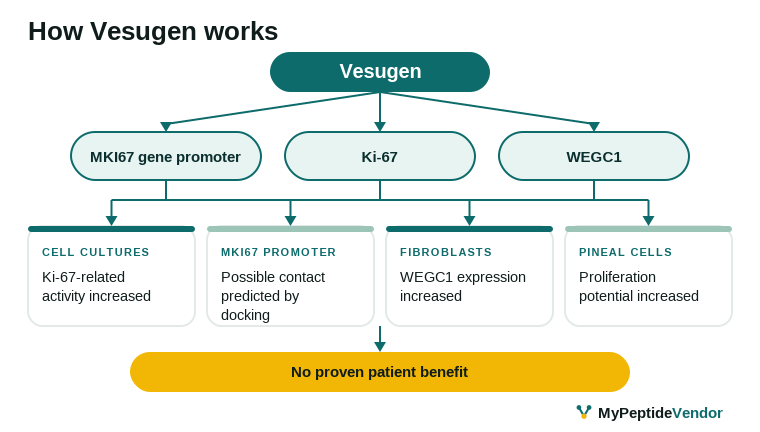
In plain terms, researchers are asking whether Vesugen can change signals that help cells divide or maintain their specialized roles. One signal is Ki-67, a protein associated with cell proliferation (cell growth and division). A study reported that Vesugen stimulated Ki-67-related activity in cell cultures 2.
The same paper used molecular docking, a computer method that predicts possible molecular contact. It predicted that Vesugen could interact with a short control region of the MKI67 gene, at positions −14 to +12 base pairs around the transcription start site 2. That specific promoter interaction has not been experimentally confirmed in the cited study, and a prediction does not show that the interaction occurs in a person.
In human prostatic fibroblast cultures, Vesugen increased expression of WEGC1, a differentiation-related marker, with a stronger effect in aged cultures than in younger cultures 6. This is a laboratory result; it does not show improved prostate function or reversal of aging in people.
In pineal immune-cell cultures, Vesugen did not change cell differentiation but did increase the cells’ proliferation potential 5. That is not evidence that it creates stem cells or increases stem-cell numbers in a person.
Oxidation findings are not simply “antioxidant.” A laboratory study found no direct antioxidant activity, but reported less lipid peroxidation in human lipoproteins, greater red blood cell resistance to osmotic breakdown, and higher intracellular reactive oxygen species (ROS) 7. These are separate laboratory measurements, not established clinical benefits or a quantified risk in people.
Use this chart
Free to reuse with a link back:
What the clinical evidence actually shows

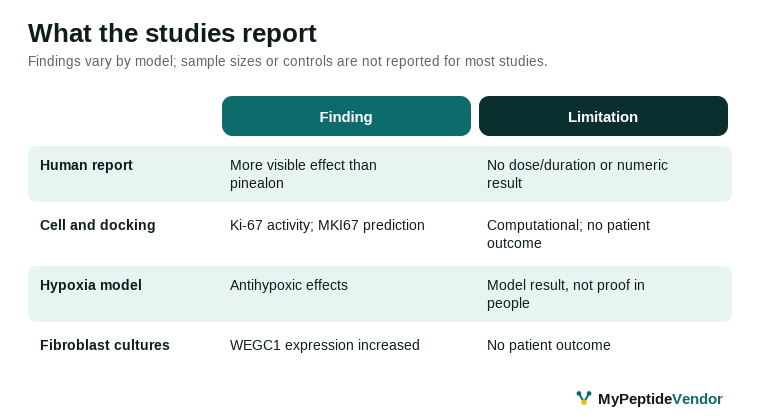
The human evidence is a single small report 3, and its study design is unclear, so it should not be assumed to be a randomized controlled trial. In 2015, Meshchaninov and colleagues studied 32 people aged 41–83 with polymorbidity (multiple chronic conditions) and organic brain syndrome in remission. The abstract lists 18 men and 12 women, which totals 30 rather than 32. It gives no Vesugen dose, treatment duration, numerical clinical outcome, or side-effect rate 3. The authors described a more visible geroprophylactic effect with Vesugen than pinealon and reported prooxidant activity and a decrease in CD34-positive blood-cell markers 3.
The study and model findings below are reported in the cited papers 234567. The abstracts do not report methodological details such as sample size or controls for most studies 24567.
| Study | Model and size | Reported finding | Key limitation |
|---|---|---|---|
| Khavinson et al., 2014 | Cell cultures and molecular docking; sample size not stated | Ki-67-related activity and a predicted MKI67 promoter interaction | Docking is computational; no patient outcome |
| Meshchaninov et al., 2015 | Human report: 32 people aged 41–83; listed as 18 men and 12 women | More visible geroprophylactic effect than pinealon; prooxidant activity and lower CD34-positive markers | Listed sex counts total 30; no dose, duration, numerical benefit, or event rates |
| Kozina et al., 2008 | Hypobaric hypoxia model; sample size not stated | Antihypoxic effects; pinealon had the strongest effect among the short peptides tested | Model result, not proof of benefit in people |
| Linkova et al., 2011 | Pineal immune-cell organ culture; sample size not stated | No change in differentiation; increased proliferation potential | Does not test stem-cell treatment in people |
| Khavinson et al., 2012 | Human prostatic fibroblast cultures; sample size not stated | WEGC1 expression increased, more strongly in aged cultures | No patient or prostate-health outcome |
| Kozina et al., 2008 | In-vitro experiments; sample size not stated | Changes in lipoprotein peroxidation, red-cell membrane stability, and ROS | Laboratory measurements do not define clinical effects or risks |
The evidence does not show that Vesugen prevents or treats a disease, slows aging in a clinically meaningful way, or improves a measured health outcome. There is no clear evidence here of independent replication outside the cited authors’ group 234567. No cited randomized controlled trial establishes effectiveness, and the human report’s missing dose and duration make its findings difficult to apply to a treatment decision 3.
Use this chart
Free to reuse with a link back:
Typical dosing

No human dose or trial range can be given from the cited research. The studies do not report doses or exposure levels 234567. That leaves no evidence-based schedule for a person to follow.
A vial size, laboratory concentration, or seller’s reconstitution directions should not be read as a human dose. Laboratory preparation depends on the experiment, while a safe route and amount for people have not been established in the cited studies 234567.
Side effects: what to actually expect
The human report gives no symptom list, adverse-event counts, or percentages 3. It does report prooxidant activity measured by chemiluminescence and a decrease in CD34-positive hematopoietic cell markers 3. Chemiluminescence measures light produced during chemical reactions and can indicate oxidation activity; CD34 is a marker found on some blood-forming cells. Neither observation alone proves that a participant had a symptom or lasting injury.
The laboratory findings also need careful interpretation. Higher intracellular ROS is an oxidation-related measurement, not a reported side effect in people 7. Greater red-cell resistance to osmotic hemolysis means the cells were less likely to break under a low-salt laboratory test; it does not establish a health benefit 7.
The safety signals and their limits are summarized here 37.
| Signal | What was observed | What it does and does not establish |
|---|---|---|
| Prooxidant activity | Reported by chemiluminescence in the human report | An oxidation-related signal, not a specific symptom or proof of tissue injury |
| Lower CD34-positive markers | Reported in blood in the human report | A change in a blood-cell marker; not a diagnosis of a blood disorder |
| Higher intracellular ROS | Reported in cell experiments involving Vesugen | A laboratory measure, not a quantified human side effect |
| Red-cell membrane stability | Resistance to osmotic hemolysis increased in vitro | A lab result that does not predict a clinical benefit |
Because the human report does not give symptom rates, it is not possible to say how often side effects occurred or to estimate the risk of common or rare reactions 3. Longer-term safety, interactions, and safety in people with blood or vascular conditions have not been established by the cited studies 37.
Regulatory & access status in the US
The FDA describes category 2 as covering bulk drug substances nominated for compounding under sections 503A or 503B that may present significant safety risks 1. The FDA category 2 page does not show whether KED or Vesugen is listed 1. Its specific 503A or 503B status therefore remains unresolved.
No FDA-approved Vesugen treatment is established by the cited regulatory information 1. The uncertain category-list status does not mean Vesugen is approved or may be compounded. A research-use-only listing is not the same as authorization for human use; anyone assessing a specific product or proposed use should check current FDA information and applicable state requirements.
Before ordering laboratory material, compare the vial’s lot number with its COA, check which identity and purity methods were used, confirm the storage directions, and review the current FDA bulk-substance information. A purity claim or COA does not establish sterility, human safety, FDA approval, or permission to administer the product.
Research-grade Vesugen is available from American Peptides (VESUGEN, from $60.00); code MYPEPTIDEVENDOR takes 15% off. Sold for laboratory research only, not for human use. Affiliate link
How it compares with its closest alternative
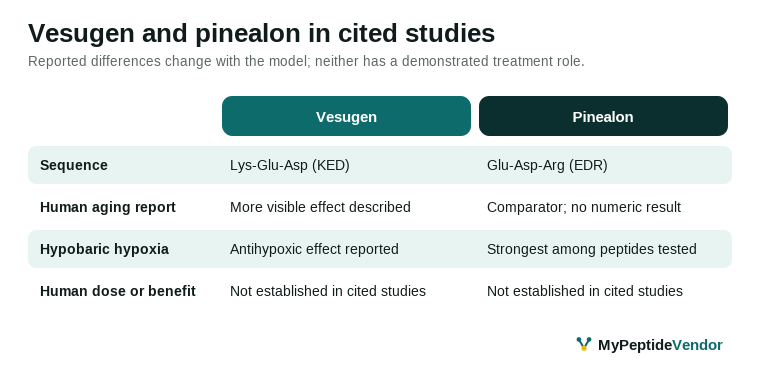
Pinealon is the closest comparison in the cited aging report and hypobaric hypoxia work. The human report described a more visible geroprophylactic effect for Vesugen, while the hypoxia model found pinealon to have the strongest effect among the short peptides tested 34. Neither paper provides numerical head-to-head results that support choosing one for patient care.
The comparison below reflects the specific models reported, not a general ranking of the peptides 34.
| Feature | Vesugen | Pinealon |
|---|---|---|
| Sequence | Lys-Glu-Asp (KED) | Glu-Asp-Arg (EDR) |
| Human aging report | More visible effect described by the authors | Comparator; no numerical head-to-head result reported |
| Hypobaric hypoxia model | Antihypoxic effect reported | Strongest effect among the short peptides tested |
| Established human dose or benefit | Not established in the cited studies | Not established in the cited studies |
The reported difference changes with the model, and neither peptide has a demonstrated treatment role in the cited evidence 34.
Use this chart
Free to reuse with a link back:
Where to Buy Vesugen for Research
American Peptides
VESUGEN · from $60.00
US-made research peptides, every lot third-party tested with a lot-matched COA.
15% offMYPEPTIDEVENDOR at checkout
- ≥99% purity verified by HPLC + mass spec, endotoxin tested
- Ships tracked from Louisiana, free shipping over $300
- 15% off your first order with code MYPEPTIDEVENDOR
Affiliate disclosure: we may earn a commission if you order through the link above. Vesugen is not approved by the FDA for human use.
Frequently asked questions
What is vesugen peptide used for?
It is chiefly investigated in laboratory work on blood-vessel lining cells and cell-growth signals 2. The small human report explored aging-related measures, but did not establish a clinical use for treating a condition 3.
Does vesugen increase stem cells?
The cited research does not demonstrate an increase in stem-cell numbers. One human report instead recorded a drop in CD34-positive blood-cell markers, while a separate pineal immune-cell culture showed greater proliferation potential without altered differentiation 35.
Is vesugen legal?
The FDA category 2 page does not show whether KED or Vesugen is listed for 503A or 503B compounding 1. Research availability is not evidence of FDA approval or permission for human use; the rules for a specific situation should be checked with current federal and state information.
What are the potential side effects of Vesugen peptide?
The human report noted oxidation activity and lower CD34-positive markers, but gave no symptom counts or percentages 3. Cell work also measured higher ROS, which is a laboratory finding and cannot be used to estimate a person's side-effect risk 7.
References
- FDA: Certain bulk drug substances for use in compounding that may present significant safety risks
- Khavinson et al. [Epigenetic aspects of peptidergic regulation of vascular endothelial cell proliferation during aging]. Adv Gerontol. 2014.
- Meshchaninov et al. [EFFECT OF SYNTHETIC PEPTIDES ON AGING OF PATIENTS WITH CHRONIC POLYMORBIDITY AND ORGANIC BRAIN SYNDROME OF THE CENTRAL NERVOUS SYSTEM IN REMISSION]. Adv Gerontol. 2015.
- Kozina et al. [Investigation of antihypoxic properties of short peptides]. Adv Gerontol. 2008.
- Linkova et al. Peptidegic stimulation of differentiation of pineal immune cells. Bull Exp Biol Med. 2011.
- Khavinson et al. Peptides tissue-specifically stimulate cell differentiation during their aging. Bull Exp Biol Med. 2012.
- Kozina et al. [Biological activity of regulatory peptides in model experiments in vitro]. Adv Gerontol. 2008.
Written by the MyPeptideVendor editorial team from the FDA label, peer-reviewed studies and ClinicalTrials.gov records listed above, fact-checked line by line and reviewed 2026-11-12.
Cite this page
MyPeptideVendor Editorial Team. Vesugen: Evidence, Safety & FDA Status. MyPeptideVendor. Updated November 12, 2026. https://mypeptidevendor.com/peptides/vesugen/MyPeptideVendor Editorial Team. (2026, November 12). Vesugen: Evidence, Safety & FDA Status. MyPeptideVendor. https://mypeptidevendor.com/peptides/vesugen/Related peptides
Argireline (Acetyl Hexapeptide-3)
Not approvedA small 4-week trial found wrinkle improvements, but lasting effects, ideal concentration, and Argireline-specific side-effect rates remain unknown.
Learn moreAHK-Cu
Not approvedAHK-Cu has early lab findings related to hair follicles, but human hair benefits, safe dosing, and side-effect rates are not established.
Learn moreAHK (Tripeptide-3)
Not establishedAHK-Cu is a copper tripeptide used as a cosmetic ingredient, but human hair-growth benefit and a proven scalp dose remain unestablished.
Learn more