Pal-AHK: Evidence, Dosing & FDA Status
Palmitoylated tripeptide
Brand names: Pal-AHK; palmitoyl-Ala-His-Lys; Palmitoyl Tripeptide-3
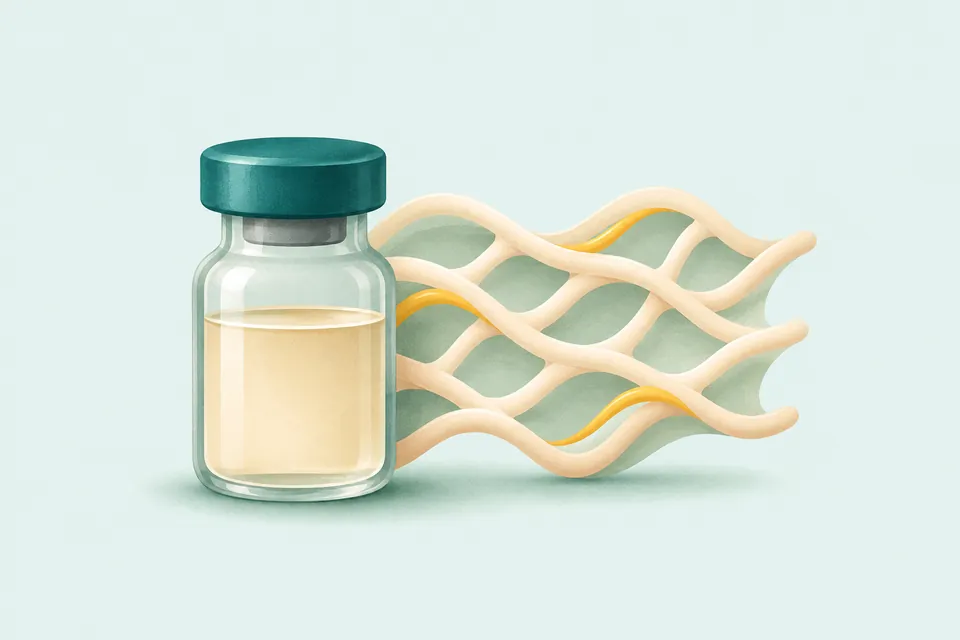
Pal-AHK is palmitoyl-Ala-His-Lys, a three-amino-acid peptide with a palmitoyl group attached. Its molecular formula is C31H56N6O5, and its molecular weight is 592.8 g/mol.
Claims about skin, collagen, antioxidant activity, and hair growth are not established benefits in people. No human trial dose, clinical side-effect rate, or injection safety profile is established for Pal-AHK.
Key takeaways
- Pal-AHK combines 3 amino acids (alanine, histidine, and lysine) with a palmitoyl group.
- Its molecular formula is C31H56N6O5 and its molecular weight is 592.8 g/mol.
- AHK-Cu research cannot establish that copper-free Pal-AHK has the same effects.
- No human Pal-AHK trial dose, benefit, or side-effect percentage is established.
- FDA’s compounding-risk page is not an approval list and does not establish Pal-AHK’s compounding status 1.
Pal-AHK at a glance
- Class
- Palmitoylated tripeptide
- Mechanism
- Proposed changes in lipid compatibility and cell behavior; human effects are not established.
- FDA Status
- No FDA-approved therapeutic product is established; FDA compounding information does not determine approval.
- Brand names
- Pal-AHK; palmitoyl-Ala-His-Lys; Palmitoyl Tripeptide-3
- Administration
- No evidence-supported or FDA-approved route is established.
- Typical Dose
- No human therapeutic dose is established.
- Half-life
- Not established in humans.
- Primary Uses
- Laboratory research; therapeutic use is not established.
What is it?

Pal-AHK is a synthetic form of AHK, a short peptide made from alanine, histidine, and lysine. The “Pal” means a palmitoyl group has been attached. Its formula is C31H56N6O5, and its molecular weight is 592.8 g/mol.
Pal-AHK is not the same chemical form as AHK-Cu. AHK-Cu refers to AHK associated with copper; Pal-AHK refers to AHK modified with a palmitoyl group. Whether Pal-AHK itself binds copper in the same way as unmodified AHK has not been established.
In plain terms, a peptide is a short chain of amino acids. A palmitoyl group is a fatty-acid-derived chemical group attached to that chain. “Lipophilic” means more compatible with fats than with water, while “ECM” means the extracellular matrix, the material around cells that includes structural proteins such as collagen and elastin.
What makes it different
The palmitoyl group is the main difference between Pal-AHK and AHK. It is intended to increase lipophilicity, which may help a molecule interact with lipid-rich parts of the skin. That idea is largely theoretical for Pal-AHK: improved penetration into human skin, delivery to living cells, and a useful effect have not been established.
AHK’s ability to bind metals is one reason antioxidant activity is discussed. Metal chelation means binding a metal ion, such as iron or copper. However, a metal-binding observation does not show that Pal-AHK acts as an antioxidant in human skin, and the amount of copper, peptide-to-copper ratio, and test conditions relevant to Pal-AHK are not established.
Fibroblasts are cells that make collagen and other ECM components. Claims about AHK-related effects on fibroblasts, collagen, and elastin do not establish that Pal-AHK increases these proteins in people. No reliable numerical collagen effect for Pal-AHK can be stated.
AHK-Cu and Pal-AHK should not be treated as interchangeable. Copper association can change a molecule’s chemical behavior, while palmitoylation changes its structure in a different way. It has not been established whether adding the palmitoyl group changes AHK’s copper binding or preserves any copper-related activity.
How does it work?
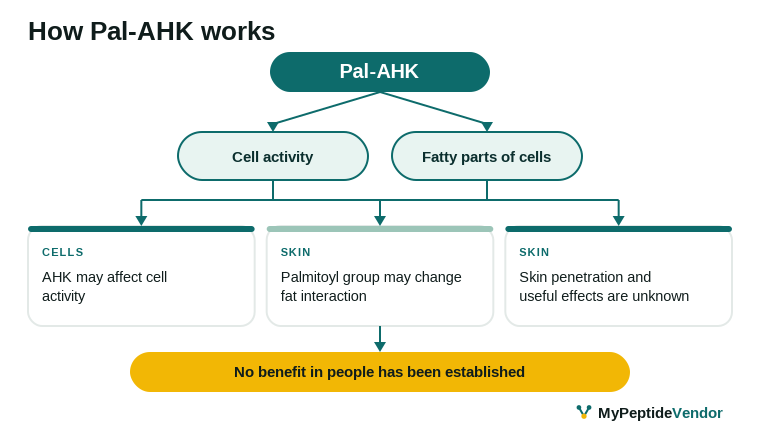
In plain language, the proposed idea is that AHK may affect cell activity, while the attached palmitoyl group may change how the peptide interacts with fatty parts of a cell or skin layer. The technical terms are cellular signaling and membrane interaction. Neither a useful effect in people nor the amount of Pal-AHK that reaches skin cells has been established.
Collagen and elastin help provide structure and flexibility to tissue, and fibroblasts produce components of the ECM. Cell-culture findings about AHK-related compounds would not, on their own, show that Pal-AHK improves skin. The relevant Pal-AHK concentration, exposure time, copper content, and effect in human tissue are not established.
That research cannot establish that Pal-AHK grows hair. No human Pal-AHK hair-growth outcome, or clinical result for the cell markers sometimes associated with this topic, is established.
Antioxidant and metal-chelating effects are also proposed, not established clinical effects. A laboratory chemical reaction would not show that Pal-AHK prevents skin damage, changes hair growth, or produces a health benefit in a person.
Use this chart
Free to reuse with a link back:
What the clinical evidence actually shows

No human Pal-AHK clinical trial with a trial name, participant count, treatment duration, or numerical outcome is established. There is no clinical result to report for skin texture, collagen, hair growth, or another therapeutic goal. This means a benefit has not been established; it does not prove that every possible effect is absent.
There is also no verified human evidence showing how Pal-AHK performs against unmodified AHK, AHK-Cu, or GHK-Cu. Cell activity, metal binding, or changes in a laboratory marker are not the same as a measured improvement in a person. A claimed fibroblast or hair-follicle result cannot be translated into a human response rate without clinical testing.
What remains unknown includes whether Pal-AHK penetrates human skin, whether it binds copper, how much reaches a target tissue, and whether repeated exposure is safe. Human outcomes during pregnancy, breastfeeding, long-term use, and use alongside other skin products have not been established.
The evidence gap also affects dose interpretation. A concentration in a laboratory solution is not a dose for a person: the solution, exposure time, tissue model, and presence or absence of copper all matter. No human Pal-AHK trial range can be reported.
Typical dosing

No therapeutic Pal-AHK dose is established. There is no human trial range or FDA-approved product label that sets an amount, schedule, route, or duration. An evidence-based topical or injectable dose cannot be recommended.
A research vial’s contents are not a dosing instruction. The amount in a container does not establish how much a person should apply, how often to use it, or how long to continue. The molecular weight of 592.8 g/mol does not answer those clinical questions.
Laboratory concentrations also cannot be converted into a personal dose without human studies. The exposure time, formulation, and copper content can change what an experiment measures, and those factors do not establish safe use in people.
Side effects: what to actually expect
No Pal-AHK clinical-trial or product-label data establish side-effect percentages. There is no reliable rate for redness, irritation, allergic reactions, or injection-site problems. Specific percentages circulated without traceable trial or label data should not be treated as established Pal-AHK safety figures.
Repeated-use safety, systemic absorption, and long-term risks have not been established in humans. An absence of measured adverse-event rates is not evidence that the peptide is harmless. Copper-related risks also cannot be quantified for Pal-AHK because its copper binding and human exposure are not established.
No human injection safety data or validated injectable product is established for Pal-AHK. Laboratory research cannot determine whether injection would cause tissue injury, contamination, or dosing errors. Injecting Pal-AHK or AHK-Cu is not supported by human safety evidence.
Regulatory & access status in the US
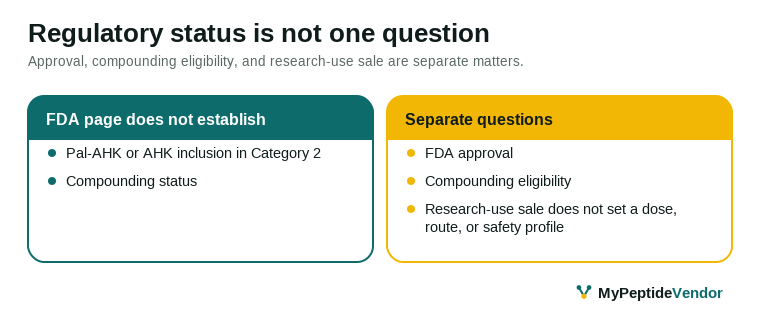
FDA’s Category 2 page describes nominated bulk drug substances that may present significant safety risks for compounding; it is not a list of FDA-approved medicines 1. The page information does not establish that Pal-AHK or AHK is included in Category 2, or settle its compounding status 1.
FDA approval, compounding eligibility, and sale for laboratory research are separate questions. A research-use designation does not provide an FDA-approved dose, route, or human safety profile. No therapeutic Pal-AHK label establishes those details.
Product identity, purity, sterility, and formulation are separate from the peptide’s name. Without an FDA-approved therapeutic product and label, there is no established standard for using Pal-AHK as a medicine.
Use this chart
Free to reuse with a link back:
How it compares to its closest alternatives
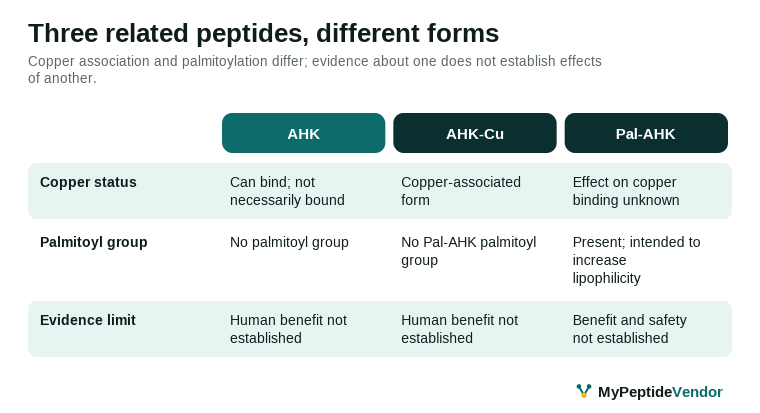
The compounds below differ in structure or copper association, so evidence about one cannot be assumed to apply to another. The Pal-AHK formula and molecular weight describe its chemical form, not a clinical benefit.
| Peptide | Copper status | Lipid character | Molecular weight | Evidence limits |
|---|---|---|---|---|
| AHK | Can bind copper; not necessarily copper-bound | No palmitoyl group | Not stated here | Laboratory claims do not establish a human therapeutic result |
| AHK-Cu | Copper-associated form | No Pal-AHK palmitoyl group | Depends on the copper form | Research claims cannot establish human benefit or Pal-AHK effects |
| Pal-AHK | Whether palmitoylation changes copper binding is unknown | Palmitoyl group is intended to increase lipophilicity | 592.8 g/mol | Human benefit, penetration, and safety are not established |
| GHK-Cu | Copper-associated form | No Pal-AHK palmitoyl group | Not stated here | A different copper peptide; findings cannot be transferred to Pal-AHK |
The practical difference is the molecule itself and whether copper is associated with it. Pal-AHK’s palmitoyl group does not make it equivalent to AHK-Cu or GHK-Cu, and no clinical comparison establishes one as more effective or safer.
Use this chart
Free to reuse with a link back:
Frequently asked questions
What is AHK-Cu peptide good for?
AHK-Cu is a copper-associated peptide studied for possible effects on cells involved in skin structure and hair-follicle biology. Those research questions do not establish a proven benefit in people, and they do not show that copper-free Pal-AHK works the same way.
Can you take AHK-Cu and GHK-Cu together?
No established combination study shows that using both is safe or effective. Because both are copper-associated peptides, combined copper exposure is an unanswered safety question. A clinician should not treat research claims as a tested combination regimen.
What is a palmitoyl peptide?
It is a peptide with a fatty-acid-derived group attached. The modification is intended to make the molecule more lipophilic, or compatible with fats, but improved absorption or a clinical benefit must be shown for each specific peptide.
Can you inject AHK-Cu?
Human injection safety and a therapeutic injection dose have not been established. Cell or follicle research does not support injecting AHK-Cu, and the same evidence gap applies to Pal-AHK. This page is general information, not medical advice.
References
Written by the MyPeptideVendor editorial team from the FDA label, peer-reviewed studies and ClinicalTrials.gov records listed above, fact-checked line by line and reviewed 2026-11-12.
Cite this page
MyPeptideVendor Editorial Team. Pal AHK: Evidence, Dosing & FDA Status. MyPeptideVendor. Updated November 12, 2026. https://mypeptidevendor.com/peptides/pal-ahk/MyPeptideVendor Editorial Team. (2026, November 12). Pal AHK: Evidence, Dosing & FDA Status. MyPeptideVendor. https://mypeptidevendor.com/peptides/pal-ahk/Related peptides
Argireline (Acetyl Hexapeptide-3)
Not approvedA small 4-week trial found wrinkle improvements, but lasting effects, ideal concentration, and Argireline-specific side-effect rates remain unknown.
Learn moreAHK-Cu
Not approvedAHK-Cu has early lab findings related to hair follicles, but human hair benefits, safe dosing, and side-effect rates are not established.
Learn moreAHK (Tripeptide-3)
Not establishedAHK-Cu is a copper tripeptide used as a cosmetic ingredient, but human hair-growth benefit and a proven scalp dose remain unestablished.
Learn more