SNAP-8: Evidence, Use & Safety
Topical cosmetic peptide
Brand names: SNAP-8; acetyl octapeptide-3
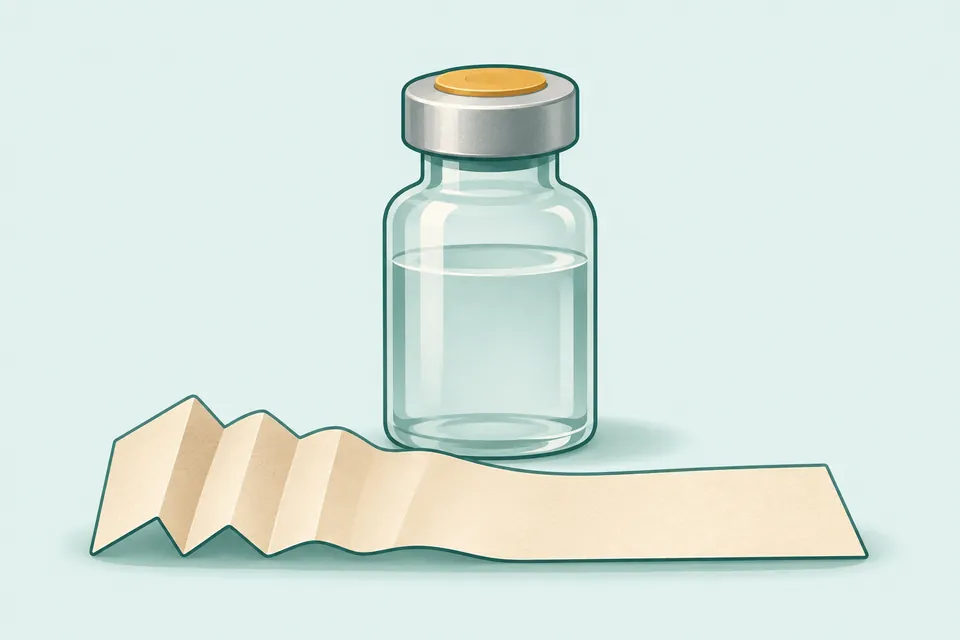
snap 8 is a skincare name for acetyl octapeptide-3, a topical cosmetic peptide made from 8 amino-acid units 6. It is marketed to soften the appearance of expression lines, but it is not an injectable treatment.
The key limit is that a proposed mechanism and a product’s marketing claims cannot tell you what a particular serum will do. There is no established clinical dose, verified monthly cost, or known duration of benefit after stopping.
Key takeaways
- SNAP-8 is acetyl octapeptide-3, an 8-amino-acid peptide; Argireline is the related 6-amino-acid acetyl hexapeptide-3 6.
- The proposed mechanism involves SNAP-25 and the SNARE complex, but a plausible mechanism does not prove a visible effect from a topical product.
- Wrinkle-percentage and timeline claims are unverified when the trial, formulation, participant count, and measurement method are not identified.
- Lotioncrafter’s 0.05% SNAP-8 solution used at 3–10% of a formula works out to roughly 0.0015–0.005% active peptide 6.
- SNAP-8 is marketed for topical cosmetic use, not injection; a research vial is not an approved injectable product 5.
SNAP-8 at a glance
- Class
- Synthetic topical cosmetic peptide
- Mechanism
- Designed to mimic part of SNAP-25 and interfere with SNARE-complex assembly
- FDA Status
- Not FDA-approved as a drug or injectable therapy
- Brand names
- SNAP-8; acetyl octapeptide-3
- Administration
- Topical use in a finished cosmetic product
- Typical Dose
- No established clinical dose; follow the finished product label
- Half-life
- Not established for topical use
- Primary Uses
- Cosmetic improvement in the appearance of expression lines
What is it?

SNAP-8 is a name used for acetyl octapeptide-3, a synthetic peptide made of 8 amino-acid units. Argireline is acetyl hexapeptide-3, a related peptide with 6 units. Those names describe different chain lengths; they do not establish that one product works better on skin.
Skincare brands market SNAP-8, a peptide, for reducing the appearance of dynamic lines. The commonly targeted areas are horizontal forehead lines, crow’s feet at the outer eyes, and the glabellar “11s” between the eyebrows. Marketing for those areas is not proof of a measured result at each site.
In retail products, the ingredient may appear on the ingredient list as “Acetyl Octapeptide-3,” rather than as SNAP-8. The ingredient list alone usually does not tell you its concentration. A finished serum also contains other ingredients, so a reaction or benefit cannot automatically be attributed to the peptide alone.
SNAP-8 is not an injectable form of botulinum toxin. A cosmetic peptide’s name or proposed biological target does not make a vial suitable for injection, and topical use does not establish safety by another route.
What makes it different
The closest peptide comparison is Argireline, also marketed for expression lines. SNAP-8 is the octapeptide and Argireline the hexapeptide 6; the difference in chain length is not evidence of greater clinical benefit. A claim that SNAP-8 is more active should be treated as unverified unless the seller can provide a clearly described, independent human comparison using the same formula and outcome measure.
Botox is a medical treatment delivered by injection. SNAP-8 is marketed for topical cosmetic use. Even if both are discussed in relation to nerve signaling, that shared topic does not mean they have the same route, strength, onset, or duration. A claim that SNAP-8 is more stable than botulinum toxin is not a useful clinical comparison without clear data showing what was measured and under what conditions.
Concentration claims can also be hard to compare. A percentage on a label could refer to the amount of an ingredient blend added to a formula, not the amount of pure acetyl octapeptide-3. Multiplying those figures gives about 0.0015–0.005% SNAP-8 in the finished product, not 3–10% pure peptide 6.
That distinction matters when comparing products. A “10%” claim may describe a blend rather than 10% pure peptide. Ask whether a stated percentage means pure acetyl octapeptide-3 or a diluted supplier solution. If a brand does not explain the basis of its number, products with the same front-label percentage may not contain the same amount of active peptide.
How does it work?
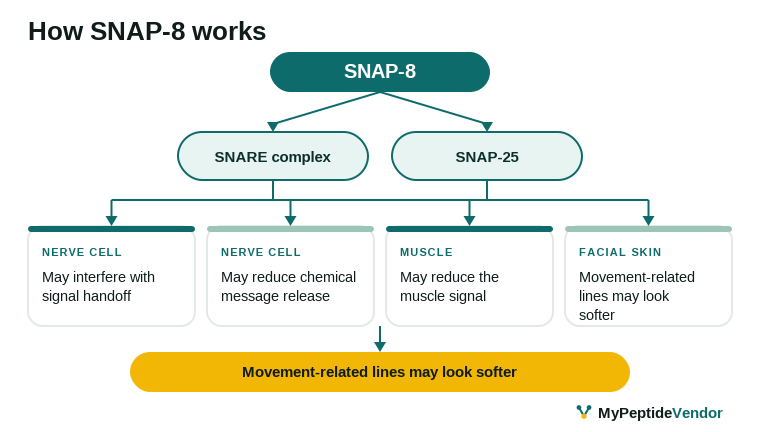
In plain language, SNAP-8 is intended to interfere with part of the handoff that lets a nerve cell send a signal to a muscle. If that handoff becomes less efficient, the muscle signal might be reduced, which could make a movement-related line look softer. That is a proposed explanation, not proof that a topical serum reliably relaxes facial muscles.
The technical term for the protein group involved is the SNARE complex. Think of it as molecular parts that help a small packet inside a nerve cell join the cell’s outer surface and release its chemical message. SNAP-25 is one of those parts.
Botulinum toxin works through a different biological action and is given by injection. The fact that both discussions involve SNAP-25 does not make a cosmetic peptide equivalent to botulinum toxin. A proposed mechanism cannot tell you how much peptide reaches its target through skin or how much visible change a finished product will produce.
Skin penetration is a practical uncertainty for any topical peptide. A mechanism described at the molecular level does not by itself show that enough active ingredient reaches the relevant tissue after application. Product formulation, concentration, and use can all affect exposure, but there is no universal SNAP-8 formula that resolves those questions.
Use this chart
Free to reuse with a link back:
What the clinical evidence actually shows

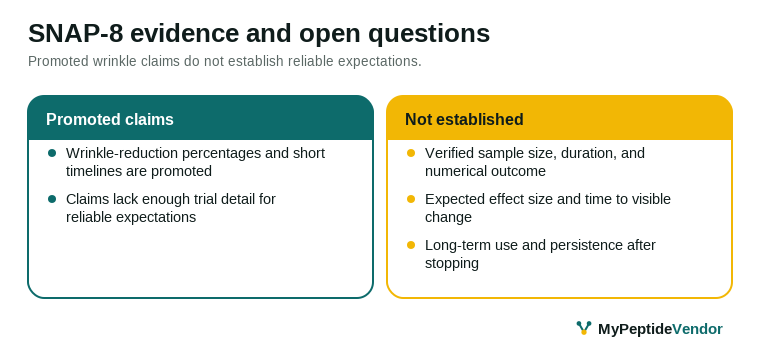
SNAP-8 is promoted with wrinkle-reduction percentages and short timelines, but those claims are not dependable expectations without an identifiable study and its methods. A useful report would name the trial, participant count, study design, exact formulation, measurement method, and whether the result was an average or the best individual response. Those details are not established for the commonly repeated claims.
A single measurement time point would not be enough on its own to judge a treatment. The result would need to be understood alongside the number of volunteers, the comparison group, the exact cream used, and the way wrinkle depth was measured. A maximum result is not a typical result, and a percentage change in wrinkle depth is not the same as the percentage of users who noticed improvement.
There is no dependable published trial evidence presented for SNAP-8 with a verified sample size, duration, and numerical outcome. Claims of specific percentage reductions and rapid changes lack enough trial detail to use as reliable expectations. Comparative activity claims are not a substitute for an independently conducted human head-to-head study.
It is also unclear whether results extend across different ages, skin types, skin tones, facial areas, or product formulas. Long-term use and persistence after stopping have not been established. A claim that improvement lasts for a set period after discontinuation should be treated as an estimate unless a study measures that outcome.
For a shopper, the fair conclusion is modest: SNAP-8 has a proposed cosmetic mechanism and is marketed for expression lines, but its expected effect size and time to visible change are uncertain. Do not use a best-case advertising number to decide whether a product is worth its price.
Use this chart
Free to reuse with a link back:
Typical dosing

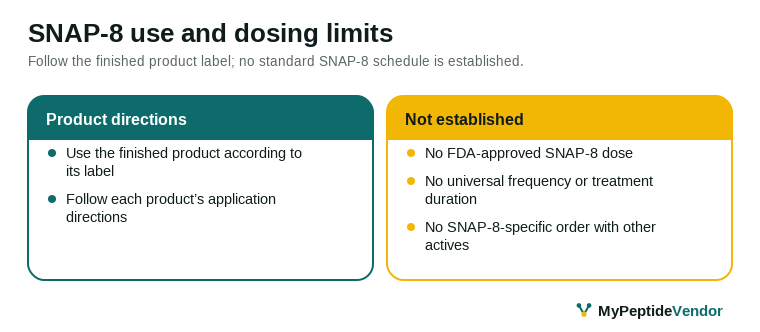
There is no FDA-approved dose or standard clinical dosing schedule for SNAP-8. It is an ingredient in topical cosmetics, so use the finished product according to its own label rather than treating a supplier blend as a dose.
No universal application frequency or treatment duration is established. How often to apply depends on each product's label, so follow the directions for the product you buy and do not increase the amount or frequency to chase a wrinkle claim. Consistent use over the product’s stated use period is more sensible than repeatedly changing the dose, but it does not guarantee a result.
Claims about “10% SNAP-8” need context. The number may refer to a blend or solution added to a cream rather than pure acetyl octapeptide-3. For comparison, Lotioncrafter’s solution contains 0.05% SNAP-8 and is intended for use at 3–10% of a formula, which calculates to about 0.0015–0.005% active peptide in the finished formula 6. Ask the brand what its percentage measures and whether it reports the active peptide level in the finished product.
There is no established SNAP-8-specific order for combining it with retinol, vitamin C, or niacinamide. Follow each product’s label and introduce one new product at a time. That makes it easier to identify which product is irritating your skin.
Use this chart
Free to reuse with a link back:
Side effects: what to actually expect
A reliable percentage for redness, stinging, swelling, or other SNAP-8 side effects cannot be given. There is no clear adverse-event table tied to an identified trial with a stated participant count and formulation. That means neither “no side effects” nor a specific reaction rate is a sound promise.
With a topical cosmetic, the practical concern is irritation or sensitivity to the finished formula. Fragrance, preservatives, and other active ingredients may also contribute. Patch-test a finished product as its label directs, and stop using it if you develop a persistent rash, burning, or swelling.
People with very reactive skin, a history of contact allergy, or an active facial skin condition should be cautious when adding any new cosmetic. Ask a dermatologist if a reaction is severe or does not settle after stopping the product. Long-term use across all skin types has not been established for SNAP-8.
Not an injectable: Do not inject SNAP-8, a research vial, or a cosmetic formulation. Topical use does not establish an injectable dose, sterility, or safety. FDA’s Category 2 page describes certain nominated bulk substances that may present significant safety risks in compounding; it is not an approval list for self-use 1.
Regulatory & access status in the US (as of 2026)
SNAP-8 is marketed as a cosmetic ingredient, not as an FDA-approved injectable drug. A cosmetic product listing acetyl octapeptide-3 should not be mistaken for FDA review of a drug claim, an approved dose, or authorization to inject the ingredient.
FDA’s Category 2 guidance describes certain bulk drug substances nominated for compounding that may present significant safety risks 1. That category is not the same as approval, and a shopper should not infer that an ingredient is cleared for injection because it is sold online.
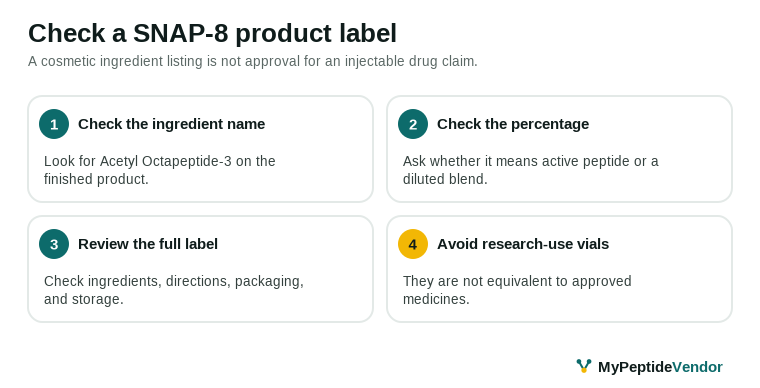
For topical use, look for a finished cosmetic product from a seller that gives clear directions and identifies the ingredient as Acetyl Octapeptide-3. A raw ingredient solution is not automatically a ready-to-use facial serum. Do not buy research-use vials for personal administration or attempt to reconstitute them; products sold as research materials are not equivalent to approved medicines.
A useful label check includes the INCI name “Acetyl Octapeptide-3,” an explanation of any stated percentage, the full ingredient list, clear application directions, intact packaging, storage instructions, and a clear non-injectable statement. Ask whether any disclosed concentration refers to active peptide or to a diluted blend.
Monthly cost cannot be calculated from the ingredient name alone. Retail price, container size, amount applied, and active concentration all matter, and there is no established standard monthly cost for SNAP-8 products. Compare the cost of a finished product over its stated period of use, not the price of a raw ingredient vial. Value also depends on whether the formula discloses a meaningful active level and whether you see a benefit worth the recurring cost.
Use this chart
Free to reuse with a link back:
Research-grade SNAP-8 is available from American Peptides (SNAP-8, from $55.00); code MYPEPTIDEVENDOR takes 15% off. Sold for laboratory research only, not for human use. Affiliate link
How it compares to its closest alternatives
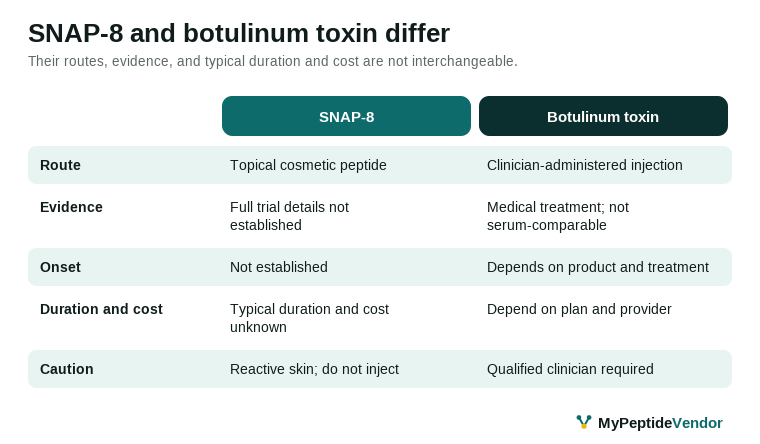
SNAP-8 and Argireline are topical cosmetic peptides; Botox is an injectable medical treatment; retinol is a different type of topical skincare active. Their routes and evidence are not interchangeable, and no direct comparison establishes that SNAP-8 matches a procedure.
| Option | Mechanism | Evidence and onset | Duration and cost | Who should be cautious |
|---|---|---|---|---|
| SNAP-8 | Topical peptide intended to influence SNARE-complex formation. | Wrinkle claims are difficult to interpret without named trials and full study details; onset is not established. | Duration after stopping and typical monthly cost are unknown. | People with reactive skin; anyone considering injection should not use it that way. |
| Argireline | Related topical peptide; acetyl hexapeptide-3. | Not proven clinically inferior or superior to SNAP-8 by a clear independent head-to-head result. | No reliable comparative duration or monthly cost is established. | People sensitive to the finished formula. |
| Botulinum toxin | Clinician-administered injectable that affects nerve-to-muscle signaling through a different action. | Medical treatment, not directly comparable with a cosmetic serum; onset depends on the product and treatment. | Cost and duration depend on the treatment plan and provider. | Requires assessment and administration by a qualified clinician. |
| Topical retinol | Topical skincare active that does not mimic SNAP-25. | Not directly compared with SNAP-8 in a head-to-head trial. | Product cost and time to assess results depend on the formulation and use. | People prone to irritation should follow the product directions. |
For someone who wants to try a noninvasive cosmetic, a topical peptide may fit that preference if expectations are modest. Someone seeking a more predictable change in muscle-driven lines should discuss medical options with a qualified clinician rather than expect a serum to reproduce an injection.
Use this chart
Free to reuse with a link back:
Where to Buy SNAP-8 for Research
American Peptides
SNAP-8 · from $55.00
US-made research peptides, every lot third-party tested with a lot-matched COA.
15% offMYPEPTIDEVENDOR at checkout
- ≥99% purity verified by HPLC + mass spec, endotoxin tested
- Ships tracked from Louisiana, free shipping over $300
- 15% off your first order with code MYPEPTIDEVENDOR
Certified-Pep
US-made research peptides with batch-specific lab reports (COA) and a QR code on every vial.
- Independent laboratory testing (Vanguard Laboratory)
- Made in the USA, ships in 1-2 business days
- Research use only, not for human or veterinary use
Affiliate disclosure: we may earn a commission if you order through the link above. SNAP-8 is not approved by the FDA for human use.
Frequently asked questions
What does the SNAP-8 peptide do?
It is used in topical cosmetics aimed at improving the look of creases that appear with facial movement. Its proposed action concerns nerve-to-muscle signaling, but a plausible mechanism does not confirm how much a particular product can change a line.
Does SNAP-8 actually work?
Some users may like the appearance of their skin while using a product that contains it, but the size and reliability of any SNAP-8-specific effect are not established by clearly identified clinical results. It should not be expected to perform like Botox or to provide a known-lasting result after use stops.
Where can I buy SNAP-8 peptide?
Look for a finished topical cosmetic that lists Acetyl Octapeptide-3 and gives clear use instructions. Check whether any stated percentage refers to active peptide or a diluted blend, and avoid research-use vials for personal use.
Can you inject SNAP-8 peptide?
No. It is marketed for topical cosmetic use, not injection 5. A research vial or cosmetic ingredient is not an approved injectable product, and topical use does not establish injection safety, sterility, or dosing.
References
Written by the MyPeptideVendor editorial team from the FDA label, peer-reviewed studies and ClinicalTrials.gov records listed above, fact-checked line by line and reviewed 2026-11-12.
Cite this page
MyPeptideVendor Editorial Team. snap 8: Evidence, Use & Safety. MyPeptideVendor. Updated November 12, 2026. https://mypeptidevendor.com/peptides/snap-8/MyPeptideVendor Editorial Team. (2026, November 12). snap 8: Evidence, Use & Safety. MyPeptideVendor. https://mypeptidevendor.com/peptides/snap-8/Related peptides
Argireline (Acetyl Hexapeptide-3)
Not approvedA small 4-week trial found wrinkle improvements, but lasting effects, ideal concentration, and Argireline-specific side-effect rates remain unknown.
Learn moreAHK-Cu
Not approvedAHK-Cu has early lab findings related to hair follicles, but human hair benefits, safe dosing, and side-effect rates are not established.
Learn moreAHK (Tripeptide-3)
Not establishedAHK-Cu is a copper tripeptide used as a cosmetic ingredient, but human hair-growth benefit and a proven scalp dose remain unestablished.
Learn more