Snap 8 Dosage 10mg: Protocol & Safety
A 10 mg SNAP-8 vial states the amount of material, not a human dose; no approved human dosing or injection schedule exists.
Quickstart Highlights for SNAP-8 10 mg
There is no established human dose for a 10 mg SNAP-8 vial. Its label tells you how much material is in the container, not how much a person should use, by what route, or how often.
SNAP-8, also called acetyl octapeptide-3, is a synthetic peptide related to Argireline. Proposed cosmetic effects and laboratory mechanisms do not establish that an injectable product is safe or effective.
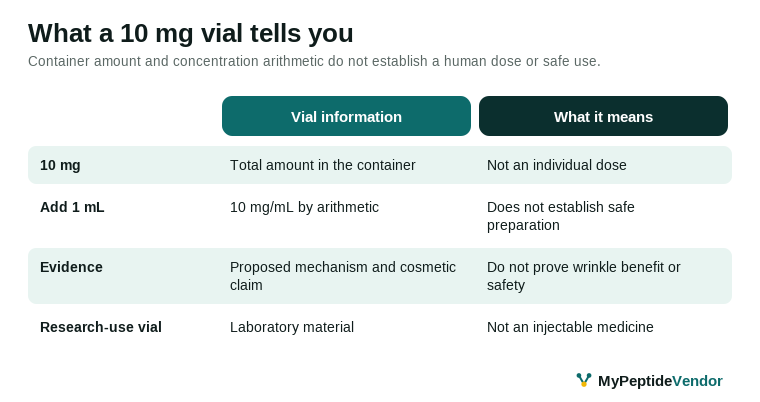
- Vial amount: 10 mg is the total amount stated for the container, not an individual dose.
- Human dosing: No approved dose, injection route, frequency, or titration plan exists for SNAP-8.
- Concentration math: Adding 1 mL to 10 mg would produce 10 mg/mL by arithmetic; it does not establish a safe concentration or preparation method.
- Evidence: A proposed molecular mechanism and a cosmetic claim are not proof of a wrinkle benefit or safety in people.
- Use: Treat a research-use vial as laboratory material, not as an injectable medicine.
“Dosage” requires evidence for the amount, route, frequency, formulation, and intended population. A vial label gives only the amount of material in the container, so 10 mg by itself cannot answer how much a person should use.
Use this chart
Free to reuse with a link back:
Key takeaways
- A 10 mg vial contains 10 mg of material; it does not set a dose, route, or treatment schedule.
- SNAP-8 has no approved human dose or FDA titration schedule.
- With 1 mL of diluent, the arithmetic concentration is 10 mg/mL; this is not a preparation or dosing recommendation.
- Reported wrinkle benefits and side-effect frequencies are not established well enough to predict a human result.
- A lot-matched certificate of analysis can help check batch identity and quality, but cannot establish safety for human use.
SNAP-8 Dosing Schedule: No Human Schedule Established
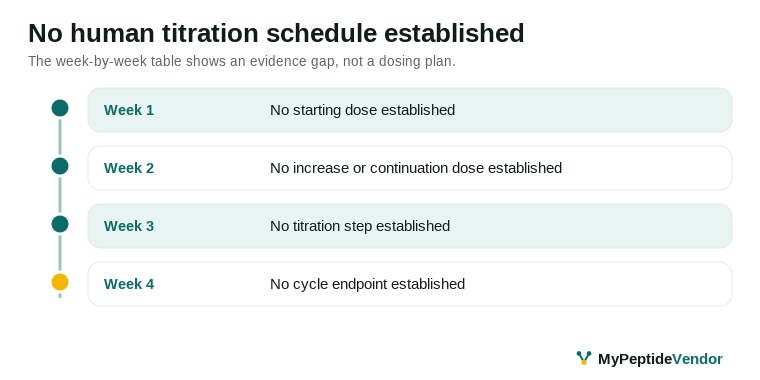
SNAP-8 has no approved human titration schedule. For approved medicines, a titration schedule should follow the FDA label or the relevant clinical trials; SNAP-8 is not an approved medicine, and no human starting dose or escalation plan is established. The table shows that evidence gap, not a plan to start, increase, or continue a dose.
| Week | Dose (mg) | Dose (mcg) | U-100 units | Human schedule |
|---|---|---|---|---|
| Week 1 | Not established | Not established | Not established | No starting dose established |
| Week 2 | Not established | Not established | Not established | No increase or continuation dose established |
| Week 3 | Not established | Not established | Not established | No titration step established |
| Week 4 | Not established | Not established | Not established | No cycle endpoint established |
A U-100 syringe measures liquid volume; it does not identify a safe amount of peptide. As arithmetic only, 10 mg in 1 mL gives 10 mg/mL (10,000 mcg/mL), and 100 mcg corresponds to 1.0 U-100 unit at that concentration. With 2 mL, the concentration is 5 mg/mL (5,000 mcg/mL), and 100 mcg corresponds to 2.0 units. These examples do not recommend a dose, route, or injection.
Do not transfer a schedule from another peptide. A similar name, proposed cosmetic purpose, or shared discussion of nerve signaling does not show that another compound’s dose or route applies to SNAP-8.
Use this chart
Free to reuse with a link back:
Syringe Unit Conversion Table
Units to draw on a U-100 insulin syringe (100 units = 1 mL) from a 10 mg vial. Find your dose, then read the column for the water you added. Every number is calculated, not estimated.
| Dose | 1 mL water 10 mg/mL · 1 unit = 100 mcg | 2 mL water 5 mg/mL · 1 unit = 50 mcg | 2.5 mL water 4 mg/mL · 1 unit = 40 mcg |
|---|---|---|---|
| 50 mcg | 0.5 · 200 doses | 1 · 200 doses | 1.25 · 200 doses |
| 100 mcg | 1 · 100 doses | 2 · 100 doses | 2.5 · 100 doses |
| 200 mcg | 2 · 50 doses | 4 · 50 doses | 5 · 50 doses |
| 250 mcg | 2.5 · 40 doses | 5 · 40 doses | 6.25 · 40 doses |
| 300 mcg | 3 · 33 doses | 6 · 33 doses | 7.5 · 33 doses |
| 500 mcg | 5 · 20 doses | 10 · 20 doses | 12.5 · 20 doses |
| 750 mcg | 7.5 · 13 doses | 15 · 13 doses | 18.75 · 13 doses |
| 1 mg | 10 · 10 doses | 20 · 10 doses | 25 · 10 doses |
| 1.5 mg | 15 · 6 doses | 30 · 6 doses | 37.5 · 6 doses |
| 1.7 mg | 17 · 5 doses | 34 · 5 doses | 42.5 · 5 doses |
| 2 mg | 20 · 5 doses | 40 · 5 doses | 50 · 5 doses |
| 2.4 mg | 24 · 4 doses | 48 · 4 doses | 60 · 4 doses |
| 2.5 mg | 25 · 4 doses | 50 · 4 doses | 62.5 · 4 doses |
| 3 mg | 30 · 3 doses | 60 · 3 doses | 75 · 3 doses |
| 4 mg | 40 · 2 doses | 80 · 2 doses | 100 · 2 doses |
| 5 mg | 50 · 2 doses | 100 · 2 doses | over 100 |
| 7.5 mg | 75 · 1 doses | over 100 | over 100 |
| 10 mg | 100 · 1 doses | over 100 | over 100 |
SNAP-8 10 mg Vial Dosage Calculator
Shows the exact insulin-syringe units to draw. Pre-loaded with the 10 mg vial; change any value to match yours.
Total volume of your syringe?
How much mg is in the vial?
How much bacteriostatic water are you adding?
Dose per injection?
Educational tool only. Concentration = vial ÷ water; units = dose ÷ concentration × 100 (U-100 syringe). Confirm every dose with your prescriber. Different vial or peptide? Use the peptide calculator.
MYPEPTIDEVENDORAffiliate link · we may earn a commission.
Reconstitution Steps for a Research Vial
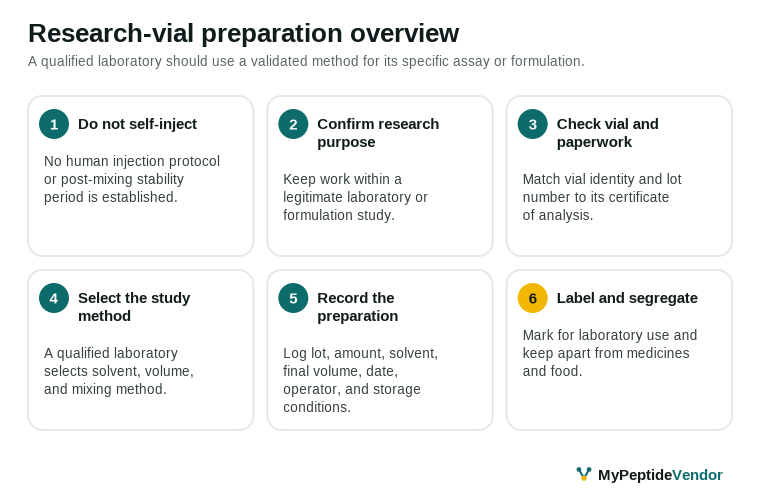
Do not reconstitute SNAP-8 for self-injection. No human injection protocol or post-mixing stability period is established. A qualified laboratory should follow a validated method for its specific assay or formulation instead of treating vial arithmetic as administration guidance.
- Confirm the research purpose. Keep the work within a legitimate laboratory or formulation study. A research-use label does not make the material suitable for human use.
- Check the vial and paperwork. Match the vial identity and lot number to its certificate of analysis before measuring the 10 mg contents.
- Use a method selected for the study. A qualified laboratory must select a compatible solvent, final volume, and mixing procedure for its intended analysis. No universal solvent or validated human preparation method is established.
- Record the preparation. Log the lot, material amount, solvent, final volume, date, operator, and storage conditions. Clear appearance does not establish identity, sterility, or stability.
- Label and segregate the material. Mark the prepared solution for its laboratory purpose and keep it apart from medicines and food. Follow the laboratory’s handling and disposal procedures.
Concentration is a mass-to-volume calculation: peptide mass divided by final solution volume. For example, 10 mg divided by 1 mL is 10 mg/mL. Percent by weight (w/w) uses peptide mass divided by the total finished batch mass, multiplied by 100; 10 mg in a 100 g batch is 0.01% w/w by arithmetic. Neither calculation validates a formula, skin delivery, or clinical use.
A percentage describes a mixture; it does not show that the amount is safe, reaches a target tissue, or produces a clinical effect.
Use this chart
Free to reuse with a link back:
Supplies Needed for a Full 10 mg Vial
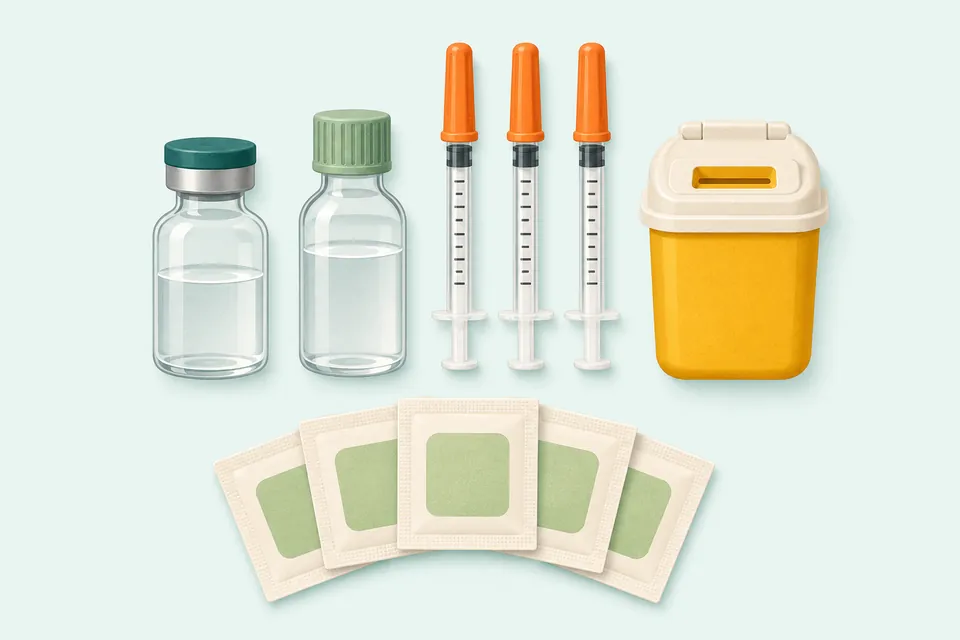
For laboratory work involving one full 10 mg vial, use a documentation and measurement checklist rather than an injection kit. The exact tools depend on the laboratory’s validated method.
- One SNAP-8 vial with its original label and lot number.
- One current certificate of analysis matched to that lot.
- One calibrated balance, if the validated method requires weighing.
- One calibrated pipette or other validated measuring tool, if the method uses liquid volumes.
- One clean receiving vessel selected for the specific assay or formulation.
- One compatible solvent or cosmetic base selected under the laboratory’s method; no universal choice is established.
- One set of clean transfer tools and the protective equipment required by the laboratory procedure.
- One preparation log for measurements, operator, date, storage conditions, and observations.
Review the COA for identity confirmation, HPLC purity, mass spectrometry, batch number, endotoxin data when relevant to the method, and stated storage conditions. These checks can help assess the tested batch; they do not prove sterility, suitability for injection, or safety in people.
Protocol Overview and Cycle Notes

SNAP-8 is the name commonly used for acetyl octapeptide-3, a synthetic peptide made from eight amino-acid units. It is related to Argireline, also called acetyl hexapeptide-8, but the names refer to different peptides. Evidence or directions for one should not be assumed to apply to the other.
The proposed mechanism involves SNAP-25 and the SNARE complex. In plain language, SNARE proteins help a small bubble inside a nerve cell join the cell surface and release its contents. SNAP-25 is one part of that machinery. That proposed action does not prove that enough peptide reaches a target in living skin or changes facial movement.
A result depends on the finished product, concentration, route, application schedule, and measurement method. No reliable human wrinkle-reduction percentage is established here, and an unverified percentage should not be treated as an expected result.
| Claim or comparison | Evidence type | What it supports |
|---|---|---|
| SNAP-8 may interfere with SNARE assembly | Proposed mechanism | A research hypothesis, not proof of human benefit |
| Wrinkle-depth reduction from a cosmetic product | Claimed cosmetic outcome | No reliable percentage to predict an individual result |
| SNAP-8 and Argireline have equivalent effects | Relationship between peptides | Does not establish equivalent performance |
| Comparison with botulinum toxin | Different substances and approaches | They should not be treated as interchangeable |
A purpose-built microneedle patch and a cream have different formulations and delivery conditions. A reported patch concentration cannot be copied into a cream as an equivalent dose or assumed to produce the same delivery. Concentration alone does not establish how much reaches the skin.
No human cycle length, washout period, or escalation plan is established. Do not treat a developer range or a formulation calculation as a validated schedule. A concentration calculation can describe what is in a mixture; it cannot establish a suitable human dose or treatment duration.
SNAP-8, Argireline, and botulinum toxin
| Substance | Target or mechanism | Human evidence and status |
|---|---|---|
| SNAP-8 | Proposed mimic of a SNAP-25 segment; proposed interference with SNARE assembly | No approved human dose or validated injection schedule established |
| Argireline | Related cosmetic peptide, but a different peptide sequence | Evidence or directions for SNAP-8 cannot be assigned to Argireline, or vice versa |
| Botulinum toxin | A distinct biologic that affects nerve signaling through a different mechanism | Not interchangeable with either cosmetic peptide |
Regulatory status
| Question | Careful interpretation |
|---|---|
| FDA-approved human dose? | No approved SNAP-8 human dose or FDA drug label is established. |
| FDA 503A or 503B Category 2? | FDA describes Category 2 as bulk substances that may present significant safety risks under its interim policies. |
| US legal status? | A seller’s listing or research-use label does not establish that a product is legally marketed as a human drug. |
| Research material for human use? | Research-use-only material should not be treated as a medicine or an approved human treatment. |
Category 2 is an FDA compounding-review category for bulk substances the agency identifies as potentially presenting significant safety risks 1. That general category description does not establish a SNAP-8 designation.
Storage and Handling
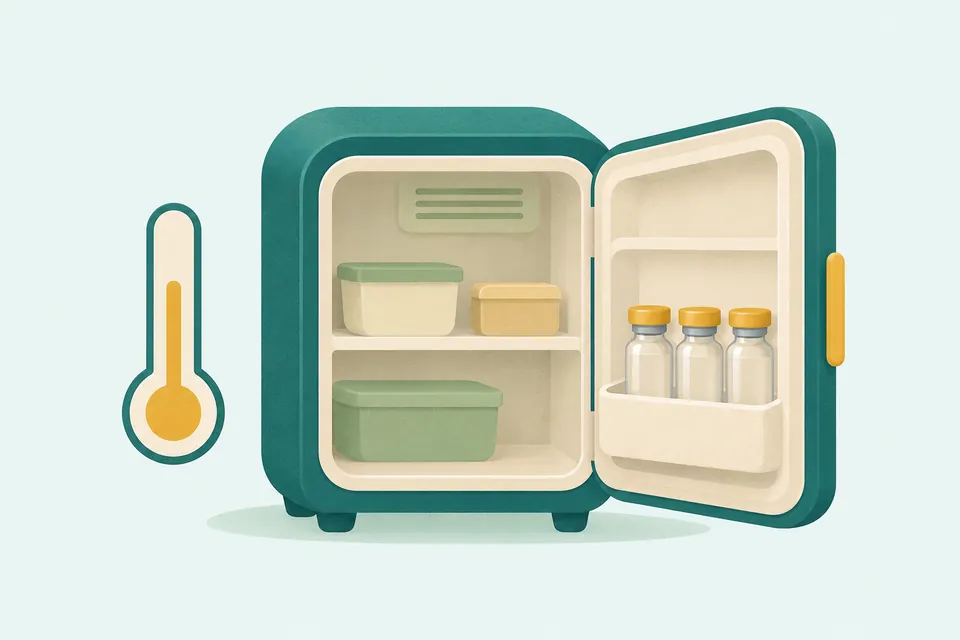
Follow the storage instructions on the specific vial and its batch paperwork. No single storage condition or post-reconstitution use period is established for every SNAP-8 product, solvent, or finished formulation.
Keep the material in its labeled container and within its stated storage conditions. Record receipt and any temperature excursion required by the laboratory procedure. Color and clarity cannot confirm identity, purity, sterility, or potency.
Use a post-preparation stability period only when a validated method supports it. Refrigeration alone does not prove that a solution remains sterile or potent. If the vial label and COA give conflicting instructions, pause the work and ask the supplier or laboratory quality lead to resolve the discrepancy.
Injection and Tracking Tips
Do not inject SNAP-8 based on a vial label, a syringe conversion, or an online schedule. No human injection dose is established. Syringe markings measure liquid volume after concentration is known; they do not identify a safe or effective amount of peptide.
For laboratory records, log the compound name, lot, COA, preparation method, calculated concentration, date, operator, storage conditions, and assay results. Work involving people requires appropriate ethics review, qualified clinical oversight, and a lawful investigational framework; a supplier disclaimer does not replace those safeguards.
For a reviewed cosmetic study, record the exact finished product and application method. If photographs are used, keep lighting, angle, and camera distance consistent across visits. A before-and-after image alone cannot establish that SNAP-8 caused a change.
Safety, Side Effects, and Buying Checks
Side-effect frequencies for SNAP-8 in people have not been established. There is no sound basis here for assigning rates to redness, swelling, allergy, muscle weakness, or systemic effects. Claims of “well tolerated,” “no systemic effects,” or “no paralysis” should not be treated as confirmed human safety findings.
Potential problems with an unverified peptide product include incorrect identity, contamination, inaccurate concentration, an allergic response, or harm from an unvalidated route. Some problems cannot be detected by looking at a vial. Do not handle a damaged package or one whose batch information does not match its paperwork; follow the laboratory’s incident procedure.
When assessing a vendor for laboratory work, request a COA for the exact lot and match its batch number to the vial. Check for an identity test, HPLC purity result, mass spectrometry, endotoxin information when relevant to the work, and storage conditions. Ask whether the report came from an independent laboratory and whether its methods and results can be verified. A COA describes a tested batch; it does not prove that the product is safe for human use.
Do not infer FDA status from a vendor’s website, product availability, or “research use only” wording. FDA describes Category 2 as applying to bulk substances identified in its compounding review as potentially presenting significant safety risks 1. SNAP-8 is not identified as a Category 2 substance.1
Reference
1 U. S. Food and Drug Administration. “Certain Bulk Drug Substances for Use in Compounding that May Present Significant Safety Risks,” Category 2 of the bulk substances nominated under sections 503A or 503B of the Federal Food, Drug, and Cosmetic Act.
Frequently asked questions
What is the dosage for a 10 mg SNAP-8 vial?
There is no established human dose. The 10 mg figure describes the vial contents, not an amount for a person, a route, or a schedule.
How much bacteriostatic water should I add to SNAP-8?
No amount is recommended for preparing a human injection. A laboratory needs a method selected for its specific assay, including a compatible solvent and a supported stability plan.
Is SNAP-8 the same as Argireline?
No. SNAP-8 is acetyl octapeptide-3, while Argireline is acetyl hexapeptide-8. Their relationship does not show that their effects or instructions are the same.
Can a microneedle patch be copied as a cream?
No equivalence can be assumed. A patch and a cream differ in formulation and delivery, so a matching percentage does not show that the same amount reaches the skin.
Is SNAP-8 on the FDA 503A or 503B Category 2 list?
FDA describes Category 2 for bulk substances that may present significant safety risks under its interim policies 1. SNAP-8's Category 2 status is not confirmed by 1.
Where should I buy SNAP-8, and what should I check?
For legitimate laboratory work, evaluate the vendor’s lot-matched COA, identity testing, HPLC purity, mass spectrometry, batch details, relevant endotoxin data, and storage conditions. A vendor listing does not make the material an approved medicine.
Does SNAP-8 reduce wrinkles by a specific percentage?
No reliable human wrinkle-reduction percentage is established here. A cosmetic claim should not be treated as a predicted result without evidence tied to the exact product and method.
References
Written by the MyPeptideVendor editorial team from the FDA label, peer-reviewed studies and ClinicalTrials.gov records listed above, fact-checked line by line and reviewed 2026-11-12.
Cite this page
MyPeptideVendor Editorial Team. snap 8 dosage 10mg: Protocol & Safety. MyPeptideVendor. Updated November 12, 2026. https://mypeptidevendor.com/protocols/snap-8-dosing-10mg/MyPeptideVendor Editorial Team. (2026, November 12). snap 8 dosage 10mg: Protocol & Safety. MyPeptideVendor. https://mypeptidevendor.com/protocols/snap-8-dosing-10mg/Related protocols
Cardiogen 20 mg
Research UseNo approved human dose or validated cycle exists for Cardiogen peptide; its published findings are preclinical, not a dosing protocol.
View protocolChonluten 20 mg
Research UseNo human Chonluten dose or titration schedule is established; the cited research tested cells, not people.
View protocolCortagen 20 mg
Research UseCortagen has no established human dose; this guide explains 20 mg vial math and the limits of the animal and laboratory evidence.
View protocol