Rigin Palmitoyl Tetrapeptide 7: Evidence & Uses
Topical cosmetic peptide
Brand names: Palmitoyl tetrapeptide-7; rigin is Gly-Gln-Pro-Arg.

Rigin palmitoyl tetrapeptide 7 is a cosmetic peptide associated with palmitoylated rigin, the four-amino-acid sequence Gly-Gln-Pro-Arg 89. Research on rigin mainly examines immune-cell activity and peptide structure, not skin tightening or other cosmetic outcomes 589.
No human skin-care trial of palmitoyl tetrapeptide-7 has reported a tested concentration, participant count, treatment duration, or measured skin result. The evidence supports a distinction between rigin’s laboratory immune activity and claims about what a topical product does in people.
Key takeaways
- Rigin is the Gly-Gln-Pro-Arg segment at positions 341–344 of the IgG heavy chain 3.
- A 1981 study reported rigin stimulated mouse macrophage phagocytosis to the same extent as tuftsin 8.
- A 2001 mouse experiment used related rigin analogs by intravenous injection for 2 days, not as a topical treatment 4.
- A 2000 NMR and modeling study described a type VII beta-turn conformation for rigin 9.
- No human cosmetic trial in the cited research gives a skin dose or a percentage for side effects 45689.
Rigin (Palmitoyl Tetrapeptide-7) at a glance
- Class
- Topical cosmetic peptide
- Mechanism
- Rigin has laboratory evidence of immune-cell activity; a skin mechanism in people is unestablished.
- FDA Status
- Not an FDA-approved drug treatment; the FDA compounding page does not establish this ingredient’s status.
- Brand names
- Palmitoyl tetrapeptide-7; rigin is Gly-Gln-Pro-Arg.
- Administration
- Topical in cosmetic products; no human clinical regimen is established.
- Typical Dose
- No human-trial dose or tested cosmetic concentration is reported.
- Half-life
- Not established for topical skin use.
- Primary Uses
- Cosmetic ingredient; clinical skin benefits are unestablished.
What is it?

Rigin is the short sequence Gly-Gln-Pro-Arg, identified as residues 341–344 of the immunoglobulin G (IgG) heavy chain 3. In 1981, researchers synthesized this tetrapeptide and reported that it stimulated phagocytosis (the process in which cells take up and clear material) to the same extent as tuftsin in their test 8.
Palmitoyl tetrapeptide-7 is a cosmetic ingredient name associated with a palmitoylated form of rigin. The foundational rigin research describes the unmodified sequence, not the precise identity or finished-product formulation of this cosmetic ingredient 38. A 2001 paper studied a different, more complex palmitoyl-containing rigin analog, N-palmitoyl-amino-ethyl-rigin amide; it should not be treated as proof that this analog and the cosmetic ingredient are identical 4.
Rigin also has a structural research history. A 2000 nuclear magnetic resonance (NMR) and computer-modeling study supported a type VII beta-turn shape and suggested that the peptide’s sequence plays a key role in its folding 9. That result describes the peptide’s structure under laboratory conditions, not a skin effect.
What makes it different
The name combines a palmitoyl group (a fatty-acid modification) with a tetrapeptide, a chain of four amino acids. The proposed idea that a fatty-acid tail helps a peptide enter skin is not confirmed by the cited primary research: no study here measures palmitoyl tetrapeptide-7 crossing human skin or compares its skin penetration with unmodified Gly-Gln-Pro-Arg.
The nearest related experiment tested a different question. In 2001, researchers incorporated hydrophobic rigin analogs into liposomes and examined their interaction with macrophages; liposome uptake by immune cells is not a measurement of absorption through skin 4. That study therefore cannot show whether a palmitoyl group improves delivery to living skin cells.
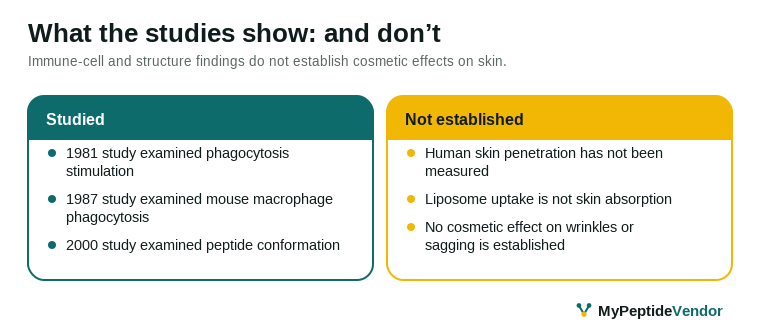
Rigin’s documented activity is also distinct from a demonstrated cosmetic effect. The 1981 study examined phagocytosis stimulation 8, the 1987 study used mouse peritoneal macrophages to examine phagocytosis 5, and the 2000 study examined peptide conformation 9. Those findings do not establish an effect on wrinkles, dark circles, puffiness, or sagging skin in people.
Use this chart
Free to reuse with a link back:
How does it work
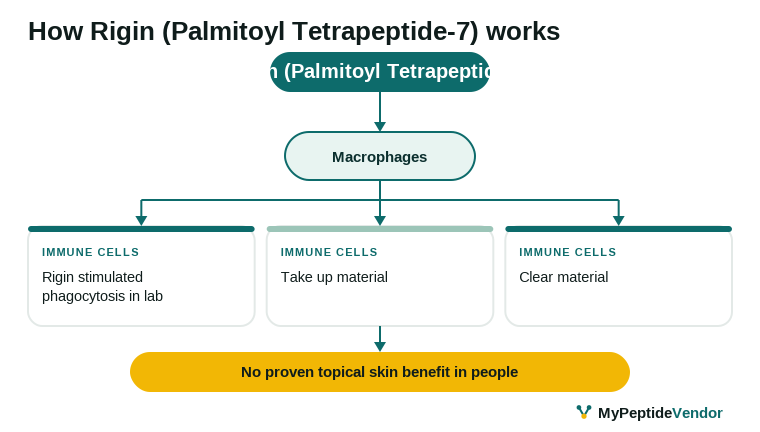
In plain terms, rigin has been studied as a small immune-related signal, not as a proven skin-firming ingredient. In the 1981 experiment, synthetic ricin stimulated phagocytosis, a job performed by immune cells such as macrophages 58. That result does not show that a face cream reaches those cells or changes the appearance of skin.
The technical mechanism for palmitoyl tetrapeptide-7 in human skin has not been established. Rigin’s immune-cell findings do not prove that a topical product reaches living skin, changes collagen production, or tightens loose skin 458. No cited primary study tests a cellular signaling pathway for this cosmetic ingredient in human skin.
The 2001 work involved related hydrophobic analogs, liposomes, macrophages, and mice, not a topical skin formulation 4. The 2000 NMR study’s type VII beta-turn finding may help describe rigin’s shape, but it supplies no skin dose or clinical outcome 9.
Use this chart
Free to reuse with a link back:
What the clinical evidence actually shows

No human cosmetic trial of palmitoyl tetrapeptide-7 is reported in the cited research 45689. There is no trial name, participant count, treatment duration, placebo comparison, or numerical change in wrinkles, puffiness, or skin firmness to report. So far, the human skin benefit and effective concentration remain unknown.
The closest study involving a palmitoyl-containing rigin analog was an animal immune experiment, not a skin trial. In 2001, mice received related analogs intravenously at 100 micrograms in 0.5 milliliters per mouse per day for 2 days; researchers then challenged them with 1 × 10⁶ malaria-parasitized red blood cells 4. This injection regimen studied immune responses and infection in mice. It is not a topical dose or a human treatment result.
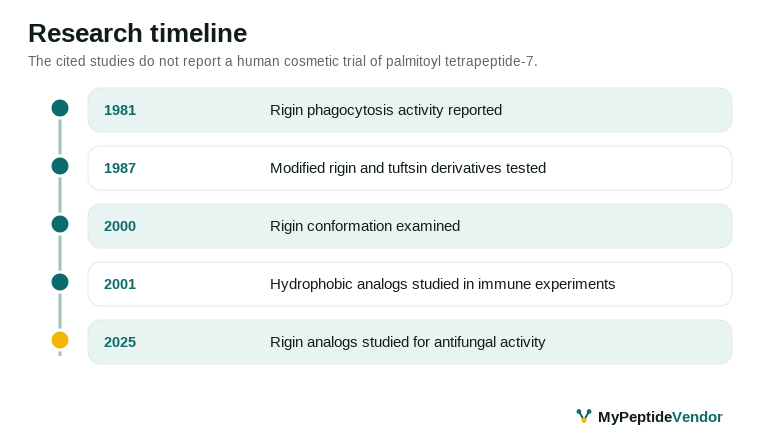
The research timeline shows how the evidence developed. In 1981, researchers reported rigin’s phagocytosis activity 8. In 1987, they tested modified rigin and tuftsin derivatives 5. A 2000 study examined rigin’s conformation 9, and a 2001 study examined hydrophobic analogs in immune experiments 4. In 2025, researchers built a library of rigin analogs and investigated antifungal activity, not cosmetic skin outcomes 6.
In the 1987 laboratory study, rigin enhanced mouse peritoneal macrophage phagocytosis to the same extent as tuftsin; some modified peptides produced only slight enhancement 5. This is evidence about immune cells in that experiment, not evidence that applying rigin to facial skin improves its appearance.
What remains unknown: whether a topical product delivers an active amount into skin; whether the palmitoyl group improves skin penetration; what concentration might change a skin marker; and whether any visible effect occurs in people. Clinical evidence for sagging skin, long-term benefit, and sensitive-skin tolerance is also not established by these studies 45689.
Use this chart
Free to reuse with a link back:
Typical dosing

No human clinical dose or tested cosmetic concentration for topical palmitoyl tetrapeptide-7 is reported in the cited research 45689. There is no evidence-based percentage range to recommend, and the ingredient name alone does not tell you how much a finished product contains.
The 100-microgram, 0.5-milliliter injection given daily for 2 days in the 2001 mouse study involved related analogs and an immune experiment 4. It is not a skin-care instruction, a human dose, or a basis for self-injection. For a finished cosmetic, follow the product’s own directions.
Side effects: what to actually expect
No trial-based percentage is available for redness, irritation, allergy, or other side effects from topical palmitoyl tetrapeptide-7. The cited research does not report a human cosmetic safety rate or a labeled clinical dose 45689. That means a numerical risk estimate cannot be given.
A finished product contains more than one ingredient, so a reaction cannot automatically be attributed to the peptide. If a product causes persistent burning, swelling, or a rash, stop using it. The available research does not establish that this ingredient is safe or tolerated for sensitive skin.
Regulatory & access status in the US (as of 2026)
Palmitoyl tetrapeptide-7 is not an FDA-approved drug treatment for wrinkles, puffiness, or sagging, and no FDA-approved therapeutic dose is established. Its presence in a cosmetic does not establish that it has been approved as a medicine.
The FDA page describes bulk substances placed in Category 2 of interim compounding policies because of potential significant safety risks 1. That page does not establish palmitoyl tetrapeptide-7’s status in Category 2 or approval for compounding 1. It should not be read as permission to inject the peptide.
Research-grade peptide material is not a finished cosmetic or a human-use product. Use products intended for skin care according to their packaging; do not use research material on people.
How it compares to its closest alternative
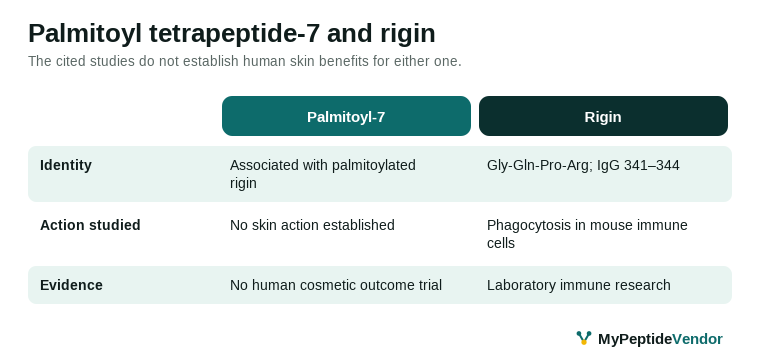
Rigin and palmitoyl tetrapeptide-7 are associated by sequence and name, but the cited research does not establish human skin benefits for either one. The primary studies also do not provide a head-to-head comparison with palmitoyl tripeptide-1 3458.
| Peptide | Sequence or origin | Action studied or described | Evidence level |
|---|---|---|---|
| Palmitoyl tetrapeptide-7 | Cosmetic ingredient name associated with palmitoylated rigin; exact equivalence is not established by the rigin studies. | No skin action is established by the cited primary research. | No human cosmetic outcome trial is reported in the cited research. |
| Rigin | Gly-Gln-Pro-Arg; IgG heavy-chain fragment 341–344. | Phagocytosis activity was studied in mouse immune cells. | Laboratory immune research; not proof of topical skin benefit. |
| Palmitoyl tripeptide-1 | Sequence and origin are not established by the cited primary studies. | The cited studies do not describe its skin action. | No head-to-head trial or evidence of superiority for sagging is established here. |
The cited studies do not identify a best peptide for sagging skin. They examine rigin’s immune activity and structure, not skin tightening in people 589.
Use this chart
Free to reuse with a link back:
Frequently asked questions
Can you absorb peptides through your skin?
Some topical formulations are designed to deliver peptides into skin, but the result depends on the peptide and the formula. For this ingredient, skin absorption has not been measured in the cited research; macrophage uptake from liposomes is a different test 4.
What is palmitoyl tetrapeptide-7 in skincare?
It is a cosmetic peptide name associated with palmitoylated rigin. Rigin itself is Gly-Gln-Pro-Arg, an IgG heavy-chain fragment, but the foundational rigin research does not confirm the exact identity of the cosmetic ingredient 38.
References
- FDA: Certain bulk drug substances for use in compounding that may present significant safety risks
- Zhang et al. The nucleoprotein of influenza A virus inhibits the innate immune response by inducing mitophagy. Autophagy. 2023.
- Navolotskaya et al. The second life of antibodies. Biochemistry (Mosc). 2014.
- Dutta et al. Immunomodulatory potential of hydrophobic analogs of Rigin and their role in providing protection against Plasmodium berghei infection in mice. Int Immunopharmacol. 2001.
- Rocchi et al. Synthesis and biological activity of tuftsin and rigin derivatives containing monosaccharides or monosaccharide derivatives. Int J Pept Protein Res. 1987.
- Porras et al. Antifungal Peptides with Unexpected Structure from a Library of Synthetic Analogs of Host-Defense Peptide Rigin. Int J Mol Sci. 2025.
- Yi et al. Palmitoyl-transferase 3 promotes mitochondrial antiviral signaling protein degradation by modulating its ubiquitination. Int J Biol Macromol. 2025.
- Veretennikova et al. Rigin, another phagocytosis-stimulating tetrapeptide isolated from human IgG. Confirmations of a hypothesis. Int J Pept Protein Res. 1981.
- Ashish et al. Characterization of a novel type VII beta-turn conformation for a bio-active tetrapeptide rigin A synergy between theoretical and experimental results. Eur J Biochem. 2000.
Written by the MyPeptideVendor editorial team from the FDA label, peer-reviewed studies and ClinicalTrials.gov records listed above, fact-checked line by line and reviewed 2026-11-12.
Cite this page
MyPeptideVendor Editorial Team. rigin palmitoyl tetrapeptide 7: Evidence & Uses. MyPeptideVendor. Updated November 12, 2026. https://mypeptidevendor.com/peptides/rigin-palmitoyl-tetrapeptide-7/MyPeptideVendor Editorial Team. (2026, November 12). rigin palmitoyl tetrapeptide 7: Evidence & Uses. MyPeptideVendor. https://mypeptidevendor.com/peptides/rigin-palmitoyl-tetrapeptide-7/Related peptides
Argireline (Acetyl Hexapeptide-3)
Not approvedA small 4-week trial found wrinkle improvements, but lasting effects, ideal concentration, and Argireline-specific side-effect rates remain unknown.
Learn moreAHK-Cu
Not approvedAHK-Cu has early lab findings related to hair follicles, but human hair benefits, safe dosing, and side-effect rates are not established.
Learn moreAHK (Tripeptide-3)
Not establishedAHK-Cu is a copper tripeptide used as a cosmetic ingredient, but human hair-growth benefit and a proven scalp dose remain unestablished.
Learn more