Pancragen Peptide: Evidence, Dosing & Safety
Synthetic tetrapeptide
Brand names: Pancragen
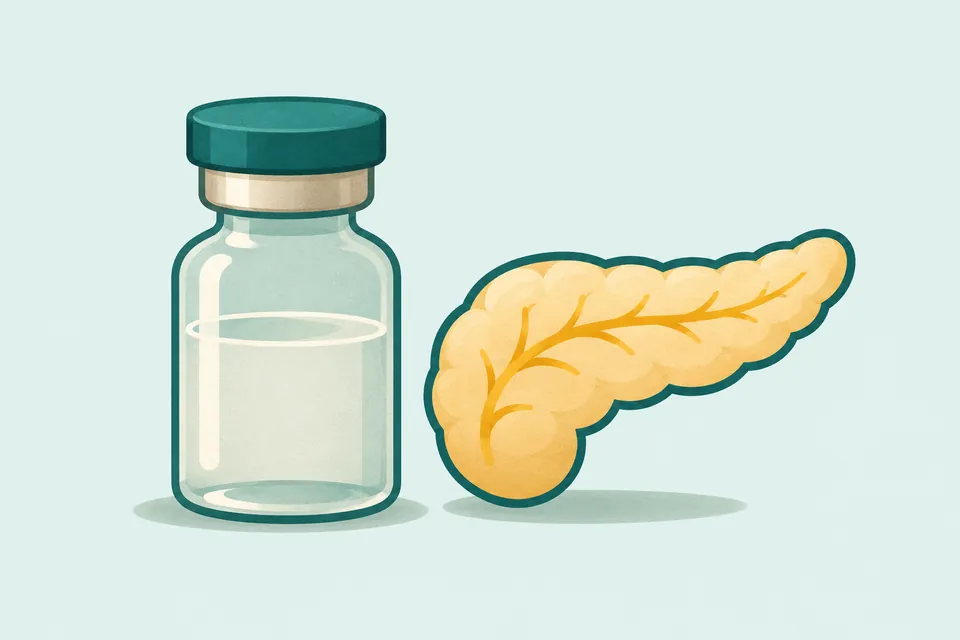
Pancragen is a synthetic tetrapeptide, Lys-Glu-Asp-Trp (KEDW), studied for possible effects on pancreatic cells and blood sugar 2,5. It is not an established treatment for diabetes or pancreatic repair.
Evidence includes a small human study of 63 older adults and animal and cell studies 2-8. The human report does not state the dose, treatment duration, or numerical size of the glucose changes, so it cannot set a human regimen 3.
Key takeaways
- The human report included 30 healthy older adults and 33 older adults with type 2 diabetes, but did not give a dose or numerical treatment effects 3.
- Two monkey studies used 50 μg per animal daily by intramuscular injection for 10 days; neither establishes a human dose 4,6.
- A monkey study reported that some pancreatic-function effects remained 3 weeks after Pancragen stopped 6.
- The cited studies report no usable adverse-event percentages, so a reliable side-effect rate is unknown 2-8.
- The FDA Category 2 page does not identify Pancragen in the displayed list, so its Category 2 status cannot be confirmed from that page 1.
Pancragen at a glance
- Class
- Synthetic tetrapeptide, Lys-Glu-Asp-Trp (KEDW)
- Mechanism
- Proposed effect on pancreatic-cell differentiation factors, including Pdx1 and Pax6
- FDA Status
- Not an established FDA-approved treatment; the cited FDA Category 2 page does not confirm a Pancragen listing
- Brand names
- Pancragen
- Administration
- Oral and intramuscular routes studied in animals; a human route is not established
- Typical Dose
- Research: 50 μg per monkey daily by intramuscular injection for 10 days; not a human dose
- Half-life
- Not established in the cited studies
- Primary Uses
- Investigated for pancreatic-cell differentiation and changes in glucose regulation
What is it?

Pancragen is a short, synthetic chain of four amino acids: Lys-Glu-Asp-Trp, written as KEDW 2,5. It belongs to the Khavinson bioregulator family, a group of short peptides studied for possible tissue-specific effects 7,8. That research label does not mean Pancragen has been shown to repair a human pancreas.
Researchers have studied Pancragen in pancreatic cell cultures, rats, rhesus monkeys, and older adults 2-8. Each setting answers a different question. A cell culture can show that a marker changes; it cannot show that a person will produce more insulin. An animal experiment can measure blood glucose and hormones, but it cannot establish a human treatment dose.
The pancreas has hormone-producing cells as well as cells involved in digestion. Pancragen research has examined markers tied to pancreatic-cell differentiation and measures of glucose, insulin, and C-peptide 2-6. The cited studies do not show that it improves digestion, treats pancreatitis, or restores damaged pancreatic tissue in people 2-8.
Pancragen is an experimental peptide, not an established medicine for diabetes or pancreatic disease 2-8. The human report described changes in blood sugar measures among older adults with type 2 diabetes, but did not provide numerical treatment effects or a dose 3.
What makes it different
Pancragen’s proposed action differs from that of a standard glucose-lowering medicine: researchers have studied whether it changes pancreatic-cell differentiation markers, while its human evidence consists of one small report without a stated dose or treatment duration 2,3. A change in a marker is not the same as proving that a person’s pancreas has repaired itself.
The closest direct comparison in the cited research is glimepiride, a glucose-lowering drug. In a study of nine older female rhesus monkeys, five received Pancragen and four received glimepiride; Pancragen was reported to normalize insulin and C-peptide, while glimepiride produced a stronger, delayed glucose-lowering effect 4. This small animal comparison does not show that Pancragen works as well as, or better than, glimepiride in people.
Online claims sometimes describe Pancragen doses of 10–20 mg daily. That range is not supported by the primary studies listed here. Ten to 20 mg daily is 200–400 times the 50 μg (0.05 mg) per-animal daily dose studied in the monkey reports 4,6. No human-equivalent dose has been established.
Claim check
Cell research supports changes in certain differentiation markers, but some popular claims go beyond what the named studies report 2,7. The comparisons below distinguish findings in cells from claims that are not reported in the cited studies 2-8.
| Claim | What the studies report | Assessment |
|---|---|---|
| Pancragen affects pancreatic differentiation markers | Pancreatic cell studies report changes in named factors | Supported in cell cultures; not proof of patient benefit |
| Pancragen binds directly to DNA | The cited studies report marker expression, not direct DNA binding | Not established |
| PDX1 rises 1.6-fold, NGN3 2.7-fold, and PAX6 1.8-fold | These exact fold changes are not reported in the cited studies | Not found in the cited studies |
| Pancragen has a favorable safety profile | The reports do not give adverse-event rates or a full safety analysis | Not established |
How does it work?
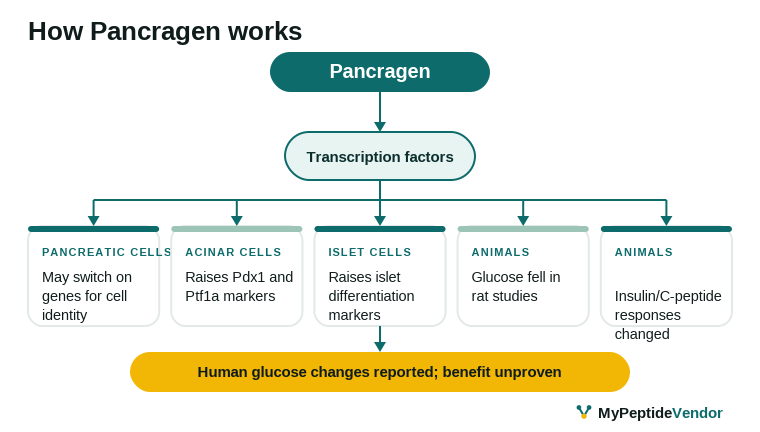
In plain terms, researchers propose that Pancragen may encourage pancreatic cells to switch on genes linked to their identity and development. The technical idea is a change in transcription factors, proteins that help control which genes a cell uses 2. This is a proposed mechanism, not proof that the peptide rebuilds a person’s pancreas.
In pancreatic cell cultures, Pancragen stimulated Pdx1 and Ptf1a, factors linked to acinar-cell differentiation, and Pdx1, Pax6, Pax4, Foxa2, and Nkx2.2, factors linked to islet-cell differentiation 2. A separate cell-culture study reported tissue-specific changes in differentiation markers in human embryonic pancreatic cells 7. These results do not show that adult human beta cells multiply or produce enough insulin to treat diabetes.
Insulin helps move glucose out of the blood. C-peptide is released when the body makes its own insulin, so researchers can measure it as a related marker of insulin production 4,6. Animal studies measured glucose, insulin, and C-peptide after Pancragen, but those measurements do not prove that new insulin-producing cells formed 4-6.
Route may affect the result. In rats with streptozotocin-induced diabetes, oral Pancragen produced a pronounced glucose-lowering effect. Intramuscular Pancragen normalized the adhesion of mesenteric capillary endothelium but did not change capillary permeability 5. The report does not explain why the outcomes differed by route, and it does not compare oral and injected treatment in people.
It remains unknown whether Pancragen can restore insulin production in type 1 diabetes or after long-standing loss of beta cells. The human study did not test either situation 3. A laboratory change in a differentiation marker cannot answer whether a person with extensive beta-cell loss can make insulin again.
Use this chart
Free to reuse with a link back:
What the clinical evidence actually shows

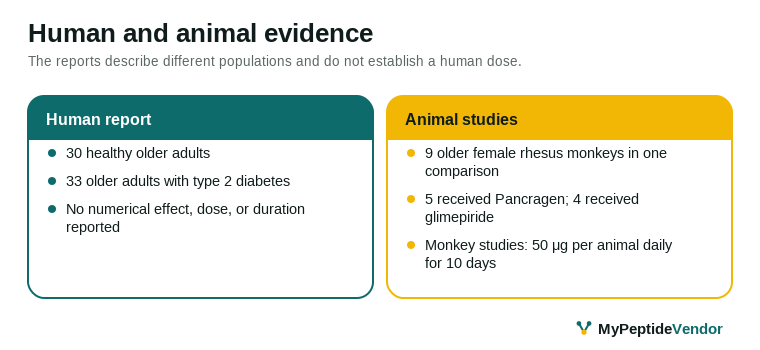
The evidence ranges from cell experiments to animal work and one small human report 2-8. The human study examined 30 healthy older adults and 33 older adults with type 2 diabetes 3. In the diabetes group, the authors reported lower fasting glucose and lower glucose during a standard glucose-tolerance test, as well as lower insulin and insulin-resistance measures. They did not report numerical treatment effects, a defined dose, or treatment duration 3.
The human report also found that nocturnal melatonin production was 70% lower in older adults with type 2 diabetes than in healthy older adults of similar age 3. That figure compares the groups; it is not a Pancragen treatment effect. Participants who did not receive Pancragen had no reported change in carbohydrate-metabolism measures, but the report does not provide enough detail to calculate how much treatment changed glucose or insulin resistance 3.
A separate study compared Pancragen with glimepiride in nine older female rhesus monkeys 4. Five animals received Pancragen at 0.05 mg per animal daily by intramuscular injection for 10 days; four received 4 mg of glimepiride per animal daily by mouth for the same duration 4. Basal glucose decreased in both groups. Pancragen was reported to normalize insulin and C-peptide, while glimepiride caused a more pronounced, delayed glucose-lowering effect and stimulated C-peptide without a significant effect on insulin secretion 4. These findings do not support replacing a prescribed diabetes medicine with Pancragen.
Another old-monkey study used 50 μg per animal daily by intramuscular injection for 10 days 6. After a glucose challenge, the researchers reported a faster glucose-disappearance rate and more normalized insulin and C-peptide responses. Some of the reported recovering effect remained 3 weeks after treatment stopped 6. The report does not provide a human dose or a numerical size for these changes.
In rats with experimentally induced diabetes, oral Pancragen produced a pronounced hypoglycemic effect 5. Intramuscular treatment normalized mesenteric capillary adhesion but did not modify permeability 5. The rat report does not state a dose, group size, or treatment duration. These different measurements should not be collapsed into a claim that either route repairs the pancreas.
The seven studies below span cell culture, animal experiments, and a small human report 2-8. Their reported study populations, routes, regimens, and outcomes are summarized in the publications 2-8.
| Study | Evidence type and number | Route, dose, duration | Reported finding |
|---|---|---|---|
| Khavinson et al., 2013 | Pancreatic cell cultures; number not reported | Dose and duration not reported | Increased expression of pancreatic differentiation factors |
| Korkushko et al., 2011 | Human: 30 healthy older adults and 33 with type 2 diabetes | Dose, route, and duration not reported | Authors reported lower glucose measures and insulin resistance in the diabetes group; numerical treatment effects not reported |
| Goncharova et al., 2015 | Animal: 9 old female rhesus monkeys; 5 received Pancragen and 4 glimepiride | Pancragen 0.05 mg/animal/day IM; glimepiride 4 mg/animal/day by mouth; both for 10 days | Glucose decreased in both groups; reported insulin and C-peptide responses differed |
| Khavinson et al., 2007 | Animal: Wistar rats with streptozotocin-induced diabetes; number not reported | Oral and IM routes; dose and duration not reported | Oral treatment lowered glucose; IM treatment changed capillary adhesion, not permeability |
| Goncharova et al., 2014 | Animal: old rhesus monkeys; number not reported | 50 μg/animal/day IM for 10 days | Glucose handling and insulin/C-peptide responses improved; some effect remained 3 weeks later |
| Khavinson et al., 2012 | Human embryonic pancreatic cell cultures; number not reported | Dose and duration not reported | Pancragen stimulated tissue-specific differentiation markers |
| Zakutskiĭ et al., 2006 | Organotypic tissue cultures from young and aged rats; number not reported | 0.05 ng/mL in culture; exposure duration not reported | Reported a stimulating effect in the relevant tissue cultures |
How to read the evidence ladder
Cell studies can show that a marker changes under controlled conditions, but they cannot establish a clinical effect in a person 2,7,8. Rat and monkey experiments can measure glucose and hormone responses, but they do not set a human dose 4-6. The human report is more directly relevant to patients, yet it lacks numerical treatment effects and a reported regimen 3.
No randomized human trial with a defined Pancragen dose and clearly reported clinical endpoints is included in these studies 2-8. The evidence also does not establish whether results in older animals apply to younger adults, people with type 1 diabetes, or people with advanced type 2 diabetes 2-7.
What remains unknown
The human-equivalent dose has not been established, and there is no human comparison showing whether oral and intramuscular Pancragen have different effects 3-6. The animal route findings cannot answer that question because the rat study measured different outcomes for each route 5.
There is no cited human evidence that Pancragen prevents diabetes complications, reduces the need for medication, restores pancreatic tissue, or produces a lasting improvement in health outcomes 2-8. Partial persistence for 3 weeks in a monkey study is not evidence of a durable human benefit 6.
Use this chart
Free to reuse with a link back:
Typical dosing

There is no established human dose or cycle. The human report does not state how much Pancragen participants received, how they took it, or how long treatment lasted 3. Therefore, it cannot support a practical human dosing schedule.
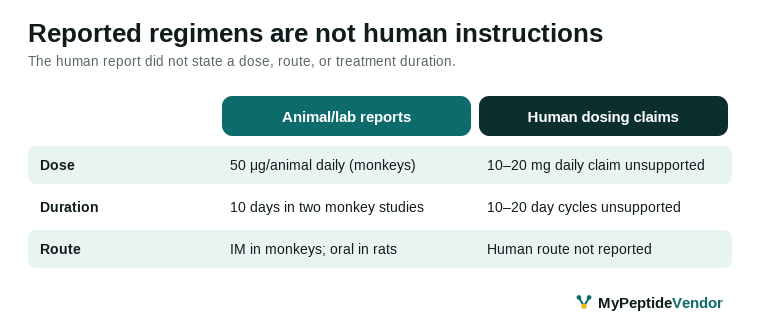
The two old-monkey studies each report 50 μg per animal daily by intramuscular injection for 10 days 4,6. One paper writes this amount as 0.05 mg; 0.05 mg is equal to 50 μg 4,6. These are animal regimens, not instructions for people.
The rat study reports a glucose-lowering effect after oral Pancragen and a separate capillary finding after intramuscular treatment, but it does not report the dose or course length 5. A tissue-culture experiment used 0.05 ng/mL, a concentration in a laboratory dish rather than an amount to take 8. These routes and units are not interchangeable.
Claims of 10–20 mg daily or 10–20 day human cycles are not supported by the primary studies cited here 2-8. Ten to 20 mg daily is 200–400 times the 50 μg (0.05 mg) per-animal daily dose studied in the monkey reports 4,6. A human-equivalent dose cannot be calculated from the available results. This is not medical advice; do not turn an animal dose into a self-treatment plan or replace prescribed diabetes treatment.
Use this chart
Free to reuse with a link back:
Side effects: what to actually expect
The cited reports provide no usable percentage of people or animals with side effects, and no detailed adverse-event table 2-8. They do not establish that Pancragen is safe for routine use. When a short report does not mention an adverse event, that silence does not prove the event did not occur.
Low blood sugar is a practical concern to discuss with a clinician because Pancragen was associated with lower glucose in a small human report and in animal studies 3-5. The studies do not test Pancragen combined with insulin, metformin, or a sulfonylurea, so the chance and size of any interaction are unknown 2-8. In the monkey comparison, glimepiride had a stronger, delayed glucose-lowering effect, but the study did not combine it with Pancragen 4.
There is no established contraindication list in the cited research 2-8. Pregnancy, breastfeeding, pancreatitis, and significant pancreatic disease have not been adequately evaluated in the described human report 3. Safety in those situations is unknown, not established.
Before considering an unapproved product
- If you take glucose-lowering medicine: do not stop or reduce it on your own. Ask your prescriber or pharmacist to review the possibility of added glucose lowering, and bring your recent blood sugar log; combination safety has not been established 2-8.
- If you use insulin or have type 1 diabetes: the cited human study does not test Pancragen in this setting 3. Contact your diabetes clinician before considering an experimental product.
- If you are pregnant, breastfeeding, or have pancreatitis: the cited studies do not establish safety for these situations 2-8. Discuss the uncertainty with a clinician rather than relying on an online dosing protocol.
- If you develop low-blood-sugar symptoms: follow your existing diabetes action plan and seek medical care when needed. Do not use an untested peptide to manage a glucose emergency.
Regulatory & access status in the US
Pancragen is not an established FDA-approved treatment for diabetes, pancreatitis, or pancreatic repair. The FDA material cited here concerns bulk substances nominated for compounding and does not itself establish approval for a drug 1. The displayed Category 2 list does not identify Pancragen, so its Category 2 status cannot be confirmed from that page 1.
FDA describes Category 2 as a group of nominated bulk drug substances for which the agency has identified potential significant safety risks during its review of substances proposed for the 503A or 503B bulks lists 1. Category 2 is not an approval, and an entry would not show that a substance is effective. Because Pancragen is not identified in the displayed list, do not assume it is on that list or use the list as proof of its regulatory status 1.
Online sale, a “research use” label, or a seller’s claim of purity does not establish that a product is an FDA-approved medicine or suitable for human use. The cited studies and FDA page do not establish a reliable legal consumer route or a quality standard for Pancragen products sold online 1-8. Product identity, strength, sterility, and suitability cannot be inferred from marketing language.
For a person managing diabetes, there are two separate uncertainties: the product’s quality and its possible effect alongside glucose-lowering medicines 3-5. A licensed clinician and pharmacist can review those risks, but Pancragen should not replace prescribed treatment.
Research-grade Pancragen is available from Certified-Pep. Sold for laboratory research only, not for human use. Affiliate link
How it compares with its closest alternative
Glimepiride is the closest comparator because it was tested directly against Pancragen in old rhesus monkeys 4. The comparison below reflects that animal experiment only; it does not establish that Pancragen is an alternative to diabetes treatment in people 4.
| Feature | Pancragen | Glimepiride |
|---|---|---|
| Type | Experimental synthetic tetrapeptide | Glucose-lowering drug used as the comparator |
| Animals in the direct comparison | 5 old female rhesus monkeys | 4 old female rhesus monkeys |
| Study regimen | 0.05 mg per animal daily by intramuscular injection for 10 days | 4 mg per animal daily by mouth for 10 days |
| Glucose finding | Basal glucose decreased during treatment | Basal glucose decreased; the effect was stronger and delayed |
| Insulin and C-peptide finding | Authors reported normalization of insulin and C-peptide | C-peptide secretion increased without a significant effect on insulin secretion |
| Human dose or benefit | Not established | The monkey comparison does not establish a Pancragen-related human regimen |
The delayed glucose-lowering effect in the glimepiride group is a reason not to assume that combining glucose-lowering agents is harmless; it does not prove a specific interaction with Pancragen 4. No cited study tests that combination in people 2-8.
Where to Buy Pancragen for Research
Certified-Pep
US-made research peptides with batch-specific lab reports (COA) and a QR code on every vial.
- Independent laboratory testing (Vanguard Laboratory)
- Made in the USA, ships in 1-2 business days
- Research use only, not for human or veterinary use
Affiliate disclosure: we may earn a commission if you order through the link above. Pancragen is not approved by the FDA for human use.
Frequently asked questions
What is pancragen peptide used for?
Researchers have studied Pancragen as a possible way to influence pancreatic-cell differentiation and glucose regulation 2,3. The small human report involved 33 older adults with type 2 diabetes, but it is not enough to establish Pancragen as a treatment for diabetes or another pancreatic disease 3.
What are the big 3 peptides?
“The big 3 peptides” is not a defined medical category in the Pancragen research 2-8. The phrase can mean different things in online discussions, so ask which three compounds someone means before comparing their evidence or risks.
Are there any peptides that can help repair the pancreas?
Pancragen has been tested for effects on pancreatic-cell markers, but those findings do not demonstrate repair of a human pancreas 2,7. The human report does not show restored pancreatic tissue or lasting recovery of insulin production 3.
How can I get my pancreas to start producing insulin again?
No Pancragen regimen has been shown to restart insulin production after beta-cell loss in people 3. If you have diabetes, ask your clinician to review your diagnosis, glucose results, and current treatment before changing medicines or considering an experimental peptide.
References
- FDA: Certain bulk drug substances for use in compounding that may present significant safety risks
- Khavinson et al. Effects of pancragen on the differentiation of pancreatic cells during their ageing. Bull Exp Biol Med. 2013.
- Korkushko et al. Prospects of using pancragen for correction of metabolic disorders in elderly people. Bull Exp Biol Med. 2011.
- Goncharova et al. [Correction of impaired glucose tolerance using tetrapeptide (Pancragen) in old female rhesus monkeys]. Adv Gerontol. 2015.
- Khavinson et al. Effect of pancragen on blood glucose level, capillary permeability and adhesion in rats with experimental diabetes mellitus. Bull Exp Biol Med. 2007.
- Goncharova et al. [Impact of tetrapeptide pancragen on endocrine function of the pancreas in old monkeys]. Adv Gerontol. 2014.
- Khavinson et al. Peptides tissue-specifically stimulate cell differentiation during their aging. Bull Exp Biol Med. 2012.
- Zakutskiĭ et al. [The tissue-specific effect of synthetic peptides-biologic regulators in organotypic tissues culture in young and old rats]. Adv Gerontol. 2006.
Written by the MyPeptideVendor editorial team from the FDA label, peer-reviewed studies and ClinicalTrials.gov records listed above, fact-checked line by line and reviewed 2026-11-12.
Cite this page
MyPeptideVendor Editorial Team. Pancragen Peptide: Evidence, Dosing & Safety. MyPeptideVendor. Updated November 12, 2026. https://mypeptidevendor.com/peptides/pancragen/MyPeptideVendor Editorial Team. (2026, November 12). Pancragen Peptide: Evidence, Dosing & Safety. MyPeptideVendor. https://mypeptidevendor.com/peptides/pancragen/Related peptides
Argireline (Acetyl Hexapeptide-3)
Not approvedA small 4-week trial found wrinkle improvements, but lasting effects, ideal concentration, and Argireline-specific side-effect rates remain unknown.
Learn moreAHK-Cu
Not approvedAHK-Cu has early lab findings related to hair follicles, but human hair benefits, safe dosing, and side-effect rates are not established.
Learn moreAHK (Tripeptide-3)
Not establishedAHK-Cu is a copper tripeptide used as a cosmetic ingredient, but human hair-growth benefit and a proven scalp dose remain unestablished.
Learn more