Syn-Coll Palmitoyl Tripeptide 5: Evidence & Safety
Topical signal peptide
Brand names: Syn-Coll; Tripeptide-5.

Syn-Coll is Palmitoyl Tripeptide-5, a peptide ingredient promoted for visible wrinkles, firmness, elasticity, and pore appearance. A manufacturer-reported study used 1% and 2. 6
Those results come from sponsor-run studies, and they do not answer whether the peptide tightens sagging skin or how often irritation occurs. Suppliers also differ on recommended use level and pH, so formulation directions should match the specific material.268
Key takeaways
- The 84-day manufacturer study reported wrinkle reductions of 7% with 1% and 12% with 2.5% Syn-Coll.6
- In a separate 4-week sponsor-run study, 77% of 33 women reported better firmness or elasticity, while 60% perceived smaller-looking pores.6
- The cited human results do not measure sagging skin directly, and a reliable side-effect percentage is not available.6
- The FDA Category 2 compounding page concerns nominated bulk drug substances; its visible portion does not list Palmitoyl Tripeptide-5 or address cosmetic status.1
Syn-Coll (Palmitoyl Tripeptide-5) at a glance
- Class
- Topical signal peptide
- Mechanism
- Proposed collagen signaling and reduced collagen breakdown; the human studies do not establish the pathway.
- FDA Status
- The FDA Category 2 compounding page does not establish this ingredient’s cosmetic status.
- Brand names
- Syn-Coll; Tripeptide-5.
- Administration
- Topical use in a finished cosmetic formula; supplier directions vary.
- Typical Dose
- Supplier use levels of 1.0%–2.5% or 1.0%–3.0%; not a medical dose.
- Half-life
- Not established for topical use.
- Primary Uses
- Supplier-promoted wrinkle, firmness, elasticity, and pore appearance claims.
What is it?

Palmitoyl Tripeptide-5 is the INCI name used for Syn-Coll; Tripeptide-5 is another name used for the ingredient.2 It is made from the three-amino-acid sequence Lys-Val-Lys bonded to palmitic acid.2 INCI is the standardized ingredient name that appears on cosmetic ingredient lists.
Supplier descriptions promote it for the look of wrinkles, firmness, elasticity, and pores.
What makes it different
The peptide is designed as a signal rather than as collagen itself: the proposed goal is to prompt skin cells to make structural proteins and limit their breakdown.25 That theory differs from applying a collagen-containing product, which does not by itself show that skin has produced new collagen.
Palmitoyl Tripeptide-5’s palmitic-acid attachment is part of its chemical identity. 28
Wrinkles, firmness, elasticity, pore appearance, and sagging are separate outcomes. The human reports include wrinkle ratings and people’s perceptions of firmness, elasticity, and pores; they do not report a direct measurement of sagging.6
How does it work?
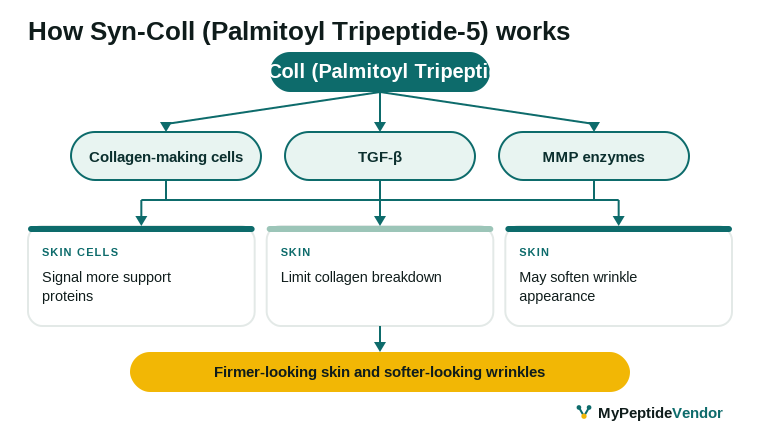
In plain words, the idea is to send skin cells a “make more support, lose less support” signal. The technical version proposed by product descriptions involves collagen-producing cells, transforming growth factor beta (TGF-β), and enzymes called matrix metalloproteinases (MMPs), which can break down collagen.25
A wrinkle score or a person’s impression of firmer skin does not prove that collagen increased or that an MMP pathway changed.6 The available human study descriptions report visible or perceived outcomes, not direct measurements of collagen production in treated skin.
Use this chart
Free to reuse with a link back:
What the clinical evidence actually shows

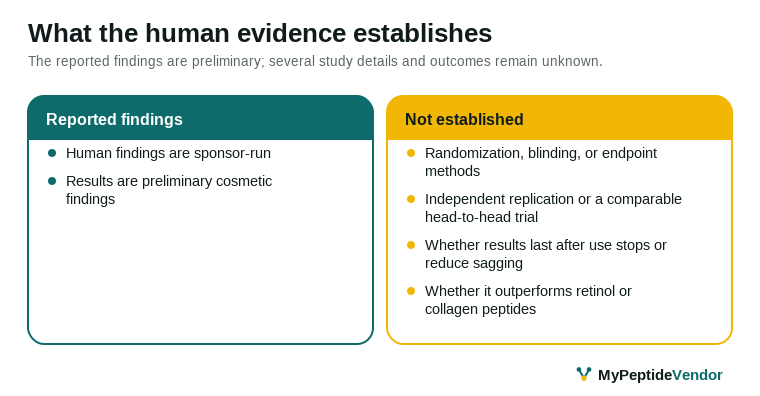
The available human findings are sponsor-run, and the study descriptions do not provide enough design detail to judge randomization, blinding, or how each endpoint was measured.6 The results are worth describing as preliminary cosmetic findings, not as a reliable prediction for every product or user.
5% will work better in a different formula or for a particular person.
5 No independent replication or comparable head-to-head trial is described in the available study information.56
It has not been studied in the reported trials whether results last after use stops, whether the ingredient reduces sagging, or whether it performs better than retinol or collagen peptides.6 A formal trial name, registry entry, and adverse-event percentages are not provided in the study descriptions.6
Use this chart
Free to reuse with a link back:
Typical dosing

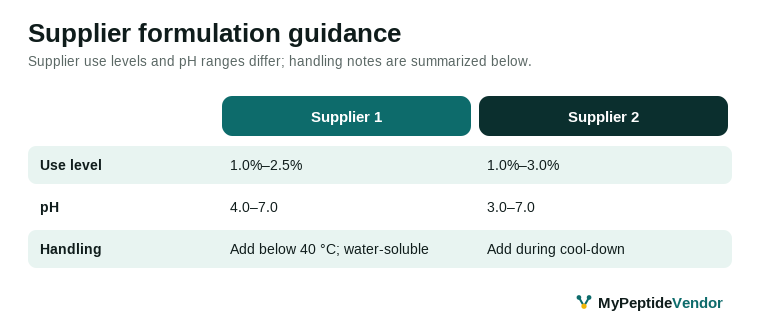
Supplier use levels are formulation ranges, not proven medical doses. One supplier recommends 1.0%–2.5% and pH 4.0–7.0; another gives 1.0%–3.0% and pH 3.0–7.0.28 The reason for the difference is not explained, so use the technical directions for the exact material rather than mixing specifications.
The 84-day wrinkle study used 1% and 2.5% formulas twice daily.6 Those study concentrations do not establish how much raw ingredient is in a retail product or whether a higher concentration will improve results outside that study.
The formulation instructions differ, as summarized below.28
| Supplier guidance | Use level | pH | Handling |
|---|---|---|---|
| Supplier 1 | 1.0%–2.5% | 4.0–7.0 | Water-soluble; add below 40 °C; store below 25 °C away from light |
| Supplier 2 | 1.0%–3.0% | 3.0–7.0 | Water-soluble; add during cool-down |
Use this chart
Free to reuse with a link back:
Side effects: what to actually expect
A dependable percentage for redness, burning, allergy, or other side effects is not reported with the human study results.6 That means the rate is unknown, not that reactions cannot happen.
2 A finished serum or cream may also contain carriers, preservatives, fragrance, or other ingredients that can cause a reaction.
If a leave-on product causes persistent redness, swelling, burning, or a rash, stop using it. Trying a small area first may help spot an immediate reaction, but it cannot guarantee that a product will be tolerated with repeated use.
Regulatory & access status in the US
The FDA Category 2 page lists bulk drug substances nominated for compounding and describes potential safety risks for substances on that list.1 Its visible portion does not list Palmitoyl Tripeptide-5, and the page does not address cosmetic approval status.1 It therefore cannot establish this ingredient’s regulatory status in a cosmetic product.
Supplier pages offer Palmitoyl Tripeptide-5 as a cosmetic formulation ingredient.
For any product, check its ingredient list, intended-use instructions, and the seller’s stated use restrictions. A raw ingredient’s availability does not establish that a particular finished formula has been reviewed for safety or effectiveness.
How it compares to its closest alternative
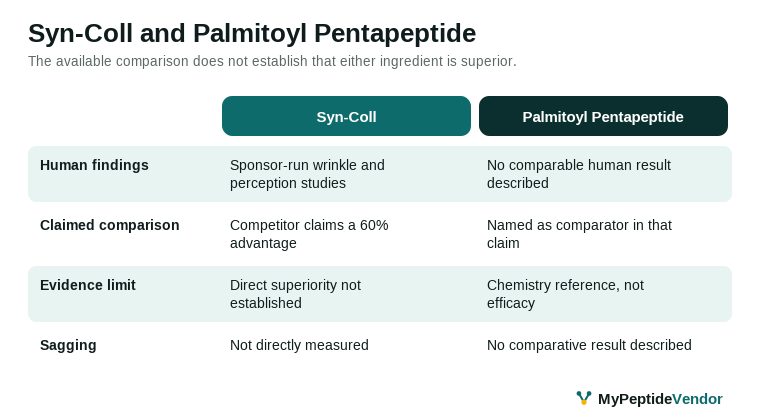
Palmitoyl Pentapeptide is the closest named comparison in the available efficacy claim: a competitor says Syn-Coll performed better, but its cited reference does not support that clinical comparison. 56
| Feature | Syn-Coll (Palmitoyl Tripeptide-5) | Palmitoyl Pentapeptide |
|---|---|---|
| Reported human findings | 45-person wrinkle study and 33-person perception study, both sponsor-run | No comparable human result described |
| Claimed comparison | Competitor claims a 60% advantage | Named as the comparator in that claim |
| Evidence limit | Study descriptions do not establish direct superiority | The cited reference concerns peptide chemistry, not clinical efficacy |
| Effect on sagging | Not directly measured in the reported studies | No comparative sagging result described |
Retinol and collagen peptides are also different choices, but the reported Syn-Coll studies do not compare either one with this peptide.6 Retinol has a different skin-care role and can irritate some users; topical collagen peptides are not the same thing as collagen made within the skin. There is no single “best” option established by these Syn-Coll results.
Use this chart
Free to reuse with a link back:
Frequently asked questions
What does palmitoyl Tripeptide-5 do for skin?
It is used in products that claim to soften the appearance of wrinkles and improve firmness, elasticity, or pore appearance.26 The human reports include an 84-day wrinkle study and a 4-week perception study, but they do not establish a lift for loose skin.6
Which peptide is best for sagging skin?
No peptide can be ranked as best for sagging from the reported Syn-Coll studies because they did not measure sagging directly.6 A product claim about firmer-looking skin is not the same as a demonstrated change in skin laxity.
What is another name for Palmitoyl Tripeptide-5?
Which is better, retinol or collagen peptide?
They are not interchangeable: retinol is a different active, while a topical collagen peptide product is not the same as collagen produced in skin. No reported Syn-Coll trial directly compares either option with Palmitoyl Tripeptide-5, so the best fit depends on the concern and the product’s tolerability.6
References
Written by the MyPeptideVendor editorial team from the FDA label, peer-reviewed studies and ClinicalTrials.gov records listed above, fact-checked line by line and reviewed 2026-11-12.
Cite this page
MyPeptideVendor Editorial Team. syn coll palmitoyl tripeptide 5: Evidence & Safety. MyPeptideVendor. Updated November 12, 2026. https://mypeptidevendor.com/peptides/syn-coll-palmitoyl-tripeptide-5/MyPeptideVendor Editorial Team. (2026, November 12). syn coll palmitoyl tripeptide 5: Evidence & Safety. MyPeptideVendor. https://mypeptidevendor.com/peptides/syn-coll-palmitoyl-tripeptide-5/Related peptides
Argireline (Acetyl Hexapeptide-3)
Not approvedA small 4-week trial found wrinkle improvements, but lasting effects, ideal concentration, and Argireline-specific side-effect rates remain unknown.
Learn moreAHK-Cu
Not approvedAHK-Cu has early lab findings related to hair follicles, but human hair benefits, safe dosing, and side-effect rates are not established.
Learn moreAHK (Tripeptide-3)
Not establishedAHK-Cu is a copper tripeptide used as a cosmetic ingredient, but human hair-growth benefit and a proven scalp dose remain unestablished.
Learn more