Palmitoyl Dipeptide-6: Evidence & Safety
Cosmetic peptide ingredient
Brand names: No verified alternate name for palmitoyl dipeptide 6 is established.

Palmitoyl dipeptide 6 is a name that suggests a palmitic-acid group attached to a two-amino-acid peptide, but its exact INCI identity and amino-acid sequence are not established in the cited medical or regulatory material.
That gap matters: evidence about other palmitoyl peptides does not prove an effect for this name. No human trial, tested concentration, or side-effect rate for palmitoyl dipeptide 6 is available to report.
Key takeaways
- A palmitoyl fatty-acid group may change a peptide’s interaction with the skin barrier; penetration by this exact ingredient has not been measured.
- The 2021 review discusses palmitoyl tripeptide-5 and palmitoyl tetrapeptide-7, but it does not establish clinical results for dipeptide 6 4.
- No trial dose, standard product percentage, or side-effect rate is established for palmitoyl dipeptide 6.
- EWG’s LOW hazard ratings and “None” data availability apply to a different named ingredient, palmitoyl dipeptide-5 diaminobutyroyl hydroxythreonine 5.
Palmitoyl Dipeptide-6 at a glance
- Class
- Cosmetic peptide ingredient; exact identity uncertain
- Mechanism
- A palmitoyl group may alter a peptide’s lipid affinity, but the target and effect of this exact ingredient are unknown.
- FDA Status
- The cited FDA compounding list does not establish the approval status of palmitoyl dipeptide 6.
- Brand names
- No verified alternate name for palmitoyl dipeptide 6 is established.
- Administration
- Topical use is suggested by the cosmetic context of the name; no trial schedule is established.
- Typical Dose
- No trial-tested or standard concentration is established.
- Half-life
- Unknown.
- Primary Uses
- Marketed-style claims may concern skin conditioning, collagen support, or firmness, but effects for this exact ingredient are unproven.
What is it?

Palmitoyl dipeptide 6 appears to describe a lipopeptide: a fatty-acid-derived group joined to a short peptide. “Dipeptide” means a chain of 2 amino acids. “Palmitoyl” refers to a group derived from palmitic acid.
This is not a small naming detail. Different amino-acid sequences can behave differently, and a similar name does not prove that two ingredients are the same.
Names and trade labels can also cause mix-ups. Treat any trade name offered for palmitoyl dipeptide 6 as unverified unless the maker confirms the full INCI identity.
Those categories do not verify that a product contains palmitoyl dipeptide 6, or show how much of any peptide it contains.
What makes it different
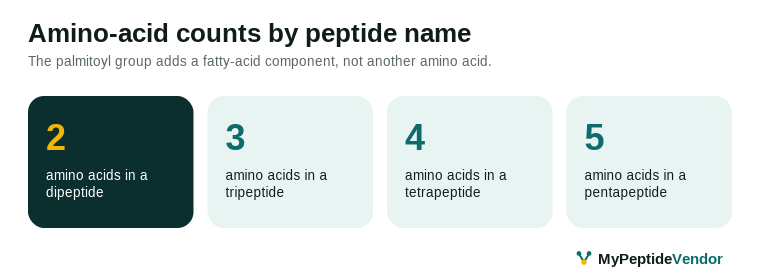
A peptide is the broad term for a chain of amino acids; a dipeptide is specifically a chain of 2. A tripeptide has 3 amino acids, a tetrapeptide has 4, and a pentapeptide has 5. The palmitoyl group adds a fatty-acid component, not another amino acid to the peptide chain.
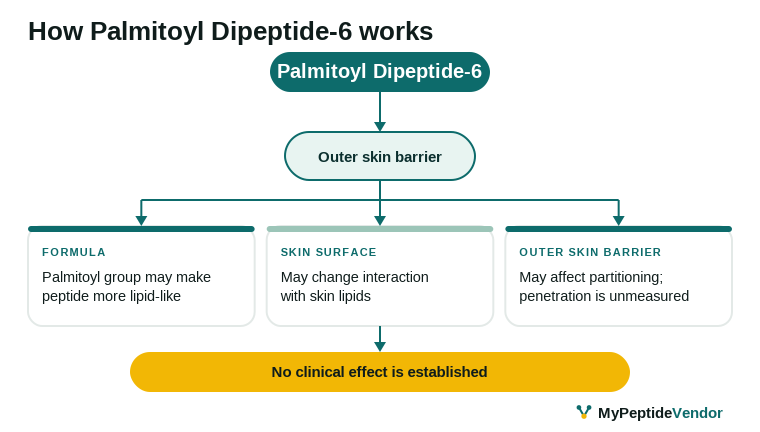
The fatty group may make a peptide more compatible with oily parts of a formula and may affect its interaction with the skin’s lipid-rich outer barrier. That is a formulation rationale, not evidence that more active ingredient reaches living skin. The effect depends on the finished formula, and penetration data for palmitoyl dipeptide 6 are not established.
Those claims are not clinical findings for this exact name. No measured change in collagen, skin thickness, or sagging is established for palmitoyl dipeptide 6.
No typical brand-use concentration is established. An ingredient list usually identifies ingredients without giving their percentages, so the name alone cannot tell you the dose. A disclosed percentage would help describe a formula, but it would not establish a benefit without testing of that finished product.
Use this chart
Free to reuse with a link back:
How does it work?
In plain words, a cosmetic peptide is often intended to act as a small skin signal or conditioning ingredient. The palmitoyl group makes the molecule more lipid-like, which may change how it behaves in a formula and at the skin surface. For palmitoyl dipeptide 6, the biological target and size of any effect are unknown.
In technical terms, adding a fatty-acid group can change a molecule’s lipophilicity, or affinity for oily environments. That may affect how it partitions into the lipid-rich outer skin barrier.
Claims about collagen support or firmer-looking skin need testing of the exact peptide or finished product in people. No dose-response result, skin-layer measurement, or collagen measurement is established for palmitoyl dipeptide 6.
Stability is formula-specific. No validated storage condition or useful pH range is established for this ingredient, and it is not established that it must be separated from AHAs or vitamin C. Ask the manufacturer for tested formula guidance rather than assuming that a particular pairing is safe or incompatible.
Use this chart
Free to reuse with a link back:
What the clinical evidence actually shows

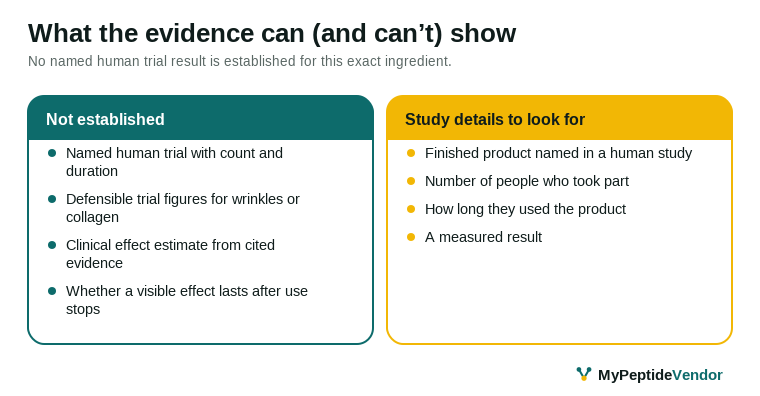
No named human trial of palmitoyl dipeptide 6 is established with a participant count, treatment duration, and numerical result. There are no defensible trial figures to report for wrinkles, collagen production, skin thickness, or sagging. Its clinical effect therefore cannot be estimated from the cited evidence.
Those sections concern other peptide identities; they do not establish a trial result for palmitoyl dipeptide 6 or show which peptide works best for sagging skin.
The same review does not make the names interchangeable. Evidence about a different sequence, or about a multi-ingredient cosmetic, cannot establish an effect for palmitoyl dipeptide 6. No independent head-to-head comparison for sagging skin is established in the cited material.
Important unanswered questions include the exact amino-acid sequence, product concentration, delivery into skin, and whether any visible effect lasts after use stops. Safety in sensitive skin, children, pregnancy, and breastfeeding has not been established for this exact ingredient.
For a useful product claim, look for a human study that names the finished product, reports how many people took part, states how long they used it, and gives a measured result. Without those details, “collagen support” is a claim, not a quantified clinical outcome.
Use this chart
Free to reuse with a link back:
Typical dosing

Trial range: No trial-tested concentration, amount per application, or schedule is established for palmitoyl dipeptide 6. A dose used for another peptide should not be borrowed as though the ingredients were interchangeable.
Product directions: Follow the directions for the finished product. No standard percentage for brands is established, and a product described as a peptide serum is not proof that it contains this specific ingredient.
Do not add a raw peptide ingredient to a homemade formula using a guessed percentage. The effects of pH, storage, and other ingredients on palmitoyl dipeptide 6 have not been established. Use the finished product as directed and stop if it irritates your skin.
Side effects: what to actually expect
No clinical-trial or product-label percentage for irritation, allergy, or other side effects of palmitoyl dipeptide 6 is established. That does not prove reactions cannot occur. A finished cosmetic may also contain fragrance, preservatives, or other ingredients that can irritate skin.
These ratings concern the named dipeptide-5 ingredient, not palmitoyl dipeptide 6, and limited data should not be read as proof of safety.
No specific safety result is established for sensitive skin, children, pregnancy, or breastfeeding for palmitoyl dipeptide 6. A small-area test may help reveal an immediate local reaction, but it cannot establish long-term safety or rule out a reaction that appears later.
Stop using a product if it causes persistent burning, swelling, or a rash. Seek medical care for a severe or spreading reaction. A frequency or percentage for these events cannot be given because a rate has not been established.
Regulatory & access status in the US
FDA’s Category 2 page concerns bulk drug substances nominated for compounding that may present significant safety risks under interim policies 1. It is a compounding-safety list; it does not establish the approval status, safety, or effectiveness of palmitoyl dipeptide 6.
Do not use that compounding list as an approval list for cosmetic ingredients. It addresses a different regulatory question, and the cited page does not identify palmitoyl dipeptide 6 1. The exact US regulatory status of this ingredient is not established by the cited material.
For a finished skin-care product, check whether the label gives a complete ingredient name and clear directions. A peptide name on a package does not establish its sequence, concentration, or clinical benefit.
How it compares to its closest alternative
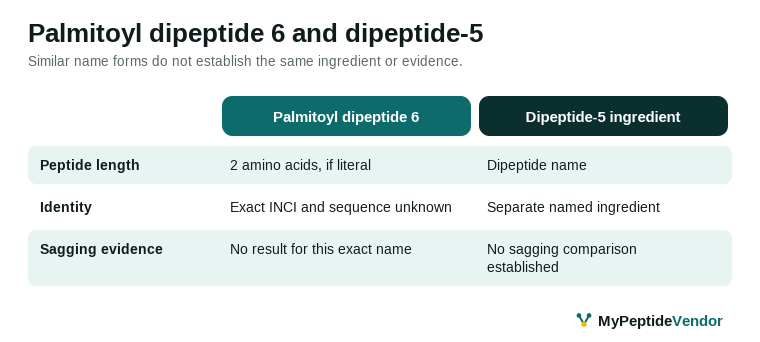
The 2021 review discusses palmitoyl tripeptide-5 and palmitoyl tetrapeptide-7 in its review of cosmetic peptides for sensitive skin; it does not establish a head-to-head winner for sagging skin 4. The EWG entry applies to palmitoyl dipeptide-5 diaminobutyroyl hydroxythreonine, not to the target ingredient 5.
| Name form | Peptide length | Identity or alternate-name note | Evidence relevant to sagging skin |
|---|---|---|---|
| Palmitoyl dipeptide 6 | 2 amino acids, if “dipeptide” is literal | Exact INCI identity and sequence are not established | No clinical result established for this exact name |
| Palmitoyl dipeptide-5 diaminobutyroyl hydroxythreonine | Dipeptide name | Separate named ingredient; EWG entry uses this name | No comparative result for sagging skin established |
| Palmitoyl tripeptide-5 | 3 amino acids | Review discussion does not establish that it is best for sagging skin | |
| Palmitoyl tetrapeptide-7 | 4 amino acids | Discussed under this name in the review | Review discussion does not establish that it is best for sagging skin |
| Palmitoyl pentapeptide | 5 amino acids | The name indicates a five-amino-acid peptide; no link to dipeptide 6 is established | No comparative result established |
When comparing products, check whether the full ingredient name is disclosed, whether the maker states a concentration, whether it provides formula-specific pH and pairing guidance, and whether an independent human study tested the finished product. Those details tell you more than the number of amino acids in a peptide name.
Use this chart
Free to reuse with a link back:
Frequently asked questions
What is palmitoyl tetrapeptide 7 in skincare?
It is a cosmetic peptide name indicating a palmitoyl group attached to a peptide chain of 4 amino acids. A 2021 review discusses palmitoyl tetrapeptide-7 in the context of cosmetic peptides for sensitive skin, but that does not establish a clinical effect on sagging skin 4.
What is the difference between peptides and dipeptides?
A peptide is a chain of amino acids. A dipeptide is a peptide made of exactly 2 amino acids; the term does not identify which amino acids form the chain.
Which peptide is best for sagging skin?
The cited evidence does not establish a best peptide for sagging skin.
What is another name for palmitoyl tripeptide-5?
The cited review refers to it as palmitoyl tripeptide-5 and does not provide an alternate name 4. Check a product maker’s full ingredient identity before treating a trade name as a synonym.
References
Written by the MyPeptideVendor editorial team from the FDA label, peer-reviewed studies and ClinicalTrials.gov records listed above, fact-checked line by line and reviewed 2026-11-12.
Cite this page
MyPeptideVendor Editorial Team. Palmitoyl Dipeptide 6: Evidence & Safety. MyPeptideVendor. Updated November 12, 2026. https://mypeptidevendor.com/peptides/palmitoyl-dipeptide-6/MyPeptideVendor Editorial Team. (2026, November 12). Palmitoyl Dipeptide 6: Evidence & Safety. MyPeptideVendor. https://mypeptidevendor.com/peptides/palmitoyl-dipeptide-6/Related peptides
Argireline (Acetyl Hexapeptide-3)
Not approvedA small 4-week trial found wrinkle improvements, but lasting effects, ideal concentration, and Argireline-specific side-effect rates remain unknown.
Learn moreAHK-Cu
Not approvedAHK-Cu has early lab findings related to hair follicles, but human hair benefits, safe dosing, and side-effect rates are not established.
Learn moreAHK (Tripeptide-3)
Not establishedAHK-Cu is a copper tripeptide used as a cosmetic ingredient, but human hair-growth benefit and a proven scalp dose remain unestablished.
Learn more